Health
What is the first sign of heart trouble in a Sheltie?
A rise in the resting breathing rate while asleep, usually before any cough. Track it weekly at home and you will notice it before the dog looks unwell.

Quick answer
What is the first sign of heart trouble in a Sheltie?
A rise in the resting breathing rate while asleep, usually before any cough. Track it weekly at home and you will notice it before the dog looks unwell.
Most Shelties who get a heart finding on their record never become heart patients. The job is telling the few who will from the many who will not.
This page is for the owner holding a discharge sheet that says grade 2/6 murmur, recheck in six months, and for the owner of an older Sheltie who has started coughing at night and wants to know whether that is the heart, the throat, or the barking.
This guide is not medical advice. If your dog shows pain, sudden behavior change, or worsening symptoms, consult a licensed veterinarian.
Some links may be affiliate links. We may earn a commission at no extra cost to you. We only suggest products we believe are helpful for dog owners.
We research and check what we publish, but we do not warrant that any figure, date, price, or statement is accurate, complete, or current, and we accept no liability for any loss, cost, injury, or other harm arising from the use of this site. Use it as one reference among several. You remain responsible for your own decisions and for your dog's care - confirm anything that matters with a licensed veterinarian or another qualified professional before you act on it. Full disclaimer.
Heart conditions in Shetland Sheepdogs are mostly the ordinary conditions of small dogs rather than anything written into the breed. A finding at an annual exam is usually a valve leak, sometimes a rhythm irregularity, occasionally a congenital defect caught in puppyhood, and often nothing at all. Day to day, the practical impact is a monitoring routine rather than a treatment plan: a weekly breathing count, honest attention to stamina, and a willingness to describe fainting episodes precisely.
Uncommon as an inherited breed problem and common as an old-age finding. Most Shelties will reach ten with a clean chest. Of those who do develop a murmur, only a fraction progress to heart failure, and many die of something else entirely with the murmur still on the record.
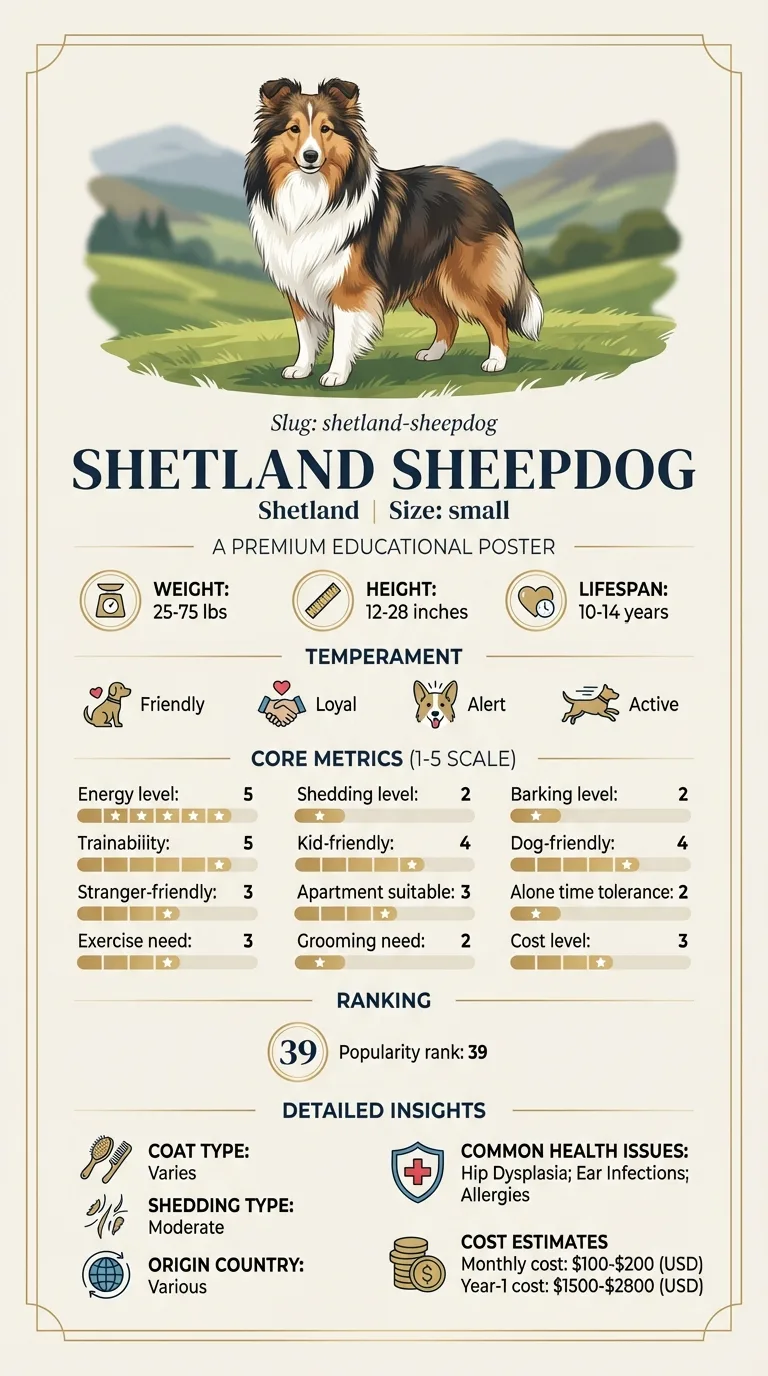
The Shetland Sheepdog's size is the main driver. At fifteen to twenty five pounds it sits squarely in the small-dog range where valve tissue tends to degenerate with age, and that is a size effect rather than a Sheltie effect. Its documented inherited problems lie elsewhere, in the eyes, thyroid, skin and stifles. The one genuinely breed-linked complication is indirect: the MDR1 variant carried in this line changes which sedatives are safe for the imaging a cardiac workup requires, so the breed's genetics shape the investigation more than the disease.
Body condition matters most. A Sheltie's dense double coat hides two or three extra pounds completely, and on a twenty pound dog three pounds is fifteen percent of body weight, which the heart carries on every walk. Heat is the second factor, because a heavily coated dog in humidity works harder to cool itself. Chronic pressure on the throat from a flat collar in a dog that pulls and barks adds airway noise that gets confused with cardiac signs and muddies the picture.
Same-day, treat as urgent: laboured or open-mouthed breathing at rest, a resting sleep breathing rate that has climbed well above your dog's own baseline and stayed there, gums that look grey or blue, a collapse, or a cough that will not let the dog settle at night. Any of those can be fluid on the lungs and is an emergency, not a Monday morning problem. Within a week: a newly discovered murmur, a drop in exercise tolerance, unexplained lethargy, or a belly that seems to be filling out while the ribs stay bony. Routine: annual auscultation for every adult Sheltie and a documented recheck interval once any murmur is on record.
See all Shetland Sheepdog health problems, which breeds are prone to heart conditions, or the full Shetland Sheepdog breed guide for temperament, exercise needs and ownership costs.
Expect the first year after a murmur is found to be about establishing a baseline rather than treating anything: an initial workup, a home breathing log, and a recheck at six or twelve months. Many Shelties stay in that watching phase for years. If the heart does begin to enlarge, medication typically starts before any symptom appears, and dogs commonly go on living an ordinary life on it for a long stretch. Adjustments then come in months, not weeks.
Success is not a clean stethoscope. It is a Sheltie whose sleeping breathing rate has not moved in a year, who still wants the evening walk, whose weight is steady in the mid-range for its frame, and whose file says MDR1 tested in a place every clinician will see. If the heart never becomes the thing that limits your dog, the monitoring did its job even though nothing dramatic ever happened.
Vets are not looking for one disease when they listen to a Sheltie's chest. They are sorting what they hear into categories that carry very different weight.
The first is a structural valve problem, meaning a valve that no longer closes cleanly and lets blood slip backwards. In dogs your Sheltie's size this is by far the most likely reason an adult develops a new murmur, and it usually arrives in the second half of life.
The second is a congenital defect, something present from birth. These are usually caught in the puppy exams before you ever take the dog home, and in the rough-coated collie family the historically reported one involves a fetal blood vessel that fails to close after birth. It is uncommon, and it is fixable when found early, which is exactly why puppy vet visits are not a formality.
The third is a rhythm problem, where the beat itself is irregular rather than the plumbing being faulty. A stethoscope may catch this, or it may not, because rhythm problems come and go.
Three things move a Sheltie from watch to act, and none of them is the murmur grade on its own.
The first is a change in how the dog breathes at rest. A Sheltie asleep on the rug should breathe slowly and quietly. Counting that rate at home, on the same sofa, once a week, is the single most useful thing an owner can do, and it costs nothing.
The second is a fainting or collapse episode. That belongs to the rhythm bucket, it needs to be described precisely to your vet, and a phone video of it is worth more than any description you can give from memory.
One breed-specific caution runs through all of it. The Shetland Sheepdog carries the MDR1 drug sensitivity variant, an inherited fault in the pump that keeps certain drugs out of the brain. Some sedatives used for chest radiographs and echocardiograms are affected. Any cardiac workup on a Sheltie should start with the words this dog may be MDR1 affected, and the DNA test that answers it costs less than the imaging does.

Piper was nine when a locum vet noted a soft murmur at her booster appointment and wrote recheck in six months on the form. Her owner, Renu, spent a fortnight assuming the worst and reading the wrong things at midnight. What changed her footing was a single instruction from her own vet: count Piper's breaths while she slept, every Sunday, and write the number on the kitchen calendar. The number sat between eighteen and twenty two for month after month. An echo that spring found a mildly leaking valve and chambers that had not changed size, so the plan stayed as monitoring. Renu made two adjustments that had nothing to do with cardiology. She moved Piper off a flat collar, which stopped the honking cough that had been frightening her after every doorbell. And she started checking ribs by hand each Sunday, which found the pound and a half hidden under Piper's winter coat. Piper died at thirteen of an unrelated kidney problem. The murmur was still just a murmur.
Key takeaway: In a breed with no inherited cardiac predisposition, a murmur is a reason to start measuring, not a diagnosis. The weekly number on the calendar is what tells you whether anything is actually happening.
No. The breed record lists Collie Eye Anomaly, MDR1 drug sensitivity, dermatomyositis, hypothyroidism and patellar luxation. Heart disease is not on it. Shelties do get the acquired valve disease common to all small dogs in old age, but they are not predisposed the way Cavaliers, Boxers or Dobermans are.
Grade describes loudness on a scale of one to six, not danger. A loud murmur can come from a trivial leak and a quiet one can come from a failing valve. What matters is whether the heart is changing shape and whether the dog's resting breathing rate and stamina are holding steady. Your vet will use imaging, not volume, to decide.
Wait until the dog is asleep and undisturbed, not just lying down. Count each rise of the chest for thirty seconds and double it. Write the number down weekly. A rate that climbs and stays climbed is the earliest home warning of fluid building in the lungs.
It could, but in this breed there are competing explanations. Shelties are among the most vocal dogs alive, and a dog that barks hard on a flat collar irritates its own airway. A honking cough after excitement in a barky Sheltie is more often airway than heart. A soft, wet cough that shows up at night in an older dog with a known murmur points the other way.
It changes the sedation conversation, not the cardiology. Some drugs used to keep a dog still for chest imaging are affected by the MDR1 variant, and an affected dog can react badly to an ordinary dose. Test your dog, keep the result where the clinic can see it, and mention it at every booking rather than assuming it is on file.
A rise in the resting breathing rate while asleep, usually before any cough. Track it weekly at home and you will notice it before the dog looks unwell.
Rarely. Congenital defects are found in puppyhood exams, and acquired valve disease is a second-half-of-life problem in dogs of this size.
No. Unless your vet has specifically restricted activity, keeping a 15 to 25 pound herding dog moving is good for the heart and better for the mind.
Chest radiographs and an echocardiogram together typically run several hundred dollars, which is meaningful against this breed's usual eighty to one hundred fifty dollar monthly budget. Insurance bought before the finding covers it; insurance bought after does not.
Yes, every single time. Say it at booking and again at drop-off. It affects sedation choices, and repeating it costs you nothing.
A one-page prep sheet for this condition: the signs, the questions to ask, what to get priced. Unlocks here.
You get: Vet visit prep sheet
No spam. One-click unsubscribe. See our privacy policy.
Preview page 1 before you decide.