Living
Griffon or Sheltie — which should you get?
Pick the Griffon for a quiet apartment and low exercise demands; pick the Sheltie if you can give it a daily job and don't mind the barking.

Quick answer
Griffon or Sheltie — which should you get?
Pick the Griffon for a quiet apartment and low exercise demands; pick the Sheltie if you can give it a daily job and don't mind the barking.
Brussels Griffon or Shetland Sheepdog? On paper they differ most on exercise need, and on the scales Shetland Sheepdog is the heavier at 15–25 lbs. Here is how the two compare on everything that shapes an ordinary week.
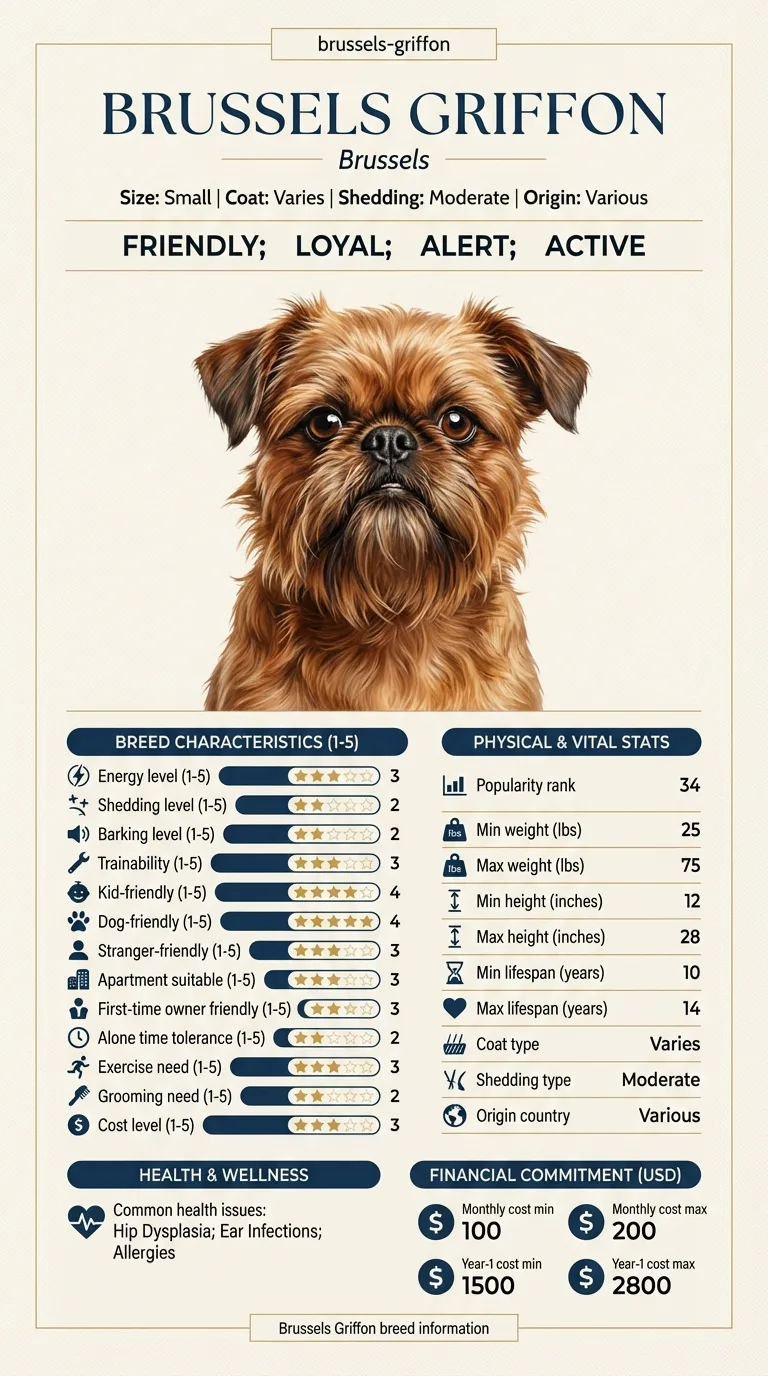
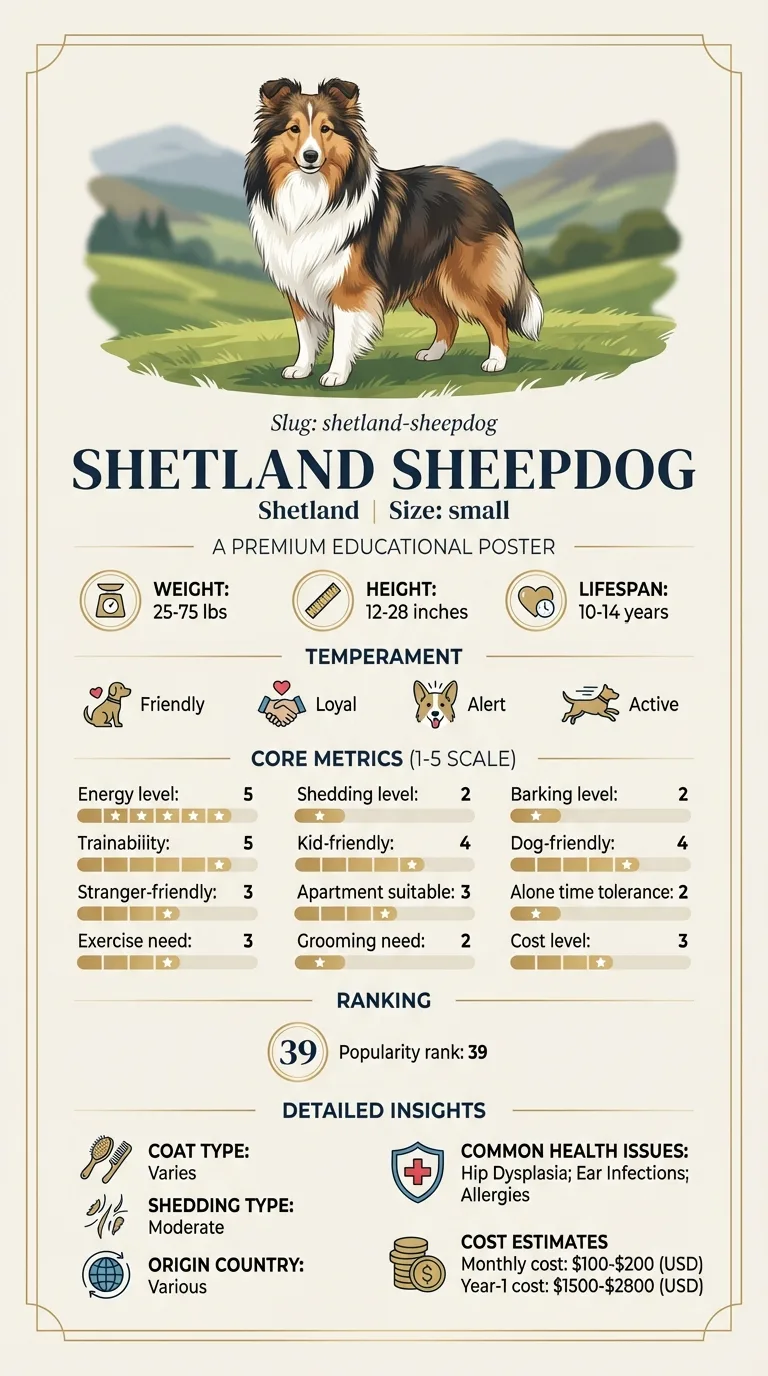
This is for someone already down to Brussels Griffon and Shetland Sheepdog and deciding between them. For this pair the decision usually turns on exercise need and apartment suitability, so those are covered first and in most detail. Anyone choosing from a flat has a clear answer here: Brussels Griffon rates 5/5 against 3/5. There is no origin story here — only what changes about your week.
Between Brussels Griffon and Shetland Sheepdog, exercise need is what separates them, and Brussels Griffon is the lower-effort dog of the two to keep.
Choose Brussels Griffon if you are in a flat or a smaller home, you do not want a standing grooming appointment and shedding is a problem in your house.
Choose Shetland Sheepdog if this is your first dog, there are young children at home and you already have another dog.
| Feature | brussels griffon | shetland sheepdog | Winner |
|---|---|---|---|
| Size class | small | small | Equal |
| Weight | 8–12 lbs | 15–25 lbs | Equal |
| Height | 7–10 in | 13–16 in | Equal |
| Lifespan | 12–15 years | 12–14 years | brussels griffon |
| Exercise need | Low (2/5) | High (4/5) | brussels griffon |
| Grooming need | Moderate (3/5) | High (4/5) | brussels griffon |
| Shedding | Low (2/5) | High (4/5) | brussels griffon |
| Energy level | Moderate (3/5) | High (4/5) | Equal |
| Barking | Moderate (3/5) | Very high (5/5) | brussels griffon |
| Apartment suitability | Very high (5/5) | Moderate (3/5) | brussels griffon |
| Good for first-time owners | Moderate (3/5) | High (4/5) | shetland sheepdog |
| Tolerates being alone | Low (2/5) | Low (2/5) | Equal |
| Trainability | Moderate (3/5) | Very high (5/5) | shetland sheepdog |
| Good with kids | Moderate (3/5) | High (4/5) | shetland sheepdog |
| Good with other dogs | Moderate (3/5) | High (4/5) | shetland sheepdog |
| Friendly to strangers | Moderate (3/5) | Low (2/5) | brussels griffon |
| Cost level | Moderate (3/5) | Moderate (3/5) | Equal |
| Coat | Rough or smooth | Long, dense double coat | Equal |
| Origin | Various | Various | Equal |
| Typical monthly cost | $80–$150 | $80–$150 | Equal |
| Typical first-year cost | $1,100–$2,300 | $1,100–$2,300 | Equal |
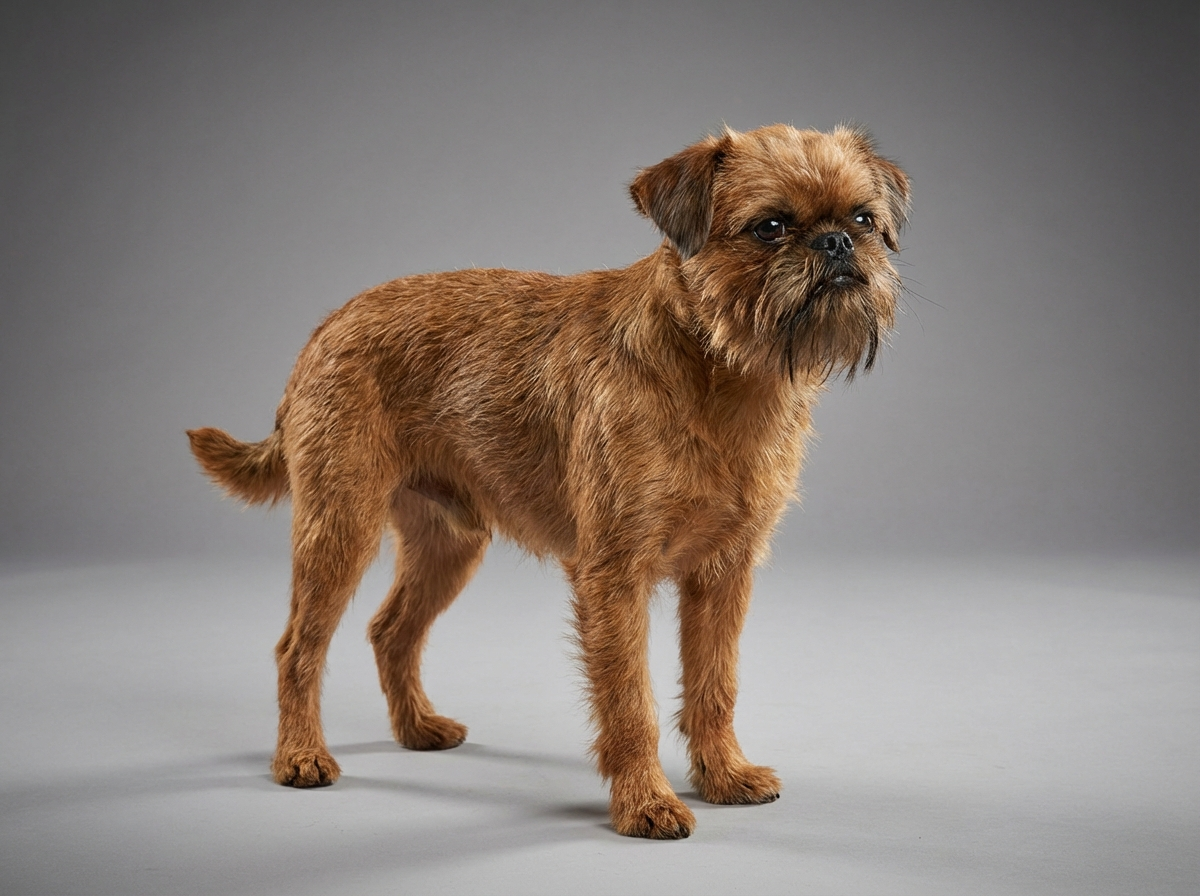
The Griffon tops out around 12 lbs and stands under 10 inches tall — a dog you could carry through an airport without much effort. The Sheltie runs 15 to 25 lbs and up to 16 inches, still compact but built along working-dog lines rather than lapdog ones. Neither will strain a small car's back seat, but the Sheltie's frame carries noticeably more muscle for its size.
This is the widest gap on the sheet: the Griffon rates a 2/5 for exercise need, the Sheltie a 4/5. A Griffon is satisfied by short walks and indoor play. A Sheltie was bred to herd sheep across hillsides and still carries that engine — expect a daily walk plus something that works its brain, or the barking and pacing will tell you it's bored.
The Sheltie's double coat sheds at a 4/5 clip and needs brushing several times a week to keep mats out, especially through spring and fall blowouts. The Griffon sheds lightly (2/5) and its rough or smooth coat is far less demanding — a weekly brush covers it. If a vacuum full of fur sounds exhausting, the Griffon is the lower-maintenance choice by a clear margin.
Apartment suitability favors the Griffon outright — 5/5 versus the Sheltie's 3/5 — and the barking numbers explain part of why: the Sheltie rates a 5/5, about as vocal as a herding breed gets, while the Griffon sits at a more manageable 3/5. Both dogs tolerate being alone poorly (2/5 each), so neither is a good match for an owner who's out of the house all day.
The Sheltie is one of the most trainable breeds on paper — 5/5 — smart, eager, and quick to pick up commands, which is part of why it edges ahead for first-time owners (4/5 to the Griffon's 3/5). The Griffon is moderately trainable but more sensitive and independent-minded, so a first dog owner will get further faster with a Sheltie's eagerness to please.
The Sheltie scores higher with kids (4/5) and other dogs (4/5) than the Griffon (3/5 on both), reflecting its history as a family herding dog used to activity and other animals underfoot. Where the Griffon pulls ahead is with strangers — 3/5 friendly versus the Sheltie's 2/5, since Shelties tend to be reserved and watchful around unfamiliar faces, which also feeds their tendency to bark at the door.
Both breeds live into their teens, with the Griffon's 12–15 year range edging past the Sheltie's 12–14. The overlap to watch is patellar luxation, which shows up on both lists. Beyond that the risks diverge: the Griffon faces brachycephalic airway issues and hip dysplasia, while the Sheltie carries Collie Eye Anomaly, MDR1 drug sensitivity, and dermatomyositis — ask a breeder about eye testing and thyroid screening.
Money-wise these two are a wash. Both land at $80–$150 a month and $1,100–$2,300 in the first year, and both rate a moderate 3/5 on overall cost level. Budget won't decide this one for you — energy level, grooming time, and how much barking your neighbors will tolerate are the real deciding factors between a Griffon and a Sheltie.
Brussels Griffon weighs 8–12 lbs and lives 12–15 years; Shetland Sheepdog weighs 15–25 lbs and lives 12–14 years. The two diverge most on exercise need, apartment suitability and shedding and 2 other rated axes. They are level on tolerates being alone and cost level, so those cannot decide it. Where the table declares a winner it means less work for the owner, nothing more; descriptive rows are left as ties on purpose. The value here is in the differences between the two columns; treat any single score as approximate.

The Griffon, by a wide margin — 8 to 12 lbs and under 10 inches tall, compared to the Sheltie's 15 to 25 lbs and up to 16 inches. Both count as small breeds, but you'd notice the difference standing them side by side.
The Griffon, clearly. It rates a 2/5 for shedding against the Sheltie's 4/5, and the Sheltie's dense double coat means more frequent brushing to manage it.
The Sheltie edges it out at 4/5 versus the Griffon's 3/5, mostly because of its very high trainability (5/5). The Griffon isn't hard to own, but its independent streak means a first-timer will need a bit more patience.
The Griffon, rated 5/5 for apartment suitability against the Sheltie's 3/5. The Sheltie's high exercise need (4/5) and heavy barking tendency (5/5) make it a tougher fit for close-quarters living.
They're identical on paper — $80 to $150 a month and $1,100 to $2,300 in the first year for both breeds.
Patellar luxation appears on both lists, so it's worth asking a breeder about hip and knee screening either way. Past that, their health concerns don't overlap much — the Griffon leans toward airway and eye issues, the Sheltie toward eye and thyroid conditions.
The Sheltie, by a wide margin — 5/5 versus the Griffon's 3/5. It's a breed trait tied to its herding background, and it's one of the biggest practical differences between the two if you have close neighbors.
Pick the Griffon for a quiet apartment and low exercise demands; pick the Sheltie if you can give it a daily job and don't mind the barking.
None — both run $80 to $150 a month, so cost isn't a deciding factor here.
The Griffon needs very little (2/5); the Sheltie needs a real daily workout (4/5) to stay settled.
The Griffon, typically 12–15 years versus the Sheltie's 12–14 — close, but the Griffon has a slight edge.
Secure checkout on Stripe. We never see your card.
7-day money-back guarantee. Instant access.
Health information here is general and is not veterinary advice. If your dog shows pain, sudden behaviour change, or worsening symptoms, consult a licensed veterinarian.
Some links on this site are affiliate links. We may earn a commission at no extra cost to you, and we only suggest products we believe are helpful for dog owners.
We research and check what we publish, but we do not warrant that any figure, date, price, or statement is accurate, complete, or current, and we accept no liability for any loss, cost, injury, or other harm arising from the use of this site. Use it as one reference among several. You remain responsible for your own decisions and for your dog's care - confirm anything that matters with a licensed veterinarian or another qualified professional before you act on it. Full disclaimer.
Match your lifestyle to the right dog.
Take quizNot sure which breed is right for you? Take our 2-minute quiz to find out.
Take the quiz