Training
More trainable?
Tied — both rate very high (5/5) for trainability.

Quick answer
More trainable?
Tied — both rate very high (5/5) for trainability.
Schnauzer (Standard) or Shetland Sheepdog? On paper they differ most on shedding, and on the scales Schnauzer (Standard) is the heavier at 26–50 lbs. Here is how the two compare on everything that shapes an ordinary week.
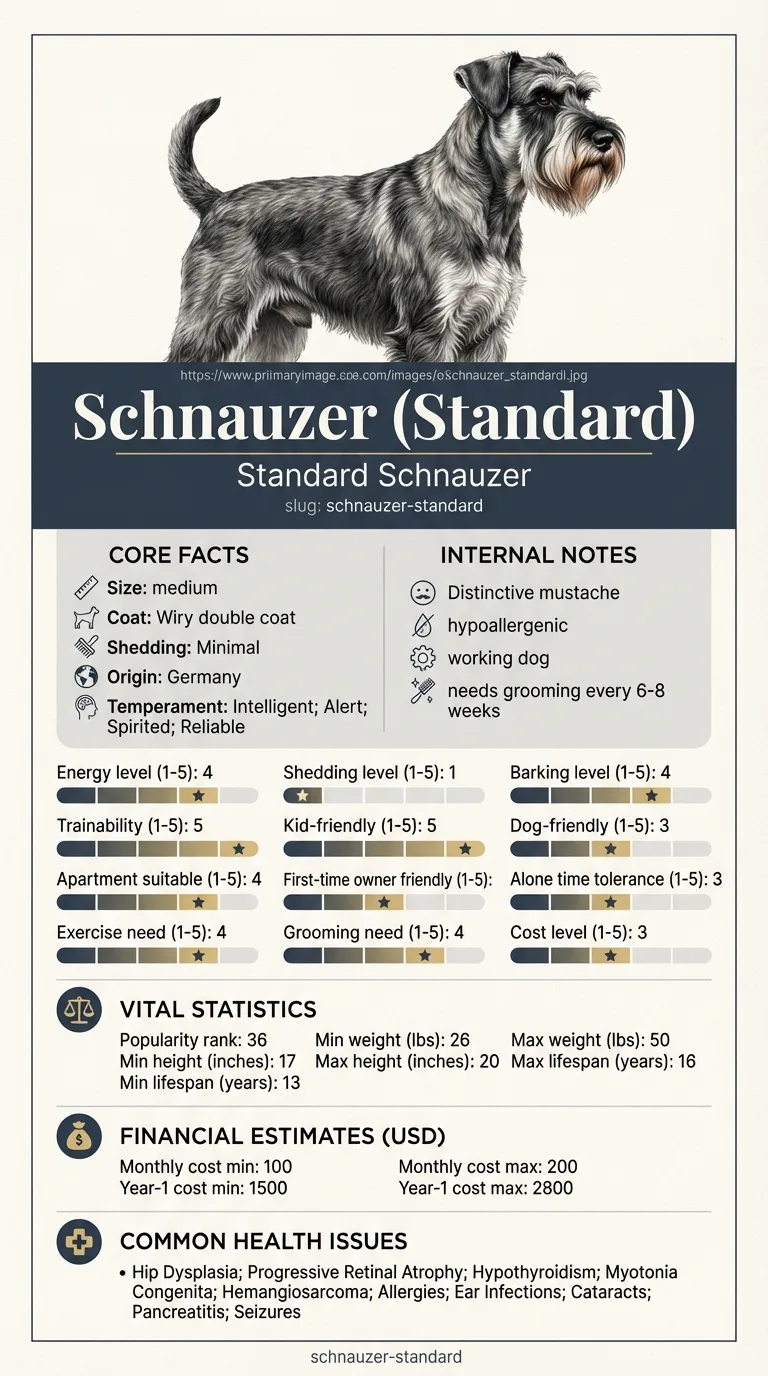
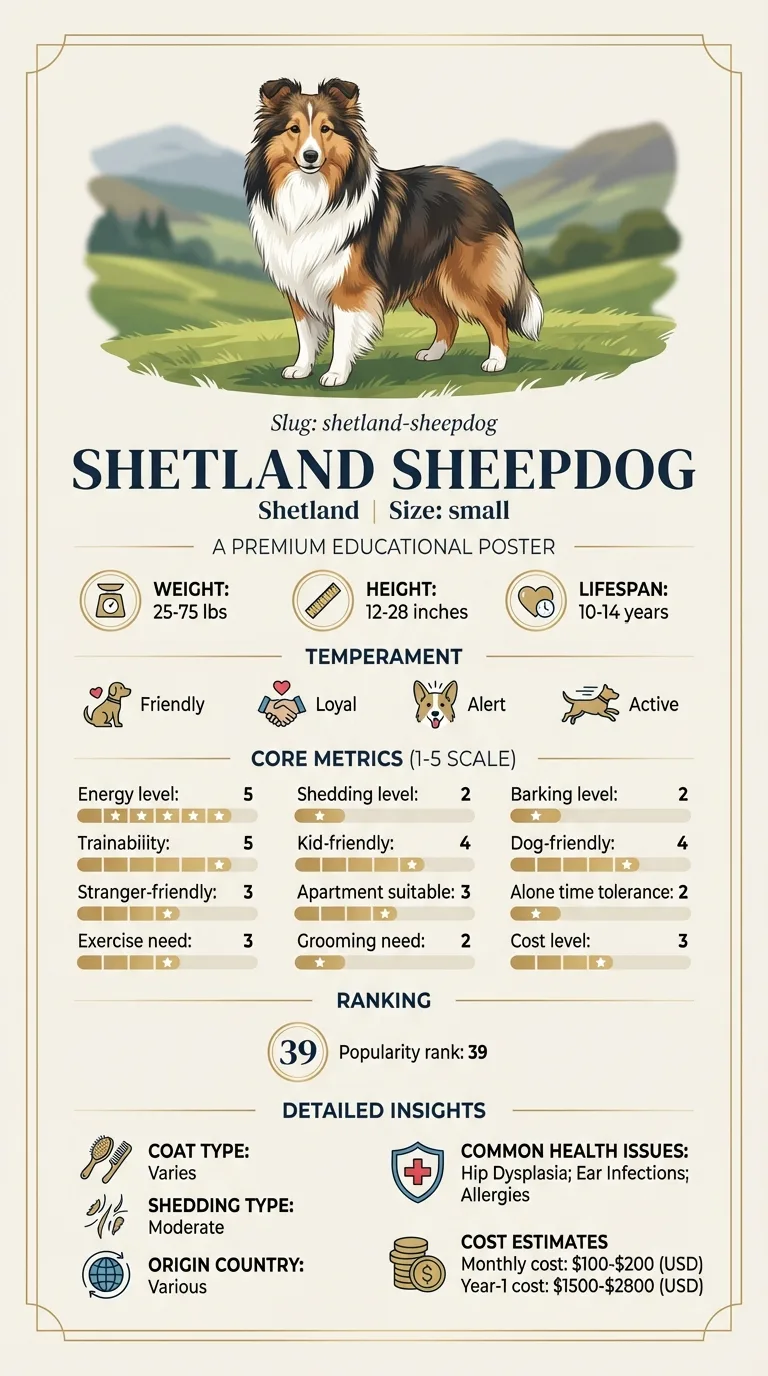
This is for someone already down to Schnauzer (Standard) and Shetland Sheepdog and deciding between them. For this pair the decision usually turns on shedding, so those are covered first and in most detail. Anyone choosing from a flat has a clear answer here: Schnauzer (Standard) rates 4/5 against 3/5. The focus throughout is on daily consequences rather than breed background.
Between Schnauzer (Standard) and Shetland Sheepdog, shedding is what separates them, and Schnauzer (Standard) is the lower-effort dog of the two to keep.
Choose Schnauzer (Standard) if you are in a flat or a smaller home, shedding is a problem in your house and the dog will be alone during the working day.
Choose Shetland Sheepdog if this is your first dog, you already have another dog and a smaller dog suits your car, your home or your back.
| Feature | schnauzer standard | shetland sheepdog | Winner |
|---|---|---|---|
| Size class | medium | small | Equal |
| Weight | 26–50 lbs | 15–25 lbs | Equal |
| Height | 17–20 in | 13–16 in | Equal |
| Lifespan | 13–16 years | 12–14 years | schnauzer standard |
| Exercise need | High (4/5) | High (4/5) | Equal |
| Grooming need | High (4/5) | High (4/5) | Equal |
| Shedding | Very low (1/5) | High (4/5) | schnauzer standard |
| Energy level | High (4/5) | High (4/5) | Equal |
| Barking | High (4/5) | Very high (5/5) | schnauzer standard |
| Apartment suitability | High (4/5) | Moderate (3/5) | schnauzer standard |
| Good for first-time owners | Moderate (3/5) | High (4/5) | shetland sheepdog |
| Tolerates being alone | Moderate (3/5) | Low (2/5) | schnauzer standard |
| Trainability | Very high (5/5) | Very high (5/5) | Equal |
| Good with kids | Very high (5/5) | High (4/5) | schnauzer standard |
| Good with other dogs | Moderate (3/5) | High (4/5) | shetland sheepdog |
| Friendly to strangers | Moderate (3/5) | Low (2/5) | schnauzer standard |
| Cost level | Moderate (3/5) | Moderate (3/5) | Equal |
| Coat | Wiry double coat | Long, dense double coat | Equal |
| Origin | Germany | Various | Equal |
| Typical monthly cost | $100–$200 | $80–$150 | Equal |
| Typical first-year cost | $1,500–$2,800 | $1,100–$2,300 | Equal |
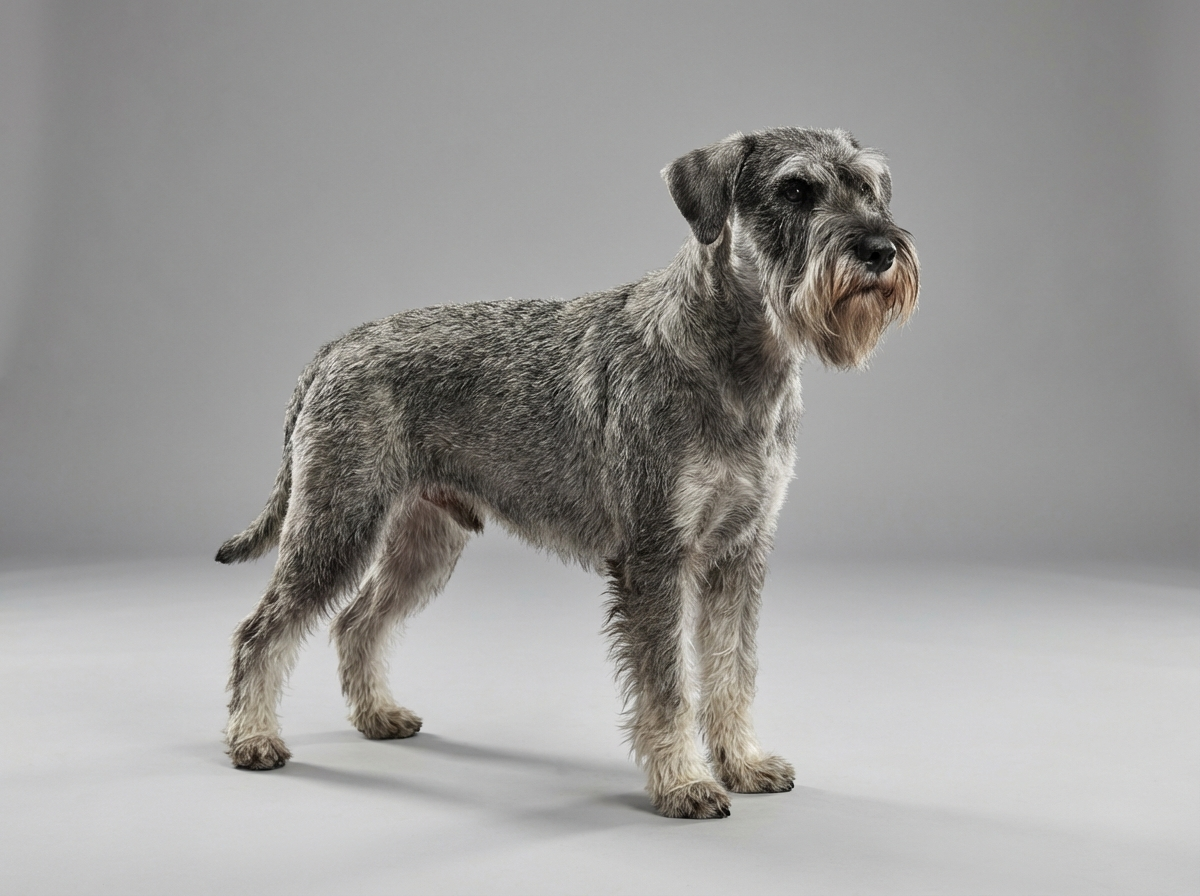
The Standard Schnauzer, at 26–50 lbs and 17–20 inches, is roughly twice the size of a Shetland Sheepdog's 15–25 lbs and 13–16 inches — a meaningful but not extreme gap, putting both firmly in the small-to-medium range. Both breeds have wiry or dense coats built for working outdoors, the Schnauzer's wiry double coat suited to German farm work and the Sheltie's long double coat built for Scottish hillsides. Neither dog needs the specialized handling a giant breed requires, making this one of the more evenly matched size comparisons on this site.
Both breeds rate high (4/5) for exercise need and energy level, a genuinely close match — the Schnauzer's "Spirited" temperament tag and the Sheltie's herding drive both call for real daily activity, not just a short walk around the block. Households considering either breed should plan for 45 minutes or more of structured exercise or mental work, since both were bred for working roles rather than as low-key companions. Neither is a good fit for an owner hoping for a naturally low-energy dog, despite their moderate size making that seem plausible at a glance.
Grooming need rates high (4/5) for both breeds, but shedding tells a very different story: the Standard Schnauzer sheds very little (1/5) thanks to its wiry coat, which typically needs hand-stripping or clipping rather than natural shedding, while the Shetland Sheepdog sheds heavily (4/5) through its long double coat. A Schnauzer owner trades a lower-shedding, low-hair home for regular trips to a groomer skilled in hand-stripping, while a Sheltie owner deals with more fur around the house but can manage more of the routine brushing themselves at home.
The Standard Schnauzer rates high (4/5) for apartment suitability against the Sheltie's moderate (3/5), a modest edge for the Schnauzer if its high exercise needs are met. Barking favors neither breed as a quiet option: the Schnauzer rates high (4/5) and the Sheltie rates very high (5/5), both breeds known for alerting to anything unusual — a real consideration for apartment living with shared walls. Alone-time tolerance favors the Schnauzer, moderate (3/5) versus the Sheltie's low (2/5), a difference that could matter for owners with long workdays.
Both breeds rate very high (5/5) for trainability, reflecting two of the more biddable working breeds in this comparison set — the Schnauzer's "Intelligent" and "Reliable" tags and the Sheltie's herding heritage both point toward dogs that learn quickly and enjoy having a job. The Sheltie edges ahead for first-time owners, high (4/5) versus the Schnauzer's moderate (3/5), likely reflecting its smaller size and lower risk if training lapses occur. Either breed rewards an owner willing to provide consistent structure and mental stimulation, not just basic obedience drilling.
The Standard Schnauzer rates very high (5/5) with kids against the Sheltie's high (4/5), while the Sheltie edges ahead with other dogs, high (4/5) versus the Schnauzer's moderate (3/5). Strangers favor the Schnauzer modestly, moderate (3/5) versus the Sheltie's low (2/5) — both are watchful breeds by nature, with the Schnauzer's "Alert" tag and the Sheltie's herding-instinct wariness both contributing to reserved first reactions to unfamiliar people, though the Schnauzer tends to warm up somewhat faster.
The Standard Schnauzer's 13–16 year lifespan edges out the Sheltie's already-solid 12–14 years, both respectable spans for their size class. The Schnauzer's health list is considerably longer, though: Hip Dysplasia, Progressive Retinal Atrophy, Hypothyroidism, Myotonia Congenita, Hemangiosarcoma, Allergies, Ear Infections, Cataracts, Pancreatitis, and Seizures, compared to the Sheltie's shorter list of Collie Eye Anomaly, MDR1 Drug Sensitivity, Dermatomyositis, Hypothyroidism, and Patellar Luxation. Both share Hypothyroidism risk, worth screening for with either breed, while Sheltie owners specifically should flag MDR1 status before certain medications are prescribed.
Cost level rates moderate (3/5) for both breeds, a close match, with monthly costs of $100–200 for the Schnauzer versus $80–150 for the Sheltie and first-year costs of $1,500–2,800 versus $1,100–2,300. The Schnauzer's wiry coat typically requires professional hand-stripping or clipping every six to eight weeks, a recurring cost the Sheltie's more DIY-friendly brushing routine largely avoids. Overall, both breeds sit toward the moderate end of ownership cost on this site, well below giant-breed pairings but not as cheap as the smallest toy breeds.
Schnauzer (Standard) weighs 26–50 lbs and lives 13–16 years; Shetland Sheepdog weighs 15–25 lbs and lives 12–14 years. The two diverge most on shedding. They are level on cost level, energy level and exercise need, so those cannot decide it. The table below marks a winner only where one breed is genuinely easier for a typical owner; size and origin are facts rather than merits and stay level. Ratings come from one source applied to both breeds, so they are meaningful against each other rather than as absolute scores.

The Shetland Sheepdog, rated very high (5/5) versus the Schnauzer's still-notable high (4/5) — both are vocal, alert breeds.
Both rate very high (5/5) for trainability — an even match, and one of the better-trained pairings on this site.
The Standard Schnauzer, rated very low (1/5) thanks to its wiry coat, against the Sheltie's high (4/5).
The Schnauzer, whose wiry coat typically needs professional hand-stripping every six to eight weeks, versus the Sheltie's more at-home brushing routine.
The Shetland Sheepdog, rated high (4/5) versus the Schnauzer's moderate (3/5).
The Standard Schnauzer, rated high (4/5) versus the Sheltie's moderate (3/5), provided its exercise needs are met.
The Standard Schnauzer, at 13–16 years, slightly ahead of the Sheltie's 12–14.
Tied — both rate very high (5/5) for trainability.
The Standard Schnauzer, rated very low (1/5) versus the Sheltie's high (4/5).
The Shetland Sheepdog, rated high (4/5) for first-time owners versus the Schnauzer's moderate (3/5).
The Shetland Sheepdog, at $80–150 versus the Schnauzer's $100–200.
Secure checkout on Stripe. We never see your card.
7-day money-back guarantee. Instant access.
Health information here is general and is not veterinary advice. If your dog shows pain, sudden behaviour change, or worsening symptoms, consult a licensed veterinarian.
Some links on this site are affiliate links. We may earn a commission at no extra cost to you, and we only suggest products we believe are helpful for dog owners.
We research and check what we publish, but we do not warrant that any figure, date, price, or statement is accurate, complete, or current, and we accept no liability for any loss, cost, injury, or other harm arising from the use of this site. Use it as one reference among several. You remain responsible for your own decisions and for your dog's care - confirm anything that matters with a licensed veterinarian or another qualified professional before you act on it. Full disclaimer.
Match your lifestyle to the right dog.
Take quizNot sure which breed is right for you? Take our 2-minute quiz to find out.
Take the quiz