Health
How do I spot diabetes in a heavily coated dog?
By the scale and the water bowl. Monthly weighing catches the weight loss the coat hides, and increased drinking is usually the first thing owners notice.

Quick answer
How do I spot diabetes in a heavily coated dog?
By the scale and the water bowl. Monthly weighing catches the weight loss the coat hides, and increased drinking is usually the first thing owners notice.
This is a page about what happens after the emergency, when a single painful episode has quietly cost the dog part of its ability to regulate blood sugar.
Owners of a senior Sheltie who has had pancreatitis and is now drinking more, losing weight despite a good appetite, or has just been diagnosed as diabetic and is trying to work out how life will change.
This guide is not medical advice. If your dog shows pain, sudden behavior change, or worsening symptoms, consult a licensed veterinarian.
Some links may be affiliate links. We may earn a commission at no extra cost to you. We only suggest products we believe are helpful for dog owners.
We research and check what we publish, but we do not warrant that any figure, date, price, or statement is accurate, complete, or current, and we accept no liability for any loss, cost, injury, or other harm arising from the use of this site. Use it as one reference among several. You remain responsible for your own decisions and for your dog's care - confirm anything that matters with a licensed veterinarian or another qualified professional before you act on it. Full disclaimer.
This is the long-term consequence of pancreatic damage rather than the emergency itself. Repeated or severe inflammation destroys insulin-producing tissue, and once enough is gone the dog becomes diabetic. In a senior Shetland Sheepdog it typically shows as increased drinking, a good appetite paired with weight loss the coat conceals, and reduced energy. Life afterwards is structured around twice-daily injections, a fixed feeding clock and watching for cataracts.
Diabetes secondary to pancreatic damage is a recognised but not inevitable outcome; the majority of dogs that have one episode of pancreatitis never become diabetic. Canine diabetes overall is a reasonably common senior diagnosis, and in Shelties the combination is most relevant in older dogs with a history of pancreatic inflammation or thyroid disease.
Two documented Shetland Sheepdog conditions bear on this. Hypothyroidism raises blood fats and thereby predisposes to the pancreatitis that starts the chain, and it also complicates metabolic control once diabetes exists. MDR1 drug sensitivity becomes relevant later, when a diabetic dog needs anti-nausea medication, sedation for eye assessment or anaesthesia for cataract surgery. Beyond that, the breed's long twelve to fourteen year lifespan simply gives a slow accumulation of pancreatic damage time to reach the threshold where it matters.
Diet and consistency dominate. High-fat food and scavenging drive the pancreatitis that causes the damage, and once diabetes exists, irregular meals, unmeasured treats and unpredictable exercise all destabilise glucose control. Household organisation genuinely matters: a diabetic dog in a busy family where several people feed it, or where the schedule shifts at weekends, is much harder to regulate than one in a household that has agreed a routine and kept to it.
Go immediately, as an emergency: weakness, wobbliness, tremor, disorientation or seizure in a dog receiving insulin, which suggests dangerously low blood glucose and needs treatment within minutes. Also immediate: vomiting with lethargy and collapse, particularly with a sweet or acetone smell on the breath, which suggests ketoacidosis. Same day: sudden vision loss, since diabetic cataracts can mature rapidly and an early ophthalmology opinion changes what is possible. Within days: increased drinking or urinating, weight loss despite a good appetite, or recurrent urinary or skin infections, which are common in undiagnosed diabetics. Give the MDR1 status at every appointment involving sedation.
See all Shetland Sheepdog health problems, which breeds are prone to pancreatitis diabetes, or the full Shetland Sheepdog breed guide for temperament, exercise needs and ownership costs.
Stabilising a newly diagnosed diabetic dog typically takes four to twelve weeks of dose adjustment with repeated glucose monitoring, and it is normal for this phase to feel discouraging. Once stable, most dogs need review every three to six months, with occasional readjustment. Cataracts, if they develop, often do so within the first year and can progress over weeks. Well-managed diabetic dogs frequently live for years with good quality of life.
Success is a routine that has become invisible. The injections happen at seven and seven, the food is measured, the weight has been stable for six months, and the dog is drinking a normal amount and doing everything it used to do. It is not a normal glucose reading every time, which is unrealistic. For many owners the honest measure is whether the disease has become background rather than the centre of the household.
A single mild episode of pancreatitis usually leaves nothing behind. Repeated or severe episodes are different, because each one destroys some tissue and replaces it with scar.
The insulin-producing islands sit within that tissue and are lost along with it. There is spare capacity, so nothing changes for a while. Once enough of the islands are gone, blood glucose stops being controlled and diabetes appears.
A parallel process affects the digestive side. Where enough enzyme-producing tissue is destroyed, the dog can no longer break down food properly, and develops exocrine pancreatic insufficiency: ravenous appetite, weight loss, and pale, greasy, voluminous stools. Some dogs end up with both.
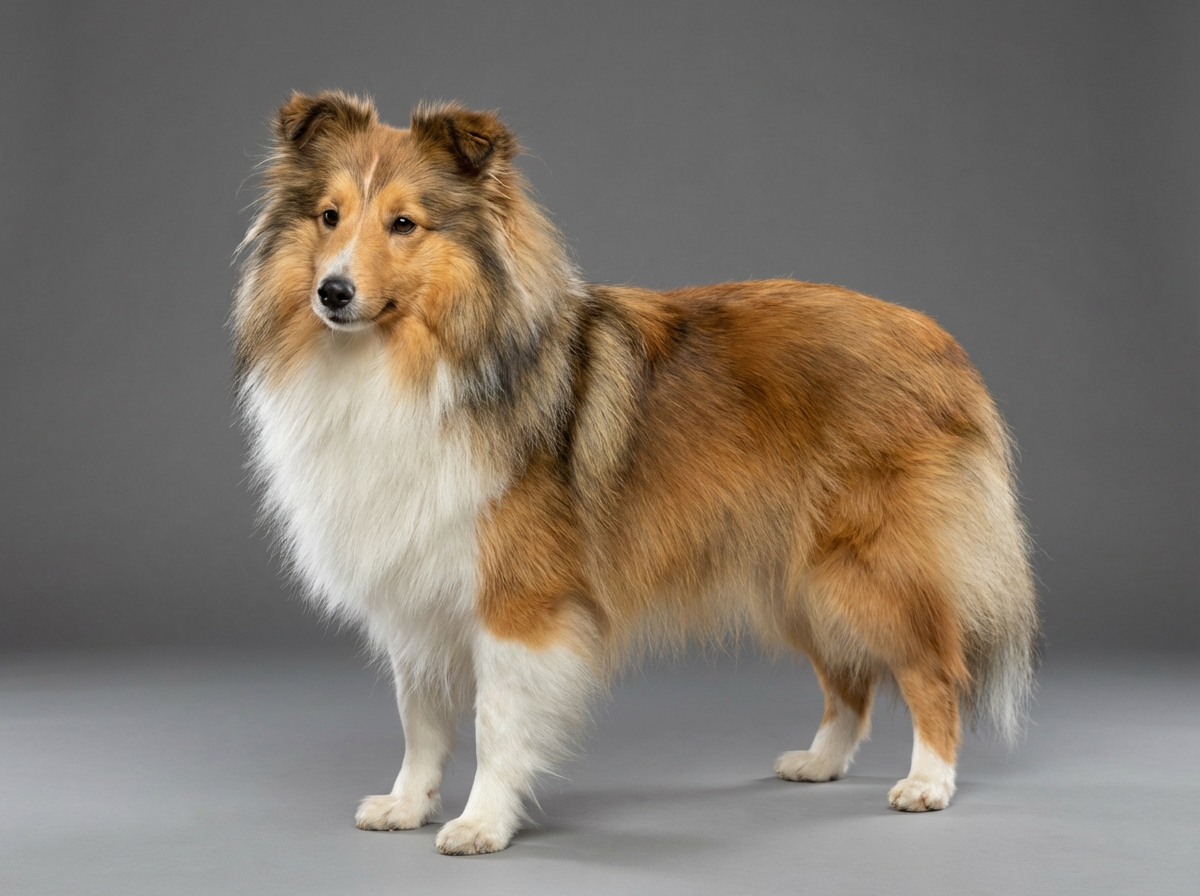
The warning signs of the diabetic transition are distinctive if you know them. Increased drinking and urination, a large appetite paired with weight loss, and in some dogs a sweet or acetone smell to the breath. In a Shetland Sheepdog the weight loss is the one that gets missed, because a heavy double coat hides a dog getting thinner just as effectively as it hides one getting fat.
Weigh the dog monthly. It is the only method that works in this breed.
Diabetes in a dog is manageable and many owners do it well for years, but it is worth being honest about what it asks of a household.

If you think your Shetland has pancreatitis & diabetes, the plan is three steps: write down what you have seen and when it started, book a veterinary appointment rather than waiting for the next flare, and take video of the behaviour or symptom before you go — the thing you are worried about rarely happens in the consulting room. Screening in the parents covers collie eye anomaly, mdr1 drug sensitivity, dermatomyositis.
What the vet visit should produce is a diagnosis and a written plan, not just reassurance: what is being ruled out, what the monitoring interval is, and which signs mean you come back sooner. Ask what the treatment costs across a year rather than per visit, because that is the number that decides whether you are managing this condition or reacting to it.
Between appointments, keep a short log — dates, what you saw, what changed. It is the single most useful thing an owner brings to a follow-up, and for pancreatitis & diabetes it is often what separates a clear pattern from a guess.
Solveig's Sheltie, Odin, was eleven when he had a severe episode of pancreatitis and spent five days in hospital. He recovered, went onto a low-fat diet, and seemed entirely himself. About a year later she noticed the water bowl needed refilling twice a day instead of once. She also thought he felt lighter when she lifted him, though he looked exactly the same under his coat. She weighed him at the practice: he had lost nearly three pounds, which was more than a tenth of him. He was diabetic. Solveig spent two difficult months on dose adjustments and glucose curves, and admits she cried more than once. What settled it was buying a continuous glucose sensor and teaching Odin, in about a fortnight, to lie on his side for his injection in exchange for a piece of his measured breakfast. His cataracts arrived at thirteen, quickly, and he had surgery on one eye. He died at fourteen and a half, still on the same seven and seven routine.
Key takeaway: The path from pancreatitis to diabetes is slow and quiet, and in a coated breed the weight loss that signals it is invisible. Monthly weighing and a jug on the water bowl are what catch it, and cooperative care training is what makes the years afterwards liveable.
No, and most dogs that have a single episode never develop it. The risk comes from repeated or severe inflammation destroying enough insulin-producing tissue. That is why preventing a second episode after a first one matters more than owners often realise.
Drinking and urinating noticeably more, a strong appetite combined with weight loss, and reduced energy. The weight loss is the sign most often missed in this breed because the coat conceals it, which is why a monthly weight on the same scale is genuinely valuable.
Canine diabetes is generally insulin-dependent and comparable to human type one, meaning insulin injections are required rather than optional. Diet and weight management support the treatment but do not replace it, and there is no oral tablet equivalent for most dogs.
Common enough that you should plan for it. A large share of diabetic dogs develop cataracts within the first year or two, sometimes very quickly. Surgery can restore vision in suitable candidates, so an early conversation with an ophthalmologist is worth having rather than waiting until the dog is blind.
Two things. Low blood sugar from too much insulin causes weakness, wobbliness, disorientation, tremor and eventually seizures, and is an immediate emergency. Ketoacidosis, from uncontrolled high glucose, causes vomiting, collapse and a sweet breath smell and is equally urgent. Ask your vet for a written emergency plan when treatment starts.
Yes, and consistency matters more than quantity. A predictable daily amount of exercise keeps glucose requirements stable, whereas an unusually long day out can drop blood sugar unexpectedly. Discuss with your vet how to handle days that break the routine.
Insulin is unaffected, but a diabetic dog with pancreatic disease will receive anti-nausea drugs, sedation for cataract assessment and possibly ophthalmic surgery over the years. Each of those is a decision where the Shetland Sheepdog's genotype should already be known and recorded.
By the scale and the water bowl. Monthly weighing catches the weight loss the coat hides, and increased drinking is usually the first thing owners notice.
The injection itself is straightforward and most dogs barely notice. The demanding part is the twelve-hour schedule tied to meals, every day, indefinitely.
Cataracts are common and can develop fast. Vision can often be restored surgically in suitable dogs, so an early ophthalmology referral is worth arranging.
Insulin, syringes, prescription food and monitoring commonly add a hundred dollars or more a month on top of ordinary costs, plus periodic curves.
Only with a facility or sitter competent to inject on schedule. Arrange this before you need it rather than in the week before a holiday.
A one-page prep sheet for this condition: the signs, the questions to ask, what to get priced. Unlocks here.
You get: Vet visit prep sheet
No spam. One-click unsubscribe. See our privacy policy.
Preview page 1 before you decide.