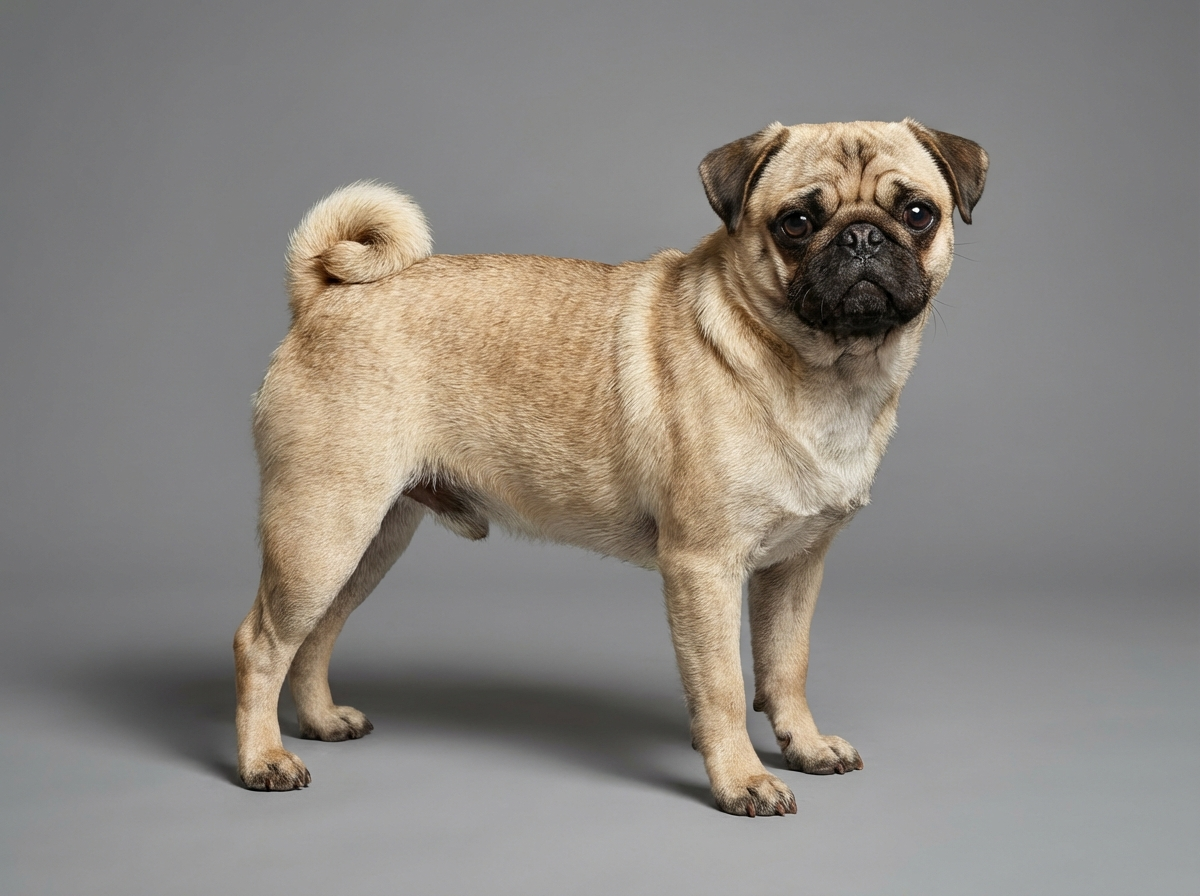
Health
Are Pugs at risk for large-breed growth disorders?
No, those conditions are tied to rapid growth in large and giant breeds and don't typically apply here.

Quick answer
Are Pugs at risk for large-breed growth disorders?
No, those conditions are tied to rapid growth in large and giant breeds and don't typically apply here.
The real story about a Pug's bones isn't rapid growth; it's that their skeleton was never built to the standard blueprint in the first place.
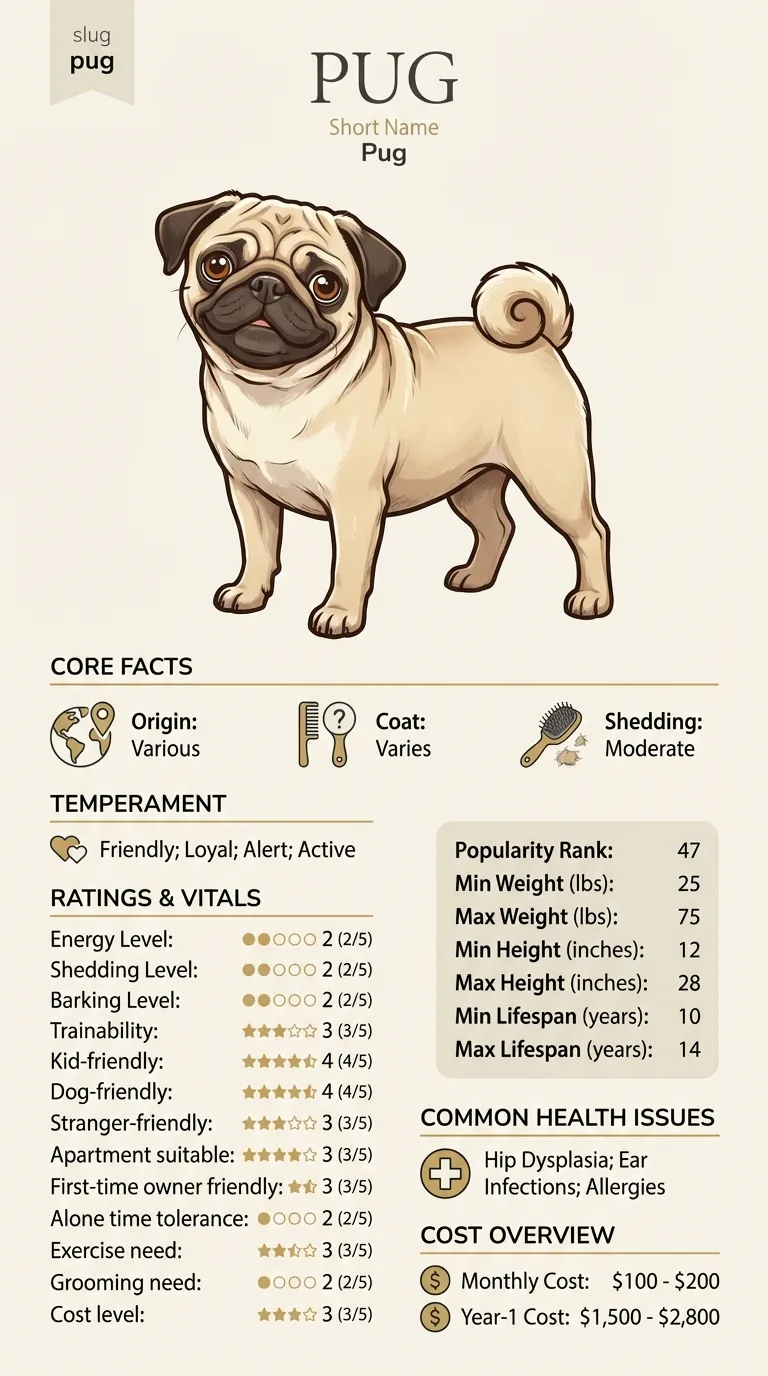
This is useful background for any new Pug owner trying to understand why so many of this breed's health topics, the flat face, short legs, curled tail, spine quirks, all trace back to one shared cause rather than being a list of unrelated problems.
This guide is not medical advice. If your dog shows pain, sudden behavior change, or worsening symptoms, consult a licensed veterinarian.
Some links may be affiliate links. We may earn a commission at no extra cost to you. We only suggest products we believe are helpful for dog owners.
We research and check what we publish, but we do not warrant that any figure, date, price, or statement is accurate, complete, or current, and we accept no liability for any loss, cost, injury, or other harm arising from the use of this site. Use it as one reference among several. You remain responsible for your own decisions and for your dog's care - confirm anything that matters with a licensed veterinarian or another qualified professional before you act on it. Full disclaimer.
A Pug's skeleton develops according to chondrodystrophy, a genetic trait that compresses and shortens the long bones and alters cartilage-to-bone development throughout the body. Unlike large-breed growth disorders tied to rapid growth, this is a fixed, breed-defining developmental pattern responsible for the short legs, compact spine, curled tail, and shortened muzzle all at once.
This developmental pattern is universal to the breed rather than something only some Pugs have; every Pug's compact body type reflects it. What varies between individual dogs is how significantly the downstream spinal and joint effects show up over a lifetime.
Chondrodystrophy is a defining, inherited trait of this breed, shaping the limbs, spine, tail, and face together rather than affecting one isolated body part. It's the same underlying biology connecting several seemingly separate health topics in this breed.
Because this is a fixed genetic pattern rather than a growth-rate issue, environment plays a much smaller role than it does for large-breed growth disorders; what environment does affect is how much strain gets placed on the resulting compact spine and joints later in life.
Bring a puppy in for evaluation if you notice persistent limping, reluctance to jump or play, or any back sensitivity, since these are more likely related to this breed's compact joint and spine structure than typical growing pains. As an adult, any sudden mobility change deserves prompt evaluation given this breed's spinal vulnerabilities.
Start here: Pug Most Common Genetic Disorders: What to Screen For
See all PUG health problems, which breeds are prone to bone growth issues, or the full PUG breed guide for temperament, exercise needs and ownership costs.
Skeletal development is largely complete by nine to twelve months of age. This is a lifelong structural trait rather than a phase to wait out, so ongoing awareness of downstream spine and joint issues matters throughout the dog's life.
Success means understanding this trait well enough to recognize the specific downstream conditions it can lead to, rather than treating your Pug's skeleton like a smaller version of a standard-proportioned dog's.
Rather than a single "bone growth disease," Pugs develop according to chondrodystrophy, a genetic trait that shortens and compresses the long bones and alters how cartilage converts to bone during development. This single underlying mechanism is responsible for several traits at once: the short legs, the compact body, the curled tail, and, in the face, the shortened muzzle that defines this breed's brachycephalic look. It's a coordinated, breed-defining developmental pattern rather than a disorder that appears unpredictably in individual dogs.
Because this compact skeletal development is a fixed, inherited trait rather than a growth-rate problem, there isn't a controllable-diet or controlled-exercise strategy that changes it the way there is for large-breed puppies at risk of growth-plate injury. What matters instead is understanding the downstream effects: a compact spine prone to early disc degeneration, an increased chance of spinal vertebrae forming irregularly, and joints that may load differently than in a standard-proportioned dog. Watching for limping, reluctance to move, or back sensitivity as a puppy grows is more useful than trying to manage growth rate itself.

When his new Pug puppy Leo seemed to move differently than a friend's Labrador puppy had at the same age, first-time owner Marcus worried something was wrong. A vet visit reassured him: Leo's proportions, short legs, compact frame, easy tiring, were exactly what a healthy Pug puppy should look like, entirely different from a large-breed puppy's growth pattern. Understanding that Leo's body type was intentional, not a growth problem, helped Marcus stop comparing him to other breeds and instead focus on the specific things, like avoiding excessive jumping, that actually matter for this compact skeletal structure.
Key takeaway: A Pug's body type isn't a smaller version of a standard dog's growth pattern; understanding what's actually normal for this breed prevents unnecessary worry and redirects attention to the downstream issues that do matter.
These are documented mainly in large and giant breeds growing quickly, and are not a typical concern for a small breed like the Pug. If your Pug is limping as a puppy, it's more likely related to their compact joint structure or an unrelated injury than a large-breed growth condition.
It's a genetic trait that shortens long bones and alters cartilage-to-bone conversion during development, producing the short legs, compact body, and curled tail characteristic of this breed, along with related effects on the spine.
Large-breed growth-control diets are designed for breeds at risk of growing too fast for their joints; that concern doesn't apply to a small, compact breed like the Pug, so a standard puppy diet appropriate for small breeds is the right choice.
Yes, the same chondrodystrophic development that shapes the limbs and tail also affects the spine, contributing to conditions like early disc calcification and, in some dogs, malformed vertebrae.
Most small breeds reach skeletal maturity by around nine to twelve months, though full bone density development can continue somewhat longer.
No, this developmental pattern is genetically fixed and isn't something diet or exercise can meaningfully alter, unlike growth-rate concerns in large breeds.
Because chondrodystrophy affects the whole body plan at once rather than one isolated part, several separately-named conditions in this breed, from spine issues to the flattened face, ultimately share the same underlying developmental origin.
No, those conditions are tied to rapid growth in large and giant breeds and don't typically apply here.
Chondrodystrophy, a genetic trait that compresses long bones and alters cartilage development throughout the body.
Yes, it also shapes the tail curl, facial structure, and spine development.
A standard small-breed puppy diet is appropriate; large-breed growth-control formulas aren't relevant here.
Persistent or worsening limping at any age warrants a vet visit rather than assuming it's growth-related.
A one-page prep sheet for this condition: the signs, the questions to ask, what to get priced. Unlocks here.
You get: Vet visit prep sheet
No spam. One-click unsubscribe. See our privacy policy.
Preview page 1 before you decide.