Health
What body areas are typically affected by skin allergies versus a localized infection?
Allergic itching tends to affect multiple areas — paws, belly, ears, armpits — rather than being confined to one specific spot.

Quick answer
What body areas are typically affected by skin allergies versus a localized infection?
Allergic itching tends to affect multiple areas — paws, belly, ears, armpits — rather than being confined to one specific spot.
A Pug that's chewing their paws, rubbing their face on furniture, and scratching their belly all in the same week is showing a generalized pattern that points toward allergies, not a single localized problem.
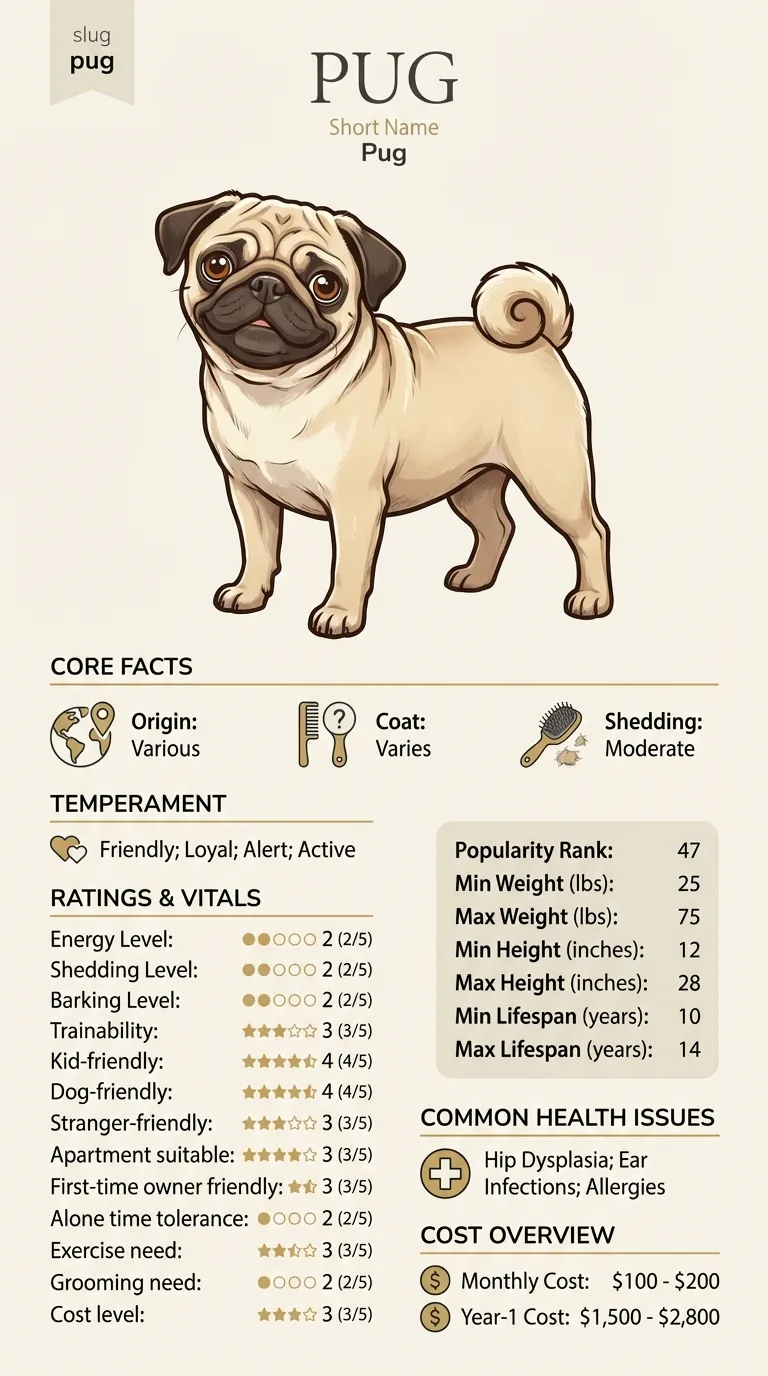
Owners watching their Pug scratch and chew at multiple different body areas, trying to figure out whether it's seasonal, food-related, or something else entirely.
This guide is not medical advice. If your dog shows pain, sudden behavior change, or worsening symptoms, consult a licensed veterinarian.
Some links may be affiliate links. We may earn a commission at no extra cost to you. We only suggest products we believe are helpful for dog owners.
We research and check what we publish, but we do not warrant that any figure, date, price, or statement is accurate, complete, or current, and we accept no liability for any loss, cost, injury, or other harm arising from the use of this site. Use it as one reference among several. You remain responsible for your own decisions and for your dog's care - confirm anything that matters with a licensed veterinarian or another qualified professional before you act on it. Full disclaimer.
Allergic skin disease in Pugs produces itching, redness, and irritation across multiple body areas — paws, belly, ears, armpits — distinguishing it from the localized skin fold infections common in this breed. Environmental allergens and, less commonly, food ingredients are the typical triggers, and management is usually ongoing rather than curative.
Allergic skin disease is a commonly diagnosed condition across dog breeds generally, and Pugs are no exception, with generalized itching being one of the more frequent reasons for a dermatology-focused vet visit in the breed.
Allergic skin disease in Pugs generally follows the same immune-mediated hypersensitivity mechanisms seen across dog breeds broadly, rather than reflecting a documented breed-specific structural cause. The breed's skin folds create a separate, distinct vulnerability to localized infection that can occur alongside, but is mechanically different from, generalized allergic disease.
Pollen, dust mites, mold, and other environmental allergens are the most commonly identified triggers, often following a seasonal pattern. Certain food proteins can trigger allergic responses in a smaller subset of dogs, identified through a structured elimination diet trial.
Schedule a visit for persistent itching, redness, or skin irritation across multiple body areas that isn't resolving with basic home care. Seek immediate care for facial swelling, difficulty breathing, or widespread hives, which can indicate a severe allergic reaction requiring urgent treatment.
See all PUG health problems, which breeds are prone to skin allergies, or the full PUG breed guide for temperament, exercise needs and ownership costs.
Initial relief from bathing and basic management can be noticeable within days to a couple of weeks. A full elimination diet trial takes eight to twelve weeks to give a reliable result, and environmental allergy management is typically an ongoing, seasonal consideration.
Success is a meaningful reduction in itching and skin irritation through consistent management — not necessarily the complete elimination of an underlying allergic tendency, which for most dogs is a lifelong trait managed rather than cured.
Distinguishing between these two categories — or accepting that both may be contributing — shapes the whole management approach going forward.
Most allergic dogs are managed rather than cured, and a combination of these approaches, tailored to the individual dog, typically works better than any single strategy alone.

Every spring, Camila's Pug, Bean, would scratch at his paws and belly constantly, and she'd assumed it was just seasonal dryness that would pass. When it started happening year-round rather than just in spring, she brought Bean in for an evaluation. Her vet suspected a combined environmental and food sensitivity, given the itching pattern was no longer strictly seasonal, and recommended both allergy testing and a diet trial. The testing confirmed a dust mite sensitivity, and the elimination trial identified chicken as a trigger as well. Camila switched Bean to a chicken-free diet and started regular hypoallergenic baths. His itching, which had become a year-round issue, dropped back to occasional mild flares — manageable in a way it hadn't been before she understood what was actually driving it.
Key takeaway: A pattern that seems to shift from occasional to year-round is worth a real workup rather than assuming it's still the same simple seasonal issue — allergies can have more than one trigger stacking together.
Allergic itching typically appears across multiple body areas — paws, belly, ears, armpits — rather than being confined to the facial or body folds where a localized infection would concentrate. Both can occur together, so a vet exam helps distinguish or identify overlap.
Pollen from trees, grasses, and weeds, along with dust mites and mold, are among the most commonly identified environmental triggers, often producing a seasonal pattern that can help narrow down likely culprits.
It involves feeding a novel protein or hydrolyzed prescription diet exclusively for eight to twelve weeks, with zero other treats or table food during that window, then carefully reintroducing prior foods one at a time to identify which one triggers symptoms.
Generally not — most allergic skin disease is managed on an ongoing basis through a combination of avoidance, medication, and supportive skin care rather than cured outright, similar to how allergies are managed in people.
Facial swelling, difficulty breathing, or widespread hives appearing suddenly can indicate a severe allergic reaction requiring immediate veterinary care, distinct from the chronic, gradual itching typical of ordinary allergic skin disease.
It can be valuable for identifying specific environmental triggers and informing targeted treatments like immunotherapy, though it's typically pursued after basic management steps haven't provided adequate relief on their own.
Yes, allergic sensitization can increase with repeated exposure over a dog's life, which is part of why consistent long-term management, rather than treating flare-ups only as they occur, tends to produce better outcomes.
Allergic itching tends to affect multiple areas — paws, belly, ears, armpits — rather than being confined to one specific spot.
Eight to twelve weeks of strict dietary control is needed for a properly conducted trial to give a reliable result.
Blood or intradermal skin allergy testing commonly runs a few hundred dollars, depending on the scope of the panel.
Yes, regular bathing with a vet-recommended shampoo helps remove allergens from the coat and can meaningfully reduce overall itch level.
Yes — this differs from ordinary chronic itching and requires immediate veterinary attention.
A one-page prep sheet for this condition: the signs, the questions to ask, what to get priced. Unlocks here.
You get: Vet visit prep sheet
No spam. One-click unsubscribe. See our privacy policy.
See a sample page before you decide.
Early access list
The free prep sheet covers the same-day warning signs, a symptom log and the questions to ask. We are considering a fuller kit that adds a cost worksheet for the usual tests and treatments (US price ranges with their sources) and a plain-English guide to ways of covering the bill. It is not built yet; this list tells us whether it is worth building.
One email, no spam, unsubscribe anytime. Information only, not veterinary advice.