Health
What causes IVDD in a Pug?
Gradual or sudden degeneration of the spinal discs cushioning the vertebrae, which Pugs are moderately predisposed to due to their compact spinal build.

Quick answer
What causes IVDD in a Pug?
Gradual or sudden degeneration of the spinal discs cushioning the vertebrae, which Pugs are moderately predisposed to due to their compact spinal build.
IVDD isn't one single event — it's a spectrum that runs from a subtle back stiffness that comes and goes to sudden hind-leg paralysis, and knowing where on that spectrum your dog sits changes everything about what to do next.
Owners who've noticed their Pug seeming reluctant to jump or occasionally yelping when picked up, unsure whether it's a minor ache or the start of something more serious.
This guide is not medical advice. If your dog shows pain, sudden behavior change, or worsening symptoms, consult a licensed veterinarian.
Some links may be affiliate links. We may earn a commission at no extra cost to you. We only suggest products we believe are helpful for dog owners.
We research and check what we publish, but we do not warrant that any figure, date, price, or statement is accurate, complete, or current, and we accept no liability for any loss, cost, injury, or other harm arising from the use of this site. Use it as one reference among several. You remain responsible for your own decisions and for your dog's care - confirm anything that matters with a licensed veterinarian or another qualified professional before you act on it. Full disclaimer.
Intervertebral disc disease describes degeneration of the cushioning discs between spinal vertebrae, ranging from gradual bulging that causes mild pain and stiffness to sudden rupture that can cause severe compression and paralysis. Pugs carry a moderate breed predisposition tied to their compact spinal build.
IVDD is documented as a moderate breed concern in Pugs — not as prevalent as in the most extremely chondrodystrophic breeds, but common enough that back-related symptoms should be taken seriously rather than assumed unlikely.
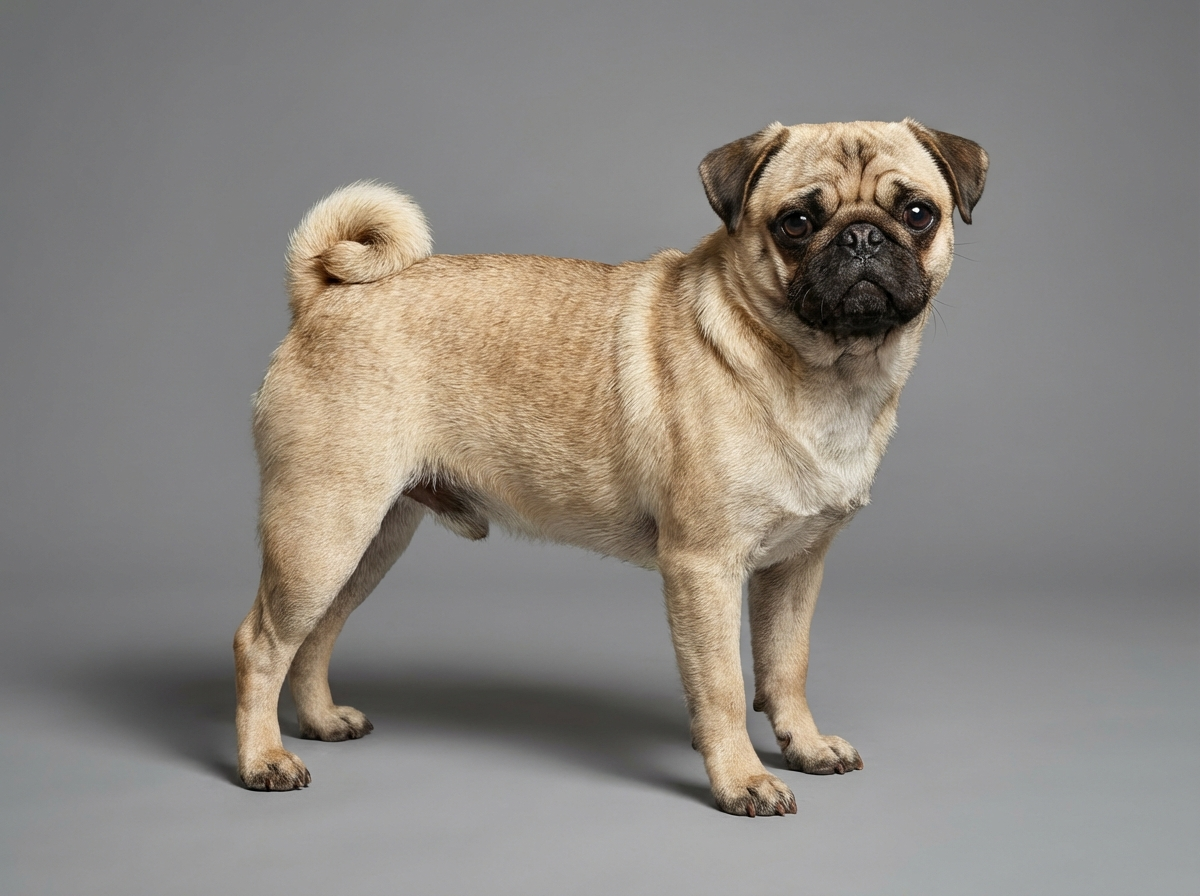
The Pug's compact, short-backed build places the spine under mechanical stress patterns that contribute to disc degeneration over time, a moderate version of the chondrodystrophic risk seen more extremely in other breeds. This structural tendency is present from the dog's basic conformation rather than something that develops solely from lifestyle factors.
Excess body weight adds direct load to the spine, accelerating disc wear. Repeated jumping on and off furniture, rough play, or sudden trauma can also trigger an acute rupture in a disc that's already degenerated, even if the dog showed no prior symptoms.
Seek immediate veterinary care for any hind-leg wobbling, weakness, dragging of the feet, or sudden inability to walk normally. These signal spinal cord compression severe enough that timing matters for outcome, and this is a genuine emergency rather than something to monitor overnight.
See all PUG health problems, which breeds are prone to intervertebral disc disease ivdd, or the full PUG breed guide for temperament, exercise needs and ownership costs.
Conservative management for lower-grade cases typically involves four to six weeks of strict rest before a gradual return to activity. Surgical cases involve a period of hospitalization followed by weeks of restricted, supervised recovery.
Success for milder cases is a full return to normal activity after the rest period; for more severe cases, it's regained mobility to whatever degree is achievable given how much spinal cord function was affected before treatment began.
Spinal discs act as cushions between vertebrae, made of a tough outer ring surrounding a gel-like center. As they degenerate, that center can either gradually bulge outward over months or years, slowly pressing on the spinal cord, or it can suddenly rupture through the outer ring in a single acute event, creating immediate, severe compression. Both fall under the IVDD label, but they present completely differently — one as a slow accumulation of stiffness and reluctance to move a certain way, the other as a sudden, dramatic loss of function.
Pugs are considered moderately predisposed to disc degeneration because of their compact, short-backed build, which places the spine under somewhat different mechanical stress than a longer-bodied dog experiences. This isn't the extreme chondrodystrophic risk seen in breeds like Dachshunds, but it's a real and documented breed tendency, and it means back symptoms in a Pug shouldn't be dismissed as unlikely simply because the breed isn't the one most associated with disc disease.
The grading scale exists because treatment decisions genuinely differ by severity — what's appropriate for grade 1 can be inadequate for grade 4 or 5.

Frank noticed his Pug, Peanut, had stopped jumping onto the couch on his own over about two weeks, and yelped once when Frank picked him up the usual way. He assumed it was a passing ache and gave it a few more days. On the third day, Peanut's back legs looked wobbly on a walk, dragging slightly with each step. Frank got him to the vet immediately, where a neurological exam and follow-up MRI confirmed a disc had ruptured, compressing the spinal cord — grade 3, with some voluntary movement still present. Peanut had surgery within 48 hours of the wobbling starting. Six weeks of restricted recovery later, he was walking normally again, though his vet was clear that acting fast during that window was what made the difference.
Key takeaway: Early, subtle signs like reluctance to jump deserve a vet visit before they progress — once hind-leg weakness appears, the clock on effective treatment starts running fast.
Yes, moderately — their compact, short-backed build carries a documented predisposition to disc degeneration, though it's not as extreme as in the most classically chondrodystrophic breeds. Back symptoms in a Pug are worth taking seriously rather than dismissing.
A reluctance to jump, yelping when picked up or handled around the back, a hunched posture, and reduced activity are common early signs. Any hind-leg wobbliness or weakness represents a more advanced stage that needs prompt evaluation.
No — lower-grade cases involving pain without weakness are often managed conservatively with rest. But any sudden hind-leg weakness, wobbling, or paralysis is an emergency, since the window for effective surgical intervention is time-sensitive.
Yes, for milder grades — strict crate rest and anti-inflammatory medication under veterinary guidance is a standard conservative approach for pain-only presentations, though it requires real discipline about restricting activity for the full recommended period.
A neurological exam assessing reflexes and pain response gives strong initial clues, and MRI is the imaging standard for confirming exact disc location and severity, particularly if surgery is being considered.
It depends heavily on severity and how quickly treatment started. Lower-grade cases managed with rest often recover fully. Higher-grade cases, especially those with loss of deep pain sensation, have a more guarded prognosis even with surgery.
Conservative management with rest and medication is comparatively affordable, while MRI and surgical decompression for severe cases represent a significant expense, often running into several thousand dollars depending on the facility and severity.
Gradual or sudden degeneration of the spinal discs cushioning the vertebrae, which Pugs are moderately predisposed to due to their compact spinal build.
It can be — back pain from disc irritation is a common cause of that reaction and warrants a vet visit rather than being assumed to be fussiness.
An MRI for spinal imaging often runs $1,500 to $3,000 or more depending on the facility and whether sedation and specialist interpretation are included.
Yes, an acute disc rupture can occur without much prior warning, though some dogs show subtler signs like reduced jumping in the weeks before.
Yes — limiting jumping and stair use during any suspected back pain episode, using ramps instead, is a standard and useful precaution.
A one-page prep sheet for this condition: the signs, the questions to ask, what to get priced. Unlocks here.
You get: Vet visit prep sheet
No spam. One-click unsubscribe. See our privacy policy.
See a sample page before you decide.
Early access list
The free prep sheet covers the same-day warning signs, a symptom log and the questions to ask. We are considering a fuller kit that adds a cost worksheet for the usual tests and treatments (US price ranges with their sources) and a plain-English guide to ways of covering the bill. It is not built yet; this list tells us whether it is worth building.
One email, no spam, unsubscribe anytime. Information only, not veterinary advice.