Behavior
Which sheds more?
The Pug, rated High (4/5) versus the Bichon's Very low (1/5).

Quick answer
Which sheds more?
The Pug, rated High (4/5) versus the Bichon's Very low (1/5).
Bichon Frise or Pug? On paper they differ most on grooming need, and on the scales Pug is the heavier at 14–18 lbs. Here is how the two compare on everything that shapes an ordinary week.
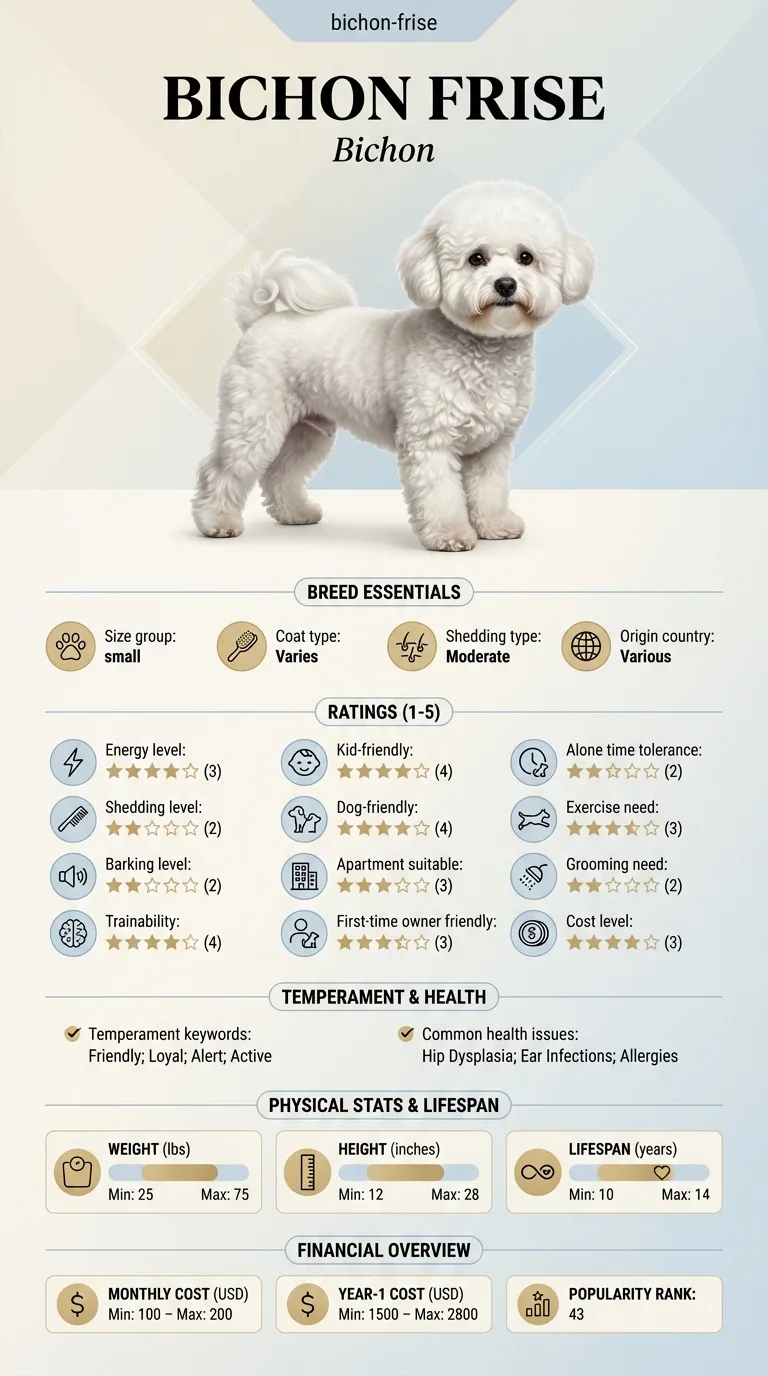
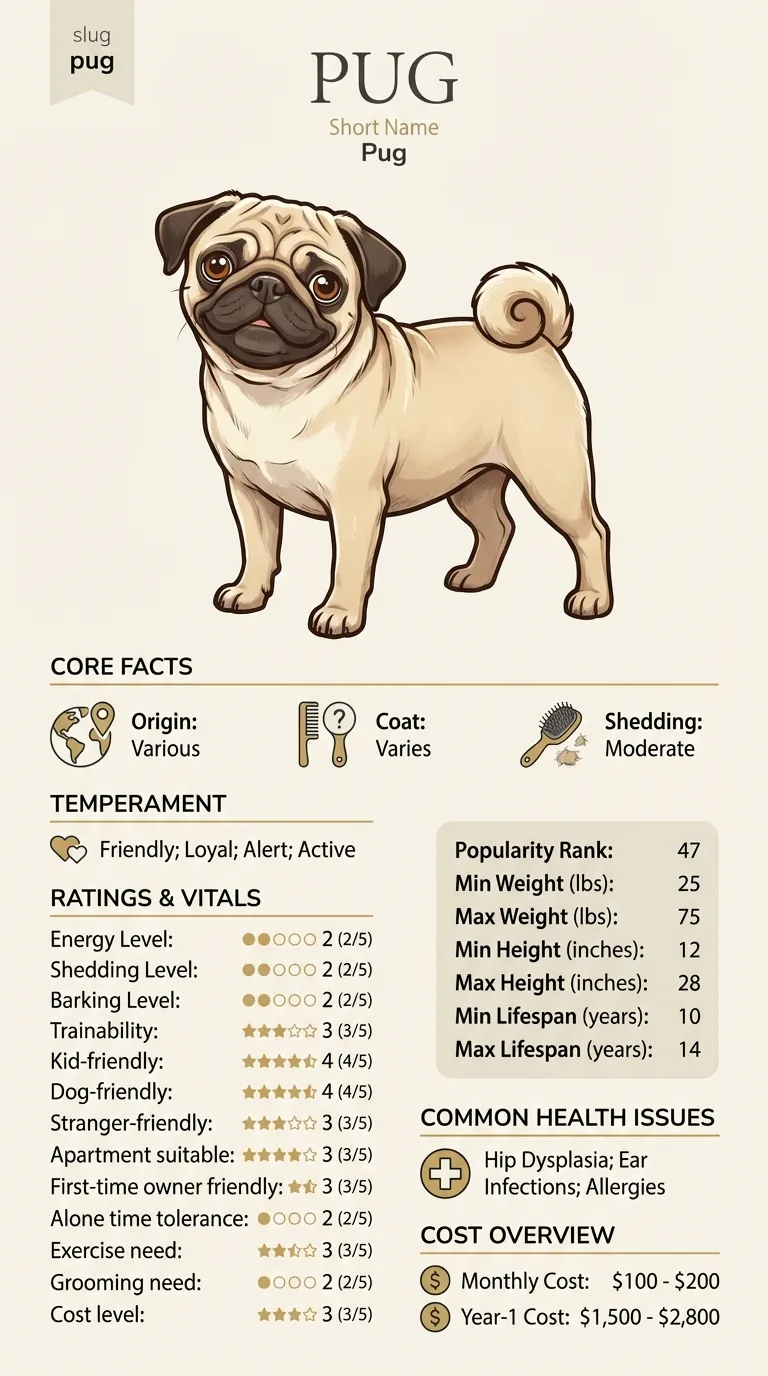
This is for someone already down to Bichon Frise and Pug and deciding between them. For this pair the decision usually turns on grooming need and shedding, so those are covered first and in most detail. Both rate 5/5 for flats, so housing does not settle this one. Breed history is left out; what follows is what you will actually live with.
Between Bichon Frise and Pug, grooming need is what separates them, and Pug is the lower-effort dog of the two to keep.
Choose Bichon Frise if shedding is a problem in your house, a smaller dog suits your car, your home or your back and you want a dog that is more watchful with visitors.
Choose Pug if this is your first dog, you do not want a standing grooming appointment and there are young children at home.
| Feature | bichon frise | pug | Winner |
|---|---|---|---|
| Size class | small | small | Equal |
| Weight | 12–18 lbs | 14–18 lbs | Equal |
| Height | 9–12 in | 10–13 in | Equal |
| Lifespan | 14–15 years | 13–15 years | bichon frise |
| Exercise need | Low (2/5) | Low (2/5) | Equal |
| Grooming need | Very high (5/5) | Low (2/5) | pug |
| Shedding | Very low (1/5) | High (4/5) | bichon frise |
| Energy level | Moderate (3/5) | Low (2/5) | Equal |
| Barking | Moderate (3/5) | Low (2/5) | pug |
| Apartment suitability | Very high (5/5) | Very high (5/5) | Equal |
| Good for first-time owners | High (4/5) | Very high (5/5) | pug |
| Tolerates being alone | Low (2/5) | Low (2/5) | Equal |
| Trainability | Moderate (3/5) | Moderate (3/5) | Equal |
| Good with kids | High (4/5) | Very high (5/5) | pug |
| Good with other dogs | High (4/5) | High (4/5) | Equal |
| Friendly to strangers | High (4/5) | Very high (5/5) | pug |
| Cost level | Moderate (3/5) | Moderate (3/5) | Equal |
| Coat | Curly, dense double coat | Short, smooth double coat | Equal |
| Origin | Various | Various | Equal |
| Typical monthly cost | $80–$150 | $80–$150 | Equal |
| Typical first-year cost | $1,100–$2,300 | $1,100–$2,300 | Equal |
At 12–18 lbs and 9–12 inches, the Bichon Frise is barely smaller than the 14–18 lb, 10–13 inch Pug — the two are close enough in scale that either would fit the same crate, the same car seat, and the same lap. What separates them is build, not size: the Bichon's curly, dense double coat and rounded face contrast with the Pug's short, smooth double coat and distinctly flat, brachycephalic muzzle. Two dogs of nearly identical weight can still feel like entirely different animals once coat texture and facial structure enter the picture, and that difference matters more here than the numbers alone suggest.
Both breeds are rated Low (2/5) for exercise need, and the table calls energy level a tie despite the Bichon nominally scoring Moderate (3/5) against the Pug's Low (2/5) — in practice, both are content with short walks and indoor play rather than serious mileage. The one real caveat is the Pug's flat-faced, brachycephalic build, which limits its heat and exertion tolerance in a way the Bichon simply doesn't share; a Pug overheats faster on a hot walk even at the same modest activity level. Neither breed suits an owner looking for a running or hiking companion.
This pairing flips the usual grooming-versus-shedding relationship: the Bichon rates Very high (5/5) grooming need against the Pug's Low (2/5), yet shedding runs the opposite direction, Very low (1/5) for the Bichon versus High (4/5) for the Pug. In plain terms, the Bichon takes real grooming effort but leaves little hair behind, while the short-coated Pug needs almost no styling but sheds noticeably, a fact that surprises many first-time Pug owners expecting a low-maintenance coat to also mean a low-hair household.
Both breeds are rated Very high (5/5) for apartment suitability, making either a strong choice for compact living, though the Pug edges ahead on noise, Low (2/5) barking against the Bichon's Moderate (3/5). Neither tolerates being left alone well, both scored Low (2/5), so long solo workdays remain a shared weak point regardless of which breed an owner picks. For anyone specifically prioritizing a quieter dog in close-quarters housing, the Pug's lower bark rating is a meaningful, if modest, advantage.
Trainability ties at Moderate (3/5) for both breeds, but the Pug edges ahead for first-time owners, Very high (5/5) versus the Bichon's already-strong High (4/5) — the highest first-time-owner score in this batch. The Pug's Charming, Even-tempered nature makes it broadly forgiving, though its Mischievous streak means consistency still matters in training sessions. Either breed suits a novice well, but the data gives the slightest edge to the Pug for anyone who has never trained a dog before.
The Pug rates Very high (5/5) with kids and Very high (5/5) friendliness to strangers, both a notch above the Bichon's already-solid High (4/5) scores, while good-with-other-dogs ties at High (4/5). Both breeds share an easygoing, people-oriented temperament — the Bichon's Cheerful, Affectionate nature and the Pug's Charming, Affectionate one — that suits busy households with children and frequent visitors, with the Pug scoring marginally higher across nearly every social measure in the table.
The Bichon's 14–15 year lifespan edges out the Pug's 13–15 years, but the real distinction is in the nature of the health risks rather than raw longevity. The Bichon's concerns — Skin Allergies, Patellar Luxation, Bladder Stones, Cataracts, Dental Disease — are common, generally manageable small-breed issues. The Pug's list — Brachycephalic Airway Syndrome (BOAS), Pug Dog Encephalitis, Corneal Ulcers, Hemivertebrae, and Obesity — includes breed-defining structural problems tied directly to its flat face and corkscrew tail, several of which can require surgical intervention.
Cost is identical on paper: both breeds rate Moderate (3/5) cost level with the same $80–$150 monthly range and $1,100–$2,300 first-year range. The headline numbers don't tell the whole story, though — a Pug's brachycephalic airway issues can lead to expensive corrective surgery later in life, and Obesity management often means specialized diet costs, so a Pug's lifetime veterinary spending can run higher than a Bichon's even with matching baseline budgets.
Bichon Frise weighs 12–18 lbs and lives 14–15 years; Pug weighs 14–18 lbs and lives 13–15 years. The two diverge most on grooming need and shedding. They are level on tolerates being alone, apartment suitability and cost level, so those cannot decide it. The comparison marks an easier option only where one exists. Facts like weight and country of origin are not scored. Both dogs are rated from the same dataset, which is what makes the numbers comparable with each other even though any individual dog sits somewhere inside its breed's range.

Yes — it's rated High (4/5) shedding versus the Bichon's Very low (1/5), a common surprise for owners who assume a short coat means minimal hair.
The Pug, rated Low (2/5) grooming need versus the Bichon's Very high (5/5), since it lacks the Bichon's dense, mat-prone curly coat.
Yes, Brachycephalic Airway Syndrome (BOAS) appears on the Pug's health list, a structural issue tied to its flat face that can affect breathing, especially in heat or during exercise.
Both are excellent, but the Pug rates slightly higher, Very high (5/5) versus the Bichon's High (4/5).
Their baseline costs match exactly — both Moderate (3/5) cost level with identical monthly and first-year ranges — though a Pug's airway or weight-related veterinary care can add unplanned expense over its lifetime.
The Pug, rated Low (2/5) versus the Bichon's Moderate (3/5).
Yes, rated Very high (5/5) for first-time owners, the top score in this comparison, thanks to its Even-tempered, forgiving nature.
The Pug, rated High (4/5) versus the Bichon's Very low (1/5).
The Pug, rated Low (2/5) versus Very high (5/5).
The Pug, rated Low (2/5).
The Bichon Frise, 14–15 years versus 13–15 years.
See every pug comparison.
Secure checkout on Stripe. We never see your card.
7-day money-back guarantee. Instant access.
Health information here is general and is not veterinary advice. If your dog shows pain, sudden behaviour change, or worsening symptoms, consult a licensed veterinarian.
Some links on this site are affiliate links. We may earn a commission at no extra cost to you, and we only suggest products we believe are helpful for dog owners.
We research and check what we publish, but we do not warrant that any figure, date, price, or statement is accurate, complete, or current, and we accept no liability for any loss, cost, injury, or other harm arising from the use of this site. Use it as one reference among several. You remain responsible for your own decisions and for your dog's care - confirm anything that matters with a licensed veterinarian or another qualified professional before you act on it. Full disclaimer.
Match your lifestyle to the right dog.
Take quizNot sure which breed is right for you? Take our 2-minute quiz to find out.
Take the quiz