Health
Is hip dysplasia common in Pugs?
It's far less common than in large breeds, but it does occur, and a Pug showing mobility changes shouldn't be assumed to only have a knee problem.

Quick answer
Is hip dysplasia common in Pugs?
It's far less common than in large breeds, but it does occur, and a Pug showing mobility changes shouldn't be assumed to only have a knee problem.
A diagnosis that most owners associate with German Shepherds and Labradors can still show up on a Pug's X-ray — just with a different weight of consequence riding on a much smaller joint.
Owners who've noticed their Pug hesitating on stairs or struggling to rise after resting, and are surprised to hear "hip dysplasia" mentioned for a dog this size.
This guide is not medical advice. If your dog shows pain, sudden behavior change, or worsening symptoms, consult a licensed veterinarian.
Some links may be affiliate links. We may earn a commission at no extra cost to you. We only suggest products we believe are helpful for dog owners.
We research and check what we publish, but we do not warrant that any figure, date, price, or statement is accurate, complete, or current, and we accept no liability for any loss, cost, injury, or other harm arising from the use of this site. Use it as one reference among several. You remain responsible for your own decisions and for your dog's care - confirm anything that matters with a licensed veterinarian or another qualified professional before you act on it. Full disclaimer.
Hip dysplasia is a structural malformation of the hip joint that creates looseness and abnormal wear, and while it's most associated with large and giant breeds, it can occur in Pugs too — often progressing more slowly because of the breed's lighter body weight, but no less real as a diagnosis.
Hip dysplasia is diagnosed far less often in Pugs than in large or giant breeds, but it isn't absent from the breed, and a Pug showing mobility changes deserves the same diagnostic consideration a larger dog would get.
The joint malformation itself is a structural, largely inherited trait that can occur regardless of breed size. What differs in a Pug is the mechanical consequence — less body weight loading the joint each stride means slower cartilage wear, which is why progression often looks different from what owners may have read about in large-breed contexts.
Excess weight is the biggest environmental amplifier, since it adds direct load to an already unstable joint. High-impact activity during puppyhood, before growth plates have closed, can also accelerate wear in a joint that's already predisposed to laxity.
Bring your Pug in for an evaluation if you notice a bunny-hopping gait, ongoing reluctance to jump or climb stairs, stiffness that doesn't ease within a few minutes of moving, or any limping that persists beyond a day or two. These warrant hip X-rays to rule dysplasia in or out rather than assuming it's simple aging.
Start here: Pug Most Common Genetic Disorders: What to Screen For
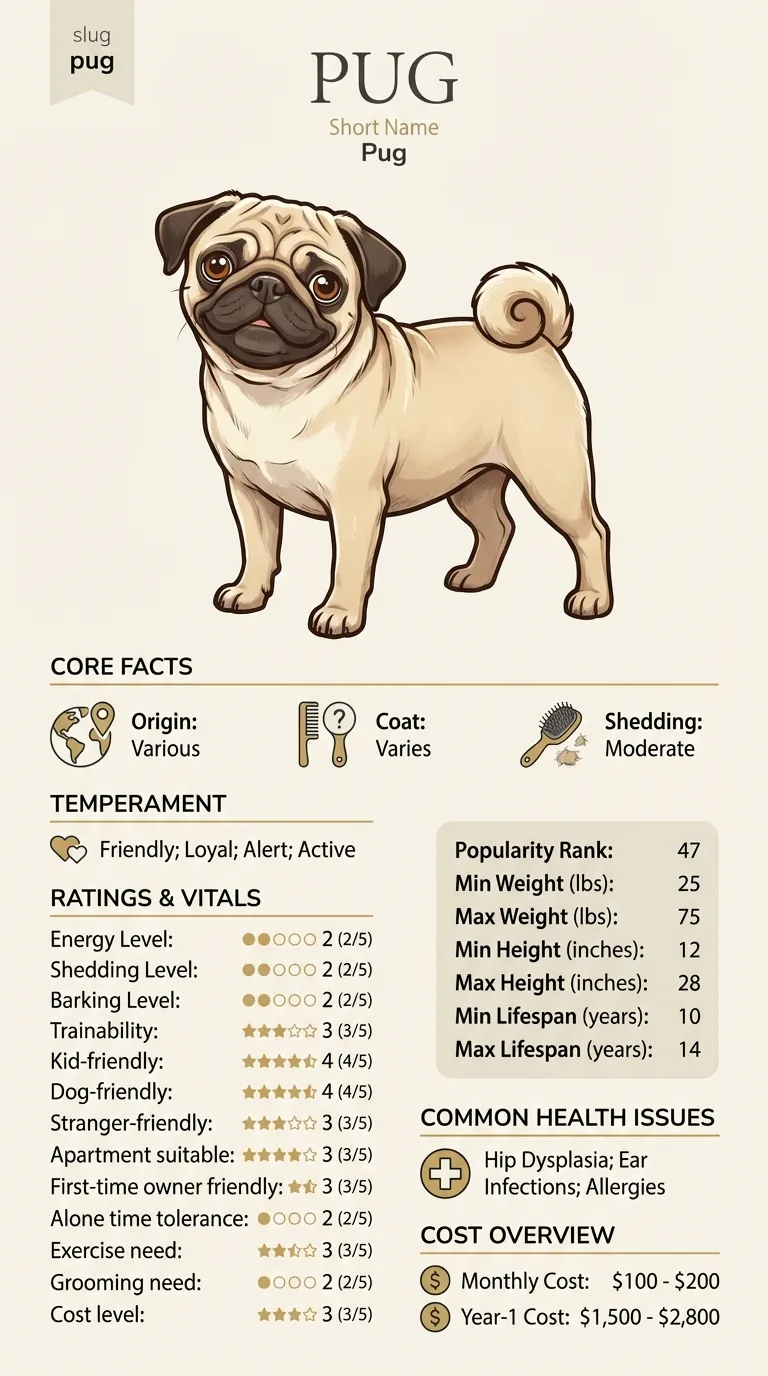
See all PUG health problems, which breeds are prone to hip dysplasia, or the full PUG breed guide for temperament, exercise needs and ownership costs.
Conservative management typically shows improved comfort within a few weeks of starting weight control and activity adjustments; surgical recovery, if needed, generally runs several weeks to a few months depending on the procedure.
Success is a Pug that moves comfortably through normal daily activity without persistent stiffness or reluctance — not a joint that returns to a perfectly normal structure, since the underlying malformation itself doesn't reverse.
In a malformed hip, the femoral head doesn't sit snugly in the socket, and every step creates a small amount of abnormal grinding and joint laxity. Over months and years, that grinding wears down the smooth cartilage lining the joint, exposing bone and triggering the pain and stiffness that eventually becomes arthritis. In large breeds this process gets accelerated by sheer body weight loading the joint with every stride. A Pug's smaller frame means less raw force through the joint, which is part of why dysplasia in this breed can progress more slowly and be less immediately obvious than in a 90-pound dog.
That slower progression is also the trap. Because symptoms build gradually — a bit more hesitation on stairs this year than last, a slightly stiffer rise after a nap — owners can mistake early hip dysplasia for simple aging or attribute it to a completely different joint problem, like the patellar issues that are more commonly discussed in small breeds. Getting hips specifically imaged, rather than assuming a small dog's mobility changes must be something else, is often the only way the diagnosis gets made at all.
Diagnosis requires imaging to confirm what's happening inside the joint, and treatment ranges from conservative management to surgery depending on severity.

Renee noticed her seven-year-old Pug, Coco, had started avoiding the two steps up to the porch, hopping both back legs together instead of walking normally. She assumed it was a knee problem, since that's what she'd read was common in small breeds. Her vet examined both the knees and hips and recommended X-rays of the hips specifically after noticing a subtle looseness during the exam. The imaging showed mild bilateral hip dysplasia, a diagnosis Renee hadn't expected for a 16-pound dog. Coco started a joint supplement and a modest weight-loss plan, losing just under two pounds over two months. Within that time, the porch steps stopped being an issue, and Coco's gait looked normal again on daily walks.
Key takeaway: Small-breed mobility changes shouldn't be assumed to be knee-related by default — hip dysplasia can hide behind symptoms that look exactly like a more "expected" small-dog problem.
Yes. Hip dysplasia is a structural joint malformation that can occur in any breed, though it's discussed far more often in large and giant breeds because their body weight accelerates the resulting joint damage. Pugs can and do get diagnosed with it.
An X-ray of the hips, usually taken under sedation so the joint can be positioned properly, is the standard way to confirm the diagnosis and assess how loose or arthritic the joint has become.
A bunny-hopping gait when running, reluctance to climb stairs or jump onto furniture, stiffness after rest that eases with movement, and a noticeable change in how the dog rises from lying down are all early clues worth mentioning to a vet.
Not always — many cases, especially milder ones, are managed successfully with weight control, joint supplements, and activity modification. Surgery is generally reserved for more severe cases where conservative management isn't keeping the dog comfortable.
The underlying joint malformation is the same, but the reduced body weight of a Pug means less mechanical stress on the joint, which often translates to a slower progression and, in many cases, a better response to non-surgical management.
The structural predisposition itself isn't preventable once present, but keeping a lean body weight throughout life and avoiding excessive high-impact activity during growth can reduce how quickly joint wear progresses.
Conservative management with supplements and periodic vet visits might run a modest ongoing amount, while surgical correction for a severe case is a significantly larger expense — a vet can give a realistic range once severity is known from imaging.
It's far less common than in large breeds, but it does occur, and a Pug showing mobility changes shouldn't be assumed to only have a knee problem.
Hesitation before stairs or jumping, and stiffness after resting that eases once the dog gets moving.
Yes — it's a structural diagnosis that can't be confirmed by physical exam alone, so imaging is the standard path.
It's still a real orthopedic surgery with genuine cost and recovery time, though a lighter dog's recovery is often more manageable than a large breed's.
Yes, meaningfully — even a small reduction in body weight lowers the mechanical load on an already compromised joint.
A one-page prep sheet for this condition: the signs, the questions to ask, what to get priced. Unlocks here.
You get: Vet visit prep sheet
No spam. One-click unsubscribe. See our privacy policy.
Preview page 1 before you decide.