Health
What triggers an IVDD episode?
Often nothing dramatic; ordinary movement like jumping off furniture can rupture an already-degenerated disc.

Quick answer
What triggers an IVDD episode?
Often nothing dramatic; ordinary movement like jumping off furniture can rupture an already-degenerated disc.
A disc that would normally stay flexible for a decade can start calcifying in this breed by early middle age.
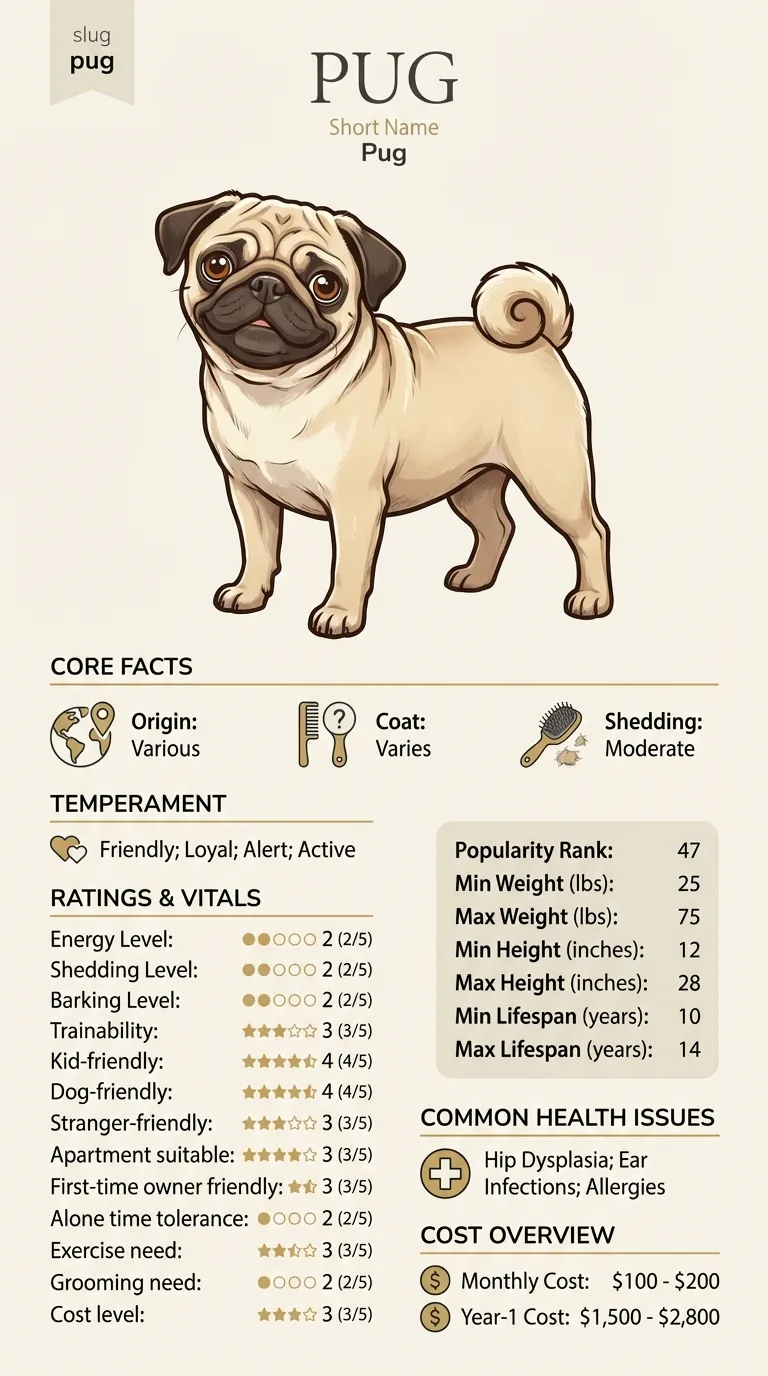
This affects owners of adult Pugs generally, since disc degeneration is a slow, silent process that can go unnoticed until a sudden episode. It's especially relevant for owners of dogs between four and eight years old, when symptomatic episodes are most often first seen.
This guide is not medical advice. If your dog shows pain, sudden behavior change, or worsening symptoms, consult a licensed veterinarian.
Some links may be affiliate links. We may earn a commission at no extra cost to you. We only suggest products we believe are helpful for dog owners.
We research and check what we publish, but we do not warrant that any figure, date, price, or statement is accurate, complete, or current, and we accept no liability for any loss, cost, injury, or other harm arising from the use of this site. Use it as one reference among several. You remain responsible for your own decisions and for your dog's care - confirm anything that matters with a licensed veterinarian or another qualified professional before you act on it. Full disclaimer.
Intervertebral disc disease is a degenerative spinal condition where discs between vertebrae harden and calcify years earlier than average in this breed, then bulge or rupture, sometimes suddenly, putting pressure on the spinal cord. It can range from mild back pain to sudden loss of back-leg function requiring emergency treatment.
IVDD is one of the more frequently diagnosed spinal conditions in chondrodystrophic breeds broadly, and Pugs share the same disc biology, making it a real risk worth understanding even though breed-specific rate data is limited.
This breed's genetically compact body type comes from the same developmental pathway that causes disc material to calcify and stiffen years earlier than in a dog with typical proportions, leaving the discs more brittle and prone to rupture under normal activity.
High-impact movement, like repeated jumping off furniture or down stairs, and excess body weight both add mechanical stress to a spine that already has less shock-absorbing capacity than normal.
Any sudden reluctance to move, yelping when touched along the spine, or especially any weakness, dragging, or loss of function in the back legs is an emergency. Get to a vet or emergency clinic immediately, since the window for effective treatment before permanent damage can be very short.
Start here: Pug Most Common Genetic Disorders: What to Screen For
See all PUG health problems, which breeds are prone to backspine issues, or the full PUG breed guide for temperament, exercise needs and ownership costs.
Mild episodes managed with rest typically improve over two to six weeks of strict activity restriction. Surgical cases involve a hospital stay followed by weeks of restricted activity and often physical rehabilitation over one to three months.
Success means regaining stable mobility and pain control, whether or not that returns to full pre-episode function, since outcomes depend heavily on how quickly severe cases were treated.
In a typical dog, the discs between vertebrae stay gel-like and flexible well into middle age, acting as shock absorbers for the spine. In chondrodystrophic breeds, that gel-like center calcifies and hardens years earlier, a change driven by the same genetic pathway responsible for this breed's short, compact limbs. A hardened disc is less able to absorb everyday movement and more prone to bulging or rupturing outward under normal activity, sometimes something as ordinary as jumping off a couch, pushing against the spinal cord it's meant to protect.
Unlike hemivertebrae, which is often silent for life, a symptomatic IVDD episode tends to appear suddenly and clearly: a dog that yelps when picked up or touched along the back, arches its back stiffly, refuses to move, or in more severe cases, drags or can't use its back legs at all. This is a sharp contrast from the gradual stiffening seen in arthritis; IVDD episodes typically develop over hours, not months. Any sudden loss of back-leg coordination or function is treated as a spinal emergency, since the window to intervene before permanent nerve damage sets in can be measured in hours to a couple of days.

Five-year-old Daisy yelped sharply when her owner went to pick her up one evening and refused to walk afterward. Within an hour, her back legs looked wobbly and uncoordinated. Her owner drove straight to an emergency vet rather than waiting until morning. An MRI confirmed a ruptured disc pressing on her spinal cord, and Daisy went into surgery that same night. She spent six weeks on strict rest and rehabilitation afterward and regained close to full use of her back legs. Her owner credits the fast decision to go in immediately, rather than waiting to see if it improved, with giving Daisy the best possible outcome.
Key takeaway: With IVDD, the speed of the decision to seek emergency care matters as much as the treatment itself; waiting even a day to see if symptoms improve can close the window for the best recovery.
Hemivertebrae is a malformed vertebra present from birth, often silent for life. IVDD is degeneration of the discs between vertebrae that develops over the dog's adult life and tends to cause sudden, acute episodes of pain or paralysis rather than being an incidental finding.
Reluctance to move, yelping when picked up or touched along the spine, a hunched or arched back posture, and reduced appetite are common early signs. Weakness or dragging of the back legs signals a more advanced, urgent episode.
Any sudden hind-leg weakness, dragging, or loss of bladder control is a spinal emergency. The window to intervene before permanent nerve damage occurs is short, so this needs same-day veterinary attention, not a wait-and-see approach.
Mild episodes are sometimes managed with strict crate rest and vet-prescribed pain and anti-inflammatory management. More severe episodes, especially with loss of leg function, typically need surgical decompression for the best chance of recovery.
Costs vary widely depending on severity: conservative management with rest and medication costs far less than surgical decompression, which can be a significant expense including imaging, surgery, and rehabilitation.
Yes, dogs who've had one episode are at higher risk for another, since the underlying disc degeneration affects multiple discs along the spine, not just the one that ruptured.
Yes, excess weight adds strain to a spine already prone to early disc degeneration, making weight management one of the more meaningful things an owner can control.
You can't prevent the underlying disc degeneration, since it's tied to this breed's genetics, but keeping your dog at a healthy weight and limiting high-impact jumping can reduce the odds of triggering a rupture.
Strict crate rest for the first several weeks, gradually increasing supervised activity, and often a course of physical rehabilitation to rebuild strength and coordination, with the specific timeline depending on how severe the episode was.
Often nothing dramatic; ordinary movement like jumping off furniture can rupture an already-degenerated disc.
Immediately; this is a spinal emergency where hours matter for the chance of recovery.
Yes, some mild cases improve with strict crate rest and vet-prescribed medication, without surgery.
Yes, using ramps or steps instead of letting your dog jump on and off furniture reduces disc strain.
It's one of the costlier common procedures in this breed; pet insurance with orthopedic and neurologic coverage helps offset it.
A one-page prep sheet for this condition: the signs, the questions to ask, what to get priced. Unlocks here.
You get: Vet visit prep sheet
No spam. One-click unsubscribe. See our privacy policy.
Preview page 1 before you decide.