Training
Easier to train?
The Pug, rated Moderate (3/5) versus the Shiba Inu's Low (2/5).

Quick answer
Easier to train?
The Pug, rated Moderate (3/5) versus the Shiba Inu's Low (2/5).
Pug or Shiba Inu? On paper they differ most on good for first-time owners, and on the scales Shiba Inu is the heavier at 17–23 lbs. Here is how the two compare on everything that shapes an ordinary week.
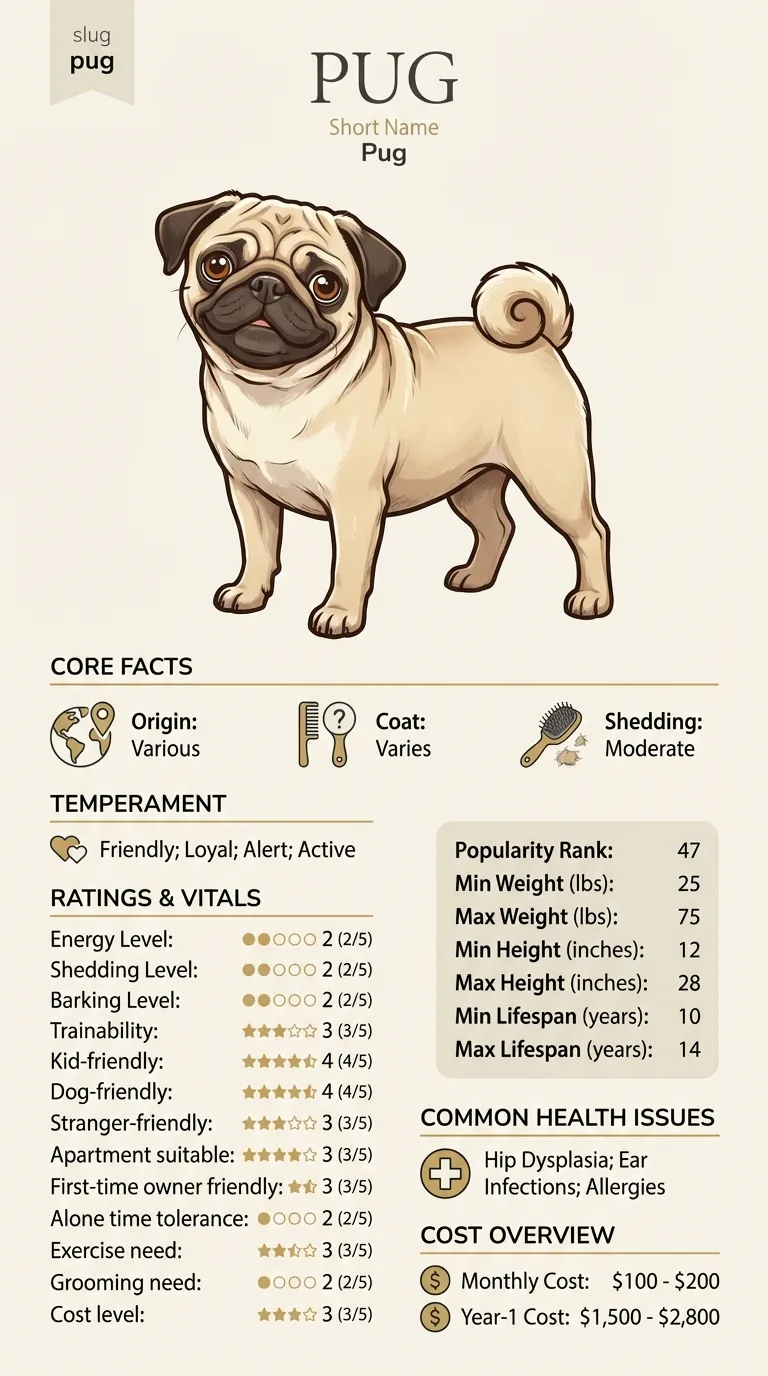
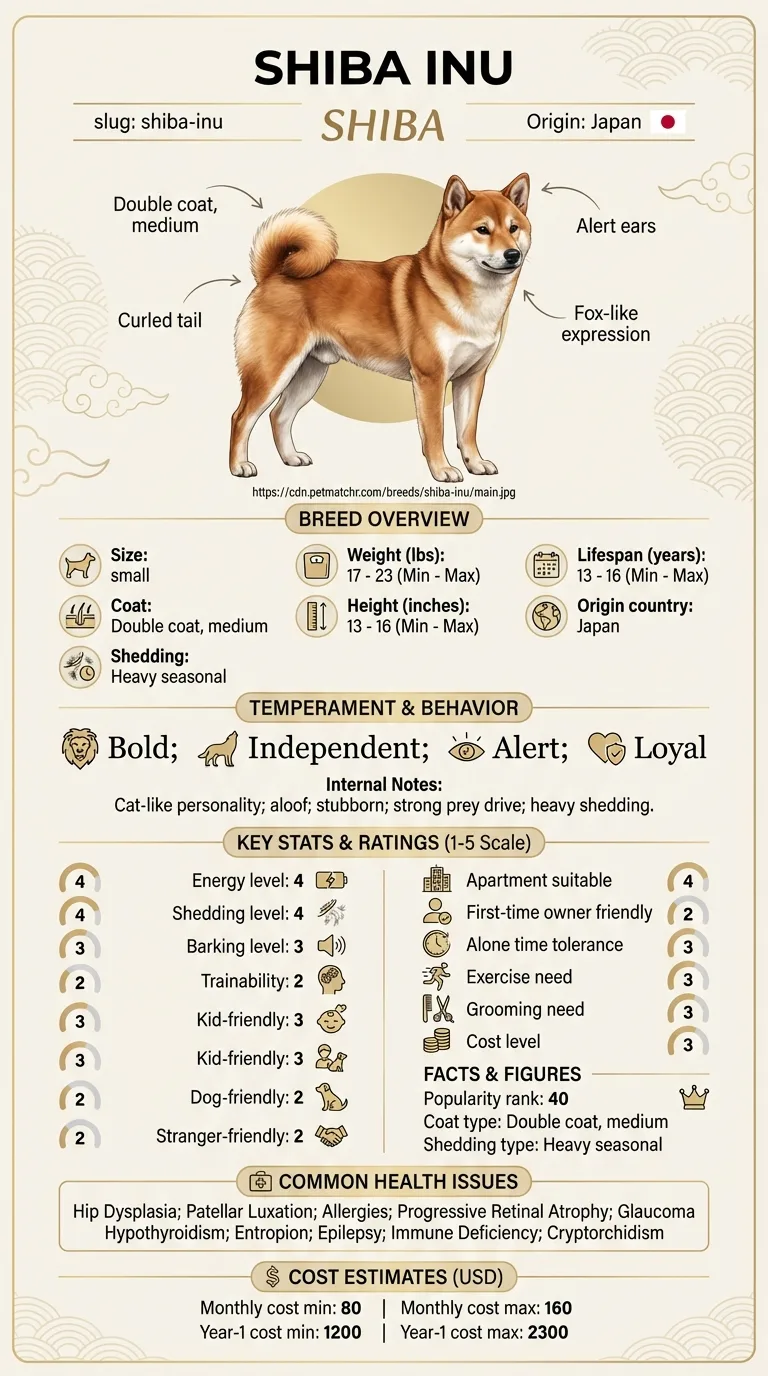
This is for someone already down to Pug and Shiba Inu and deciding between them. For this pair the decision usually turns on good for first-time owners and friendly to strangers, so those are covered first and in most detail. Anyone choosing from a flat has a clear answer here: Pug rates 5/5 against 4/5. There is no origin story here — only what changes about your week.
Between Pug and Shiba Inu, good for first-time owners is what separates them, and Pug is the lower-effort dog of the two to keep.
Choose Pug if you are in a flat or a smaller home, this is your first dog and you do not want a standing grooming appointment.
Choose Shiba Inu if the dog will be alone during the working day, you want a dog that can keep up with an active routine and you want a dog that is more watchful with visitors.
| Feature | pug | shiba inu | Winner |
|---|---|---|---|
| Size class | small | small | Equal |
| Weight | 14–18 lbs | 17–23 lbs | Equal |
| Height | 10–13 in | 13–16 in | Equal |
| Lifespan | 13–15 years | 13–16 years | shiba inu |
| Exercise need | Low (2/5) | Moderate (3/5) | pug |
| Grooming need | Low (2/5) | Moderate (3/5) | pug |
| Shedding | High (4/5) | High (4/5) | Equal |
| Energy level | Low (2/5) | High (4/5) | Equal |
| Barking | Low (2/5) | Moderate (3/5) | pug |
| Apartment suitability | Very high (5/5) | High (4/5) | pug |
| Good for first-time owners | Very high (5/5) | Low (2/5) | pug |
| Tolerates being alone | Low (2/5) | Moderate (3/5) | shiba inu |
| Trainability | Moderate (3/5) | Low (2/5) | pug |
| Good with kids | Very high (5/5) | Moderate (3/5) | pug |
| Good with other dogs | High (4/5) | Low (2/5) | pug |
| Friendly to strangers | Very high (5/5) | Low (2/5) | pug |
| Cost level | Moderate (3/5) | Moderate (3/5) | Equal |
| Coat | Short, smooth double coat | Double coat, medium | Equal |
| Origin | Various | Japan | Equal |
| Typical monthly cost | $80–$150 | $80–$160 | Equal |
| Typical first-year cost | $1,100–$2,300 | $1,200–$2,300 | Equal |
The Shiba Inu edges out the Pug in every physical dimension without leaving the small class: 17–23 pounds and 13–16 inches against the Pug's 14–18 pounds and 10–13 inches. But the more meaningful difference is structural rather than numerical — the Shiba is a spitz-type dog with erect ears, a curled tail, and a fox-like build descended from Japanese hunting stock, while the Pug is a brachycephalic companion breed with a flat face and compact, square frame. A Shiba's athletic, primitive build gives it far more physical capability than its modest size suggests, something the Pug's body simply isn't built for.
Exercise need is rated Low (2/5) for the Pug and Moderate (3/5) for the Shiba Inu, a smaller gap than the breeds' reputations might suggest — but energy level readings list the Shiba as High against the Pug's Low, and that daily intensity matters more than the raw exercise number. Bred originally to flush small game in mountainous terrain, the Shiba carries a sharp, bursty energy that shows up as sudden zoomies and a strong prey drive rather than a need for marathon distances. The Pug's energy, by contrast, rarely spikes — it's content pacing itself through short outings all day.
Grooming need is Low (2/5) for the Pug against Moderate (3/5) for the Shiba Inu, whose plush double coat needs more regular brushing to manage, particularly during its dramatic seasonal blowouts. Shedding itself is tied at High (4/5) for both breeds, so despite the grooming gap, neither is a good match for anyone trying to avoid dog hair entirely. The Shiba's coat is famously self-cleaning and low-odor between full grooming sessions, a trait it's known for, while the Pug relies more on facial wrinkle care than coat care to stay comfortable and clean.
Apartment suitability favors the Pug, Very high (5/5) against the Shiba Inu's still-solid High (4/5), and barking follows a similar pattern — Low (2/5) for the Pug versus Moderate (3/5) for the Shiba. The Shiba is famous less for volume than for its distinctive high-pitched 'Shiba scream,' an intense vocalization some owners find startling in shared housing. Tolerating time alone actually favors the Shiba slightly, Moderate (3/5) against the Pug's Low (2/5), suggesting its independent streak — noted directly in its own temperament list — makes it somewhat more self-sufficient during a workday than the more people-attached Pug.
This is one of the widest gaps in the whole comparison: first-time-owner suitability rates Very high (5/5) for the Pug against just Low (2/5) for the Shiba Inu, and trainability follows suit at Moderate (3/5) versus Low (2/5). The Shiba's own temperament list says it plainly — Bold, Independent — and that independence, inherited from its primitive hunting-dog ancestry, translates into a strong-willed dog that questions commands rather than following them reflexively. Shiba Inus are widely considered one of the more challenging breeds to train well, and this page's data backs that reputation up clearly against the far more biddable Pug.
The household categories all favor the Pug by a wide margin: Very high (5/5) with kids against the Shiba's Moderate (3/5), High (4/5) with other dogs against the Shiba's Low (2/5), and Very high (5/5) with strangers against the Shiba's Low (2/5). None of this makes the Shiba a bad dog — Bold, Alert, and Loyal are accurate descriptors for a devoted, self-possessed companion — but it does mean a Shiba needs more careful socialization and management around unfamiliar dogs, kids, and visitors than a naturally gregarious Pug, which tends to greet the whole household's world with open enthusiasm.
Lifespan tilts marginally toward the Shiba Inu, 13–16 years against the Pug's 13–15, and the Shiba's ten-item health list — including Hip Dysplasia, Progressive Retinal Atrophy, Glaucoma, Epilepsy, and Immune Deficiency — is broader in scope than the Pug's five. The Pug's shorter list is no less serious, though: Brachycephalic Airway Syndrome, Pug Dog Encephalitis, Corneal Ulcers, Hemivertebrae, and Obesity all trace back to its flat-faced, short-spined build. Neither breed's health profile is simple, so both benefit from owners who budget for regular specialist screening — eye exams for the Shiba, airway and spine monitoring for the Pug — rather than routine care alone.
Cost level ties at Moderate (3/5) for both breeds, and the dollar ranges are nearly identical too — $80–$150 monthly for the Pug against $80–$160 for the Shiba Inu, with first-year totals of $1,100–$2,300 versus $1,200–$2,300. The small gap mostly reflects the Shiba's slightly larger size and moderate grooming needs rather than any dramatic cost driver. Where actual spending can diverge is training: a Shiba's Low (2/5) trainability score often pushes owners toward professional obedience classes or a specialist trainer, an expense the more naturally biddable Pug is less likely to need.
Pug weighs 14–18 lbs and lives 13–15 years; Shiba Inu weighs 17–23 lbs and lives 13–16 years. The two diverge most on good for first-time owners, friendly to strangers and energy level and 2 other rated axes. They are level on cost level and shedding, so those cannot decide it. Where the table declares a winner it means less work for the owner, nothing more; descriptive rows are left as ties on purpose. The value here is in the differences between the two columns; treat any single score as approximate.

The Pug, decisively — Very high (5/5) for first-time owners against the Shiba Inu's Low (2/5), reflecting the Shiba's independent, strong-willed nature.
Yes, it's a well-documented trait; combined with its Moderate (3/5) barking rating, it's a louder, more vocal breed than the Low (2/5) Pug.
Neither — both rate High (4/5) for shedding, though the Shiba's plush double coat blows out seasonally in more dramatic bursts.
Not especially — it rates Low (2/5) for sociability with other dogs, versus the Pug's High (4/5), and needs careful, early socialization.
The Shiba Inu, rated Moderate (3/5) versus the Pug's Low (2/5), thanks to its more independent temperament.
The Shiba Inu, with ten listed conditions including Epilepsy and Immune Deficiency, versus five for the Pug.
Very close — both rate Moderate (3/5) cost level with nearly matching monthly and first-year ranges.
The Pug, rated Moderate (3/5) versus the Shiba Inu's Low (2/5).
The Pug, rated Very high (5/5) versus the Shiba's Low (2/5).
The Shiba Inu, described directly in its temperament as Independent.
The Shiba Inu, at 13-16 years versus the Pug's 13-15.
See every pug comparison.
Secure checkout on Stripe. We never see your card.
7-day money-back guarantee. Instant access.
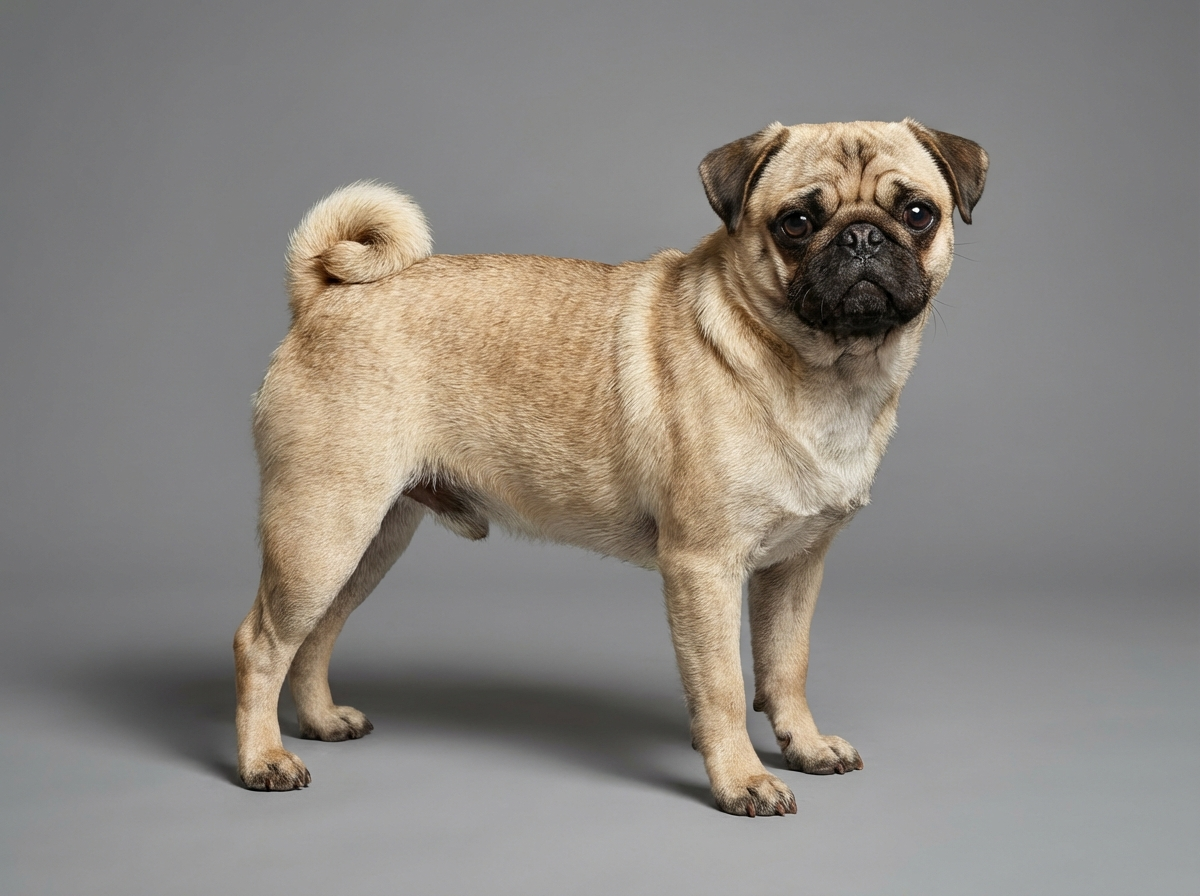
Health information here is general and is not veterinary advice. If your dog shows pain, sudden behaviour change, or worsening symptoms, consult a licensed veterinarian.
Some links on this site are affiliate links. We may earn a commission at no extra cost to you, and we only suggest products we believe are helpful for dog owners.
We research and check what we publish, but we do not warrant that any figure, date, price, or statement is accurate, complete, or current, and we accept no liability for any loss, cost, injury, or other harm arising from the use of this site. Use it as one reference among several. You remain responsible for your own decisions and for your dog's care - confirm anything that matters with a licensed veterinarian or another qualified professional before you act on it. Full disclaimer.
Match your lifestyle to the right dog.
Take quizNot sure which breed is right for you? Take our 2-minute quiz to find out.
Take the quiz