Behavior
Why are Pugs prone to separation anxiety?
Their history as companion dogs bred specifically for closeness with people, rather than independent work, shaped a temperament with lower natural alone-time tolerance.

Quick answer
Why are Pugs prone to separation anxiety?
Their history as companion dogs bred specifically for closeness with people, rather than independent work, shaped a temperament with lower natural alone-time tolerance.
A breed literally bred to want constant human company doesn't automatically know how to be okay without it — and for a lot of Pugs, alone time is a skill that has to be taught rather than something that comes naturally.
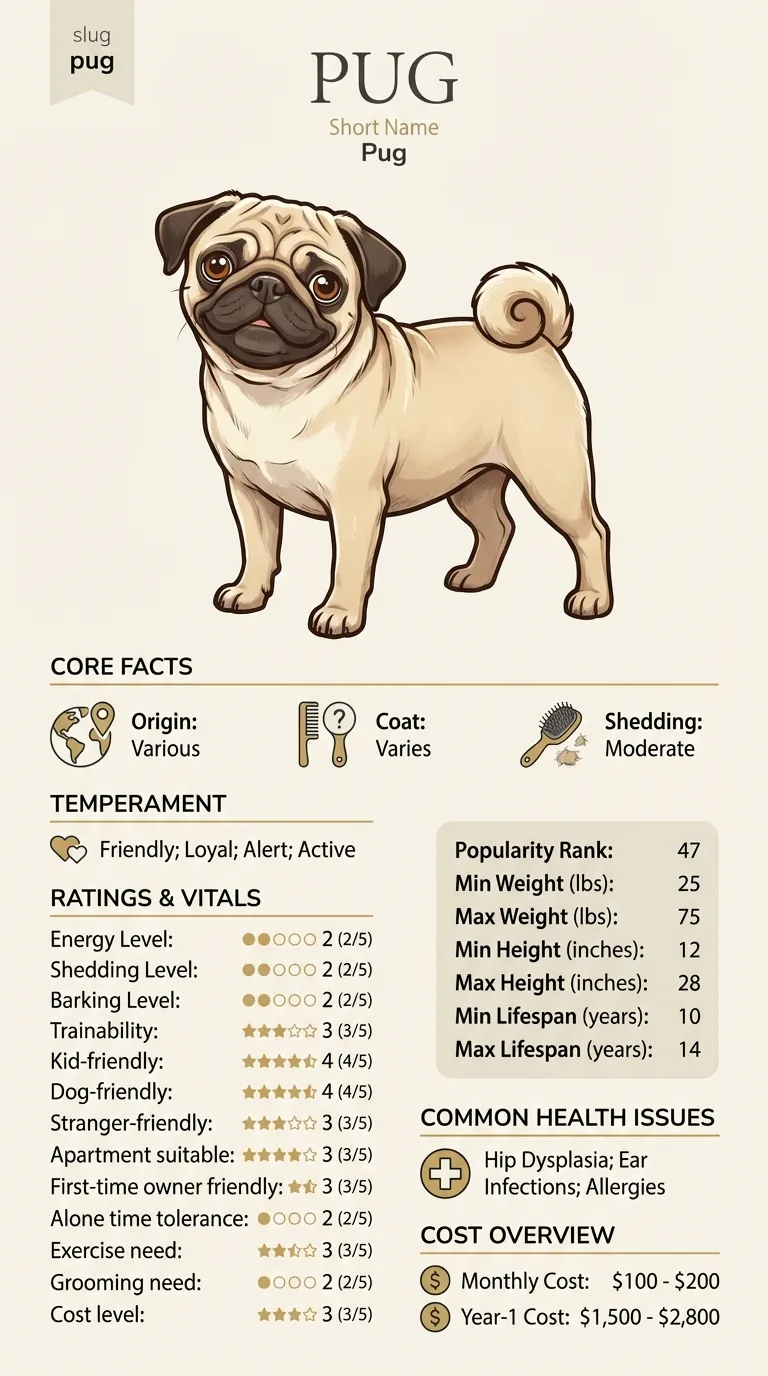
Owners of a Pug that seems distressed, destructive, or vocal specifically when left alone, trying to figure out whether this is normal breed clinginess or a real anxiety problem needing a structured plan.
This guide is not medical advice. If your dog shows pain, sudden behavior change, or worsening symptoms, consult a licensed veterinarian.
Some links may be affiliate links. We may earn a commission at no extra cost to you. We only suggest products we believe are helpful for dog owners.
We research and check what we publish, but we do not warrant that any figure, date, price, or statement is accurate, complete, or current, and we accept no liability for any loss, cost, injury, or other harm arising from the use of this site. Use it as one reference among several. You remain responsible for your own decisions and for your dog's care - confirm anything that matters with a licensed veterinarian or another qualified professional before you act on it. Full disclaimer.
Separation anxiety is a well-documented tendency in Pugs, rooted in the breed's centuries-long history as a companion dog selectively bred for closeness with people rather than independent work. This history translates into a genuine, often lower-than-average tolerance for being left alone that many owners need to actively build through gradual training.
Separation-related distress is widely recognized as a common behavioral pattern in Pugs specifically, given the breed's companion-focused history, though severity varies considerably from mild preference for company to genuine, disruptive anxiety.
The Pug's centuries-long development as a companion breed, valued specifically for wanting closeness with people rather than performing independent work, shaped a temperament genuinely prone to distress during separation — a documented tendency rather than a trained-in bad habit or individual failing.
Inconsistent alone-time exposure, especially during puppyhood, dramatic departure and arrival routines, and sudden changes in a household's schedule can all worsen or fail to build the tolerance a dog needs to manage being left alone comfortably.
A certified trainer or veterinary behaviorist experienced with separation anxiety specifically is worth involving for cases that aren't improving with a basic gradual program, or where the anxiety is severe enough to cause significant distress or property damage.
Consult your vet if destructive behavior, house-soiling, or excessive vocalization during absences is severe, persistent, or accompanied by signs of physical distress, since ruling out a medical contributor and discussing whether medication might support a behavioral plan can both be worthwhile for more significant cases.
Start here: Pug Most Common Genetic Disorders: What to Screen For
See all PUG health problems, which breeds are prone to separation anxiety, or the full PUG breed guide for temperament, exercise needs and ownership costs.
Meaningful improvement through a consistent, gradual desensitization program often takes several weeks, with more established or severe cases sometimes taking longer and benefiting from professional guidance.
Success is a dog that can settle calmly during reasonable daily absences — not necessarily one that's indifferent to being alone, since some preference for company is a natural, breed-typical trait that doesn't need to be eliminated, only managed to a comfortable, functional degree.
Unlike breeds developed for herding, guarding, or hunting — jobs that often required a dog to work independently at some distance from a handler — the Pug's entire historical purpose centered on close companionship, frequently as an indoor lapdog for households that valued near-constant proximity. That selective breeding history shaped a temperament that finds genuine reward in closeness and, correspondingly, real distress in prolonged separation, which isn't simply "clinginess" in the dismissive sense but a documented breed tendency toward lower alone-time tolerance than many other breeds display.
This matters practically because owners sometimes assume a dog's distress at being left alone is either an overreaction to be ignored or a discipline problem to be corrected, when for a companion breed like this it's often closer to a genuine mismatch between the dog's temperament and modern life's routine need for alone time. Recognizing that this isn't a flaw unique to one "difficult" dog, but a broader breed-typical tendency, is often the first step toward addressing it constructively rather than with frustration.
This is a skill built incrementally over weeks, not something addressed by simply leaving for longer periods and hoping the dog adjusts.

Every time Priyanka left for work, her Pug, Biscuit, would bark continuously for the first twenty minutes, according to the neighbor who mentioned it. Priyanka had assumed Biscuit was just "a barker" until she set up a camera and realized the barking was tightly linked to her actual departure, easing only once Biscuit apparently accepted she wasn't coming right back. She started a gradual program: brief, one-minute departures with zero fanfare, building slowly over three weeks to absences of a couple hours. She also began giving Biscuit a stuffed food toy only when she left, building a specific positive association with her departure routine. Within a month, the camera showed Biscuit settling within a few minutes of her leaving, rather than barking for twenty. Priyanka still keeps departures low-key as an ongoing habit, having seen directly how much that specific change mattered.
Key takeaway: A gradual, structured approach to alone time — not simply hoping a dog adjusts on its own — is what actually shifts a companion breed's genuine distress at being left.
It's a well-documented tendency in the breed, tied to their history as companion dogs selectively bred for closeness rather than independent work, making many Pugs more prone to struggling with alone time than breeds developed for other purposes.
Genuine separation anxiety typically involves specific behaviors during actual absences — destructive behavior, excessive vocalization, house-soiling despite being trained, or signs of significant distress — rather than simply preferring your company when you're present.
It can often be meaningfully improved through a gradual, structured desensitization process, though the timeline and degree of improvement vary by individual dog and how established the anxiety pattern has become.
This can help in some cases but isn't a guaranteed fix, since the anxiety is often specifically about the absence of a particular person rather than being alone in a general sense — a second dog doesn't necessarily address that specific attachment.
It depends entirely on the individual dog — some find a properly introduced crate to be a comforting, secure space, while others with anxiety find confinement adds distress. Introducing it gradually and watching your dog's specific response matters more than a universal rule.
For more severe cases, a vet or veterinary behaviorist may discuss anti-anxiety medication as part of a broader behavioral plan, though this is typically used alongside training rather than as a standalone solution.
This varies considerably by dog and how established the anxiety pattern already is, but gradual desensitization plans often show meaningful progress over several weeks of consistent practice.
Their history as companion dogs bred specifically for closeness with people, rather than independent work, shaped a temperament with lower natural alone-time tolerance.
Starting with very short absences — even just a minute or two — and gradually building duration only once your dog stays calm.
Mild cases can often be addressed with a consistent, gradual home program, though a certified trainer or behaviorist can help with more established or severe cases.
Working with a certified trainer or behaviorist on this specific issue commonly runs from a modest per-session fee to a more comprehensive program cost.
Many dogs show meaningful, lasting improvement with a consistent gradual program, though some degree of preference for company may always remain part of this companion breed's temperament.
Behaviour changes often start with pain. The prep sheet for this page covers what to rule out, and what to ask.
You get: Vet visit prep sheet
No spam. One-click unsubscribe. See our privacy policy.
Preview page 1 before you decide.