Health
What blood test is used to screen for a liver shunt?
A bile acids test measures how well the liver is processing certain compounds and is typically the first screening step when a shunt is suspected.

Quick answer
What blood test is used to screen for a liver shunt?
A bile acids test measures how well the liver is processing certain compounds and is typically the first screening step when a shunt is suspected.
A puppy that's noticeably smaller than its littermates, seems foggy or disoriented after meals, and doesn't grow the way expected — a liver shunt is one of the explanations that's easy to miss until specific testing points to it.
Owners of small, slow-growing puppies whose vet has raised the possibility of a liver shunt after ruling out more obvious explanations for poor growth or unusual behavior.
This guide is not medical advice. If your dog shows pain, sudden behavior change, or worsening symptoms, consult a licensed veterinarian.
Some links may be affiliate links. We may earn a commission at no extra cost to you. We only suggest products we believe are helpful for dog owners.
We research and check what we publish, but we do not warrant that any figure, date, price, or statement is accurate, complete, or current, and we accept no liability for any loss, cost, injury, or other harm arising from the use of this site. Use it as one reference among several. You remain responsible for your own decisions and for your dog's care - confirm anything that matters with a licensed veterinarian or another qualified professional before you act on it. Full disclaimer.
A liver shunt is an abnormal blood vessel, most often congenital, that lets blood bypass the liver's normal filtering role, allowing toxins to build up and affect other organs, particularly the brain. It commonly presents in puppies as stunted growth and post-meal disorientation.
Congenital liver shunts are a recognized, though not extremely frequent, condition diagnosed in puppies across various breeds, and are one of the considerations vets rule in or out when a puppy shows unexplained poor growth alongside neurological symptoms.
Most congenital liver shunts result from a fetal blood vessel that should close shortly after birth failing to do so, and a genetic predisposition is suspected in certain lines and breeds, though the exact hereditary pattern isn't always clearly mapped.
There's no environmental trigger for the congenital vessel itself, since it's present from birth. Diet composition, particularly protein content, does directly affect how much toxin load the body has to manage around the existing shunt, which is why dietary management can meaningfully reduce symptom severity.
Bring your puppy in for evaluation if you notice stunted growth compared to littermates, disorientation or staring spells (especially after meals), excessive thirst and urination, or any seizure activity. Seizures or sudden severe disorientation warrant same-day emergency care rather than a routine appointment.
Start here: Pug Most Common Genetic Disorders: What to Screen For
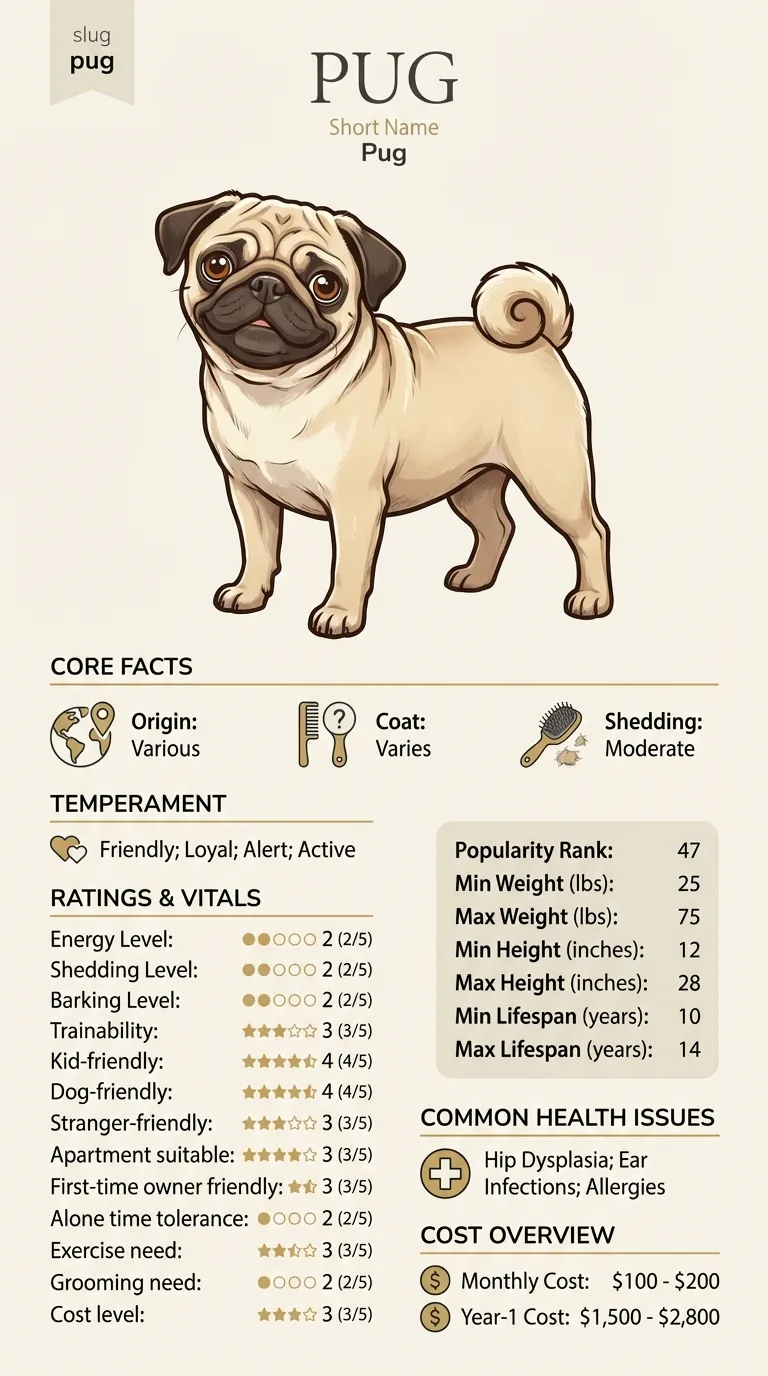
See all PUG health problems, which breeds are prone to liver shunts, or the full PUG breed guide for temperament, exercise needs and ownership costs.
Diagnosis typically takes a few weeks of investigation once poor growth or symptoms are noticed, involving bloodwork and imaging. Surgical recovery generally takes several weeks, with the liver gradually adjusting to full blood flow over subsequent months.
Success after surgical correction is a dog whose growth catches up reasonably well and whose neurological symptoms resolve as toxin levels normalize — though the degree of full "catch-up" varies by how significantly growth was affected before treatment.
The liver's job includes filtering toxins, particularly ammonia produced during normal protein digestion, out of the blood before it reaches general circulation. When a shunt vessel allows blood to skip that filtering step, those toxins build up and can affect the brain directly, causing a set of neurological symptoms — disorientation, staring into space, circling, or even seizures — that tend to appear or worsen especially after meals, when the digestive system is producing the most toxins for the liver to normally process.
Because the liver also isn't getting its usual full blood supply, it often doesn't grow to a normal size, and a puppy affected from birth frequently shows stunted overall growth and is noticeably smaller than littermates. This combination — small size, occasional post-meal disorientation, sometimes drinking and urinating more than expected — is a recognizable pattern, but each piece individually can look like something else, from a picky eater to a puppy simply being the runt of the litter.
The path from suspicion to diagnosis usually runs through bloodwork first, then imaging to confirm exactly what's happening structurally.

If you think your Pug has liver shunts, the plan is three steps: write down what you have seen and when it started, book a veterinary appointment rather than waiting for the next flare, and take video of the behaviour or symptom before you go — the thing you are worried about rarely happens in the consulting room. Screening in the parents covers brachycephalic airway syndrome (boas), pug dog encephalitis, corneal ulcers.
What the vet visit should produce is a diagnosis and a written plan, not just reassurance: what is being ruled out, what the monitoring interval is, and which signs mean you come back sooner. Ask what the treatment costs across a year rather than per visit, because that is the number that decides whether you are managing this condition or reacting to it.
Between appointments, keep a short log — dates, what you saw, what changed. It is the single most useful thing an owner brings to a follow-up, and for liver shunts it is often what separates a clear pattern from a guess.
Devon's Pug puppy, Biggie, was noticeably the smallest of his litter and seemed to "space out" for a few seconds after nearly every meal — something Devon initially found almost funny rather than concerning. At his four-month checkup, his vet asked pointed questions about growth and behavior, then ran a bile acids test that came back significantly elevated. An ultrasound confirmed a single congenital shunt vessel. Biggie had surgery to close the abnormal vessel at five months old. Within a few months of recovery, his growth had noticeably caught up, and the post-meal staring spells stopped completely — a puppy quirk that turned out to have a specific, fixable cause.
Key takeaway: Stunted growth and odd post-meal behavior in a puppy are worth investigating specifically, rather than assuming a small dog is simply the runt of the litter.
It's an abnormal blood vessel, usually present from birth, that allows blood from the digestive tract to bypass the liver instead of being filtered by it. This lets toxins that the liver would normally remove build up in the bloodstream and affect other organs, especially the brain.
Stunted growth compared to littermates, disorientation or staring spells especially after meals, excessive drinking and urination, and occasionally seizures are common signs. Symptoms can be subtle at first and easy to attribute to other causes.
A bile acids blood test is usually the first step, since elevated results strongly suggest impaired liver processing. Ultrasound or specialized imaging is then used to actually visualize and confirm the abnormal shunting vessel.
Some milder cases are managed with a special diet and medication that reduces toxin production, though surgical correction generally offers the best long-term outcome for congenital shunts and is often recommended when feasible.
Most cases in young dogs are congenital, meaning the abnormal vessel was present from birth as a leftover fetal blood vessel that should have closed but didn't. Acquired shunts, which develop later due to other liver disease, are a separate and less common category.
Many dogs go on to live full, normal lives after successful surgical correction, once the liver has had time to adjust to receiving full, normal blood flow and toxin buildup resolves.
A genetic component is suspected in dogs with congenital liver shunts, and this is a relevant consideration for breeding decisions involving affected lines, though the exact inheritance pattern isn't always straightforward.
A bile acids test measures how well the liver is processing certain compounds and is typically the first screening step when a shunt is suspected.
Digestion produces toxins that a shunt allows to bypass liver filtering, and those toxins can temporarily affect the brain, which is why symptoms often worsen after meals.
Surgical correction is a significant expense, often running several thousand dollars given the specialized imaging and surgical skill involved.
For some milder cases, yes, though many dogs do better long-term with surgical correction rather than diet management alone.
No — many small or slow-growing puppies have no liver issue at all, but persistent poor growth alongside other symptoms is worth discussing with a vet.
A one-page prep sheet for this condition: the signs, the questions to ask, what to get priced. Unlocks here.
You get: Vet visit prep sheet
No spam. One-click unsubscribe. See our privacy policy.
Preview page 1 before you decide.