Behavior
Needs the most exercise?
The Vizsla, rated Very high (5/5) versus the Pug's Low (2/5).

Quick answer
Needs the most exercise?
The Vizsla, rated Very high (5/5) versus the Pug's Low (2/5).
Pug or Vizsla? On paper they differ most on apartment suitability, and on the scales Vizsla is the heavier at 45–65 lbs. Here is how the two compare on everything that shapes an ordinary week.
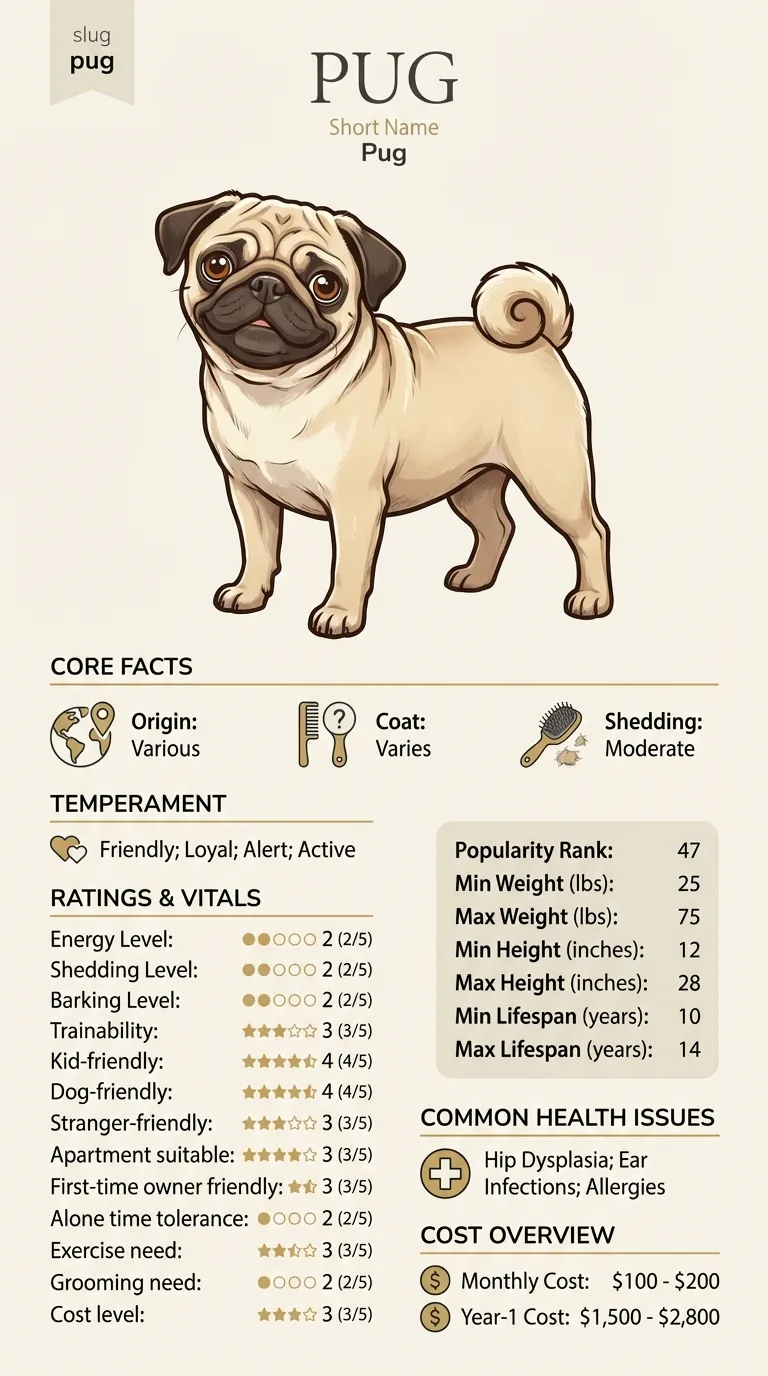
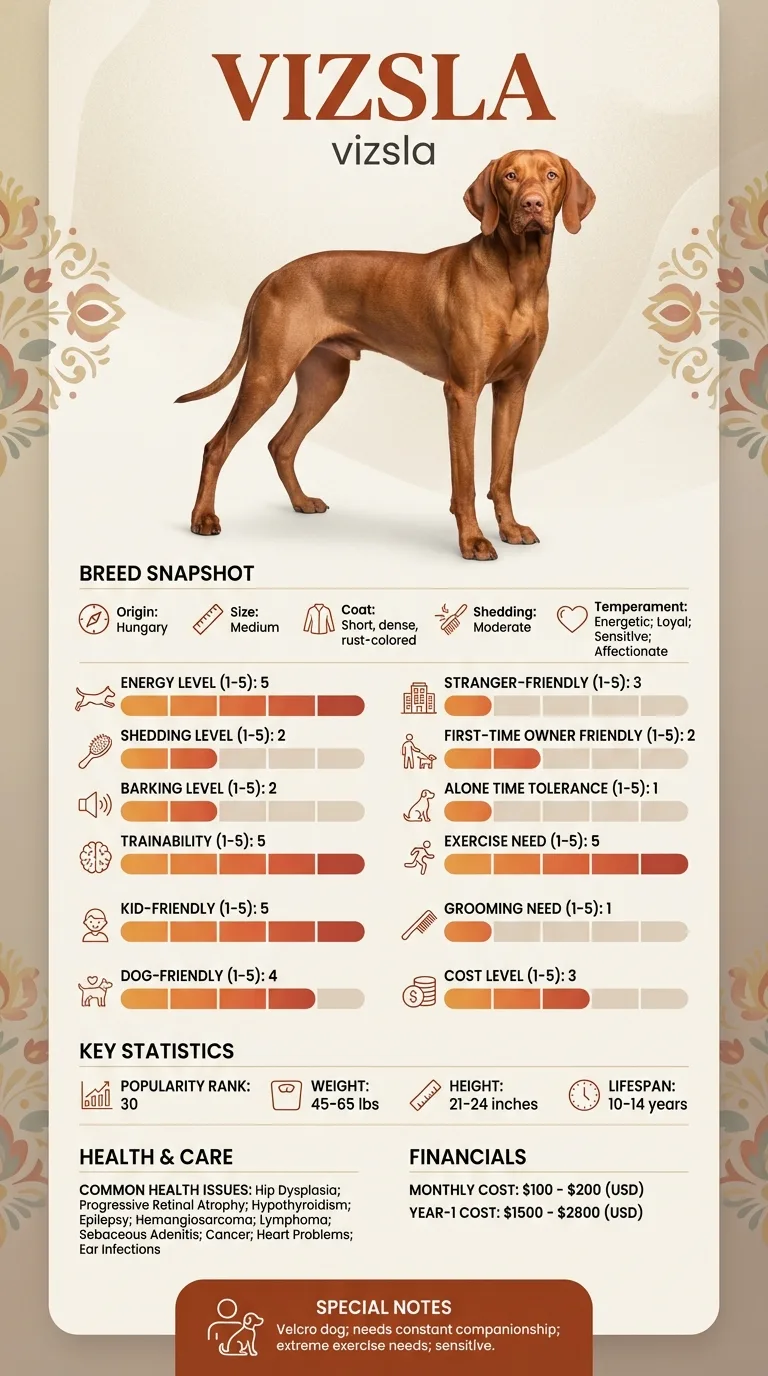
This is for someone already down to Pug and Vizsla and deciding between them. For this pair the decision usually turns on apartment suitability and exercise need, so those are covered first and in most detail. Anyone choosing from a flat has a clear answer here: Pug rates 5/5 against 1/5. Breed history is left out; what follows is what you will actually live with.
Between Pug and Vizsla, apartment suitability is what separates them, and Pug is the lower-effort dog of the two to keep.
Choose Pug if you are in a flat or a smaller home, this is your first dog and your walking routine is modest.
Choose Vizsla if you do not want a standing grooming appointment, shedding is a problem in your house and you want a dog that picks up training quickly.
| Feature | pug | vizsla | Winner |
|---|---|---|---|
| Size class | small | medium | Equal |
| Weight | 14–18 lbs | 45–65 lbs | Equal |
| Height | 10–13 in | 21–24 in | Equal |
| Lifespan | 13–15 years | 10–14 years | pug |
| Exercise need | Low (2/5) | Very high (5/5) | pug |
| Grooming need | Low (2/5) | Very low (1/5) | vizsla |
| Shedding | High (4/5) | Low (2/5) | vizsla |
| Energy level | Low (2/5) | Very high (5/5) | Equal |
| Barking | Low (2/5) | Low (2/5) | Equal |
| Apartment suitability | Very high (5/5) | Very low (1/5) | pug |
| Good for first-time owners | Very high (5/5) | Low (2/5) | pug |
| Tolerates being alone | Low (2/5) | Very low (1/5) | pug |
| Trainability | Moderate (3/5) | Very high (5/5) | vizsla |
| Good with kids | Very high (5/5) | Very high (5/5) | Equal |
| Good with other dogs | High (4/5) | High (4/5) | Equal |
| Friendly to strangers | Very high (5/5) | Moderate (3/5) | pug |
| Cost level | Moderate (3/5) | Moderate (3/5) | Equal |
| Coat | Short, smooth double coat | Short, dense, rust-colored | Equal |
| Origin | Various | Hungary | Equal |
| Typical monthly cost | $80–$150 | $100–$200 | Equal |
| Typical first-year cost | $1,100–$2,300 | $1,500–$2,800 | Equal |
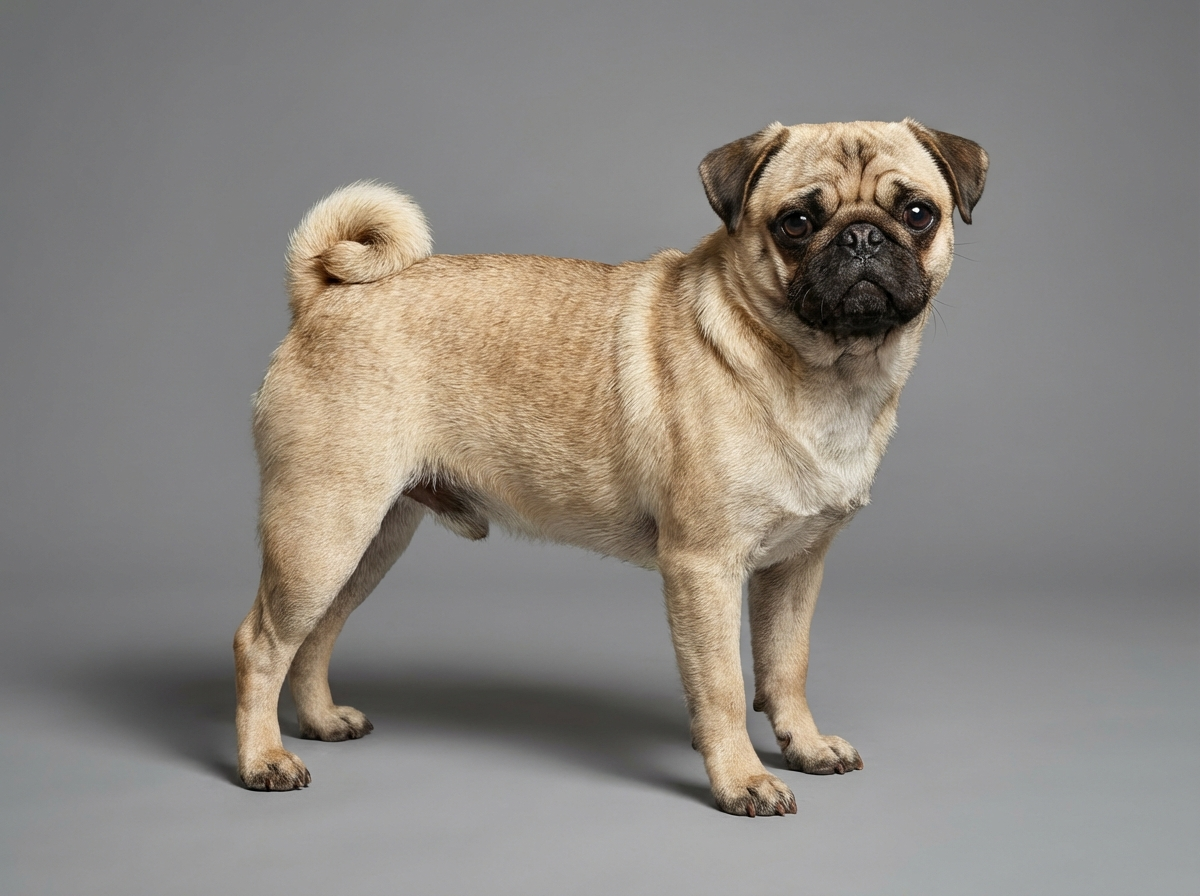
The Vizsla stands nearly twice as tall as the Pug and can outweigh it by 50 pounds — 45–65 pounds and 21–24 inches against the Pug's 14–18 pounds and 10–13 inches. Bred in Hungary as a versatile pointer and retriever, the Vizsla has a lean, athletic build with a short, dense, rust-colored coat that's the visual opposite of the Pug's flat-faced, compact silhouette. Everything about the Vizsla's frame — long legs, deep chest, minimal body fat — was shaped by generations of all-day fieldwork, while the Pug's body was shaped purely to be a companion, and that split defines most of what separates them below.
Exercise need is rated Low (2/5) for the Pug and Very high (5/5) for the Vizsla, a sporting breed famously described as needing to run daily or risk becoming anxious and destructive — some owners call the breed 'Velcro dogs' for how closely they shadow their people during and between activity sessions. Its own temperament list includes Energetic and Sensitive, a combination that means both its body and its emotional state need regular vigorous outlets. The Pug's Low (2/5) exercise need is close to the opposite extreme, satisfied with short leisurely walks rather than the hour-plus daily runs a Vizsla genuinely requires.
Coat care actually favors the Vizsla: Very low (1/5) grooming need against the Pug's already-modest Low (2/5), and Low (2/5) shedding against the Pug's High (4/5). The Vizsla's short, dense coat sheds lightly and needs essentially no brushing beyond an occasional wipe-down, a genuine advantage over the Pug's double coat, which sheds steadily despite its short length. For anyone weighing this pairing purely on coat maintenance and hair around the house, the Vizsla is the clear winner — though that advantage comes bundled with the far more demanding exercise schedule described above.
Living-situation fit runs heavily toward the Pug: apartment suitability is Very high (5/5) against the Vizsla's Very low (1/5), first-time-owner suitability is Very high (5/5) against Low (2/5), and tolerating time alone is Low (2/5) against the Vizsla's Very low (1/5). That last number matters most — Vizslas are widely known for separation anxiety when left alone regularly, a trait consistent with the 'Sensitive' descriptor in its own temperament list. An apartment-bound Vizsla without a large, securely fenced yard and hours of daily attention is a mismatch this data spells out clearly.
Trainability flips in the Vizsla's favor here: Very high (5/5) against the Pug's Moderate (3/5), reflecting the breed's sporting-dog heritage as a biddable hunting and pointing companion that works closely with a handler. Its Loyal, Affectionate temperament makes it eager to please once engaged, but that trainability only pays off when paired with the exercise and mental stimulation the breed needs — an under-exercised Vizsla's excess energy can undermine even strong obedience training. The Pug's more modest Moderate (3/5) trainability asks less of an owner in return, making it the lower-effort choice for someone without time for serious training work.
Kids and other dogs are a wash — both breeds tie at Very high (5/5) with children and High (4/5) with other dogs, so families aren't choosing between them on either front. Strangers is the one gap: Very high (5/5) for the Pug against Moderate (3/5) for the Vizsla, whose sensitive, people-focused nature tends to bond tightly with its immediate family rather than greeting every visitor with equal enthusiasm. A well-socialized Vizsla still warms to guests, just with more reserve at first than the instantly friendly Pug typically shows.
Lifespan favors the Pug, 13–15 years against the Vizsla's 10–14, and the Vizsla's ten-item health list leans notably toward cancer risk — Hemangiosarcoma, Lymphoma, and Cancer all appear alongside Hip Dysplasia, Epilepsy, and Heart Problems. That's a meaningfully different risk profile than the Pug's five-item list of Brachycephalic Airway Syndrome, Pug Dog Encephalitis, Corneal Ulcers, Hemivertebrae, and Obesity, which centers on structural and airway issues rather than systemic disease. Anyone drawn to the Vizsla should ask breeders about family cancer history specifically, since it shows up three separate times across the breed's documented health concerns.
Cost level ties at Moderate (3/5), but the dollar ranges favor the Pug: $80–$150 monthly and $1,100–$2,300 in year one against the Vizsla's $100–$200 and $1,500–$2,800. Food for a 45–65 pound athletic dog accounts for a real chunk of that gap, but the Vizsla's Very high (5/5) exercise need can add costs too — dog walkers, daycare, or agility and field-training classes are common expenses for owners without time to meet its needs personally, costs a low-energy, low-maintenance Pug essentially never requires.
Pug weighs 14–18 lbs and lives 13–15 years; Vizsla weighs 45–65 lbs and lives 10–14 years. The two diverge most on apartment suitability, exercise need and energy level and 4 other rated axes. They are level on barking, cost level and good with other dogs, so those cannot decide it. The comparison marks an easier option only where one exists. Facts like weight and country of origin are not scored. Both dogs are rated from the same dataset, which is what makes the numbers comparable with each other even though any individual dog sits somewhere inside its breed's range.

For many, yes — it rates Very high (5/5) for exercise need against the Pug's Low (2/5), and typically needs an hour or more of vigorous daily activity.
It's a well-documented breed trait — they rate Very low (1/5) for tolerating time alone, the same as the Pug's lowest-scoring category but starting from a much higher attachment need.
The Vizsla, rated Very high (5/5) versus the Pug's Moderate (3/5), thanks to its sporting-dog heritage and eagerness to work with a handler.
The Vizsla, rated Low (2/5) versus the Pug's High (4/5), despite the Pug's shorter grooming requirement overall.
Their health list includes Hemangiosarcoma, Lymphoma, and Cancer specifically, a heavier cancer burden than the Pug's list, which centers on airway and spine issues instead.
The Pug, at 13-15 years versus the Vizsla's 10-14.
No — it rates Very low (1/5) for apartment suitability, versus the Pug's Very high (5/5); it needs space and daily vigorous exercise.
The Vizsla, rated Very high (5/5) versus the Pug's Low (2/5).
The Vizsla, rated Very high (5/5) versus the Pug's Moderate (3/5).
The Pug, rated Very high (5/5) versus the Vizsla's Very low (1/5).
The Vizsla, rated Low (2/5) versus the Pug's High (4/5).
See every pug comparison.
Secure checkout on Stripe. We never see your card.
7-day money-back guarantee. Instant access.
Health information here is general and is not veterinary advice. If your dog shows pain, sudden behaviour change, or worsening symptoms, consult a licensed veterinarian.
Some links on this site are affiliate links. We may earn a commission at no extra cost to you, and we only suggest products we believe are helpful for dog owners.
We research and check what we publish, but we do not warrant that any figure, date, price, or statement is accurate, complete, or current, and we accept no liability for any loss, cost, injury, or other harm arising from the use of this site. Use it as one reference among several. You remain responsible for your own decisions and for your dog's care - confirm anything that matters with a licensed veterinarian or another qualified professional before you act on it. Full disclaimer.
Match your lifestyle to the right dog.
Take quizNot sure which breed is right for you? Take our 2-minute quiz to find out.
Take the quiz