Health
What does the 1.9 times cancer figure mean?
It is a relative risk comparing purebred to non-purebred populations. It does not give the underlying rate, and it cannot be applied to an individual dog.

Quick answer
What does the 1.9 times cancer figure mean?
It is a relative risk comparing purebred to non-purebred populations. It does not give the underlying rate, and it cannot be applied to an individual dog.
The statistic is about groups. Your dog is not a group, and the number cannot be applied to it.
People deciding between a purebred Mastiff and a crossbreed, and Mastiff owners who have read alarming comparisons and want to know how much weight to give them.
This guide is not medical advice. If your dog shows pain, sudden behavior change, or worsening symptoms, consult a licensed veterinarian.
Some links may be affiliate links. We may earn a commission at no extra cost to you. We only suggest products we believe are helpful for dog owners.
We research and check what we publish, but we do not warrant that any figure, date, price, or statement is accurate, complete, or current, and we accept no liability for any loss, cost, injury, or other harm arising from the use of this site. Use it as one reference among several. You remain responsible for your own decisions and for your dog's care - confirm anything that matters with a licensed veterinarian or another qualified professional before you act on it. Full disclaimer.
Purebred dogs show higher population rates of certain conditions than mixed-breed dogs, with cancer figures around 1.9 times commonly cited. The underlying reason is real: closed breeding populations concentrate genetic variants. But relative risk figures describe groups, not individuals, and for a Mastiff most of the health burden comes from being a giant breed rather than from being purebred at all.
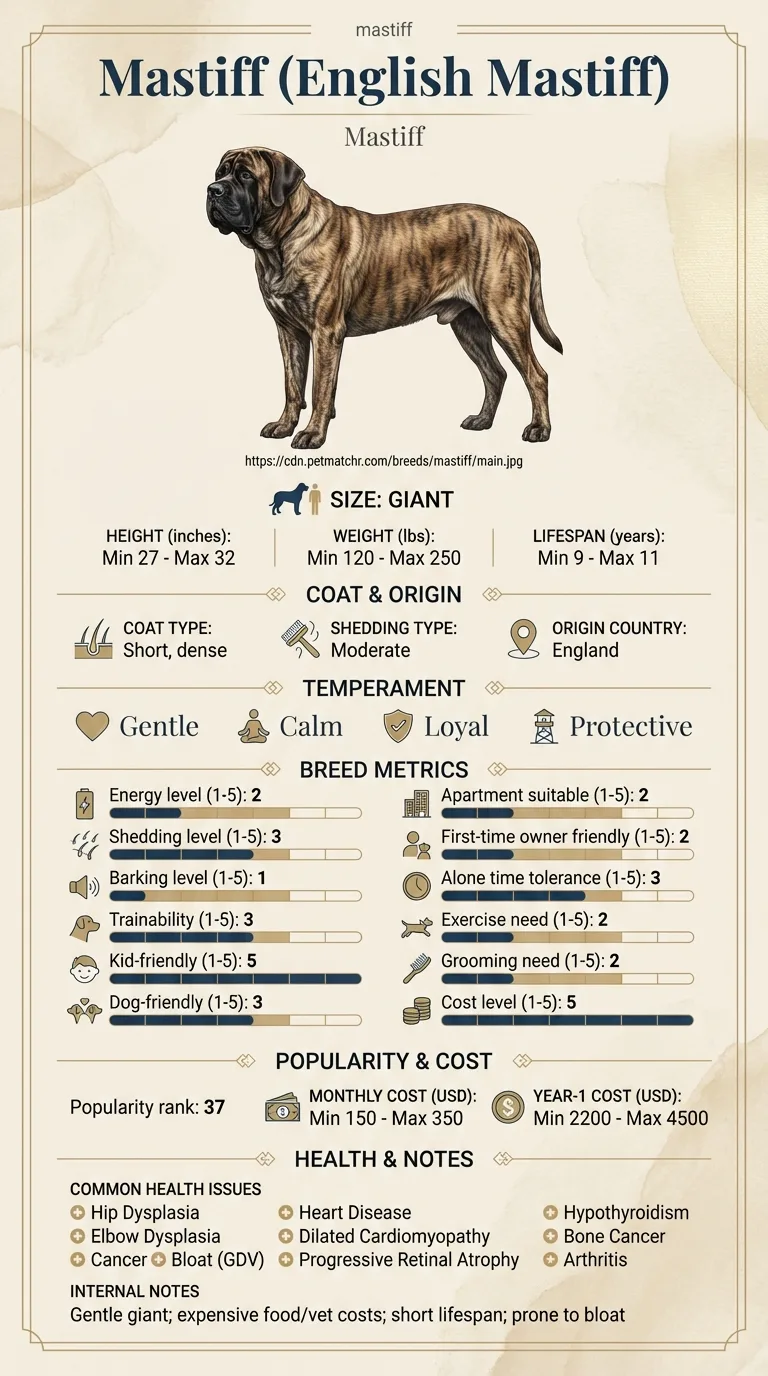
The comparison applies across the whole dog population rather than to Mastiffs specifically. What is documented for this breed is a substantial list of health issues including hip dysplasia, elbow dysplasia, cancer, bone cancer, bloat, heart disease, dilated cardiomyopathy, hypothyroidism, progressive retinal atrophy and arthritis. Several of those are strongly size-driven and appear in large crossbreeds too.
Closed breeding populations are the mechanism. When a limited group of dogs is bred among themselves across generations, all genetic variants present become more concentrated than in the general dog population, including harmful recessives. That is why individual breeds carry recognisable disease clusters, and why the Mastiff's documented health list looks the way it does. Layered on top is size, which is independently one of the strongest predictors of canine lifespan and disease. A Mastiff at 120 to 250 pounds living nine to eleven years is showing the effect of being enormous as much as the effect of being purebred.
How data is gathered shapes what the statistics say. Purebred dogs are registered, identifiable and often more intensively monitored, so their diagnoses are more likely to be recorded, which inflates apparent rates. Beyond the numbers, the environmental factors that genuinely move an individual dog's outcome are the same regardless of ancestry: body condition, growth-stage feeding, preventive veterinary care, whether a bloat-prone dog's owner discussed gastropexy, and whether changes were noticed early enough to act on.
Talk to your vet about which preventive measures are worth prioritising for a giant breed in your household, particularly gastropexy for bloat risk and a cardiac baseline before any elective anaesthesia. Book an appointment for any new lump, persistent lameness, unexplained weight loss, or change in appetite or stamina, since early assessment is where an individual owner genuinely changes outcomes. Seek emergency care immediately for a distended or hard abdomen with unproductive retching, collapse, laboured breathing at rest, or an inability to stand. None of these decisions depend on whether the dog is purebred.
See all Mastiff health problems, which breeds are prone to purebred vs mixed breeds, or the full Mastiff breed guide for temperament, exercise needs and ownership costs.
Choosing well is a matter of weeks to months of research, and good Mastiff breeders often have waiting lists, which is generally a positive sign. The consequences of the decision unfold across the dog's whole nine-to-eleven-year life, and most inherited conditions announce themselves in the second half of it. No decision made at the point of purchase removes the need for ongoing monitoring, and expectations should be set around influencing odds rather than guaranteeing outcomes.
Success is a decision made on documents rather than on slogans. You know what the parents were screened for, you understand which risks come from size rather than from pedigree, and you are not falsely reassured by a crossbreed label or falsely alarmed by a relative risk figure. Whatever dog you end up with will have its own health story, and the useful outcome is that you shifted the odds where you could and stopped trying to control what you could not.
A figure like 1.9 times is a relative risk: it compares the rate in one group to the rate in another. It does not tell you the underlying rate in either. A condition affecting a small proportion of dogs, doubled, still affects a small proportion.
Several things complicate the comparison further. Purebred dogs are identifiable, registered and often more closely monitored, so their diagnoses are more likely to be recorded. Breeds differ enormously from one another, and lumping every purebred together averages a Chihuahua with a Great Dane, which conceals more than it reveals. Lifespan matters too: cancer is largely a disease of older age, and breeds vary hugely in how long they live and therefore in how long they are exposed to that risk.
The underlying biology is real, though. Closed breeding populations concentrate genetic variants, both helpful and harmful, which is why individual breeds carry recognisable clusters of disease. That is exactly why a Mastiff has a documented health list including hip dysplasia, elbow dysplasia, cancer, bone cancer, bloat, heart disease, dilated cardiomyopathy, hypothyroidism, progressive retinal atrophy and arthritis. Crossbreeding widens the gene pool and reduces the odds of inheriting two copies of a recessive fault.
What crossbreeding does not do is guarantee health. A cross between two breeds that both carry hip dysplasia inherits risk from both sides, and mixed-breed dogs get cancer, joint disease and heart failure in large numbers.
Almost everything that shifts risk for a specific dog operates below the level of purebred versus mixed.

After losing a Mastiff to bone cancer at eight, Rhona was determined that her next dog would be a crossbreed. She had read the statistic about purebred cancer risk and did not want to go through it again. She found a litter advertised as a Mastiff crossed with another giant breed, described as combining the best of both with hybrid vigour. There were no health certificates for either parent. When she asked, she was told the parents were both fine and that crossbreeds do not get those problems. Rhona walked away, largely because of that last sentence. Both parent breeds carry documented hip dysplasia, and crossing them does not remove a risk they share. She eventually bought a purebred Mastiff puppy from a breeder with hip, elbow and cardiac certificates on both parents and an honest account of a hip problem in an earlier litter. Her dog is now six, lean, and sound. Rhona is clear that this is not proof of anything. It was the better-documented decision, not a guaranteed one.
Key takeaway: The crossbreed label is not a health test, and the purebred label is not a diagnosis. A cross between two breeds that share a risk inherits it from both sides, and the only thing that distinguished the two options Rhona was offered was whether anyone could show her the paperwork.
As a population, purebred dogs show higher rates of some inherited conditions, and cancer figures of around 1.9 times are quoted. But most of a Mastiff's health profile is driven by being enormous rather than by being purebred, and a large crossbreed of similar size carries much of the same joint, cardiac and lifespan burden.
Possibly, and possibly not. It depends entirely on what it is crossed with and on the health of both parents. Crossing with another giant breed that shares hip dysplasia and bloat risk changes little. The advantage of crossbreeding lies in reducing the chance of inheriting two copies of the same recessive fault, not in cancelling shared risks.
Closed populations concentrate variants, and where a variant contributing to cancer risk exists in a breed, it becomes more common within it than in the wider dog population. Cancer and bone cancer both appear on the Mastiff's documented health list, which is consistent with that pattern. Body size is also independently associated with certain cancers.
The concept is real but is often overstated in dog marketing. It reduces the expression of recessive faults; it does not confer general robustness. A crossbreed's expected lifespan is influenced heavily by its size, and a two-hundred-pound crossbreed will not live like a terrier.
No, the opposite. Testing is the part you can influence. It removes specific known risks from a specific mating, and it produces documentation you can verify. Luck operates on top of that, but starting from a screened line rather than an unscreened one shifts the odds in the direction you want.
Ask for dated health certificates on both parents relevant to the breed, ask about siblings and previous litters, ask whether any dog in the line died young or unexpectedly, and ask about growth-stage feeding. Those questions tell you more about your future dog than any statistic comparing purebreds to crossbreeds.
It is a relative risk comparing purebred to non-purebred populations. It does not give the underlying rate, and it cannot be applied to an individual dog.
No. Crossing reduces the chance of inheriting two copies of one recessive fault, but shared risks between the parent breeds carry straight through.
Size. Giant breeds carry more joint and cardiac disease and live shorter lives regardless of pedigree, which is why this breed lives nine to eleven years.
The documented health screening of its specific line, its body condition through life, and preventive decisions such as gastropexy and cardiac assessment.
For dated health certificates on both parents, about outcomes in siblings and previous litters, about any young or unexpected deaths, and about growth-stage feeding.
A one-page prep sheet for this condition: the signs, the questions to ask, what to get priced. Unlocks here.
You get: Vet visit prep sheet
No spam. One-click unsubscribe. See our privacy policy.
Preview page 1 before you decide.