Health
What causes a limp in a Mastiff puppy?
Most often panosteitis, a self-limiting inflammation of the long bones causing lameness that shifts between legs. It still needs a veterinary examination.

Quick answer
What causes a limp in a Mastiff puppy?
Most often panosteitis, a self-limiting inflammation of the long bones causing lameness that shifts between legs. It still needs a veterinary examination.
Every instinct says a giant puppy needs generous food and plenty of exercise. Both instincts, followed enthusiastically, produce lame dogs.
New owners of a Mastiff puppy who have been handed conflicting feeding advice, and owners of a four to twelve month old dog that has developed a limp which moves from leg to leg and cannot be explained by an injury.
This guide is not medical advice. If your dog shows pain, sudden behavior change, or worsening symptoms, consult a licensed veterinarian.
Some links may be affiliate links. We may earn a commission at no extra cost to you. We only suggest products we believe are helpful for dog owners.
We research and check what we publish, but we do not warrant that any figure, date, price, or statement is accurate, complete, or current, and we accept no liability for any loss, cost, injury, or other harm arising from the use of this site. Use it as one reference among several. You remain responsible for your own decisions and for your dog's care - confirm anything that matters with a licensed veterinarian or another qualified professional before you act on it. Full disclaimer.
Growth-related orthopaedic disease covers a group of conditions affecting the developing skeleton of a large or giant breed puppy: inflammation inside the long bones, disturbance of the growth plates, and failure of joint cartilage to mature into bone correctly. They produce lameness, pain and sometimes systemic illness in dogs between roughly three and fourteen months, and some leave permanent joint damage while others resolve completely.
Growth problems are recognised as a giant breed issue rather than a rare curiosity, and panosteitis in particular is common enough that many Mastiff owners will meet it. The more serious cartilage conditions are less frequent but far more consequential, because they can leave a joint permanently abnormal in a dog that then has nine to eleven years to wear that joint out.
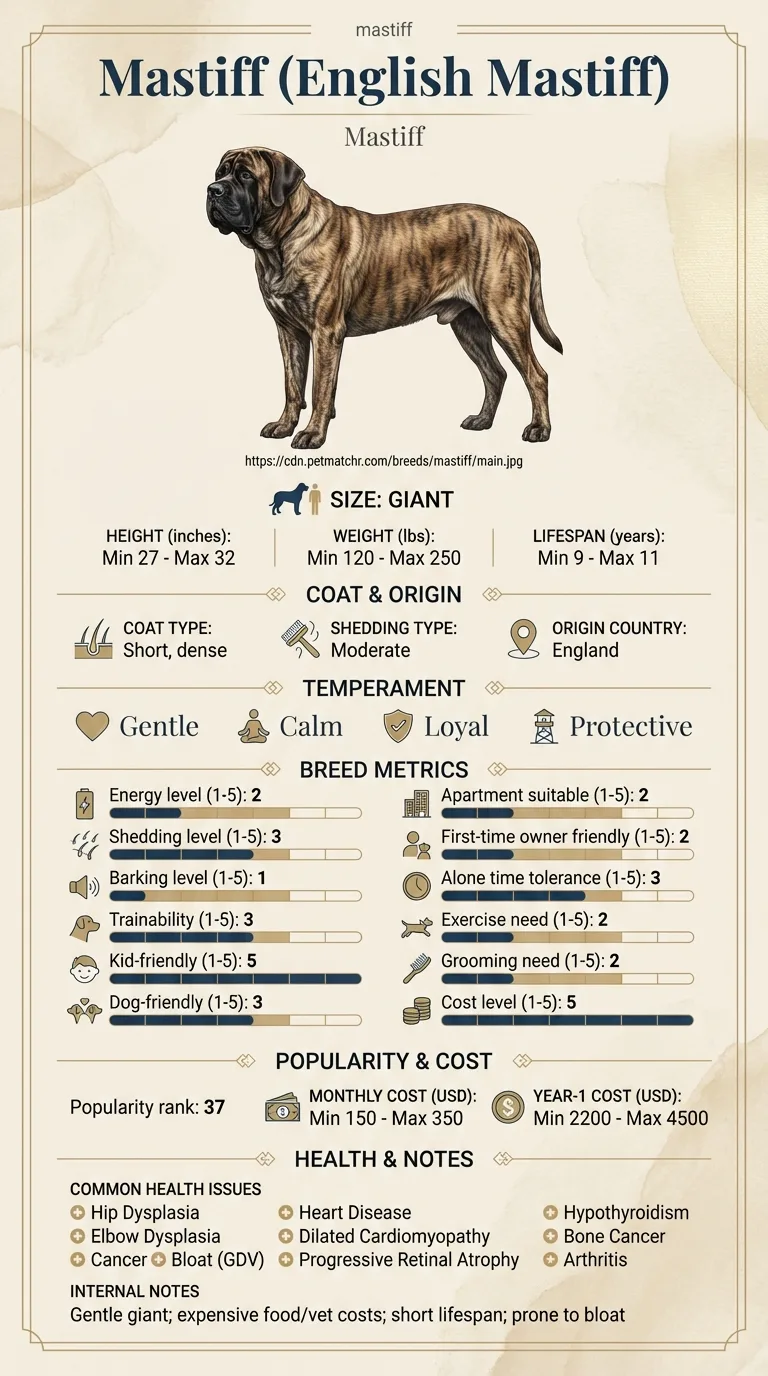
The mechanism is rate of growth against maturity of tissue. A Mastiff multiplies its birth weight more than a hundredfold, and reaches a shoulder height of 27 to 32 inches, in the same eighteen months that a terrier uses to grow into a fifteen pound adult. Cartilage converts into bone on a biological timetable that does not accelerate to match, so the faster the body mass climbs, the more load immature cartilage carries. Giant breeds also have late-closing growth plates, extending the vulnerable window well past a year.
Almost everything modifiable here is a household decision. Diet composition and quantity set the growth rate directly. Supplements added with good intentions distort mineral balance. Exercise type and surface determine repetitive loading. Slippery floors cause splayed limbs in a heavy, clumsy puppy. And a family that lets a giant puppy climb and descend stairs freely for a year is delivering thousands of high-impact repetitions through joints that are still forming.
Book an appointment for any lameness in a growing Mastiff that lasts more than a day or two, for a puppy that seems sore when picked up, or for legs that look bowed or uneven. Seek same-day or emergency attention if a young puppy has hot, painfully swollen areas just above the wrists or ankles, a high temperature, refuses to stand, or has stopped eating and become lethargic, since that combination can indicate hypertrophic osteodystrophy, which can be severe. Never give human painkillers, which are toxic to dogs, and do not attempt to work a limping puppy through it with exercise.
This is the single most useful thing an owner of a Mastiff puppy can understand, and it runs against every instinct.
A giant breed puppy grows to its adult size regardless of how generously it is fed. What extra calories change is the speed. Feeding for maximum growth produces a skeleton being built faster than the cartilage can safely mature, and immature cartilage under the load of a rapidly increasing body weight is where osteochondrosis and joint abnormalities come from. Slower growth to the same eventual size gives better joints, and this is one of the few genuinely well-established principles in canine nutrition.
Calcium works the same way and matters even more. A growing large-breed dog cannot regulate calcium absorption the way an adult can, so excess calcium in the diet is absorbed and disrupts normal bone remodelling. This is why supplementing calcium, adding bone meal, or feeding a puppy food not formulated for large breeds is actively harmful rather than merely unnecessary. A diet specifically formulated for large or giant breed growth has controlled calcium levels and appropriate energy density, and that formulation is not marketing.
Exercise follows the same logic. A growing giant should not be jogged, cycled alongside, taken on long hikes, or encouraged to jump and twist repeatedly. Free play on soft, non-slip ground, in short sessions, in the dog's own time, is what builds a skeleton. Repetitive forced exercise on hard surfaces is what damages one.
The good news inside all of this is that the most common growth condition, panosteitis, resolves on its own as the dog matures. It hurts, it needs veterinary pain relief, and it frightens owners, but a dog that has had it does not carry it into adulthood.

See all Mastiff health problems, which breeds are prone to bone growth issues, or the full Mastiff breed guide for temperament, exercise needs and ownership costs.
Panosteitis typically comes and goes in episodes over several months and stops when growth finishes, usually by fourteen to eighteen months. Hypertrophic osteodystrophy resolves over weeks with supportive care in most cases. Cartilage conditions such as osteochondrosis may need surgery and are assessed over months. Diet and exercise decisions made in the first year determine joint health for the following decade.
Success is a lean, sound eighteen-month-old that has grown slowly to full size, has never been supplemented, has climbed few stairs, and whose hips and elbows can be screened with a reasonable expectation of good scores. The absence of drama is the whole objective. Nothing about a well-reared giant puppy looks impressive at the time.
A limping Mastiff puppy is not usually a sprain. These are the specific developmental problems that produce lameness in a growing giant.
If you think your Mastiff has bone & growth issues, the plan is three steps: write down what you have seen and when it started, book a veterinary appointment rather than waiting for the next flare, and take video of the behaviour or symptom before you go — the thing you are worried about rarely happens in the consulting room. Screening in the parents covers hip dysplasia, elbow dysplasia, cancer.
What the vet visit should produce is a diagnosis and a written plan, not just reassurance: what is being ruled out, what the monitoring interval is, and which signs mean you come back sooner. Ask what the treatment costs across a year rather than per visit, because that is the number that decides whether you are managing this condition or reacting to it.
Between appointments, keep a short log — dates, what you saw, what changed. It is the single most useful thing an owner brings to a follow-up, and for bone & growth issues it is often what separates a clear pattern from a guess.
Ludo came home at ten weeks with a feeding sheet from his breeder that recommended a standard puppy food, a calcium supplement and a joint powder, all in generous quantities. His owner Fiona followed it precisely because it came from someone with thirty years in the breed. By six months Ludo was heavy for his frame, and by seven he was limping, first on the right front, then two weeks later on the left. Radiographs showed panosteitis, which was reassuring, but the examination also raised concern about how much weight he was carrying and how quickly he had gained it. His vet moved him onto a giant breed growth diet, cut the supplements entirely, set a measured daily ration and asked Fiona to stop the long walks she had proudly built up to. Ludo's growth curve flattened, and his lameness episodes finished by thirteen months. His hip and elbow screening at two years came back well within acceptable limits. Fiona's summary was that the best thing she did for him was to do less.
Key takeaway: With a giant breed puppy the ambitious approach is the harmful one. Slow growth, a lean body, a controlled diet and modest exercise are what a Mastiff skeleton needs.
A shifting lameness in a large breed puppy between roughly five and twelve months is the classic description of panosteitis. It needs veterinary confirmation, because other conditions must be ruled out, but it is common, painful and self-limiting, and it resolves as growth finishes.
A food specifically formulated for large or giant breed growth. Standard puppy foods are more energy dense and higher in calcium than a growing Mastiff should receive, and that combination is directly linked to developmental joint disease. Discuss the specific product and quantity with your vet.
No. This is one of the clearest do-nots in giant breed rearing. A growing dog cannot down-regulate calcium absorption effectively, and excess calcium disrupts bone development. Do not supplement calcium, bone meal or vitamin D unless a vet has specifically prescribed it.
Far less than owners expect. Short, frequent, free-form play on soft ground, allowing the puppy to rest when it chooses. Avoid forced repetitive exercise, running alongside a bicycle, long walks and stairs. The old rule of a few minutes per month of age is crude but errs in the right direction for this breed.
Minimise them, particularly going down, and carry a young puppy where practical. Repeated descent puts high impact through immature shoulders and elbows. A stair gate for the first year is a cheap intervention against a lifetime of elbow trouble.
The opposite. A giant breed puppy should be kept lean enough that you can feel ribs easily under a thin covering. Excess weight during growth loads immature joints and is one of the strongest modifiable risk factors for later dysplasia.
Growth plates in a giant breed close later than in small dogs, commonly around fourteen to eighteen months, and the skeleton continues to mature beyond that. This late closure is also why the timing of neutering is a separate discussion worth having with your vet in this breed.
Most often panosteitis, a self-limiting inflammation of the long bones causing lameness that shifts between legs. It still needs a veterinary examination.
No. It makes the puppy grow faster to the same adult size, and fast growth is what damages developing joints.
No. Excess calcium disrupts bone development in large breed puppies and is a recognised cause of skeletal disease.
Short, self-paced free play on grass. No jogging, no cycling alongside, no long hikes and as few stairs as possible.
Considerably more than for a small dog, simply by volume, and it is not a place to economise. Feeding a growing Mastiff properly is one of the larger first-year expenses.
A one-page prep sheet for this condition: the signs, the questions to ask, what to get priced. Unlocks here.
You get: Vet visit prep sheet
No spam. One-click unsubscribe. See our privacy policy.
Preview page 1 before you decide.