Health
What is the very first sign of arthritis in a Mastiff?
Hesitation before standing up, and a preference for grippy surfaces over slippery ones. Limping comes much later.

Quick answer
What is the very first sign of arthritis in a Mastiff?
Hesitation before standing up, and a preference for grippy surfaces over slippery ones. Limping comes much later.
Owners usually describe the first sign as the dog getting lazy. Lazy is not a diagnosis. In a middle-aged Mastiff it is often the earliest word for pain.
Owners of Mastiffs from about four onward who have noticed the dog is slower on the second half of a walk, and owners of seniors who are already struggling with the practical problem of a large dog that cannot get up off a smooth floor without help.
This guide is not medical advice. If your dog shows pain, sudden behavior change, or worsening symptoms, consult a licensed veterinarian.
Some links may be affiliate links. We may earn a commission at no extra cost to you. We only suggest products we believe are helpful for dog owners.
We research and check what we publish, but we do not warrant that any figure, date, price, or statement is accurate, complete, or current, and we accept no liability for any loss, cost, injury, or other harm arising from the use of this site. Use it as one reference among several. You remain responsible for your own decisions and for your dog's care - confirm anything that matters with a licensed veterinarian or another qualified professional before you act on it. Full disclaimer.
Arthritis is the progressive breakdown of joint cartilage, followed by inflammation, bone remodelling and pain. In Mastiffs it most often affects hips, elbows, stifles and the lower spine, and it frequently follows on from a developmental joint problem rather than appearing out of nowhere. The lived experience is a dog that moves less, rises slowly, and gradually withdraws from things it used to do.
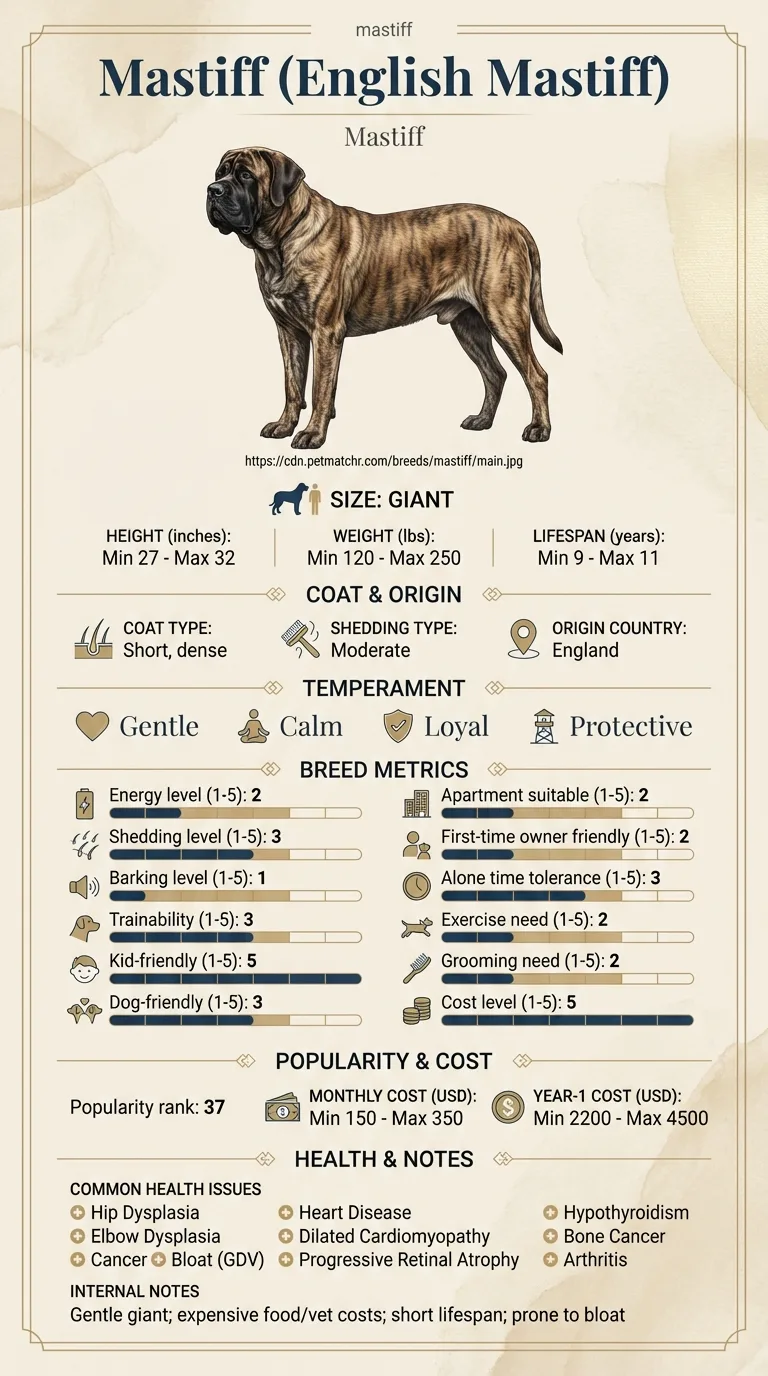
Arthritis appears on the recognised health issue list for the English Mastiff and it is close to universal in the second half of life. Given a typical lifespan of nine to eleven years, most owners should expect to be managing joints from middle age onward. What varies enormously is how early it starts and how well it is controlled, and both of those are partly within an owner's influence.
Mass is the driver. A dog standing 27 to 32 inches at the shoulder and weighing what an adult human weighs loads every joint surface far harder than a mid-sized dog does, and it does so from puppyhood, since a Mastiff reaches enormous size while its skeleton is still immature. Developmental problems documented in the breed, particularly hip and elbow dysplasia, create abnormal joint surfaces that then wear early. Add a naturally low activity level and the muscle that should stabilise those joints is often underbuilt.
Household surfaces matter more than owners expect. Modern hard floors give no traction to a heavy dog, and each slip strains the soft tissue around a joint. Stairs, car boots and high sofas add repeated high-impact loading. Cold and damp reliably worsen stiffness. And a sedentary routine, which is easy to fall into with a breed that is content to lie down all day, accelerates muscle loss and with it joint instability.
Book an appointment for any persistent stiffness, a change in willingness to walk, or a dog that has started struggling to rise, rather than waiting for a limp. Seek same-day help if your Mastiff cannot bear weight on a limb at all, if a joint is hot and swollen, if there is sudden severe pain after a fall or a slip, or if the dog cannot stand up unaided. Sudden loss of use of the back legs is an emergency and needs immediate assessment, because that is a spinal picture rather than an arthritic one. Also call if a dog on long-term pain medication stops eating, vomits, or develops black stools.
See all Mastiff health problems, which breeds are prone to arthritis, or the full Mastiff breed guide for temperament, exercise needs and ownership costs.
Environmental changes such as flooring and bedding help within days. Weight loss takes three to six months to show its full effect and is worth every week of it. Veterinary pain management is usually assessed over two to four weeks and then adjusted. Arthritis itself is progressive and permanent, so the plan is revisited every few months for the rest of the dog's life.
Success is a dog that rises without hesitation, chooses to come on the walk, sleeps through the night without shifting position constantly, and remains interested in its household. It is not a dog with a normal joint on an X-ray. Comfort, not radiographs, is the measure that counts.
Dogs distribute weight away from a sore joint long before they visibly limp, and a four-legged animal has a lot of room to compensate. These are the signs that come first.
Medical management is your vet's territory. The part owners control, and consistently underestimate, is the physical environment, and for a dog of this size it does more work than any supplement.
Flooring is the first item. Laminate, tile and polished wood offer no grip, and a Mastiff that has slipped once will hesitate on that surface for the rest of its life. Runners, rubber-backed rugs and mats laid end to end along the routes the dog actually uses will change its willingness to move more than anything else you buy.
Bed height matters next. A thick orthopaedic mattress at floor level, wide enough that the dog can stretch out rather than curl, removes a painful lever from every rising. Getting up from a deep soft sofa is far harder on sore joints than getting up from a firm surface.
Then the car. A ramp, introduced with food and patience before it is needed, prevents both the jump down that hurts and the lift that hurts your back. Nobody lifts a 200 pound dog twice.
Finally, weight. This is the single most powerful lever in canine arthritis and the least popular. Every pound removed is a pound not pressing through a damaged joint at every step, and in a breed where the healthy range spans more than a hundred pounds there is often real room to work with. A dog that has been slimmed sensibly frequently looks years younger before any other change takes effect.

Wilf was six, brindle, and had stopped coming into the kitchen. His owner Ruth read it as sulking. In fact the kitchen was tiled, Wilf had slipped there twice, and he had quietly redrawn the map of the house to exclude it. His vet examination found stiff, painful hips and a dog nearly forty pounds above where he should have been. The plan had three parts and only one of them was medical: rubber-backed runners across the tiles, a measured diet with treats counted into the daily total, and pain relief with regular monitoring. The flooring changed his behaviour within a week. The weight took five months. By the following spring Ruth's note to her vet was that Wilf had started climbing the low bank on their usual walk again, something he had not done for two years.
Key takeaway: In a giant breed, two of the three most effective arthritis interventions cost almost nothing and involve no medicine at all: grip underfoot and a lighter dog.
Earlier than most owners expect. Where hip or elbow dysplasia is present, joint change can be visible on imaging in a young adult, and clinical stiffness often appears somewhere between four and seven. Waiting for an old dog before thinking about joints is waiting too long in this breed.
Slowing down is not a natural law, it is a symptom with causes. A Mastiff is a low-energy breed to begin with, which makes decline easy to miss, so compare against the same dog a year ago rather than against a Labrador. A clear change deserves an examination.
Evidence is mixed and effects, where present, are modest and slow. They are a reasonable addition to a plan built on weight control, controlled exercise and veterinary pain management, and a poor substitute for one. Discuss any product with your vet before adding it.
Yes, and this surprises people. Regular, moderate, low-impact movement maintains the muscle that supports the joint. What harms is the weekend pattern of nothing all week then two hours on Sunday. Short daily walks on soft ground beat occasional long ones.
Hydrotherapy is genuinely useful for arthritic giants because it builds muscle without loading the joints, and it is one of the few forms of exercise a very heavy dog can do freely. Use a supervised facility rather than a cold lake, and check with your vet first.
Panting at rest, restlessness at night, licking repeatedly at one joint, loss of appetite, a hunched posture or a change in temperament are pain signals. Dogs rarely cry out. Absence of vocalising tells you nothing.
It adds up, because most treatment is dosed by body weight and continues for years. Budgeting for ongoing medication, periodic blood monitoring, and equipment like ramps and orthopaedic bedding is realistic for the second half of a Mastiff's life.
Hesitation before standing up, and a preference for grippy surfaces over slippery ones. Limping comes much later.
Non-slip flooring along the routes the dog uses. Confidence on the floor changes how much a stiff dog is willing to move.
Yes. Weight reduction is the most effective non-medical intervention in canine arthritis, and in a breed spanning 120 to 250 pounds there is usually room to act.
No. Common human anti-inflammatories are toxic to dogs, and dosing by size does not make them safe. Pain relief must come from your vet.
No. Reduce distance and impact, keep it daily and consistent, and choose grass over pavement. Muscle loss makes arthritis worse.
A one-page prep sheet for this condition: the signs, the questions to ask, what to get priced. Unlocks here.
You get: Vet visit prep sheet
No spam. One-click unsubscribe. See our privacy policy.
Preview page 1 before you decide.