Health
What does a raised ALT mean?
That liver cells are being damaged. It indicates injury, not its cause, and a persistently raised value needs investigating rather than repeating indefinitely.

Quick answer
What does a raised ALT mean?
That liver cells are being damaged. It indicates injury, not its cause, and a persistently raised value needs investigating rather than repeating indefinitely.
Most dogs diagnosed with chronic hepatitis were not brought in because they seemed ill. They were brought in for something else, and a routine blood panel came back with liver values that did not fit.
Owners handed a blood result showing raised liver enzymes in an apparently healthy dog and asked to decide about further investigation, and owners of Mastiffs on long-term medication for another condition whose monitoring bloods have started drifting.
This guide is not medical advice. If your dog shows pain, sudden behavior change, or worsening symptoms, consult a licensed veterinarian.
Some links may be affiliate links. We may earn a commission at no extra cost to you. We only suggest products we believe are helpful for dog owners.
We research and check what we publish, but we do not warrant that any figure, date, price, or statement is accurate, complete, or current, and we accept no liability for any loss, cost, injury, or other harm arising from the use of this site. Use it as one reference among several. You remain responsible for your own decisions and for your dog's care - confirm anything that matters with a licensed veterinarian or another qualified professional before you act on it. Full disclaimer.
Chronic active hepatitis is ongoing inflammation and destruction within the liver, continuing over months or years. As liver cells are lost they are replaced by scar tissue, and function declines only once a large proportion has gone. The typical route to diagnosis is a blood test taken for another reason, followed by repeat testing, imaging and ultimately a biopsy to establish which of several very different causes is responsible.
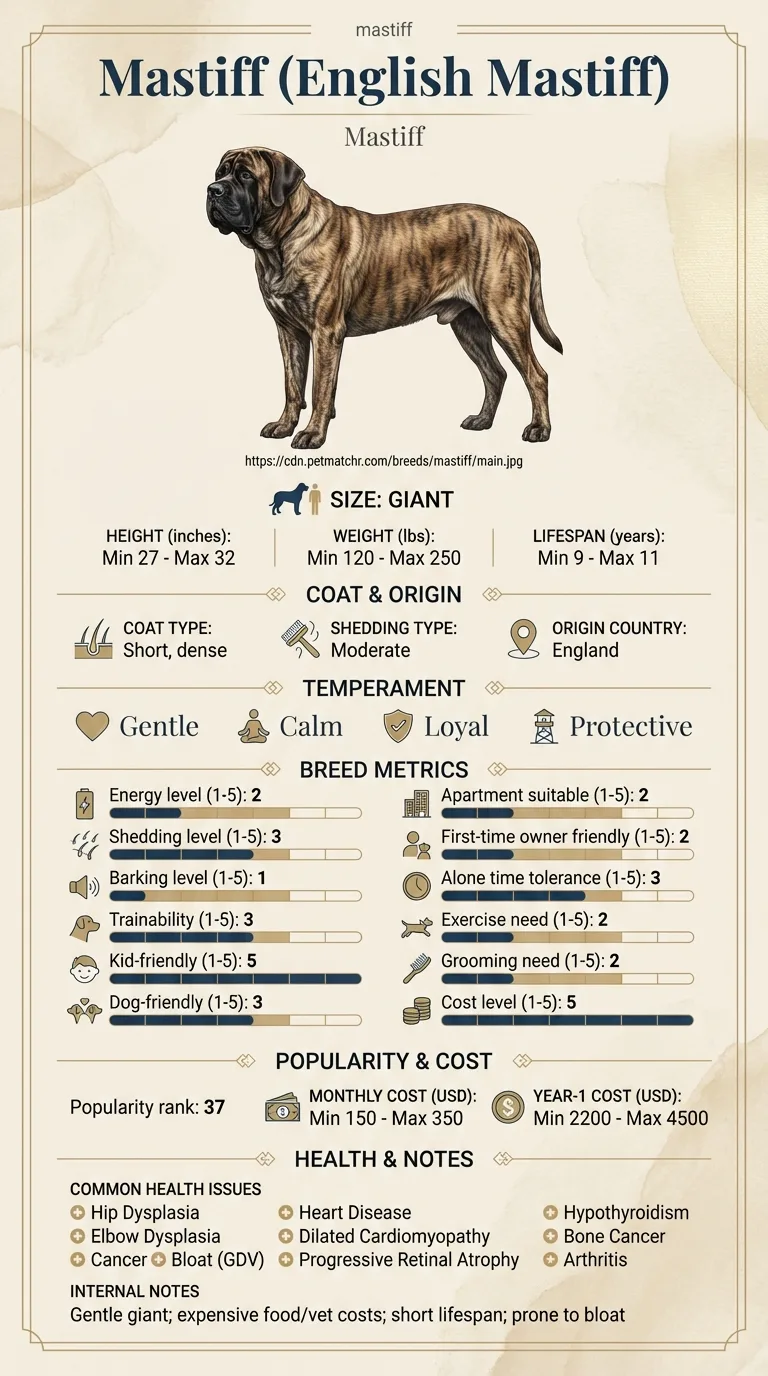
Chronic hepatitis is a recognised canine disease but is not among the documented health issues of the English Mastiff, and it is most strongly linked with other breeds. Its relevance here is practical rather than genetic: Mastiffs frequently end up on long-term medication for joint and cardiac disease, those medicines require liver monitoring, and a proportion of owners will therefore be handed an abnormal liver panel at some point.
There is no established Mastiff predisposition to chronic hepatitis and it would be misleading to suggest one. What the breed does contribute is context. A dog weighing 120 to 250 pounds receives large absolute doses of any medication, and the liver processes those doses. A breed with documented arthritis and heart disease is a breed likely to be on long-term drugs from middle age. And with a lifespan of only nine to eleven years, the window for a slow disease to declare itself before other problems intervene is short.
Household exposures matter more here than in most conditions. Certain plants, mouldy food from bins or compost heaps, and some household and garden chemicals are hepatotoxic, and a dog with the reach and appetite of a Mastiff can access things a smaller dog cannot. Copper content of the diet and of drinking water is relevant in copper-associated disease. Beyond that, whether monitoring bloods are actually taken on schedule is a purely human variable that determines how early disease is caught.
Book promptly for persistently raised liver enzymes, unexplained weight loss, a drop in appetite lasting more than a couple of days, or increased thirst and urination. Go immediately, as an emergency, if the gums, the whites of the eyes or the skin inside the ears look yellow, if the abdomen swells rapidly, if there is vomiting with blood or black tarry stools, if the dog becomes disorientated, circles, presses its head against a wall or has a seizure, or if it collapses. Those signs indicate advanced liver failure or bleeding and are time-critical. Never give any human medication to a dog with suspected liver disease.
See all Mastiff health problems, which breeds are prone to chronic active hepatitis, or the full Mastiff breed guide for temperament, exercise needs and ownership costs.
From a first abnormal result to a definitive diagnosis usually takes four to eight weeks, allowing for repeat bloods, imaging and biopsy with laboratory turnaround. Response to correct treatment is assessed over two to three months with repeat bloodwork. Chronic hepatitis is generally managed for the rest of the dog's life, with monitoring every three to six months once stable.
Success is enzyme values that fall and then stay steady, stable weight and appetite, and a dog that behaves entirely normally. It is not usually a normal liver. Where fibrosis has already developed, holding the disease still and preventing complications for years is a genuinely good outcome, and dogs treated before extensive scarring do considerably better than those found late.
A raised liver enzyme is a signal, not a diagnosis. The panel answers several different questions and it is worth knowing which is which.
Blood tests and ultrasound between them can tell you that the liver is inflamed, roughly how badly its function is affected, and whether there is an obvious structural problem. They cannot tell you what kind of inflammation it is, and that is the question treatment depends on.
Chronic hepatitis has several causes with genuinely different management. Copper accumulation is a well-recognised one in dogs, and it is treated with copper-restricted diets and specific medication. Immune-mediated inflammation is treated with immunosuppression. Infection, drug reactions and toxin exposure each have their own approach. Treating a copper-storage liver with immunosuppressants, or vice versa, wastes months in a disease that does not pause.
Biopsy answers this. It requires sedation or anaesthesia, which in a giant breed means a proper plan, and clotting function is checked beforehand because a compromised liver may not clot normally. Samples are usually taken either with a needle guided by ultrasound or via keyhole surgery, and copper content is measured directly on the sample where indicated.
Many owners understandably hesitate at biopsy in a dog that seems perfectly well. The honest framing is that the alternative is treating blind, and that the earlier the specific cause is identified the more liver there is left to save. Liver tissue can regenerate, but scarred tissue cannot, and once cirrhosis is established the disease becomes management of complications rather than treatment of a cause.
A practical note for this breed: several conditions Mastiffs commonly receive long-term medication for, including joint disease and cardiac disease, involve drugs that require liver monitoring. If your dog's enzymes have risen after starting a new medication, tell the prescribing vet before assuming a primary liver disease, because the answer may be a dose review rather than a biopsy.

Priyanka's Mastiff Tobias had a blood panel taken before a dental at seven. The dental went ahead, and the panel came back with a moderately raised ALT which her vet flagged and asked to repeat in a month. Tobias was bright, eating well and behaving exactly as usual, and Priyanka very nearly did not go back. The repeat was higher. So was the one after that. Bile acids showed function was already mildly reduced, and an ultrasound found a liver with an abnormal texture but no mass. The biopsy that followed identified copper accumulation, which meant a specific diet and specific medication rather than the immunosuppressants that would have been the guess. Tobias responded within three months and his enzymes have been stable for two years. Her vet's remark afterwards was that the dogs who do well are almost always the ones whose owners came back for the boring repeat test on a dog that seemed perfectly healthy.
Key takeaway: The liver conceals damage until very late. A mildly abnormal blood result in a well dog is worth following up precisely because nothing appears to be wrong.
It can matter a great deal, because the liver hides disease well. A single mildly raised value in a well dog is often repeated in a few weeks before anything else is done. Persistently raised enzymes over successive samples, however, warrant proper investigation rather than continued observation.
They appear late and are non-specific: reduced appetite, weight loss, vomiting, increased thirst and urination, lethargy. Later signs are more distinctive and more serious, including yellowing of the gums, eyes or skin, a swollen fluid-filled abdomen, and disorientation or seizures.
It is not among the documented health issues for this breed, which centre on joints, heart, eyes, cancer, bloat and thyroid. Chronic hepatitis is more strongly associated with breeds such as the Doberman, Bedlington Terrier, Labrador and Cocker Spaniel. It appears here because raised liver values are a common incidental finding in any dog on long-term medication.
Diet is an important part of management in several forms, particularly copper-associated disease, where a copper-restricted diet is central. It is not something to improvise. Liver diets are formulated to specific protein, copper and mineral profiles and should be chosen with your vet rather than from a shelf.
Some are used routinely by vets as supportive treatment alongside a specific plan. None of them substitutes for identifying the cause. Buying supplements instead of pursuing a diagnosis is the pattern that wastes the time when the disease is still treatable.
Functioning liver tissue can regenerate, which is why early diagnosis matters so much. Scar tissue cannot. A dog treated before extensive fibrosis develops can do very well for years. Once cirrhosis is established, the focus shifts to managing complications rather than reversing the disease.
Often yes. The liver processes most drugs, so doses may need adjusting and some medicines avoided. Make sure every vet who treats your dog knows about the diagnosis, and check before starting anything new, including over-the-counter supplements and parasite products.
That liver cells are being damaged. It indicates injury, not its cause, and a persistently raised value needs investigating rather than repeating indefinitely.
Because the different causes of chronic hepatitis need opposite treatments, and only tissue can distinguish copper accumulation from immune-mediated inflammation.
Yellow gums or eyes, a rapidly swelling abdomen, disorientation, collapse or seizures all need immediate veterinary attention.
No. Liver diets are precisely formulated and the right one depends on the cause. Choose it with your vet.
Bloods, bile acid testing, ultrasound and biopsy together represent a significant workup, and the anaesthetic component is higher in a giant breed.
A one-page prep sheet for this condition: the signs, the questions to ask, what to get priced. Unlocks here.
You get: Vet visit prep sheet
No spam. One-click unsubscribe. See our privacy policy.
Preview page 1 before you decide.