DogBreedCompass

Malamute or English Mastiff: Two Hours a Day or Two Hundred Pounds

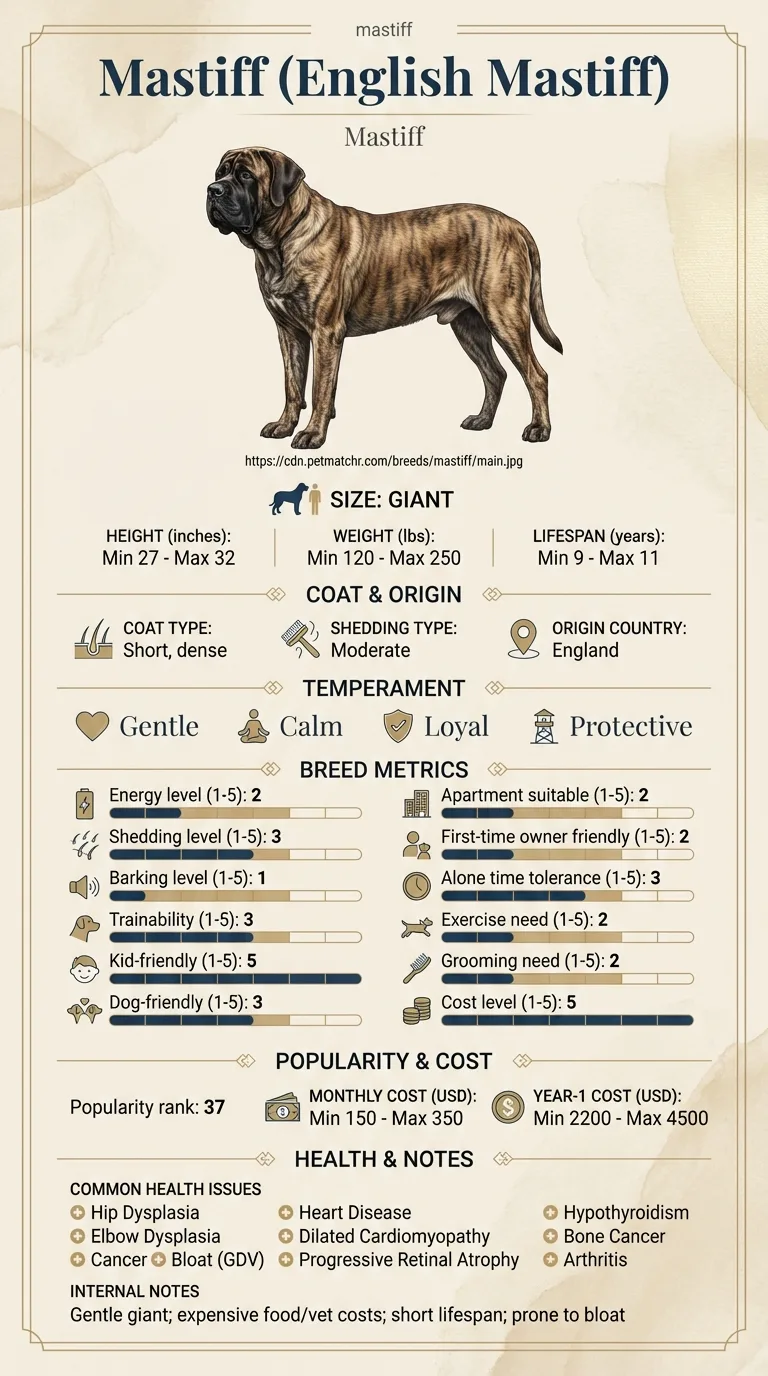
The English Mastiff is the heaviest breed on this site at up to 250 pounds, and it rates 2/5 for exercise and 1/5 for barking. The Malamute is less than half its weight and needs five times the activity.

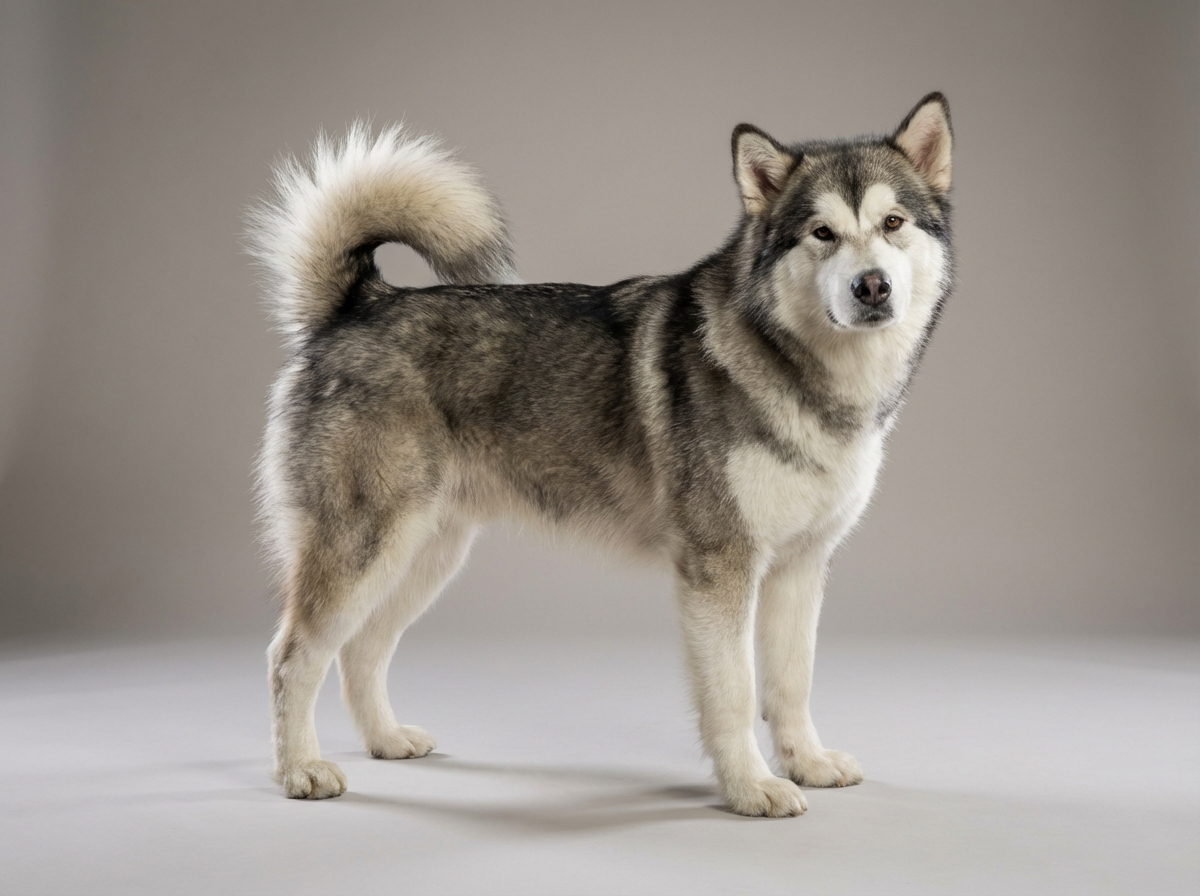
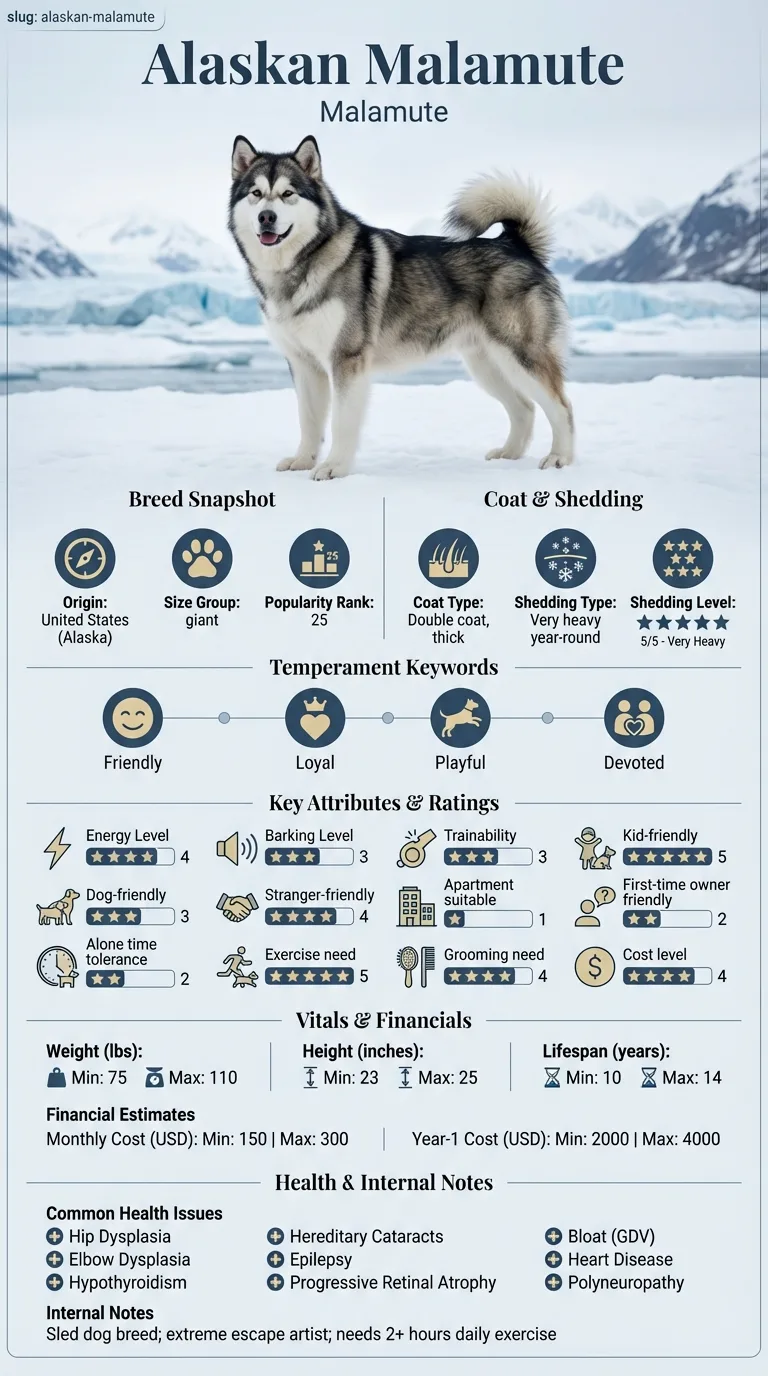
alaskan malamute infographic
mastiff infographic

This page is for someone who wants a genuinely enormous dog and is deciding between mass and motion — whether the giant in the house should be a sedentary presence or an athlete with a schedule.

Quick verdict

The Mastiff asks for far less of your day and far more of your budget, floor space and emotional tolerance for a short life; the Malamute is cheaper, longer-lived and demands two hours every single day.

Choose alaskan malamute if...

Choose the Alaskan Malamute if you want an active outdoor life with a large dog, you have cold weather and a secure garden, and three or four extra years and a lower food bill matter more than an easy daily routine.

Choose mastiff if...

Choose the English Mastiff if you want overwhelming presence with a calm 2/5 exercise requirement and near-silence at 1/5 barking, you have the space and the budget, and you can accept 9 to 11 years.

Head-to-head comparison

Featurealaskan malamutemastiffWinner
Weight75–110 lbs120–250 lbsalaskan malamute
Height23–25 in27–32 inalaskan malamute
Lifespan10–14 years9–11 yearsalaskan malamute
CoatThick double coatShort, densemastiff
Grooming need4/52/5mastiff
Shedding5/5 — very heavy year-round3/5 — moderatemastiff
Energy level4/52/5mastiff
Exercise need5/52/5mastiff
Trainability3/53/5Equal
Barking3/51/5mastiff
Good with kids5/55/5Equal
Good with other dogs3/53/5Equal
Friendly to strangers4/53/5alaskan malamute
Apartment suitability1/52/5mastiff
Good for first-time owners2/52/5Equal
Tolerates being alone2/53/5mastiff
Typical monthly cost$150–300$150–350alaskan malamute
Typical first-year cost$2,000–4,000$2,200–4,500alaskan malamute

Deep dive

2/5 against 5/5: the quietest giant and the busiest one

The Mastiff rates 2/5 for both exercise and energy, which are among the lowest scores any large dog carries on this site. That is not laziness — it is what the breed was selected for. A guardian's job is to be present, to be still, and to react only when something requires reacting to. Motion was never part of the specification.

An adult Mastiff is comfortable with two moderate walks a day totalling perhaps forty-five minutes, and spends most of the remaining twenty-three hours lying down somewhere inconvenient. Owners describe having to step over the dog rather than walk around it. That low requirement is genuinely the breed's main practical advantage, and it is why Mastiffs suit people who want an enormous dog without an enormous routine.

The Malamute's 5/5 is at the other end. Two hours minimum, with resistance — a loaded pack, a pulling harness, a rig, deep snow, steep ground. Flat walking does not spend it. There is no indoor version, no rainy-day substitute and no week off.

There is one significant caveat on the Mastiff side. Puppies grow from a few pounds to well over a hundred in eighteen months, and that growth window is fragile in exactly the way the breed's bone and joint problems suggest. Forced exercise, long walks, stairs and repeated jumping before around eighteen months are avoidable risks. A Mastiff puppy needs less exercise than its owner expects, not more, and the temptation to build muscle early is the wrong instinct entirely.

So the daily picture inverts what people assume about size: the smaller dog owns your mornings and the larger one owns the hallway.

Barking 1/5 against 3/5, and two very different kinds of deterrence

The Mastiff's 1/5 barking rating is the lowest on this site. It is a near-silent dog by default, and the silence is functional rather than incidental.

A breed described as gentle, calm, loyal and protective does its deterring by existing. A 200 pound dog standing up and walking to the door ends most situations without a sound being made. When a Mastiff does bark it is rare, deep and genuinely alarming — but it is a considered response rather than a reflex, and that is the difference between a guardian and an alarm dog. At 3/5 with strangers the Mastiff is measured rather than hostile: it watches, it positions itself, it does not usually approach.

The Malamute is the opposite proposition. At 4/5 with strangers it is indiscriminately friendly and will greet a burglar as warmly as a friend. Its 3/5 barking rating understates the noise question, because Malamutes howl and hold conversations in a range of woos and grumbles that carry considerably further than a bark does. In a terraced house the Mastiff is the better neighbour by a wide margin.

The liability side is worth stating plainly. A protective breed at 200 pounds is a serious responsibility even when its temperament is excellent — and Mastiff temperament is generally excellent. Socialisation through the first two years matters more here than in almost any other breed, because an under-socialised guardian of this size has no safe failure mode. Check homeowners insurance before committing; some policies name Mastiff-type breeds.

Neither dog should be bought as security. One will not do it and the other should not need to.

Two hundred and fifty pounds: the practical realities

The Mastiff's weight range tops out at 250 pounds, which is more than most adults, and that number reshapes ordinary tasks.

Lifting is the first. A Mastiff that cannot walk — after surgery, in old age, after a fall on a wet floor — needs two people and often a sling. Getting one into a car requires a ramp and a plan. Vets will need help lifting it onto a table, and some practices are not physically set up for the breed at all, so it is worth asking before you need to.

Drool is the second, and it is the thing owners mention most. A loose-lipped breed produces it constantly and distributes it by shaking the head, which sends it up walls and across ceilings. Mastiff households keep towels in every room and consider it normal. The Malamute is a dry-mouthed breed and produces essentially none.

Space is the third. A dog 32 inches at the shoulder and six feet long from nose to tail changes a room. The 2/5 apartment rating is generous and assumes a large flat with a lift; stairs are a real problem for both giants, though for different reasons — joints in the Mastiff's case, and in the Malamute's simply because it will not use them quietly.

Heat affects both, again for different reasons. The Malamute is limited by an Arctic double coat. The Mastiff is limited by mass and a heavy head: large dogs shed heat poorly, and Mastiffs overheat quickly in warm weather even with a short coat. Both breeds need summer exercise moved to the cool ends of the day, which is one of the few places where their routines actually agree.

Cost level 5/5 against 4/5, and where the difference lands

The monthly ranges look close — $150–350 for the Mastiff against $150–300 for the Malamute — but the Mastiff sits at cost level 5/5 and reaches $4,500 in the first year against $4,000, and the real gap is wider than the numbers suggest because the Mastiff's ceiling is where most owners actually land.

Food is the visible part. Feeding a 200 pound dog on a quality diet is a serious monthly line, and giant-breed puppies need controlled calcium and calorie density in the first eighteen months, which narrows the options and raises the price.

The invisible part is weight-based pricing across everything medical. Anaesthesia, sedation, antibiotics, pain relief and parasite prevention are all dosed by kilogram, and a Mastiff can be more than twice a Malamute. A routine dental, a lump removal, a course of anti-inflammatories — each costs proportionally more, every time. Insurance premiums for Mastiff-type breeds are among the highest available, reflecting the cancer, cardiac and orthopaedic entries on the breed's list.

Equipment steps up a tier too: beds, crates, ramps, harnesses, and boarding fees where kennels accept giants at all.

The Malamute's only cost the Mastiff does not carry is grooming — 4/5 against 2/5, and 5/5 shedding against 3/5, meaning an undercoat rake two or three times a week and two heavy annual blows. That is time rather than money if you do it yourself.

Lifespan is the last cost nobody puts in a spreadsheet. The Mastiff's 9 to 11 years against the Malamute's 10 to 14 means a shorter return on everything above, and giant-breed medicine tends to concentrate its expense in the final two years.

Health lists, bloat and the giant-breed pattern

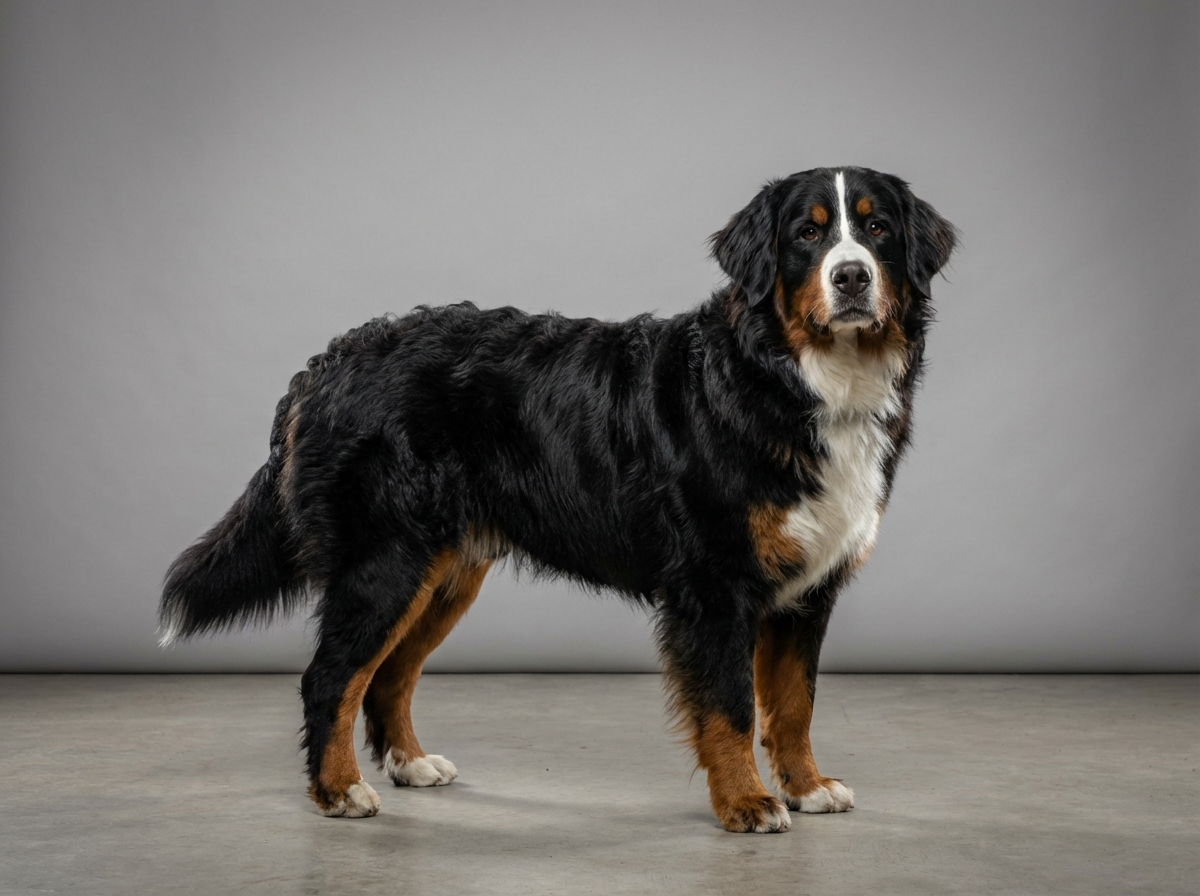
Hip dysplasia, elbow dysplasia, bloat, hypothyroidism and progressive retinal atrophy appear on both breeds' lists, which makes the breeder conversation similar: hip and elbow scores on both parents, eye certification, and honesty about longevity in the line.

Bloat deserves emphasis for the Mastiff, whose own notes flag it directly. A deep-chested giant is at meaningful risk, the presentation is a restless dog with a distending abdomen trying repeatedly to vomit without producing anything, and the window is measured in hours. Split meals, quiet time either side of eating, a slow-feeder bowl for a fast eater, and a known route to an out-of-hours clinic are the practical measures. Prophylactic gastropexy is a conversation worth having with a vet for any giant breed.

The Mastiff's list then diverges into the giant-breed pattern: cancer and bone cancer, heart disease and dilated cardiomyopathy, and arthritis. Osteosarcoma is the entry that shortens most giant-breed lives, and it usually presents as a persistent limp in a middle-aged dog rather than as anything dramatic — a limp that does not resolve in a giant breed is an X-ray, not a wait.

The Malamute's list adds zinc-responsive dermatosis, inherited polyneuropathy, hereditary cataracts and epilepsy. Its orthopaedic risks are real but its cancer burden is not comparable, which is most of why it lives longer.

One shared practical point: both breeds benefit enormously from staying lean. Excess weight on a giant frame accelerates every joint problem on either list, and it is the single variable an owner fully controls.

Alaskan Malamute vs Mastiff (English Mastiff) at a glance

The English Mastiff is the heaviest breed on this site at up to 250 pounds, and it rates only 2/5 for exercise and 1/5 for barking — a genuinely quiet, low-activity giant. The Malamute is less than half its weight and needs roughly five times the daily activity.

The Mastiff asks far less of your day and far more of everything else: your budget, your floor space, and your emotional tolerance for a short life. The Malamute is cheaper to run, needs a securely fenced garden and two hours of exercise every single day, and lives three to four years longer in exchange.

Choose the Malamute if you want an active outdoor life with a large dog, cold weather, and a secure garden, and extra years and a lower food bill matter more than an easy daily routine. Choose the Mastiff if you want overwhelming presence with a calm exercise requirement and near-silence, you have the space and budget, and you can accept a shorter life.

Frequently asked questions

Which giant needs less exercise?

The English Mastiff, at 2/5 against the Malamute's 5/5 despite being up to twice the weight. Two moderate walks totalling around forty-five minutes suits an adult. The Malamute needs two hours daily with physical resistance.

Which is quieter?

The Mastiff, decisively — 1/5 for barking, the lowest rating here. The Malamute rates 3/5 but howls, and a howl carries much further than a bark. In a terrace or a semi the Mastiff is the better neighbour.

Do Mastiffs really drool that much?

Yes. A loose-lipped breed produces drool constantly and spreads it by shaking its head, which puts it on walls and ceilings. Owners keep towels in every room. The Malamute is a dry-mouthed breed by comparison.

Which is more expensive?

The Mastiff at cost level 5/5 against 4/5, $150–350 a month against $150–300, and up to $4,500 in the first year. Food, weight-based veterinary dosing, insurance and equipment all price higher at 200 pounds.

Which lives longer?

The Malamute at 10 to 14 years against 9 to 11. Extreme size shortens life, and bone cancer and cardiac disease are the entries that most often decide the end of a Mastiff's.

Is a Mastiff a good guard dog?

It deters by presence rather than by noise or action, and its temperament keywords include protective. That is a serious responsibility at 200 pounds, and it makes early socialisation more important here than in almost any other breed.

How much exercise should a Mastiff puppy get?

Less than most owners expect. Growth plates stay open until around eighteen months, and forced walking, stairs and repetitive jumping in that window are linked to the bone and joint problems on the breed's list.

Quick answers

View more answers
Living

Malamute or English Mastiff: which should I choose?

The Mastiff if you want a still, quiet, overwhelming presence with a 2/5 exercise requirement and can afford the running costs. The Malamute if you want an active outdoor dog, a lower food bill and three or four more years.

Costs

Which costs more to run?

The English Mastiff — cost level 5/5 against 4/5, $150–350 a month, and up to $4,500 in the first year against $4,000. Weight-based veterinary pricing accounts for much of it.

Health

What health problem should worry a Mastiff owner most?

Bloat in the short term and bone cancer in the long term. A limp in a middle-aged giant breed that does not resolve deserves an X-ray rather than a period of rest and hope.

Living

Which is better in a hot climate?

Neither is good. The Malamute is limited by an Arctic double coat and the Mastiff by sheer mass, which sheds heat poorly. Both need summer exercise moved to the cool ends of the day.

Related DogBreedCompass guides

  • Alaskan Malamute breed guideThe Malamute profile covers exercise load, coat raking and containment requirements.
  • English Mastiff breed guideThe Mastiff profile covers growth management, space needs and the breed's running costs.
  • common genetic disorders in MastiffsThe breed's inherited risks follow the giant-breed pattern and are worth reading as a set.
  • bloat in Alaskan MalamutesBloat appears on both lists and both dogs are deep-chested enough for it to need a plan.
  • hip dysplasia in Alaskan MalamutesHip dysplasia is the first screening question for either breeder and affects both giants.
  • Alaskan Malamute vs Great DaneBuyers weighing giant breeds usually want the other very large option side by side.

Related guides

Important reminder

Health information here is general and is not veterinary advice. Giant-breed risks and preventive options should be discussed with your own veterinarian.

Some links on this site are affiliate links. We may earn a commission if you buy through them, at no additional cost to you.

Find Your Perfect Breed

Match your lifestyle to the right dog.

Take quiz

Find your match

Not sure which breed is right for you? Take our 2-minute quiz to find out.

Take the quiz