Health
Do Mastiffs get classic dachshund-style disc rupture?
Rarely. Explosive disc extrusion is tied to chondrodystrophic build, which this long-legged breed does not have. Slow age-related protrusion is the more plausible giant-breed pattern.

Quick answer
Do Mastiffs get classic dachshund-style disc rupture?
Rarely. Explosive disc extrusion is tied to chondrodystrophic build, which this long-legged breed does not have. Slow age-related protrusion is the more plausible giant-breed pattern.
If your Mastiff has become wobbly behind, disc disease is on the list — but in this breed it is rarely at the top of it.
Owners whose Mastiff has developed an unsteady gait, weakness or back pain, and who have found advice online that was written for a completely different kind of dog.
This guide is not medical advice. If your dog shows pain, sudden behavior change, or worsening symptoms, consult a licensed veterinarian.
Some links may be affiliate links. We may earn a commission at no extra cost to you. We only suggest products we believe are helpful for dog owners.
We research and check what we publish, but we do not warrant that any figure, date, price, or statement is accurate, complete, or current, and we accept no liability for any loss, cost, injury, or other harm arising from the use of this site. Use it as one reference among several. You remain responsible for your own decisions and for your dog's care - confirm anything that matters with a licensed veterinarian or another qualified professional before you act on it. Full disclaimer.
Intervertebral disc disease means a spinal disc has degenerated and is pressing on the spinal cord. In short-legged breeds this happens suddenly and young; in a long-legged giant breed like the Mastiff it is more often a slow, age-related bulging that develops over months. Because several other giant-breed conditions produce similar signs, the diagnostic priority in a wobbly Mastiff is careful differentiation rather than assuming the disc.
Disc disease is not among the health problems documented as characteristic of Mastiffs, and the breed lacks the skeletal type that drives high-risk disc disease in dachshunds and similar dogs. Age-related disc change can occur in any dog. When a Mastiff shows spinal signs, wobbler syndrome and orthopaedic causes are statistically more likely explanations.
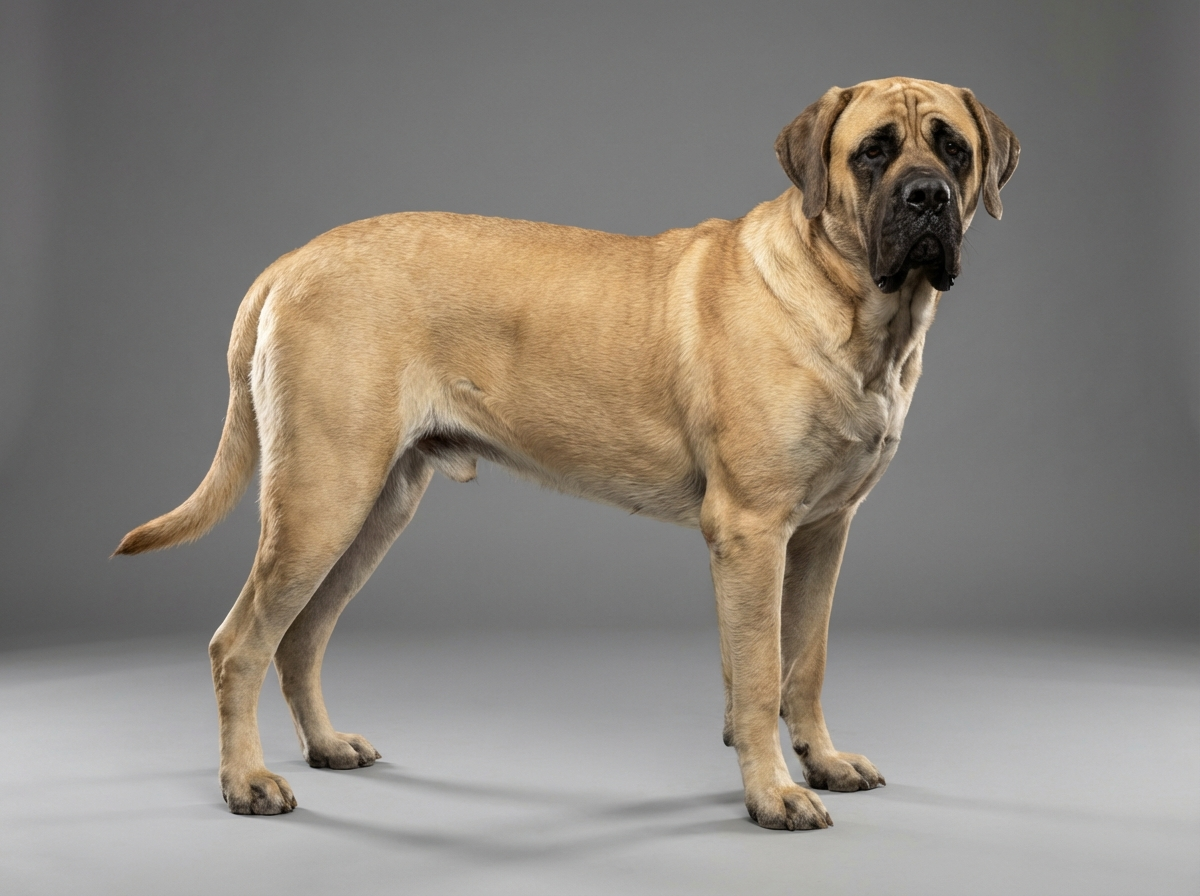
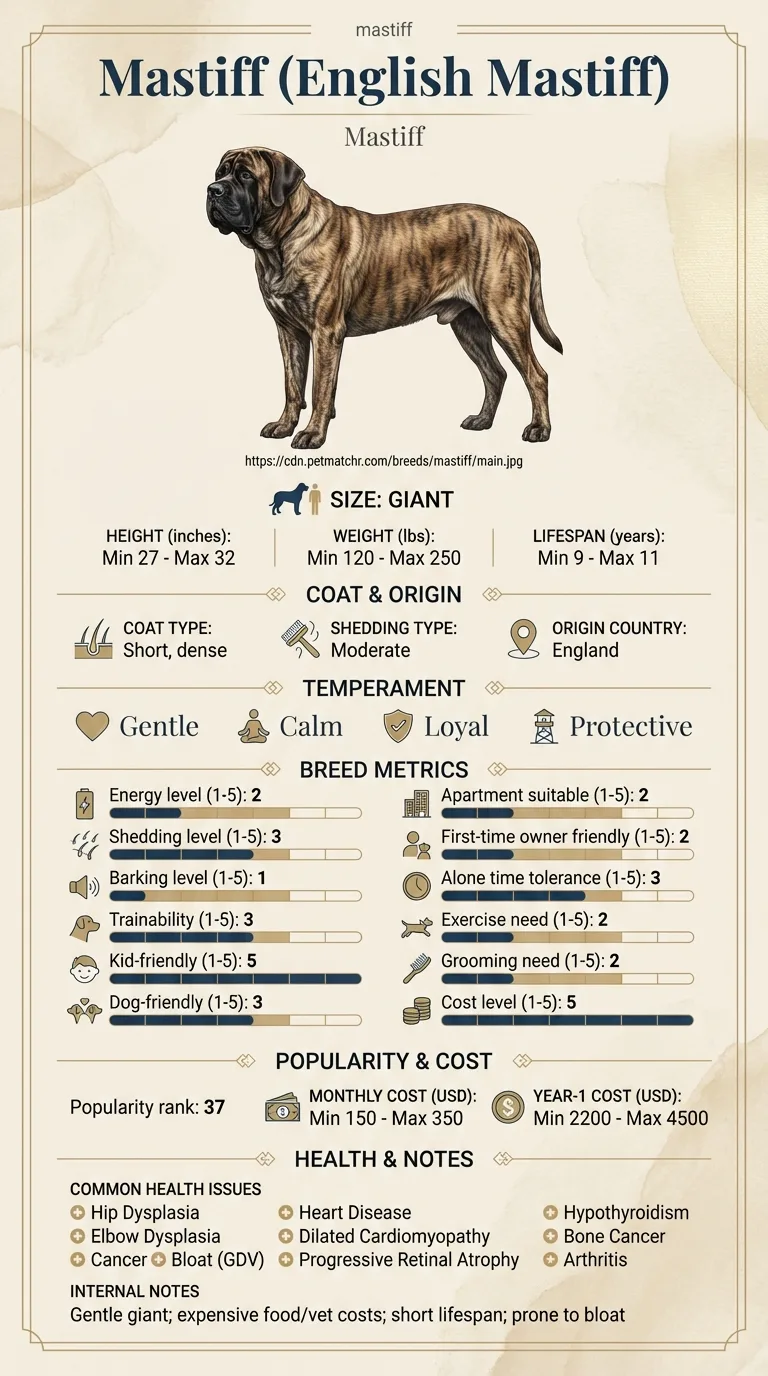
The Mastiff's skeletal type is the key point, and it works in the breed's favour here. Standing 27 to 32 inches at the shoulder with normal limb proportions, this is not a chondrodystrophic breed and does not carry the early disc calcification that makes short-legged dogs so vulnerable. What the breed does bring is mass. At 120 to 250 pounds, the compressive and shearing forces travelling through the spinal column with every step, turn and landing are far greater than in an average dog, so ordinary age-related disc wear happens under heavier load. Giant breeds also carry their own separate spinal vulnerability in the neck, which is why wobbler syndrome features so prominently in the differential list.
Household mechanics matter more than most owners realise. A dog that jumps down from a high tailgate lands with enormous force; one that scrambles on polished floors twists the spine repeatedly; one walked on a neck collar while pulling loads the cervical spine directly. Excess weight raises every one of those forces. None of these causes disc degeneration by itself, but each accelerates a spine that is already changing with age, and all of them are within an owner's control.
Book an appointment for any new unsteadiness behind, scuffed or worn nails on the hind feet, a narrow or wobbly gait, or reluctance to turn the head or lower it to a bowl. Go urgently, the same day, if your Mastiff cannot stand, is dragging a limb, has lost bladder or bowel control, cries out when the back or neck is touched, or if weakness has worsened noticeably within hours. Sudden severe spinal signs in any dog are a genuine emergency because the window for effective intervention can be short, and a giant-breed dog that goes down is extremely difficult to manage at home.
See all Mastiff health problems, which breeds are prone to intervertebral disc disease ivdd, or the full Mastiff breed guide for temperament, exercise needs and ownership costs.
Diagnosis usually takes two to six weeks, since neurological assessment often precedes referral and advanced imaging. Conservative management is judged over four to eight weeks of genuinely restricted activity, which in a giant breed is demanding. Where a slowly compressive lesion is confirmed, expect long-term management rather than resolution, with function preserved or slowly lost depending on the underlying cause. Surgical options exist but carry more difficult recovery logistics in a dog this heavy.
Success in a giant breed is usually a stable dog rather than a recovered one: an animal who still walks, stands, turns and toilets independently, without pain, and whose gait has not deteriorated further over six months. It also means the diagnosis is right. Given how many giant-breed conditions imitate disc disease, correctly identifying wobbler syndrome, hip disease or degenerative myelopathy instead is itself a good outcome, because those have different management paths.
A disc is a cushion between two vertebrae: a firm outer ring around a softer centre. It can fail in two quite different ways.
In the first, the soft centre calcifies early and eventually bursts through the outer ring, firing material into the spinal canal in a moment. This is a sudden, dramatic event, it typically strikes young to middle-aged dogs, and it is overwhelmingly a disease of chondrodystrophic breeds — the short-legged, long-backed types bred for a specific skeletal trait. The Mastiff is not one of them. This breed is built long-legged and tall, standing 27 to 32 inches at the shoulder, with none of the disproportionate dwarfism that drives early disc calcification.
In the second, the outer ring degenerates gradually with age and bulges into the canal, compressing the spinal cord slowly over months or years. There is no explosion. The dog becomes progressively less coordinated, and pain may be modest or absent. This is the pattern seen in large and giant breeds, and it usually appears in older dogs.
The practical consequence is that a Mastiff presenting with hind-end weakness is telling a different story from a dachshund with the same signs. The dachshund is likely to be a surgical emergency. The Mastiff needs a careful workup, because several giant-breed conditions produce similar signs and the right answer changes everything.
Before accepting disc disease as the explanation, these are the conditions a vet will be weighing, several of which are more characteristic of this breed than disc disease is.

Fionnuala's Mastiff, Cassius, was eight when his back legs started crossing over each other on walks. She had read about disc disease and arrived at her vet fairly certain that was the answer, with a printout about crate rest. The neurological exam pointed higher up the spine than she expected. The vet noted that Cassius was reluctant to lower his head to his bowl and had begun eating from a raised stand of his own accord — a detail Fionnuala had registered but not connected to anything. MRI showed compression in the neck consistent with cervical spondylomyelopathy, a condition strongly associated with giant breeds and not a thoracolumbar disc problem at all. The management plan looked nothing like the crate rest she had prepared for: a harness instead of a collar, controlled physiotherapy, weight reduction and specialist review every four months. Cassius was still walking, more slowly, two years later.
Key takeaway: The advice most easily found online about canine disc disease was written for a body shape a Mastiff does not have. In a giant breed with a wobbly back end, the neck is often where the answer is, and getting the localisation right changes the entire treatment plan.
Not in the way short-legged breeds are. The classic explosive disc rupture is tied to chondrodystrophic skeletal type, which Mastiffs do not have. Slow, age-related disc protrusion can occur in any large breed, but in a wobbly Mastiff, conditions such as wobbler syndrome and hip disease are usually higher on the list.
A neurological examination first, to localise the problem to a region of the spine. Plain radiographs are limited because discs and spinal cord do not show well on them, so advanced imaging such as MRI is usually needed for a definitive answer. That requires general anaesthesia, which is a more considered decision in a dog of this size and age.
Less immediately dramatic, but not necessarily less serious. Gradual compression can produce permanent damage if it continues unaddressed, and the slow onset means owners often wait, which uses up the window in which intervention helps most. Progressive worsening over weeks is a reason to investigate, not to watch.
Sometimes, particularly where compression is mild and signs are stable. Conservative management centres on genuinely restricted activity, weight control, pain management prescribed by your vet, and physiotherapy. In a giant breed, meaningful rest confinement is far harder to achieve than most owners expect and is the part that usually fails.
Because it separates the possibilities. Disc protrusion and wobbler syndrome are often painful; degenerative myelopathy characteristically is not. In a stoic breed like the Mastiff, pain can be hard to read, so vets look for indirect signs: reluctance to lower the head to a bowl, a stiff neck, or a tense reaction to spinal palpation.
Keep the dog lean, use a ramp rather than allowing jumping in and out of vehicles, lay non-slip flooring on routes the dog uses, and walk on a harness rather than a neck collar. None of this prevents degenerative disc change, but all of it reduces the repeated loading and sudden twisting that make an existing problem worse.
Rarely. Explosive disc extrusion is tied to chondrodystrophic build, which this long-legged breed does not have. Slow age-related protrusion is the more plausible giant-breed pattern.
Wobbler syndrome, a cervical instability strongly associated with giant breeds, along with hip disease, cruciate injury and degenerative myelopathy.
Yes. Disc protrusion and wobbler syndrome are often painful, while degenerative myelopathy typically is not. In a stoic breed, look for reluctance to lower the head or a stiff neck.
Neurological examination first, then usually MRI, since plain radiographs show discs and spinal cord poorly. Advanced imaging requires anaesthesia.
A lean body weight, a car ramp instead of jumping, non-slip flooring, and a harness rather than a neck collar. These reduce loading rather than prevent degeneration.
A one-page prep sheet for this condition: the signs, the questions to ask, what to get priced. Unlocks here.
You get: Vet visit prep sheet
No spam. One-click unsubscribe. See our privacy policy.
Preview page 1 before you decide.