Health
How is disc disease different in giant breeds?
It is chronic rather than explosive: the disc thickens and bulges over months, so signs creep in instead of appearing overnight.

Quick answer
How is disc disease different in giant breeds?
It is chronic rather than explosive: the disc thickens and bulges over months, so signs creep in instead of appearing overnight.
Ask a Mastiff owner when the back trouble began and you usually get a shrug. That vagueness is itself diagnostic.
Owners of middle-aged and older Mastiffs who have been dismissing a gradual loss of coordination as ageing, and owners trying to work out whether an expensive MRI is justified for a dog that is still, technically, walking.
This guide is not medical advice. If your dog shows pain, sudden behavior change, or worsening symptoms, consult a licensed veterinarian.
Some links may be affiliate links. We may earn a commission at no extra cost to you. We only suggest products we believe are helpful for dog owners.
We research and check what we publish, but we do not warrant that any figure, date, price, or statement is accurate, complete, or current, and we accept no liability for any loss, cost, injury, or other harm arising from the use of this site. Use it as one reference among several. You remain responsible for your own decisions and for your dog's care - confirm anything that matters with a licensed veterinarian or another qualified professional before you act on it. Full disclaimer.
In large non-dwarfed breeds the intervertebral discs lose water content and toughen with age, then bulge upward into the spinal canal. The cord is compressed slowly rather than struck suddenly, so the dog loses coordination in the hind limbs by degrees. Pain may or may not be present. The picture develops over months and is easily filed under getting old.
Sudden disc rupture is uncommon in this breed. Slow disc degeneration is not: it is a normal ageing process that becomes a clinical problem in a proportion of large dogs, and Mastiffs fall squarely in that group. Because the typical lifespan is nine to eleven years, the window in which it usually declares itself, from about six onward, covers a large part of a Mastiff's adult life.
Load and geometry. Every spinal segment in a Mastiff carries a share of a body that may weigh a quarter of a ton, and discs are the shock absorbers taking that force thousands of times a day. Giant breeds also tend to have relatively narrow spinal canals for the size of the cord within them, which means a bulge that a smaller dog would tolerate silently produces symptoms here. There is no dwarfing gene involved, which is exactly why this breed gets the chronic form rather than the explosive one.
The environment decides how fast a degenerating spine becomes a disabled one. Slick floors force a heavy dog into repeated recovery movements that twist the spine. High car boots and sofas add impact. Long gaps between exercise sessions allow the muscle that stabilises the trunk to waste away, and a naturally low-energy breed that is happy to lie down all day loses it faster than most. Extra weight makes every one of these worse.
Make a routine appointment for scuffed nails, a developing sway, or a dog that has become reluctant to lower its head or turn its neck. Treat as an emergency, going straight in, any sudden inability to use the back legs, a dog that cannot stand, loss of bladder or bowel control, or a rapid deterioration over the course of a few hours. Severe unrelenting pain with a rigid posture also needs immediate assessment. Time matters in acute spinal cord compression, and delay narrows the options. Never attempt manipulation or massage of a suspected spinal problem.
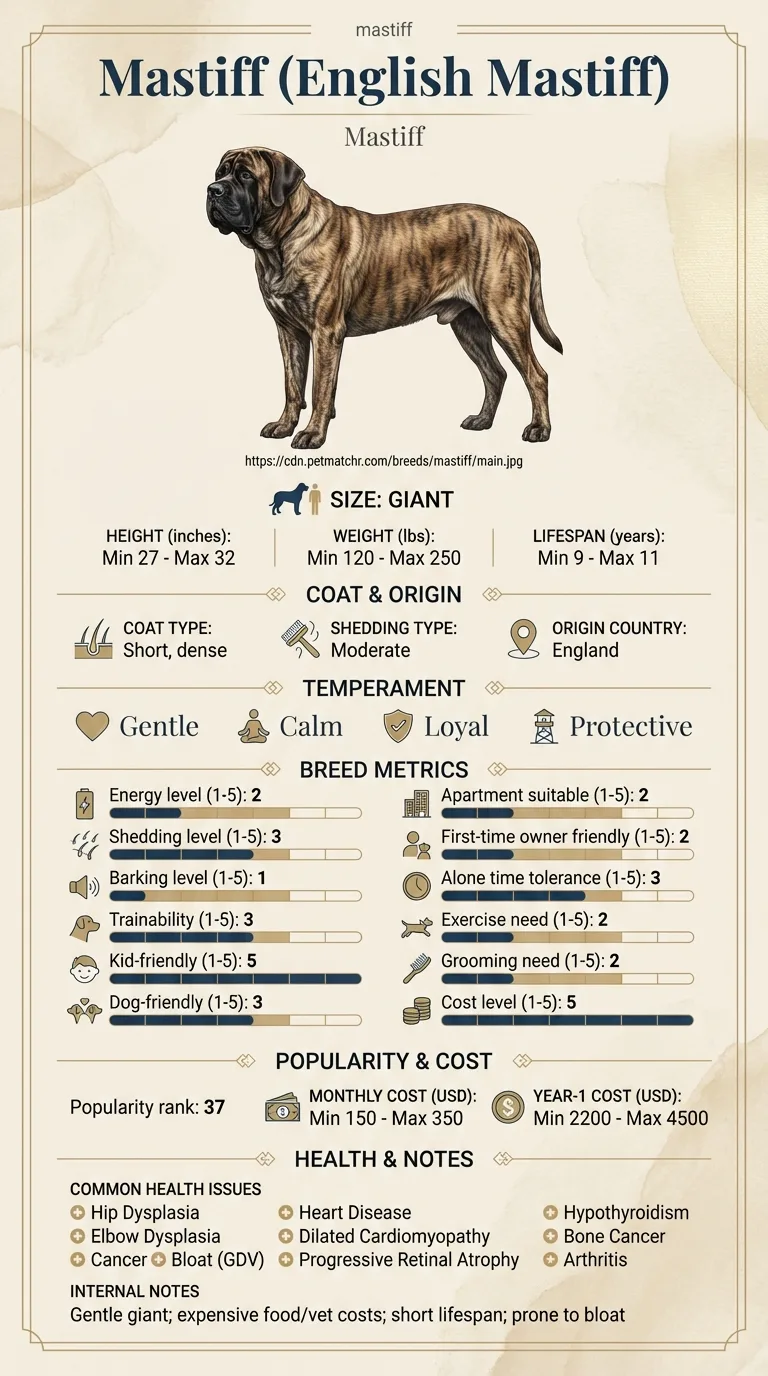
See all Mastiff health problems, which breeds are prone to backspine issues, or the full Mastiff breed guide for temperament, exercise needs and ownership costs.
Conservative management is assessed over eight to twelve weeks, with the honest goal of holding ground rather than reversing anything. Surgical recovery in a giant breed is three to six months of tightly controlled activity, and the first six weeks are the hardest to deliver. Chronic cases are then monitored for life, with a review of the plan every few months.
Stability is the win. A dog that still walks its route a year later, gets up without help, has no falls, and shows no further loss of coordination is a well-managed case even if the MRI looks alarming. Full reversal of established neurological deficits is uncommon and should not be the benchmark against which you judge the plan.
The chronic protrusion seen in large breeds behaves quite differently from the acute rupture that made this condition famous, and the differences cut both ways.
First, a change in surfaces. The dog stops using a particular room, or starts avoiding the polished hallway, because its footing has become unreliable and it knows it.
Second, the toenails. Back nails worn flat on the outer edge, or scuffing audible on a walk, means the foot is not being lifted cleanly. This is a nerve sign and it is objective, which makes it more useful than any impression of stiffness.
Third, a sway. Watch your dog walk directly away from you on flat ground. Hind legs that drift wide, cross over, or seem to arrive a fraction after the front end has decided to move are showing a coordination problem, not a pain problem.
Fourth, the transitions. Getting up, turning in a tight space and stepping over a threshold become the hard moments, while walking in a straight line stays reasonable for a long time.
What is usually missing is drama. There is often no yelp, no acute episode, no obvious day when things changed. Some dogs do show neck or back pain, an unwillingness to lower the head to the bowl or a flinch when lifted, but many simply get quietly worse.
The imaging that answers the question is MRI, because plain radiographs show bones and this is a soft tissue problem pressing on a soft tissue structure. That is a real cost and requires an anaesthetic in a giant breed, which is why the decision to image is usually made once the signs are clearly progressive rather than at the first suspicion.

If you think your Mastiff has back/spine issues, the plan is three steps: write down what you have seen and when it started, book a veterinary appointment rather than waiting for the next flare, and take video of the behaviour or symptom before you go — the thing you are worried about rarely happens in the consulting room. Screening in the parents covers hip dysplasia, elbow dysplasia, cancer.
What the vet visit should produce is a diagnosis and a written plan, not just reassurance: what is being ruled out, what the monitoring interval is, and which signs mean you come back sooner. Ask what the treatment costs across a year rather than per visit, because that is the number that decides whether you are managing this condition or reacting to it.
Between appointments, keep a short log — dates, what you saw, what changed. It is the single most useful thing an owner brings to a follow-up, and for back/spine issues it is often what separates a clear pattern from a guess.
Kirsty started filming her Mastiff Sable walking down the garden path after a physiotherapist suggested it, more as a record than as a test. Sable was six and mildly stiff, and everyone including her vet thought it was early arthritis. By the eighth month the videos told a story nobody had noticed in person. Sable's left hind foot was landing progressively wider, and in the most recent clip it crossed the midline twice. Side by side with the first video the difference was undeniable. That evidence is what justified an MRI, which found chronic disc protrusion in the lower back. Sable was managed without surgery: thirty pounds off, matting through the house, twice-daily short walks and a physiotherapy programme. Three years later she is slower but has not deteriorated further, and Kirsty still films the garden path on the first of every month.
Key takeaway: Gradual conditions defeat memory. A monthly ten-second video costs nothing and is the single most useful diagnostic tool an owner of a giant breed can keep.
It shares the name but not the behaviour. Short-legged breeds get an acute rupture of the disc centre, often in young or middle-aged dogs, causing sudden paralysis. Large non-dwarfed breeds get a slow thickening and bulging of the disc that compresses the cord gradually, usually from middle age.
It can. A chronically narrowed spinal canal leaves little spare room, so a relatively minor extrusion or a slip can tip a dog that was coping into acute weakness. Any sudden deterioration in a dog with known spinal disease is urgent.
Radiographs are useful for ruling other things out, such as fracture, bone tumour or advanced spondylosis, but they cannot show the disc pressing on the cord. If surgery is genuinely on the table, MRI or CT myelography is what makes it possible to plan.
Sometimes clearly yes, sometimes clearly no, and the answer depends on the site, the severity, the dog's age and how much function is already lost. Have the conversation with a neurologist rather than deciding from a website, and factor in months of restricted activity for a very large dog.
Weight reduction, grip underfoot everywhere the dog walks, short frequent controlled lead walks rather than long ones, veterinary pain management, and physiotherapy. That combination holds many dogs stable for a long time, which is a legitimate outcome rather than a consolation prize.
They can protect a knuckling foot from being worn raw, and some dogs walk better with the extra sensory feedback. Check the fit obsessively, because a dog that cannot feel its foot properly will not tell you a boot is rubbing.
Not necessarily. Many chronic cases progress slowly enough that the dog remains mobile for the rest of a normal Mastiff lifespan with good management. The honest answer is that the trajectory varies, which is precisely why monitoring is worth doing properly.
It is chronic rather than explosive: the disc thickens and bulges over months, so signs creep in instead of appearing overnight.
Uneven wear on the outer back toenails, which shows the foot is being dragged rather than lifted.
Sudden inability to stand, rapid worsening over hours, severe pain, or loss of bladder control all need immediate veterinary attention.
Better not. The jump down delivers a hard impact through the spine, and a floor-level orthopaedic bed removes the risk entirely.
MRI plus the anaesthetic is one of the larger single veterinary expenses an owner will face, which is a strong argument for insuring this breed early.
A one-page prep sheet for this condition: the signs, the questions to ask, what to get priced. Unlocks here.
You get: Vet visit prep sheet
No spam. One-click unsubscribe. See our privacy policy.
Preview page 1 before you decide.