Health
What makes Type I disc disease an emergency?
Disc material strikes the spinal cord suddenly, and function can be lost within hours. Where deep pain perception is gone, the surgical window is measured in hours, not days.

Quick answer
What makes Type I disc disease an emergency?
Disc material strikes the spinal cord suddenly, and function can be lost within hours. Where deep pain perception is gone, the surgical window is measured in hours, not days.
This is one of the few spinal problems where the difference between going now and going tomorrow can be the difference between walking and not.
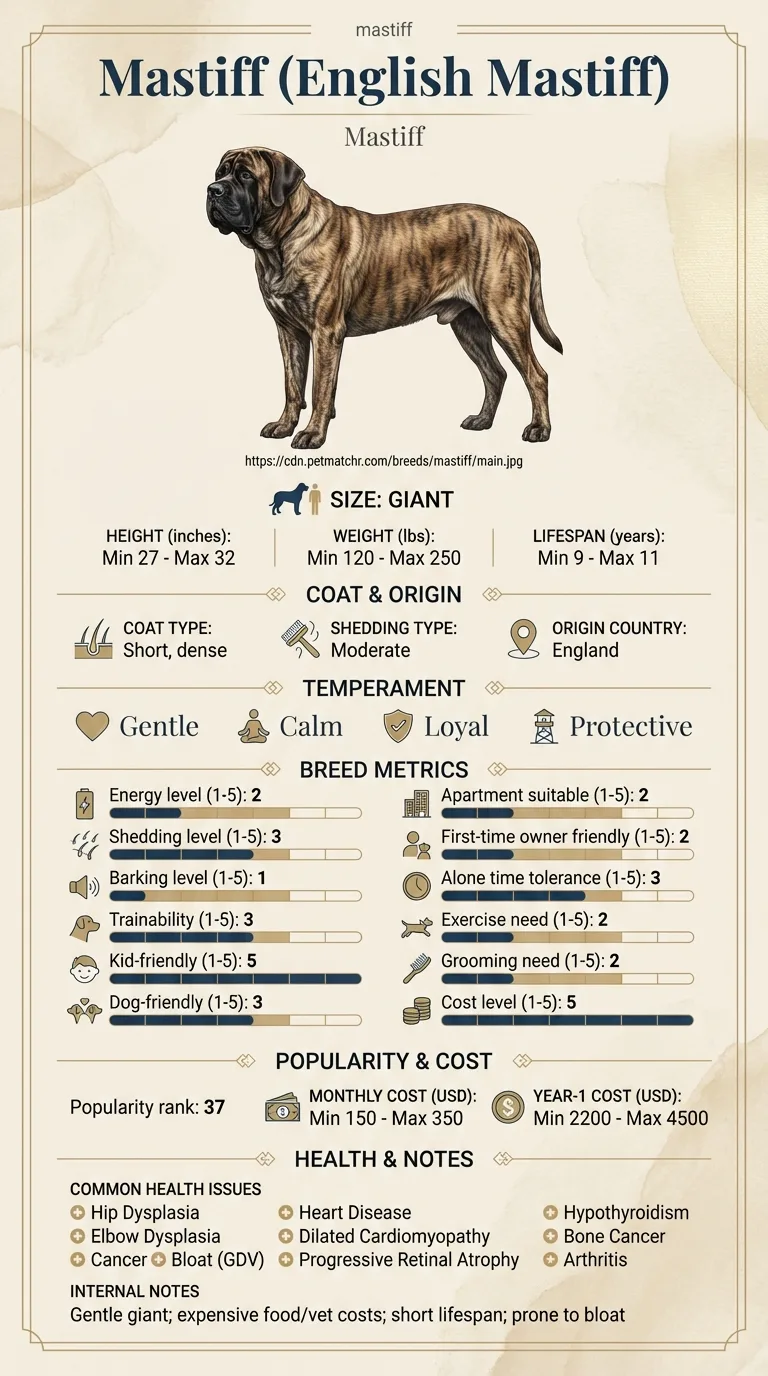
Owners facing a Mastiff who has gone down suddenly, and owners who want to understand in advance what the neurologist's questions mean and how to physically move a dog nobody can carry.
This guide is not medical advice. If your dog shows pain, sudden behavior change, or worsening symptoms, consult a licensed veterinarian.
Some links may be affiliate links. We may earn a commission at no extra cost to you. We only suggest products we believe are helpful for dog owners.
We research and check what we publish, but we do not warrant that any figure, date, price, or statement is accurate, complete, or current, and we accept no liability for any loss, cost, injury, or other harm arising from the use of this site. Use it as one reference among several. You remain responsible for your own decisions and for your dog's care - confirm anything that matters with a licensed veterinarian or another qualified professional before you act on it. Full disclaimer.
Type I intervertebral disc disease is a sudden extrusion of disc material into the spinal canal, bruising the cord within moments. It is graded by remaining function, and the presence or absence of deep pain perception is the single strongest predictor of outcome. It is not a characteristic Mastiff condition, but when sudden paralysis occurs in any dog it is a time-critical emergency, and a giant breed adds severe practical difficulty to every stage of the response.
Acute disc extrusion is overwhelmingly a disease of chondrodystrophic breeds and is uncommon in long-legged giant breeds such as the Mastiff. It does not appear among this breed's documented health issues. Owners should know the emergency response nonetheless, because the cost of not recognising it is very high and the signs overlap with more likely giant-breed problems.
The disc changes that cause Type I extrusion are tied to chondrodystrophic skeletal type, a genetic trait producing short, curved limbs and abnormally early disc calcification. The Mastiff does not carry it: this is a tall, normally proportioned breed standing 27 to 32 inches at the shoulder. That biology means true Type I disease is uncommon here. Where the breed does contribute is in force and in aftermath. A body of 120 to 250 pounds generates large loads through any degenerating disc, and once a dog of that weight goes down, every subsequent step of transport, surgery and nursing becomes substantially harder than in a small dog.
Sudden mechanical events are the usual precipitants where an event can be identified at all: a bad landing from a tailgate, a slip on tile, a heavy fall during play. Household features that permit repeated jumping from height, or that force a heavy dog to scramble on slick flooring, raise the number of opportunities for such an event. Excess body weight increases the force behind every one of them. None of this creates a chondrodystrophic disc, but all of it matters for a spine already carrying age-related change.
Go to an emergency veterinary hospital immediately, at any hour, if your Mastiff suddenly cannot walk, is dragging the hind limbs, has lost bladder or bowel control, cries out sharply when the back or neck is touched, or has deteriorated noticeably within hours. Do not wait to see whether it improves overnight, do not give any human medication, and do not let the dog walk to the car. Call ahead with your dog's weight so staff can meet you with a trolley. Sudden severe spinal signs in a giant breed are a genuine emergency in which the available options narrow with every hour.
See all Mastiff health problems, which breeds are prone to intervertebral disc disease ivdd type i, or the full Mastiff breed guide for temperament, exercise needs and ownership costs.
The critical decisions happen within hours. If surgery goes ahead, expect several days in hospital, then six to eight weeks of severely restricted activity at home with intensive nursing. Where deep pain perception was retained, many dogs regain useful function over weeks to months. Where it was absent, recovery is far less likely and some dogs never walk again. In a giant breed, physical recovery is also limited by how much support two people can realistically provide.
The most honest measure of success is a dog who can stand, walk without falling, and toilet independently, even if the gait is never quite what it was. Owners should also be prepared for a different outcome: with a dog too heavy for one person to manage, a permanently non-ambulatory Mastiff raises genuine quality-of-life questions that are worth discussing openly with your veterinary team rather than facing unprepared.
Spinal cord injury is graded by what the dog can still do, and the grades map onto prognosis more reliably than almost anything else in neurology.
The mild end is pain only: a dog who is clearly sore along the spine, tense, reluctant to move, but walking. Next comes weakness with a wobbly, uncoordinated gait, then an inability to walk while still able to move the legs voluntarily, then complete paralysis of the hind limbs, often accompanied by loss of bladder control.
The final and most important distinction is deep pain perception. A vet tests this by applying firm pressure to a toe and watching not for a reflex withdrawal but for a conscious response — the dog turning its head, vocalising, reacting as an animal that felt something. A leg pulling back on its own is a spinal reflex and does not require an intact connection to the brain, which is exactly why owners misread it as a good sign.
When deep pain perception is absent, the injury is severe and prognosis drops sharply, and the surgical window narrows to a matter of hours rather than days. This is the reason emergency clinics take a suddenly paralysed dog straight through rather than booking it for the morning. It is also why nobody should assess this at home; testing it properly requires someone who knows the difference between a reflex and a response.
This is the part no article about dachshund disc disease covers, and it is the part that stops Mastiff owners in their tracks at two in the morning.

If you think your Mastiff has intervertebral disc disease (ivdd) type i, the plan is three steps: write down what you have seen and when it started, book a veterinary appointment rather than waiting for the next flare, and take video of the behaviour or symptom before you go — the thing you are worried about rarely happens in the consulting room. Screening in the parents covers hip dysplasia, elbow dysplasia, cancer.
What the vet visit should produce is a diagnosis and a written plan, not just reassurance: what is being ruled out, what the monitoring interval is, and which signs mean you come back sooner. Ask what the treatment costs across a year rather than per visit, because that is the number that decides whether you are managing this condition or reacting to it.
Between appointments, keep a short log — dates, what you saw, what changed. It is the single most useful thing an owner brings to a follow-up, and for intervertebral disc disease (ivdd) type i it is often what separates a clear pattern from a guess.
Callum's nine-year-old Mastiff, Ottoline, was fine at ten at night and could not stand at midnight. She was lying in the hallway, back legs splayed, panting and unwilling to be touched near her lower back. Callum weighed 165 pounds and Ottoline weighed 178. There was no way to carry her. He rang the emergency hospital, who told him her weight was the most useful thing he had said, and that they would have four people and a trolley at the door. He took the door off the downstairs cloakroom, slid it under her with his neighbour's help, and the two of them carried her out flat and level. She was in the hospital fifty minutes after she went down. Imaging showed a disc extrusion, which the neurologist described as an unusual finding in a dog of her build. Deep pain perception was present. She had surgery that night, spent nine weeks recovering with a sling and daily physiotherapy, and walked again — stiffly, and never far, but on her own four feet.
Key takeaway: The medicine was the specialist's job; the first fifty minutes were Callum's. Knowing not to lift her, having a neighbour to call, and thinking of the door were what got a 178-pound dog to a surgeon inside the window that mattered.
It is much less characteristic of this breed than of short-legged, long-backed dogs, whose discs calcify early because of their skeletal type. Mastiffs are long-legged and do not carry that trait. It can still happen, and sudden severe spinal signs in any breed must be treated as an emergency rather than reasoned away by breed statistics.
Immediately. If your dog has suddenly lost the ability to walk, go to an emergency veterinary hospital straight away, at whatever hour. Where deep pain perception has been lost, outcomes fall off sharply with delay, and the surgical decision is often measured in hours. There is no version of this where waiting until morning improves anything.
Not necessarily, and this is the most dangerous misunderstanding in the whole subject. Leg withdrawal is a reflex that happens within the spinal cord itself and does not prove the message reached the brain. Only a conscious reaction — turning, crying out, looking at you — indicates deep pain perception. Leave the assessment to a vet.
A surgeon removes bone to access the canal and takes out the extruded disc material pressing on the cord. It requires advanced imaging first, general anaesthesia, and a specialist facility. For a giant breed it is a major undertaking, and the cost typically runs into thousands. Recovery involves weeks of very restricted movement and intensive nursing.
Honestly, it is the hardest part. A Mastiff that cannot support itself needs help to be turned to prevent pressure sores, help to toilet, sometimes manual bladder expression, and a sling to be walked. This is physically demanding work several times a day for weeks, and it usually needs more than one able adult in the household.
Dogs with pain only or mild weakness sometimes do well with strict rest and prescribed pain relief. The more function that has been lost, the less likely conservative management is to succeed, and the more the delay costs. Nobody should make that judgement without a neurological examination.
Disc material strikes the spinal cord suddenly, and function can be lost within hours. Where deep pain perception is gone, the surgical window is measured in hours, not days.
No. Withdrawal is a spinal reflex that does not need the brain. Only a conscious reaction counts, and only a vet should assess it.
Never alone. Slide a rigid flat surface under the whole body, or use a taut blanket with a person at each corner, keeping the spine straight.
No. Human painkillers can be toxic to dogs, and analgesia beforehand can mask the neurological findings a specialist needs to grade the injury.
No. Explosive disc extrusion is far more characteristic of short-legged breeds. It remains an emergency in any dog it happens to.
A one-page prep sheet for this condition: the signs, the questions to ask, what to get priced. Unlocks here.
You get: Vet visit prep sheet
No spam. One-click unsubscribe. See our privacy policy.
Preview page 1 before you decide.