Behavior
Which needs more exercise?
The Weimaraner, rated very high (5/5) versus the Mastiff's low (2/5).

Quick answer
Which needs more exercise?
The Weimaraner, rated very high (5/5) versus the Mastiff's low (2/5).
Mastiff (English Mastiff) or Weimaraner? On paper they differ most on exercise need, and on the scales Mastiff (English Mastiff) is the heavier at 120–250 lbs. Here is how the two compare on everything that shapes an ordinary week.
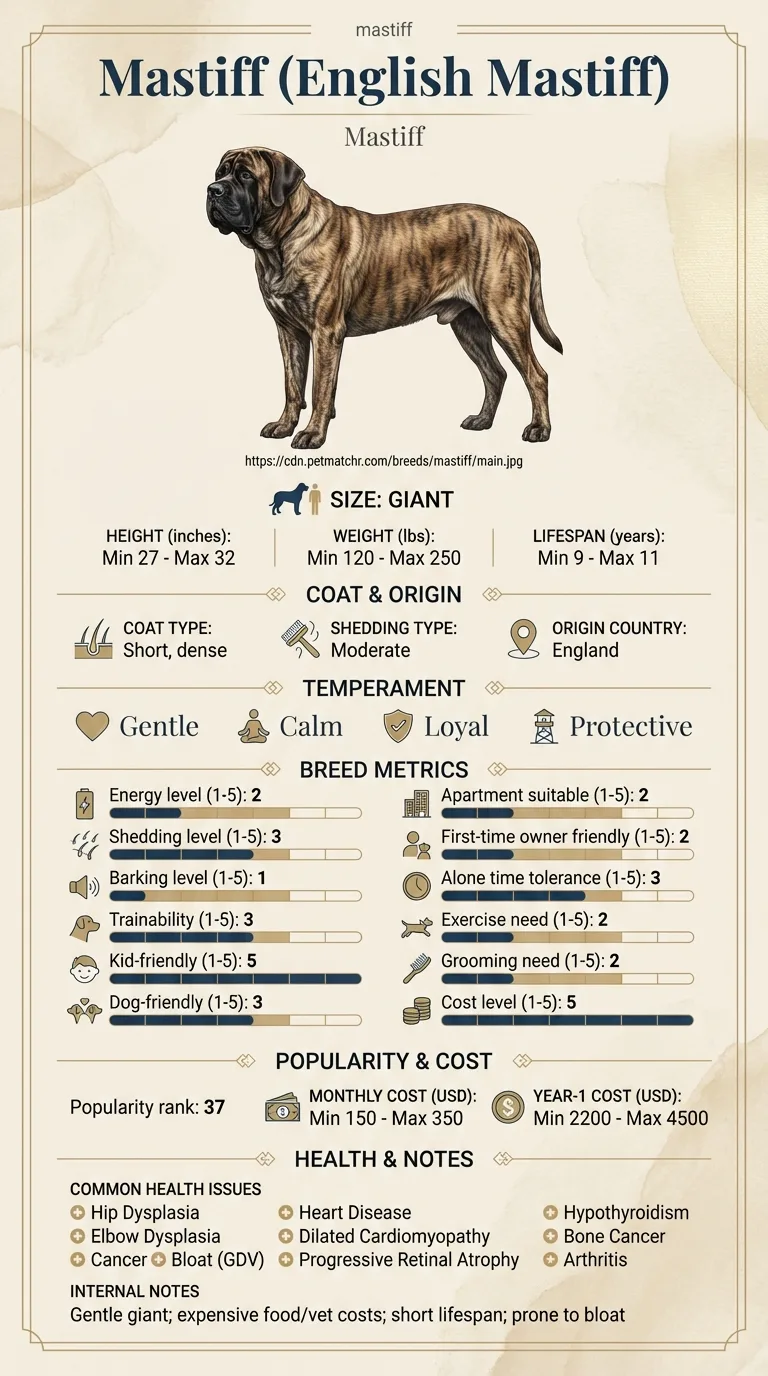
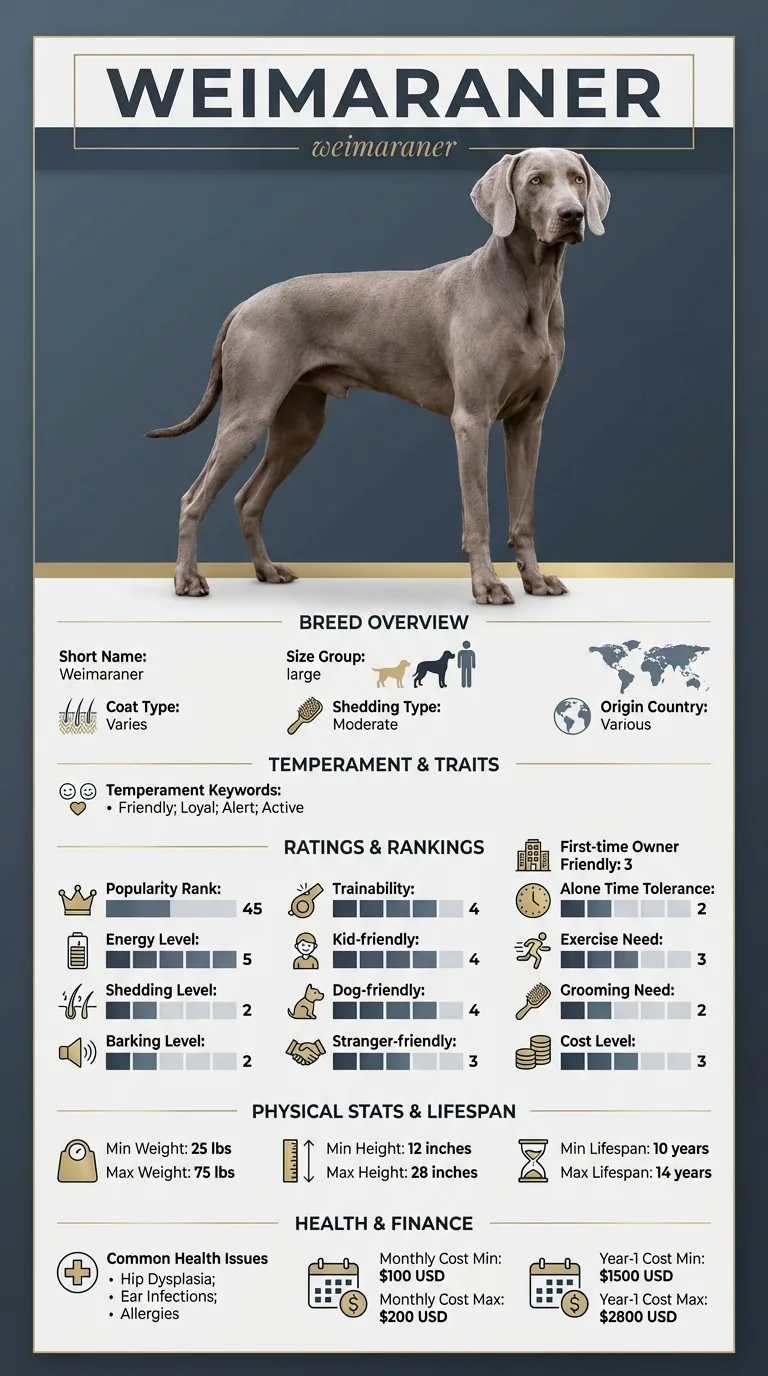
This is for someone already down to Mastiff (English Mastiff) and Weimaraner and deciding between them. For this pair the decision usually turns on exercise need and energy level, so those are covered first and in most detail. Anyone choosing from a flat has a clear answer here: Mastiff (English Mastiff) rates 2/5 against 1/5. Breed history is left out; what follows is what you will actually live with.
Between Mastiff (English Mastiff) and Weimaraner, exercise need is what separates them, and Mastiff (English Mastiff) is the lower-effort dog of the two to keep.
Choose Mastiff (English Mastiff) if your walking routine is modest, the dog will be alone during the working day and there are young children at home.
Choose Weimaraner if you do not want a standing grooming appointment, shedding is a problem in your house and you want a dog that picks up training quickly.
| Feature | mastiff | weimaraner | Winner |
|---|---|---|---|
| Size class | giant | large | Equal |
| Weight | 120–250 lbs | 55–90 lbs | Equal |
| Height | 27–32 in | 23–27 in | Equal |
| Lifespan | 9–11 years | 10–13 years | weimaraner |
| Exercise need | Low (2/5) | Very high (5/5) | mastiff |
| Grooming need | Low (2/5) | Very low (1/5) | weimaraner |
| Shedding | Moderate (3/5) | Low (2/5) | weimaraner |
| Energy level | Low (2/5) | Very high (5/5) | Equal |
| Barking | Very low (1/5) | Moderate (3/5) | mastiff |
| Apartment suitability | Low (2/5) | Very low (1/5) | mastiff |
| Good for first-time owners | Low (2/5) | Low (2/5) | Equal |
| Tolerates being alone | Moderate (3/5) | Very low (1/5) | mastiff |
| Trainability | Moderate (3/5) | High (4/5) | weimaraner |
| Good with kids | Very high (5/5) | High (4/5) | mastiff |
| Good with other dogs | Moderate (3/5) | Moderate (3/5) | Equal |
| Friendly to strangers | Moderate (3/5) | Moderate (3/5) | Equal |
| Cost level | Very high (5/5) | Moderate (3/5) | weimaraner |
| Coat | Short, dense | Short and sleek | Equal |
| Origin | England | Various | Equal |
| Typical monthly cost | $150–$350 | $110–$240 | Equal |
| Typical first-year cost | $2,200–$4,500 | $1,700–$3,200 | Equal |
A Mastiff can weigh up to 250 pounds, nearly three times the Weimaraner's upper range of 90 pounds, though the Weimaraner is no small dog itself at 55-90 pounds and 23-27 inches — well into large-breed territory, just dwarfed by the Mastiff's giant-breed 27-32 inch, 120-250 pound frame. The Weimaraner's lean, athletic build, developed for tracking and pointing game, contrasts sharply with the Mastiff's dense, heavy-boned mass built for guarding. Both need real space, but only the Mastiff genuinely strains the limits of a typical home's furniture and doorways at its largest end.
The Weimaraner rates very high (5/5) for both exercise need and energy level, while the Mastiff sits at low (2/5) on both — one of the widest gaps in this comparison. Weimaraners were bred as all-day hunting companions and carry that stamina into pet life, needing vigorous daily runs or fieldwork; without it, their alert, headstrong temperament tends to turn into destructive boredom. The Mastiff's giant-breed calm means moderate activity is genuinely sufficient, and pushing it toward more vigorous exercise offers little benefit given its build. An owner drawn to both breeds' size should recognize this is really a choice between an athlete and a couch companion.
Both breeds are low-maintenance on the coat front, but the Weimaraner edges out the Mastiff — very low (1/5) grooming need versus low (2/5), and low (2/5) shedding versus moderate (3/5). The Weimaraner's short, sleek coat needs almost nothing beyond the occasional bath, while the Mastiff's short coat sheds a touch more and comes with the breed's characteristic drool, which the Weimaraner mostly avoids. Neither breed suits someone chasing a truly hairless home, but compared to double-coated or long-haired breeds, both are genuinely easy care. For a household weighing coat maintenance heavily, the difference here is real but modest.
Neither breed belongs in a small apartment, but the Weimaraner rates even lower — very low (1/5) versus the Mastiff's low (2/5) — and its very low (1/5) tolerance for being alone is a serious practical concern, with separation anxiety appearing directly on its health and behavior list. The Mastiff barks very low (1/5), quieter than the Weimaraner's moderate (3/5), and its calmer temperament makes confined space somewhat more tolerable despite its bulk. A Weimaraner left alone in a small space for long stretches is a recipe for anxious, destructive behavior; a Mastiff in the same situation is more likely to simply nap through the day, space permitting.
The Weimaraner rates high (4/5) for trainability against the Mastiff's moderate (3/5), reflecting real intelligence, though its headstrong nature means that intelligence doesn't always translate into easy compliance. Both breeds share the same low (2/5) rating for first-time owners — a rare tie — but the underlying challenges differ: the Mastiff's difficulty is physical management of a giant, occasionally stubborn dog, while the Weimaraner's is channeling an alert, energetic, strong-willed temperament that needs a confident, consistent handler. Neither is a natural first dog. Owners considering either should have some prior experience with large, independent-minded breeds before taking one on.
With kids, the Mastiff edges ahead at very high (5/5) against the Weimaraner's high (4/5), and both tie at moderate (3/5) with other dogs and strangers alike. The Mastiff's gentle, protective nature makes it a famously patient family dog despite its size, while the Weimaraner's devoted but alert temperament tends toward closer bonding with its immediate family and more watchfulness around outsiders and unfamiliar dogs. Neither breed is standoffish exactly, just differently expressive — the Mastiff calm and steady, the Weimaraner more energetic and reactive to novelty. A household with frequent visiting dogs or guests may find the Mastiff's even temperament slightly easier to manage day to day.
The Weimaraner's 10-13 year lifespan beats the Mastiff's 9-11, and its health list is notably shorter at five conditions versus the Mastiff's ten. Both share bloat (GDV) and hip dysplasia as serious concerns given their large, deep-chested builds — bloat in particular can become fatal within hours without emergency care, making awareness of the symptoms critical for owners of either breed. The Weimaraner's remaining list includes hypertrophic osteodystrophy, a painful bone condition in fast-growing puppies, von Willebrand disease (a bleeding disorder), and separation anxiety. The Mastiff's longer list adds cancer, bone cancer, and dilated cardiomyopathy, conditions more strongly associated with giant-breed genetics and rapid growth.
Cost level rates very high (5/5) for the Mastiff against moderate (3/5) for the Weimaraner, with monthly costs of $150-$350 versus $110-$240 and first-year costs of $2,200-$4,500 versus $1,700-$3,200. As with the size comparison, food volume driven by the Mastiff's much greater body weight accounts for most of the gap. Grooming costs stay low for both given their short coats, so the difference isn't about coat maintenance the way it is in some other Mastiff comparisons. Over a decade, the Weimaraner remains the more budget-friendly of the two large-to-giant breeds, though still not a cheap dog by most standards.
Mastiff (English Mastiff) weighs 120–250 lbs and lives 9–11 years; Weimaraner weighs 55–90 lbs and lives 10–13 years. The two diverge most on exercise need, energy level and tolerates being alone and 2 other rated axes. They are level on good with other dogs, good for first-time owners and friendly to strangers, so those cannot decide it. The comparison marks an easier option only where one exists. Facts like weight and country of origin are not scored. Both dogs are rated from the same dataset, which is what makes the numbers comparable with each other even though any individual dog sits somewhere inside its breed's range.

The Weimaraner, by a wide margin — rated very high (5/5) for exercise need against the Mastiff's low (2/5). Weimaraners were bred for all-day fieldwork and need serious daily activity.
Not comfortably — it rates very low (1/5) for tolerating being alone, and separation anxiety appears directly on its health list. The Mastiff manages moderate (3/5) alone time better.
The Weimaraner, rated low (2/5) versus the Mastiff's moderate (3/5), though both have short, easy-care coats compared to most breeds on this site.
Neither scores well — both rate low (2/5) for first-time owners, though for different reasons: the Mastiff's size demands physical management, while the Weimaraner's energy and independence demand experienced handling.
The Weimaraner, at roughly $1,700-$3,200 in its first year versus the Mastiff's $2,200-$4,500, largely due to the Mastiff's much greater food requirements.
Yes — bloat (GDV) appears on both health lists, a serious risk tied to their large, deep chests. Owners of either breed should learn the warning signs and discuss preventive options with a vet.
The Weimaraner, at 10-13 years versus the Mastiff's 9-11 years, with a notably shorter list of associated health conditions as well.
The Weimaraner, rated very high (5/5) versus the Mastiff's low (2/5).
The Mastiff, rated very low (1/5) for barking versus the Weimaraner's moderate (3/5).
The Weimaraner, at roughly $1,700-$3,200 versus the Mastiff's $2,200-$4,500 in year one.
The Mastiff, up to 250 lbs versus the Weimaraner's 90 lbs.
Secure checkout on Stripe. We never see your card.
7-day money-back guarantee. Instant access.

Health information here is general and is not veterinary advice. If your dog shows pain, sudden behaviour change, or worsening symptoms, consult a licensed veterinarian.
Some links on this site are affiliate links. We may earn a commission at no extra cost to you, and we only suggest products we believe are helpful for dog owners.
We research and check what we publish, but we do not warrant that any figure, date, price, or statement is accurate, complete, or current, and we accept no liability for any loss, cost, injury, or other harm arising from the use of this site. Use it as one reference among several. You remain responsible for your own decisions and for your dog's care - confirm anything that matters with a licensed veterinarian or another qualified professional before you act on it. Full disclaimer.
Match your lifestyle to the right dog.
Take quizNot sure which breed is right for you? Take our 2-minute quiz to find out.
Take the quiz