Health
What is the one sign that means go immediately?
Repeated retching that brings nothing up, in a restless dog. In a Mastiff that is enough on its own. Do not wait for a swollen abdomen.

Quick answer
What is the one sign that means go immediately?
Repeated retching that brings nothing up, in a restless dog. In a Mastiff that is enough on its own. Do not wait for a swollen abdomen.
The single most useful thing an owner of this breed can own is not a slow feeder. It is a phone number, a rehearsed route, and the willingness to leave the house at two in the morning without debating it.
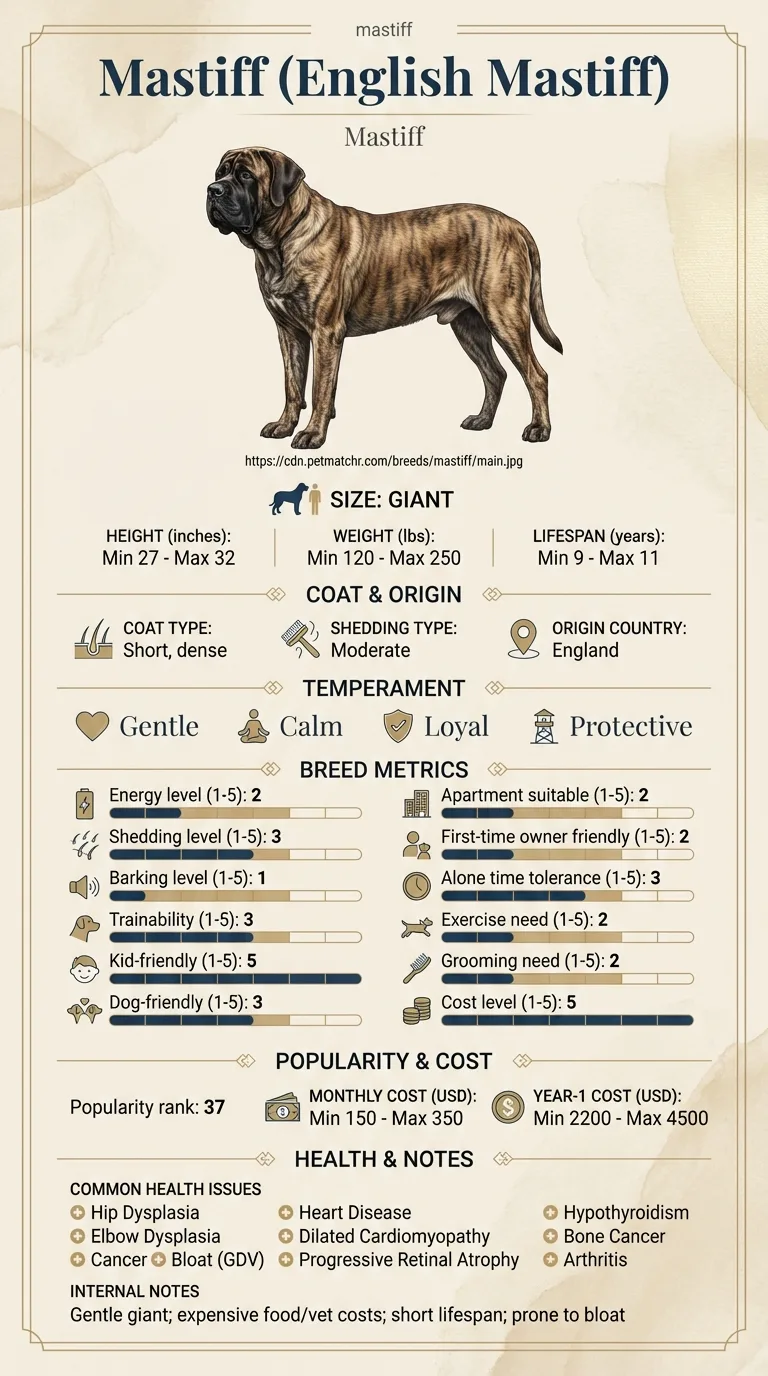
Every Mastiff owner, whether they know it yet or not. This page is written particularly for people who have just watched their dog try to vomit without producing anything and are searching for confirmation while the clock runs.
This guide is not medical advice. If your dog shows pain, sudden behavior change, or worsening symptoms, consult a licensed veterinarian.
Some links may be affiliate links. We may earn a commission at no extra cost to you. We only suggest products we believe are helpful for dog owners.
We research and check what we publish, but we do not warrant that any figure, date, price, or statement is accurate, complete, or current, and we accept no liability for any loss, cost, injury, or other harm arising from the use of this site. Use it as one reference among several. You remain responsible for your own decisions and for your dog's care - confirm anything that matters with a licensed veterinarian or another qualified professional before you act on it. Full disclaimer.
GDV is the twisting of a gas-filled stomach on its own axis. Both entrance and exit are sealed, gas cannot escape, and the expanding organ compresses the major vein returning blood to the heart. The dog goes into circulatory shock while the stomach wall loses its blood supply. It is one of the few genuine surgical emergencies in small animal practice and it disproportionately affects deep-chested giant breeds.
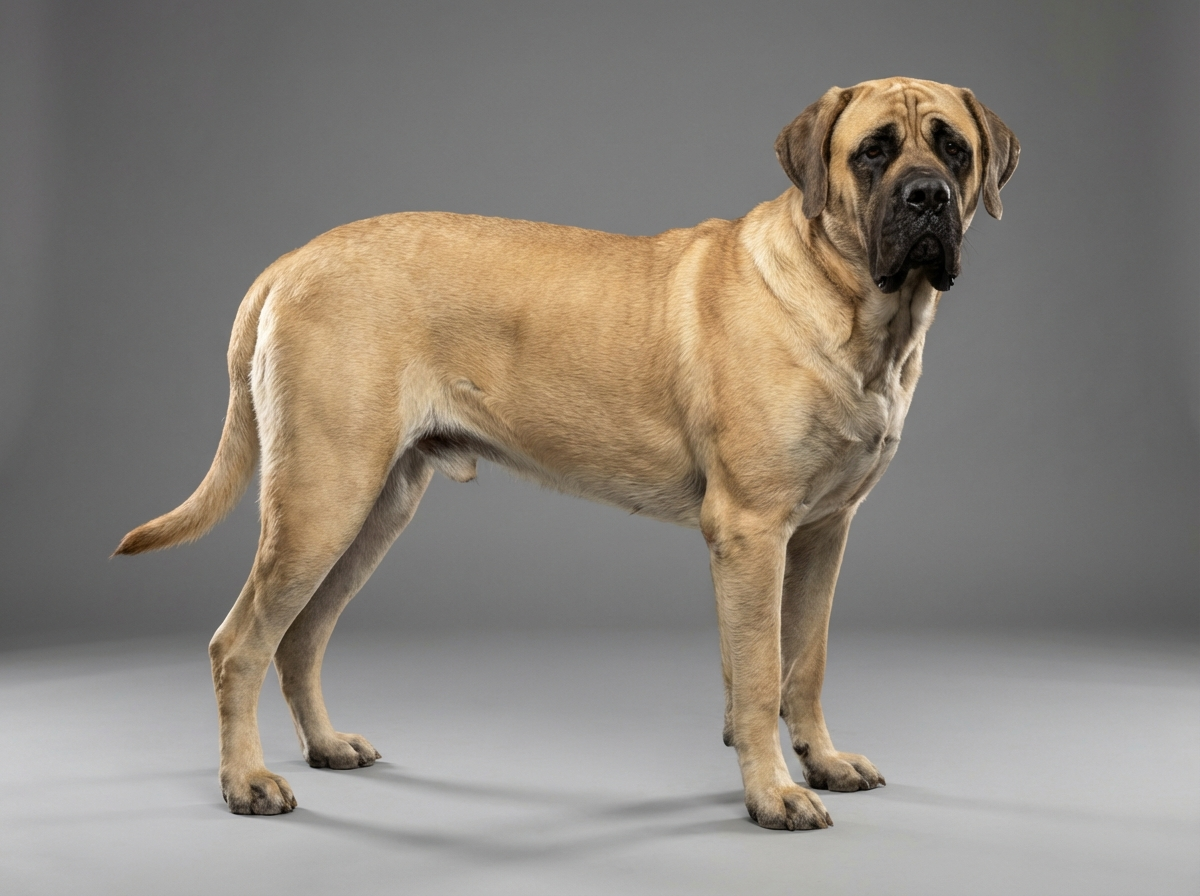
Bloat appears explicitly among the documented health issues for the English Mastiff, and giant deep-chested breeds carry the highest lifetime risk of any group. Estimates vary, but a meaningful minority of dogs in the highest-risk breeds will experience an episode. Because the case fatality rate without surgery approaches one hundred percent, it accounts for a disproportionate share of deaths in the breed.
Chest shape is the single strongest anatomical predictor, and the English Mastiff has exactly the conformation involved: a chest that is deep from spine to sternum relative to its width. That geometry appears to give the stomach more room to move and rotate, and the ligaments that should anchor it stretch over a lifetime of carrying a very large organ. Age raises risk steadily, and a family history of bloat raises it further, which is a reasonable question to put to any breeder.
How a dog is fed and what happens around mealtimes matters. Gulping a large volume quickly, exercising close to a meal, drinking heavily after exertion and eating in a state of competitive excitement all appear to contribute. Stress is a recognised factor, so kennelling, house moves, fireworks and changes in routine deserve extra caution. None of these cause a stomach to twist by themselves, but they stack the odds in a dog already built for it.
This is the clearest emergency in this breed. Go immediately, day or night, without an appointment, if your Mastiff retches repeatedly without bringing anything up, cannot settle and paces persistently, has a firm swollen abdomen behind the ribs, is drooling heavily, or shows pale gums, weakness or collapse. Telephone from the car so the team is waiting. Do not offer food or water, do not give any medication, and do not attempt to relieve the pressure yourself. If you are unsure whether what you are seeing counts, that uncertainty is itself a reason to drive: this is a condition where an unnecessary trip costs a consultation fee and a delayed one costs the dog.
See all Mastiff health problems, which breeds are prone to bloat gastric dilatation volvulusgdv, or the full Mastiff breed guide for temperament, exercise needs and ownership costs.
From the first sign to surgery should be under two hours. Hospitalisation after surgery is typically two to four days with cardiac monitoring. Home recovery runs ten to fourteen days of restricted activity and small frequent meals, with a wound check at around the two-week mark. Most survivors are back to normal life within a month.
Success is a dog that reaches theatre early enough that its stomach wall is still healthy, comes through surgery with a gastropexy in place, passes the arrhythmia window without incident, and lives the rest of an ordinary Mastiff lifespan. The measure of a good owner here is not prevention, which is only partly possible, but reaction time.
Nobody diagnoses GDV from a checklist while it happens. What you need is one memorable trigger, and unproductive retching in a Mastiff is that trigger. Go.
Knowing the sequence in advance removes the paralysis that costs dogs their lives at the reception desk.
On arrival the team will move fast and mostly without explaining, because shock treatment comes before diagnosis. Large-bore intravenous lines go in, fluids run, pain relief is given, and pressure is released from the stomach either by passing a tube or by inserting a needle through the body wall. A single radiograph confirms whether the stomach has twisted or merely distended.
Then you will be asked to consent to surgery, and to a cost estimate, quickly. Typical treatment for a confirmed GDV runs from roughly 1,500 dollars at the simplest end to 7,500 dollars or beyond when the stomach wall has been damaged and part of it has to be removed, or when the spleen has to come out too. That estimate arrives at the worst possible moment for clear thinking, which is why the time to decide your ceiling and check your insurance is now, not then.
The surgery untwists the stomach, assesses whether the tissue is viable, removes what is not, and then tacks the stomach permanently to the body wall. That last step, gastropexy, is what stops it happening again, and it is the reason survivors of a first episode rarely have a second.
Afterwards the dog stays in hospital for two to four days, monitored above all for heart rhythm disturbances, which are common in the days following a GDV and are one of the ways dogs are still lost after apparently successful surgery.
Survival with prompt surgery is good, commonly quoted in the region of eighty percent. Survival without it is close to zero. Almost all of the difference is made in the first two hours, by the owner.

Ade's Mastiff Jonah started retching at nine minutes past eleven on a Tuesday night. Ade knew the time precisely because he wrote it on his hand in biro while pulling on his shoes, having read once that emergency teams always ask. Jonah brought up nothing but a little froth, then paced the hallway and would not lie down. Ade did not examine him further. He put the blanket in the boot, walked Jonah out while he could still walk, and rang the emergency hospital from the end of the road. They were waiting at the door. Radiographs confirmed a rotated stomach. Jonah was in surgery within forty minutes of arriving, the stomach wall was still healthy so nothing had to be removed, and he was home on the Friday with a gastropexy and a shaved belly. Ade's vet told him afterwards that the biro on the hand had been genuinely useful, and that the decision not to spend twenty minutes deciding was worth more than anything else he did.
Key takeaway: With bloat, the owner's contribution is entirely front-loaded. Recognise one sign, note the time, and drive. Everything else belongs to the surgical team.
Hours, not days. Some dogs deteriorate within an hour of the first sign. There is no version of this condition where waiting until morning is reasonable, and the outcome correlates closely with how quickly the dog reaches surgery.
Simple distension without twisting occasionally settles. You cannot tell the difference at home, and a dog that appears to improve may have a partially rotated stomach that will complete the turn shortly. Any suspicion is a veterinary visit, not a period of observation.
Then you have paid an emergency consultation fee and can go home relieved. That is the correct trade. Every emergency vet would rather see ten Mastiffs with indigestion than one that arrived ninety minutes late.
No. Attempting to pass a tube or puncture the abdomen without training and without shock treatment running causes serious harm. The only useful thing you can do at home is get into the car and telephone ahead.
Because the danger does not end with the operation. Cardiac arrhythmias frequently develop in the twenty-four to seventy-two hours afterwards, and the stomach wall needs monitoring. Continuous observation during that window is a large part of what the bill buys.
Distension can recur, but a properly performed gastropexy makes a repeat twist very unlikely, which is why it is done routinely as part of the emergency surgery. This is the one genuinely reassuring fact in the whole subject.
Ask now rather than at 2am. Not every emergency clinic has the table capacity, the staff numbers to move a 200 pound dog, or a surgeon available overnight. Knowing which of your local options can actually operate tonight is information worth having in advance.
The early signs are set out in the sections above, and they are the reason to book a veterinary appointment rather than wait. Bloat (gastric Dilatation-volvulus/gdv) in Mastiffs is diagnosed by a vet, not from a symptom list, and the sooner it is on record the more options remain open.
The early signs are set out in the sections above, and they are the reason to book a veterinary appointment rather than wait. Bloat (Gastric Dilatation-Volvulus/GDV) in Mastiff (English Mastiff)s is diagnosed by a vet, not from a symptom list, and the sooner it is on record the more options remain open.
Repeated retching that brings nothing up, in a restless dog. In a Mastiff that is enough on its own. Do not wait for a swollen abdomen.
Assume you have less than two hours to reach surgery. Outcomes fall sharply with delay and dogs have died within an hour of the first sign.
Commonly quoted at roughly 1,500 to 7,500 dollars depending on how much of the stomach has been damaged and whether the spleen is involved.
Call from the car, not from the house. The clinic can prepare while you are in transit, which saves the minutes that matter.
With a second person and a blanket or board, sliding rather than lifting. Plan this before you ever need it.
A one-page prep sheet for this condition: the signs, the questions to ask, what to get priced. Unlocks here.
You get: Vet visit prep sheet
No spam. One-click unsubscribe. See our privacy policy.
Preview page 1 before you decide.
Early access list
The free prep sheet covers the same-day warning signs, a symptom log and the questions to ask. We are considering a fuller kit that adds a cost worksheet for the usual tests and treatments (US price ranges with their sources) and a plain-English guide to ways of covering the bill. It is not built yet; this list tells us whether it is worth building.
One email, no spam, unsubscribe anytime. Information only, not veterinary advice.