Living
Which is the more manageable dog day to day?
The Beagle, for most households -- cheaper, easier to house, and better with other pets. The Mastiff's appeal is its temperament, not its convenience.

Quick answer
Which is the more manageable dog day to day?
The Beagle, for most households -- cheaper, easier to house, and better with other pets. The Mastiff's appeal is its temperament, not its convenience.
Beagle or Mastiff (English Mastiff)? On paper they differ most on barking, and on the scales Mastiff (English Mastiff) is the heavier at 120–250 lbs. Here is how the two compare on everything that shapes an ordinary week.
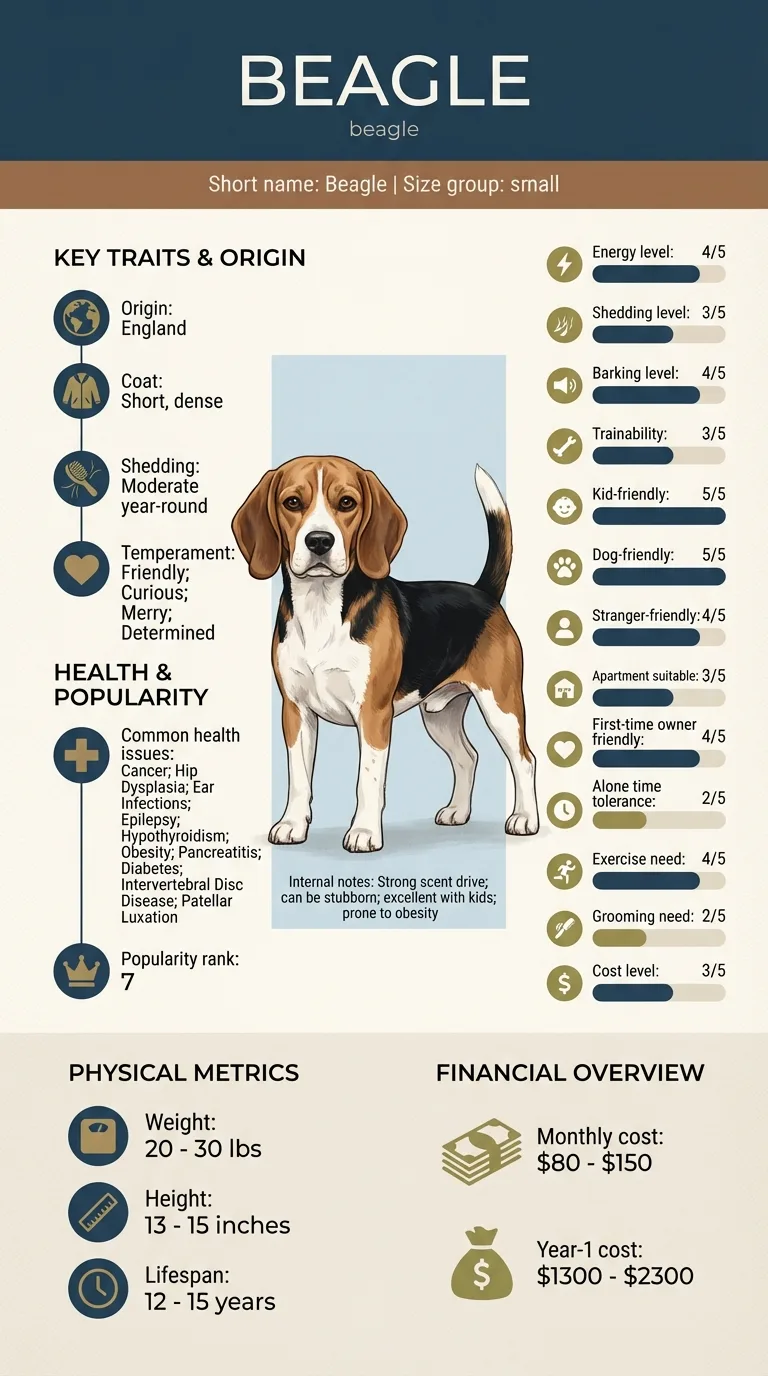
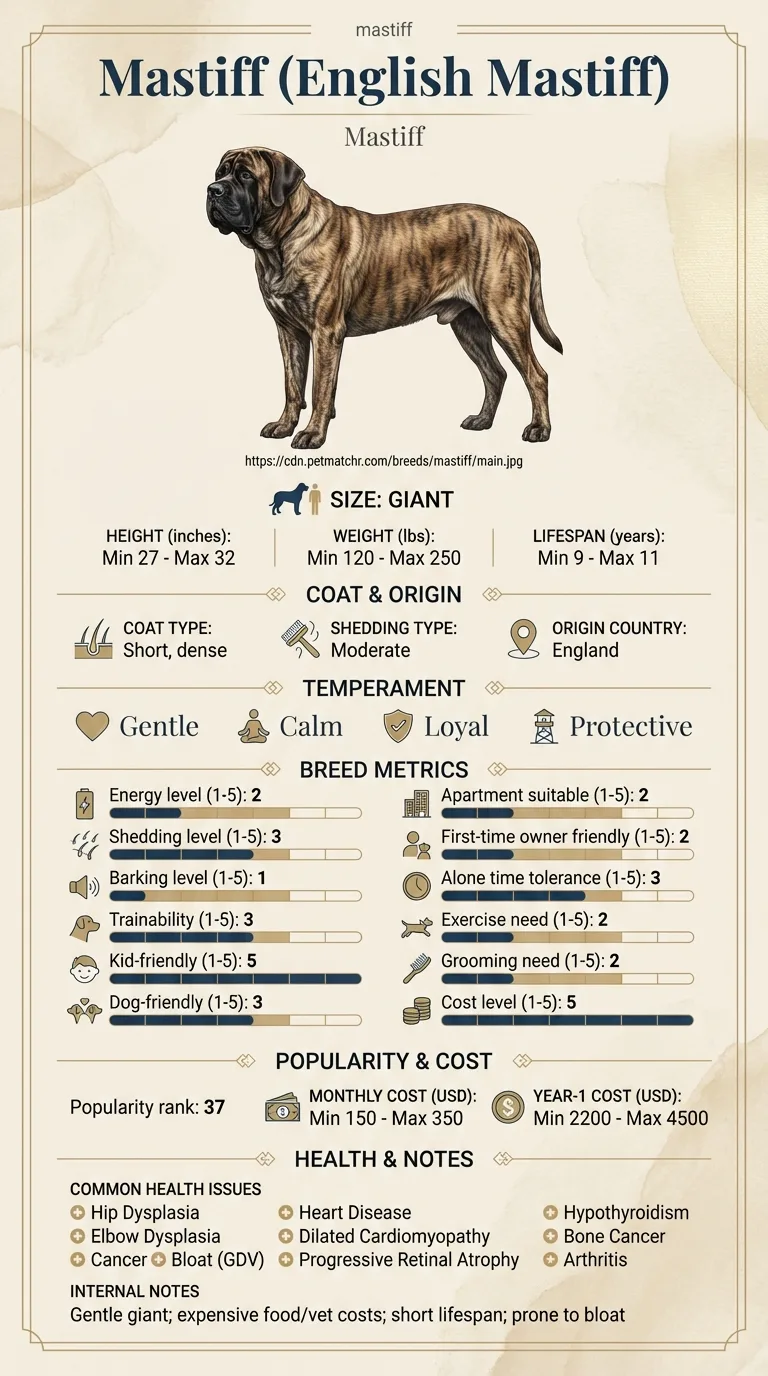
This is for someone already down to Beagle and Mastiff (English Mastiff) and deciding between them. For this pair the decision usually turns on barking and exercise need, so those are covered first and in most detail. Anyone choosing from a flat has a clear answer here: Beagle rates 3/5 against 2/5. There is no origin story here — only what changes about your week.
Between Beagle and Mastiff (English Mastiff), barking is what separates them; neither is the lower-effort dog overall.
Choose Beagle if you are in a flat or a smaller home, this is your first dog and you already have another dog.
Choose Mastiff (English Mastiff) if your walking routine is modest, the dog will be alone during the working day and you want a dog that is more watchful with visitors.
| Feature | beagle | mastiff | Winner |
|---|---|---|---|
| Size class | small | giant | Equal |
| Weight | 20–30 lbs | 120–250 lbs | Equal |
| Height | 13–15 in | 27–32 in | Equal |
| Lifespan | 12–15 years | 9–11 years | beagle |
| Exercise need | High (4/5) | Low (2/5) | mastiff |
| Grooming need | Low (2/5) | Low (2/5) | Equal |
| Shedding | Moderate (3/5) | Moderate (3/5) | Equal |
| Energy level | High (4/5) | Low (2/5) | Equal |
| Barking | High (4/5) | Very low (1/5) | mastiff |
| Apartment suitability | Moderate (3/5) | Low (2/5) | beagle |
| Good for first-time owners | High (4/5) | Low (2/5) | beagle |
| Tolerates being alone | Low (2/5) | Moderate (3/5) | mastiff |
| Trainability | Moderate (3/5) | Moderate (3/5) | Equal |
| Good with kids | Very high (5/5) | Very high (5/5) | Equal |
| Good with other dogs | Very high (5/5) | Moderate (3/5) | beagle |
| Friendly to strangers | High (4/5) | Moderate (3/5) | beagle |
| Cost level | Moderate (3/5) | Very high (5/5) | beagle |
| Coat | Short, dense | Short, dense | Equal |
| Origin | England | England | Equal |
| Typical monthly cost | $80–$150 | $150–$350 | Equal |
| Typical first-year cost | $1,300–$2,300 | $2,200–$4,500 | Equal |
An English Mastiff can outweigh a Beagle by a factor of ten. The Beagle sits at 20 to 30 pounds and 13 to 15 inches; the Mastiff runs 120 to 250 pounds and 27 to 32 inches, making it one of the heaviest breeds in this entire comparison set. This isn't a size difference you adjust to gradually -- it's a different category of dog to feed, house, and physically manage.
The Beagle rates high (4/5) for exercise need; the Mastiff rates low (2/5). Despite its size, the Mastiff is a famously sedentary breed once past puppyhood -- short walks and a lot of napping suit it fine. A Beagle owner expecting similar laziness from a giant breed is in for a surprise; Mastiffs are the low-energy exception among big dogs, not the rule.
An even match: both breeds tie at low (2/5) grooming need and moderate (3/5) shedding. The Mastiff's size means moderate shedding still produces more total fur simply due to surface area, but in terms of time and effort required, neither breed asks much of you here. A weekly brush handles both, which is one less thing to weigh in an otherwise lopsided comparison.
The Beagle handles a smaller footprint better -- moderate (3/5) apartment suitability against the Mastiff's low (2/5), which tracks given the sheer floor space a 150-plus pound dog needs just to lie down comfortably. Noise runs the opposite way: Mastiffs bark at a very low (1/5) rate, among the quietest in this comparison set, while Beagles rate high (4/5). Alone tolerance actually favors the Mastiff slightly, moderate (3/5) against the Beagle's low (2/5).
Trainability ties at moderate (3/5), so neither breed is especially easy or especially hard to teach. First-time-owner suitability is where they split hard: high (4/5) for the Beagle, low (2/5) for the Mastiff. A gentle, calm temperament doesn't change the physical reality of managing a dog that can weigh more than most adult humans -- leash training in particular needs to happen early and thoroughly.
Both breeds rate very high (5/5) with kids, which might be the most reassuring number on this whole page given the Mastiff's size -- its temperament (gentle, calm, protective) matches that rating. The Beagle pulls ahead with other dogs (very high 5/5 versus moderate 3/5) and with strangers (high 4/5 versus moderate 3/5); a Mastiff's protective instincts can make it more reserved around unfamiliar people and animals than its size alone would suggest.
The lifespan gap is significant: 12 to 15 years for the Beagle against just 9 to 11 for the Mastiff, typical for a giant breed carrying that much body weight. Both share risk of hip dysplasia, cancer, and hypothyroidism. The Mastiff's list adds serious size-linked conditions -- bloat (GDV), dilated cardiomyopathy, and bone cancer -- that the Beagle doesn't carry. Bloat risk in particular is worth discussing with a vet before bringing home a deep-chested giant breed.
Keeping a Mastiff costs meaningfully more: $150 to $350 a month against the Beagle's $80 to $150, and $2,200 to $4,500 in the first year against $1,300 to $2,300. Food is the obvious driver -- a 200-pound dog eats like one -- but oversized gear, larger-dose medications, and vet care scaled to body weight all add up too. Price out a crate and bed built for a giant breed before you commit.
Beagle weighs 20–30 lbs and lives 12–15 years; Mastiff (English Mastiff) weighs 120–250 lbs and lives 9–11 years. The two diverge most on barking, exercise need and energy level and 3 other rated axes. They are level on grooming need, good with kids and shedding, so those cannot decide it. Where the table declares a winner it means less work for the owner, nothing more; descriptive rows are left as ties on purpose. The value here is in the differences between the two columns; treat any single score as approximate.

Dramatically -- a Mastiff can weigh up to 250 pounds against a Beagle's 30-pound ceiling, roughly eight to ten times as much depending on the individual dog.
The Beagle, somewhat surprisingly -- it rates high (4/5) while the Mastiff rates low (2/5). Mastiffs are one of the calmer giant breeds and don't need the intense activity their size might suggest.
Not really, according to the data -- it rates low (2/5) for first-time owners against the Beagle's high (4/5). Its gentle temperament helps, but managing a dog over 100 pounds still takes experience most new owners don't have yet.
The Beagle, by a wide margin -- high (4/5) against the Mastiff's very low (1/5), one of the quietest ratings in this whole comparison.
The Mastiff runs $150-$350 a month against the Beagle's $80-$150, and $2,200-$4,500 in year one against $1,300-$2,300 -- largely a function of how much a dog this size eats.
Yes -- hip dysplasia, cancer, and hypothyroidism appear on both lists. The Mastiff's profile adds bloat and dilated cardiomyopathy, both linked to its size and deep chest.
According to the ratings, yes -- very high (5/5), tied with the Beagle. Their gentle, patient temperament is well documented, though supervision still matters simply because of how much a Mastiff outweighs a small child.
The Beagle, for most households -- cheaper, easier to house, and better with other pets. The Mastiff's appeal is its temperament, not its convenience.
Beagle: $80-$150. Mastiff: $150-$350 -- driven mainly by food for a dog that can top 200 pounds.
The Beagle, rated High (4/5) against the Mastiff's Low (2/5) -- a giant breed that's genuinely low-energy once grown.
The Beagle, 12-15 years, well ahead of the Mastiff's 9-11 -- typical for a giant breed.
Secure checkout on Stripe. We never see your card.
7-day money-back guarantee. Instant access.
Health information here is general and is not veterinary advice. If your dog shows pain, sudden behaviour change, or worsening symptoms, consult a licensed veterinarian.
Some links on this site are affiliate links. We may earn a commission at no extra cost to you, and we only suggest products we believe are helpful for dog owners.
We research and check what we publish, but we do not warrant that any figure, date, price, or statement is accurate, complete, or current, and we accept no liability for any loss, cost, injury, or other harm arising from the use of this site. Use it as one reference among several. You remain responsible for your own decisions and for your dog's care - confirm anything that matters with a licensed veterinarian or another qualified professional before you act on it. Full disclaimer.
Match your lifestyle to the right dog.
Take quizNot sure which breed is right for you? Take our 2-minute quiz to find out.
Take the quiz