Health
Is wobbler syndrome a Labrador-specific concern?
No — it's far more classically associated with Dobermans and Great Danes; it's uncommon but not impossible in Labradors.

Quick answer
Is wobbler syndrome a Labrador-specific concern?
No — it's far more classically associated with Dobermans and Great Danes; it's uncommon but not impossible in Labradors.
A dog that seems to 'wobble' when walking, especially in the back end, is describing a symptom with several possible causes in a Labrador — wobbler syndrome is one of the less likely ones, but ruling it in or out is still part of a proper neurological workup.
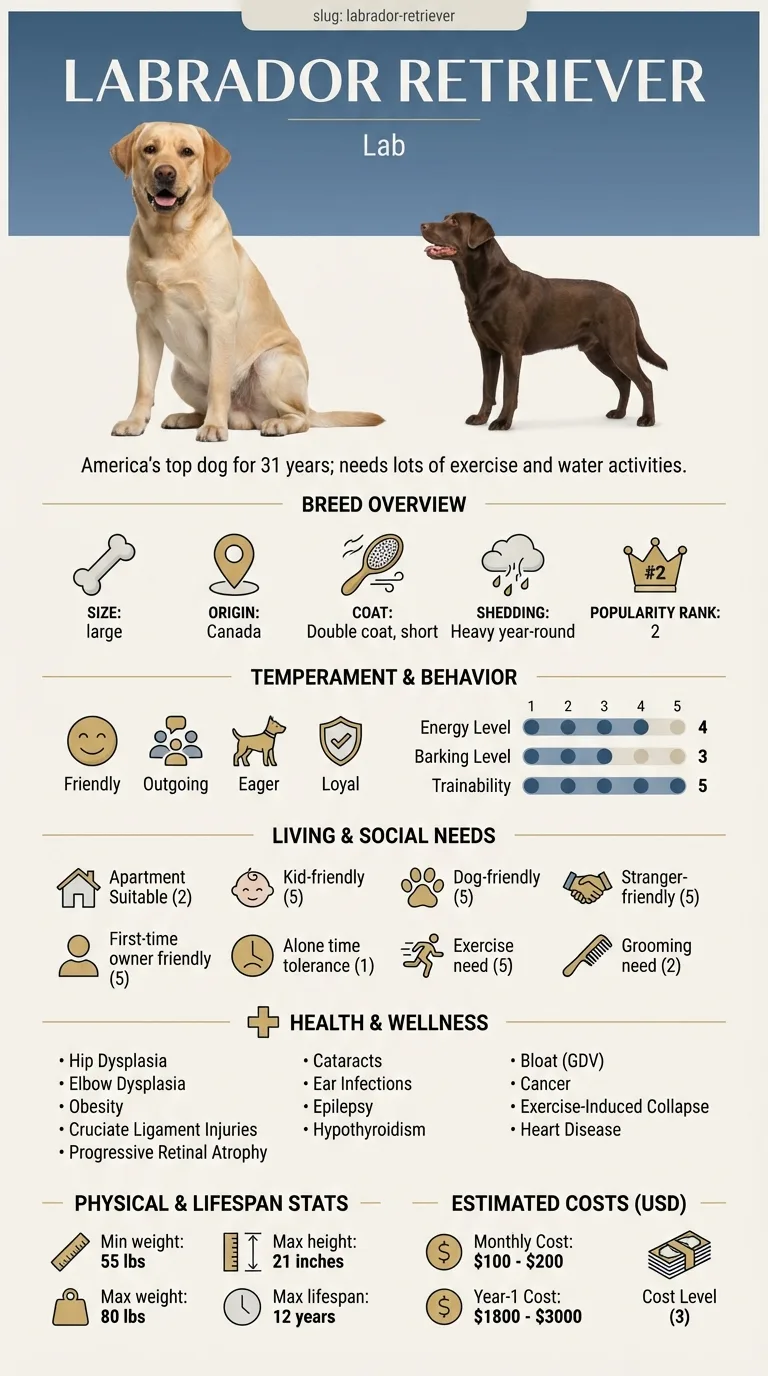
Owners of a large-breed Lab noticing an unsteady, swaying gait, particularly in the hind legs, trying to understand how worried to be given how strongly this condition is associated with other breeds.
This guide is not medical advice. If your dog shows pain, sudden behavior change, or worsening symptoms, consult a licensed veterinarian.
Some links may be affiliate links. We may earn a commission at no extra cost to you. We only suggest products we believe are helpful for dog owners.
We research and check what we publish, but we do not warrant that any figure, date, price, or statement is accurate, complete, or current, and we accept no liability for any loss, cost, injury, or other harm arising from the use of this site. Use it as one reference among several. You remain responsible for your own decisions and for your dog's care - confirm anything that matters with a licensed veterinarian or another qualified professional before you act on it. Full disclaimer.
Wobbler syndrome, or cervical spondylomyelopathy, is compression of the spinal cord in the neck that produces an unsteady, swaying gait, most classically documented in Dobermans and Great Danes. It's uncommon in Labrador Retrievers, and hip dysplasia or lumbar disc disease are far more likely explanations for gait changes in this breed, though cervical spinal cord compression remains part of a thorough neurological differential when other causes don't fit the clinical picture.
Wobbler syndrome is genuinely uncommon in Labrador Retrievers compared to breeds like Dobermans and Great Danes where it's a well-recognized, frequently discussed condition, making it a less statistically likely explanation for gait changes in this breed even though it isn't impossible.
Labradors don't carry the strong documented genetic and conformational predisposition toward cervical spondylomyelopathy that Dobermans and Great Danes do, which is exactly why this diagnosis would be considered less likely in this breed's neurological workups. At 55 to 80 pounds, their frame is also generally less predisposed to the specific cervical instability patterns seen in giant breeds like Great Danes.
There's no well-established environmental trigger specific to this condition in Labradors, given how uncommon it is in the breed to begin with. General factors like rapid growth and excess body weight can theoretically add strain to any developing spine, but these are more directly tied to this breed's far more common hip dysplasia and lumbar disc disease risks instead.
See a vet for any persistent unsteady or swaying gait, weakness, or coordination changes — while wobbler syndrome itself is unlikely in this breed, the more common alternatives like hip dysplasia and lumbar disc disease also benefit significantly from prompt diagnosis and management.
See all Labrador Retriever health problems, which breeds are prone to wobbler syndrome, or the full Labrador Retriever breed guide for temperament, exercise needs and ownership costs.
If wobbler syndrome is confirmed, conservative management shows results within four to eight weeks; surgical cases typically involve a longer recovery of two to three months with structured rehabilitation. Given how uncommon this diagnosis is in Labradors, most gait-change workups in this breed will land on a different, more common condition instead.
Success means restored or stabilized function through whichever treatment path matches the confirmed severity, whether that's conservative management or surgery — and, given the rarity of this specific diagnosis in the breed, success for most Lab owners investigating a gait change will mean identifying and treating one of the far more common alternative causes instead.
Wobbler syndrome describes compression of the spinal cord in the neck (cervical) region, caused by malformation, instability, or disc-related changes in the cervical vertebrae, which puts pressure on the spinal cord and disrupts nerve signals to the legs — producing the characteristic unsteady, swaying 'wobbling' gait, most pronounced in the hind legs, that gives the condition its name. It's most classically documented in Dobermans (often disc-associated, in middle-aged dogs) and Great Danes (often bony malformation-associated, in younger dogs), where specific genetic and conformational factors are well established.
Labrador Retrievers don't carry the same strong documented predisposition toward this condition that those breeds do, which is exactly why a vet investigating an unsteady gait in a Lab would typically consider several other possibilities first — hip dysplasia, general intervertebral disc disease, or age-related degenerative changes — before landing on wobbler syndrome specifically. That said, cervical spinal cord compression can occur in any large breed, including occasionally in Labradors, so it remains part of a thorough neurological differential rather than something to rule out purely based on breed.
Diagnosis when it is suspected requires advanced imaging — MRI or CT — since plain X-rays can suggest but not definitively confirm the specific spinal cord compression this condition involves, and severity ranges from mild, manageable cases to more significant, surgery-requiring compression.

Given how many conditions can produce a similar-looking gait change in this breed, a systematic workup matters more than guessing based on symptoms alone.
When seven-year-old Lab Marley started showing an unsteady, swaying gait in his back legs, his owner Priya had read about wobbler syndrome online and worried that's what was happening. Her vet explained the condition is uncommon in Labradors and ran hip and lumbar spine X-rays first, given how much more likely those explanations were for this breed. The imaging revealed moderate hip dysplasia with early arthritis, a far more statistically likely explanation that fit Marley's specific symptom pattern well. Priya started a weight-management and joint-support plan, and within two months Marley's gait had noticeably steadied, confirming the hip-related diagnosis had been the right one to pursue first.
Key takeaway: A well-known condition discussed heavily online isn't necessarily the most likely explanation for your specific breed — trusting a systematic workup that starts with the statistically probable causes usually gets to an accurate answer faster than chasing the more dramatic-sounding diagnosis first.
No — it's far more classically associated with Dobermans and Great Danes, where specific genetic and conformational factors are well documented. It's uncommon in Labradors, though not impossible, and a vet would typically consider other more likely causes of gait changes first.
An unsteady, swaying gait, most pronounced in the hind legs, caused by spinal cord compression in the neck region. Affected dogs may also show weakness, a wide-based stance, or difficulty with coordinated movement.
Hip dysplasia and lumbar intervertebral disc disease are both significantly more common causes of gait changes in Labrador Retrievers specifically, and a thorough vet would typically investigate these possibilities before considering cervical wobbler syndrome.
A full neurological exam to localize the problem, followed by advanced imaging like MRI or CT of the cervical spine, is the standard diagnostic approach, since plain X-rays alone can't definitively confirm the specific spinal cord compression involved.
Costs range from $500 for conservative management with medication and activity restriction up to $7,000 for surgical correction in more severe cases, reflecting the wide range of severity this condition can present with.
Mild cases are sometimes managed with activity restriction, a supportive harness instead of a neck collar, and anti-inflammatory medication, though more significant spinal cord compression generally responds better to surgical decompression.
It's reasonable to be aware of it, but given how uncommon it is in this breed compared to Dobermans and Great Danes, hip dysplasia and other more common large-breed orthopedic conditions are far more statistically likely explanations for any gait concerns in a young Lab.
No — it's far more classically associated with Dobermans and Great Danes; it's uncommon but not impossible in Labradors.
An unsteady, swaying gait most pronounced in the hind legs, caused by spinal cord compression in the neck.
Hip dysplasia and lumbar disc disease are both significantly more common explanations in this breed.
Roughly $500 for conservative management up to $7,000 for surgical correction, depending on severity.
MRI or CT imaging of the cervical spine, since plain X-rays alone can't confirm the specific spinal cord compression.
A one-page prep sheet for this condition: the signs, the questions to ask, what to get priced. Unlocks here.
You get: Vet visit prep sheet
No spam. One-click unsubscribe. See our privacy policy.
Preview page 1 before you decide.