Health
Is stenotic nares a Labrador Retriever concern?
No — it's specific to flat-faced brachycephalic breeds; Labradors have a normal muzzle with no documented predisposition toward it.

Quick answer
Is stenotic nares a Labrador Retriever concern?
No — it's specific to flat-faced brachycephalic breeds; Labradors have a normal muzzle with no documented predisposition toward it.
If you're searching for this term because you're worried about your Lab's breathing, the more useful, breed-relevant answer is that this specific condition doesn't apply — but there is a real nasal health topic worth knowing about in longer-nosed breeds like this one, and it's not about airflow at all.
Owners who've encountered brachycephalic breathing terminology online and want to know what, if anything, genuinely applies to their normal-muzzled Labrador.
This guide is not medical advice. If your dog shows pain, sudden behavior change, or worsening symptoms, consult a licensed veterinarian.
Some links may be affiliate links. We may earn a commission at no extra cost to you. We only suggest products we believe are helpful for dog owners.
We research and check what we publish, but we do not warrant that any figure, date, price, or statement is accurate, complete, or current, and we accept no liability for any loss, cost, injury, or other harm arising from the use of this site. Use it as one reference among several. You remain responsible for your own decisions and for your dog's care - confirm anything that matters with a licensed veterinarian or another qualified professional before you act on it. Full disclaimer.
Stenotic nares, a narrowing of the nostrils seen in flat-faced brachycephalic breeds, is not a condition that applies to Labrador Retrievers, whose moderate-length muzzle carries no documented predisposition toward it. This breed's genuinely relevant nasal health consideration is instead an elevated nasal tumor risk associated with longer-nosed breeds generally, an entirely different, senior-onset concern unrelated to nostril anatomy.
Stenotic nares essentially does not occur as a breed-relevant condition in Labrador Retrievers. Nasal tumors, the more relevant consideration for longer-nosed breeds broadly, remain a relatively uncommon but documented senior-dog cancer type worth being aware of rather than a frequent occurrence.
Labradors are classified as mesocephalic, with a moderate, non-extreme muzzle length, meaning they lack the compressed skull structure that causes stenotic nares in brachycephalic breeds. Their proportionally longer nasal passage, relative to flat-faced breeds, is instead cited in some research as a factor in elevated nasal tumor risk, a completely unrelated mechanism from nostril shape.
There's no environmental trigger relevant to stenotic nares in this breed since the condition doesn't apply. For nasal tumor risk broadly, chronic exposure to airborne irritants or pollutants over a dog's lifetime is a general contributing factor discussed in veterinary oncology, though it's not specific to Labradors alone.
See a vet for one-sided nasal discharge (especially bloody), noisy breathing from one side, facial swelling, or sneezing that persists beyond one to two weeks — these warrant investigation rather than a wait-and-see approach, particularly in a senior dog.
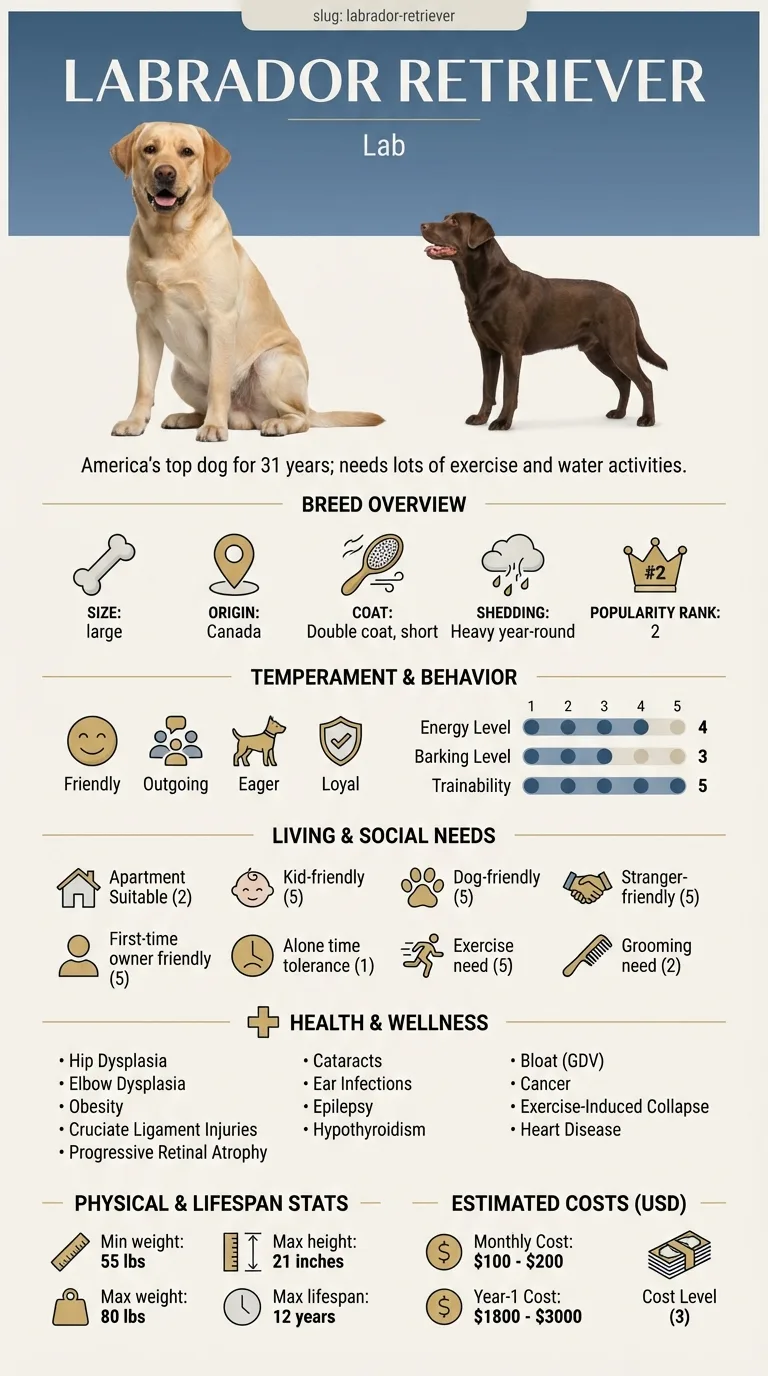
See all Labrador Retriever health problems, which breeds are prone to small nostrils stenotic nares, or the full Labrador Retriever breed guide for temperament, exercise needs and ownership costs.
Since stenotic nares doesn't apply to this breed, there's no relevant timeline for it. If a nasal tumor is suspected, diagnostic workup typically takes one to two weeks for imaging and biopsy results, with treatment planning following based on the specific findings.
Success here mostly means accurate information — understanding that this specific condition isn't a Labrador concern — combined with appropriate vigilance for the genuinely relevant, unrelated nasal health consideration this breed does carry as it ages.
Stenotic nares develops because a compressed, shortened skull crowds the cartilage that normally holds the nostrils open, causing them to collapse inward, especially during inhalation. A Labrador's skull and muzzle proportions are entirely different — classified as mesocephalic, a moderate, non-extreme length — meaning there's no crowding effect on the nasal cartilage and no documented breed predisposition toward this anatomical narrowing at all.
What's actually a documented and relevant nasal health consideration for longer-nosed breeds, somewhat counterintuitively, is nasal tumor risk. Several studies have found that dolichocephalic and mesocephalic (longer and moderate-nosed) breeds carry higher risk for certain nasal tumors compared to brachycephalic breeds, possibly related to the greater surface area of nasal passage lining exposed to inhaled carcinogens over a longer nasal cavity. This is a senior-onset concern, generally showing up as one-sided nasal discharge (sometimes bloody), noisy or obstructed breathing on one side, facial swelling, or sneezing that doesn't resolve — a genuinely different presentation and mechanism from anything related to nostril shape.
The practical takeaway is that a Lab's nostrils themselves function completely normally, but this breed's proportionally longer nasal passage is worth being aware of for a different, unrelated reason entirely as the dog ages, particularly for a persistent one-sided nasal symptom that doesn't fit a simple cold or seasonal irritation.

None of this relates to nostril shape — these are the signs that matter for the genuinely relevant senior-onset nasal concern in longer-nosed breeds.
After reading about stenotic nares online, new Lab owner Priti spent an evening worried that her puppy's occasional loud snoring meant a breathing obstruction requiring surgery. Her vet reassured her that Labradors don't have the anatomical narrowing that condition describes, and that normal puppy snoring wasn't a concern. Years later, at age eleven, that same dog developed persistent discharge from just one nostril. Remembering her vet's earlier explanation that longer-nosed breeds carry a different, unrelated nasal risk, Priti brought him in promptly rather than assuming it was a simple cold. Imaging confirmed an early-stage nasal tumor, caught early enough for a meaningful treatment discussion with an oncologist.
Key takeaway: Understanding which conditions genuinely apply to your specific breed, rather than borrowing worry from a different breed's anatomy, actually helps you notice the real warning signs when they eventually show up.
No — this is an anatomical trait specific to flat-faced brachycephalic breeds like Bulldogs and Pugs. Labradors have a normal, moderate-length muzzle with no documented predisposition toward narrowed nostrils.
Occasional snoring or nasal noise in a Labrador is usually normal and unrelated to any nostril narrowing — it can reflect sleeping position, mild allergies, or simple anatomy variation rather than a breathing obstruction condition.
Interestingly, yes — several studies have found dolichocephalic and mesocephalic breeds carry elevated nasal tumor risk compared to brachycephalic breeds, a completely different concern from nostril shape, generally showing up in senior dogs.
One-sided nasal discharge (sometimes bloody), noisy breathing from one side, facial swelling, and sneezing that doesn't resolve over one to two weeks are the classic signs, typically emerging in senior dogs.
Imaging like CT scans, combined with a biopsy of the affected tissue, are the standard diagnostic tools, usually pursued after persistent one-sided nasal symptoms don't respond to simpler initial treatments.
Diagnostic workup including CT and biopsy commonly runs $1,500–$3,000, with treatment costs, which may include radiation therapy, running significantly higher depending on the specific tumor type and treatment plan chosen.
No — the anatomical breathing obstruction concerns relevant to brachycephalic breeds simply don't apply to a Lab's normal muzzle structure, though it's still worth watching for the unrelated nasal symptoms described above as your dog ages.
No — it's specific to flat-faced brachycephalic breeds; Labradors have a normal muzzle with no documented predisposition toward it.
Usually normal variation like sleeping position or mild allergies, unrelated to any nostril narrowing condition.
Yes — somewhat counterintuitively, longer-nosed breeds show elevated nasal tumor risk compared to brachycephalic breeds, a senior-onset concern unrelated to nostril shape.
One-sided nasal discharge, especially if bloody or persistent, along with noisy breathing from one side.
Typically $1,500–$3,000 for imaging and biopsy.
A one-page prep sheet for this condition: the signs, the questions to ask, what to get priced. Unlocks here.
You get: Vet visit prep sheet
No spam. One-click unsubscribe. See our privacy policy.
Preview page 1 before you decide.