Health
Is one seizure a dog emergency?
Not necessarily — a single short seizure under five minutes usually warrants a same-week vet visit rather than an emergency trip, unless it's the first one or lasts longer.

Quick answer
Is one seizure a dog emergency?
Not necessarily — a single short seizure under five minutes usually warrants a same-week vet visit rather than an emergency trip, unless it's the first one or lasts longer.
'Neurologic disease' isn't one diagnosis — it's an umbrella covering epilepsy, spinal cord compression, peripheral nerve disorders, and more, each with a completely different urgency level and treatment path.
Owners who've come across an alarming statistic online and want to understand what it actually means for their specific dog, and owners of a dog with a new, unexplained neurologic symptom trying to figure out how worried to be.
This guide is not medical advice. If your dog shows pain, sudden behavior change, or worsening symptoms, consult a licensed veterinarian.
Some links may be affiliate links. We may earn a commission at no extra cost to you. We only suggest products we believe are helpful for dog owners.
We research and check what we publish, but we do not warrant that any figure, date, price, or statement is accurate, complete, or current, and we accept no liability for any loss, cost, injury, or other harm arising from the use of this site. Use it as one reference among several. You remain responsible for your own decisions and for your dog's care - confirm anything that matters with a licensed veterinarian or another qualified professional before you act on it. Full disclaimer.
Check this first
Given how broad this category is, here's a practical framework for triaging a new neurologic symptom at home before you can get to a vet.
If any of these apply, call your vet or an emergency clinic now. The rest of this page is for the cases that are not an emergency.
Neurologic disease in Labrador Retrievers is a broad claims category covering distinct conditions like idiopathic epilepsy, spinal disc disease, and peripheral nerve issues, each with its own urgency level and treatment path. Insurance data shows this breed with elevated claims in the category overall, but understanding which specific condition is actually involved matters far more for any individual dog than the umbrella statistic itself.
Neurologic conditions as a broad category are diagnosed often enough in Labradors to show up meaningfully in aggregated insurance claims data, though this reflects the combined frequency of several distinct conditions rather than any single overwhelming risk.
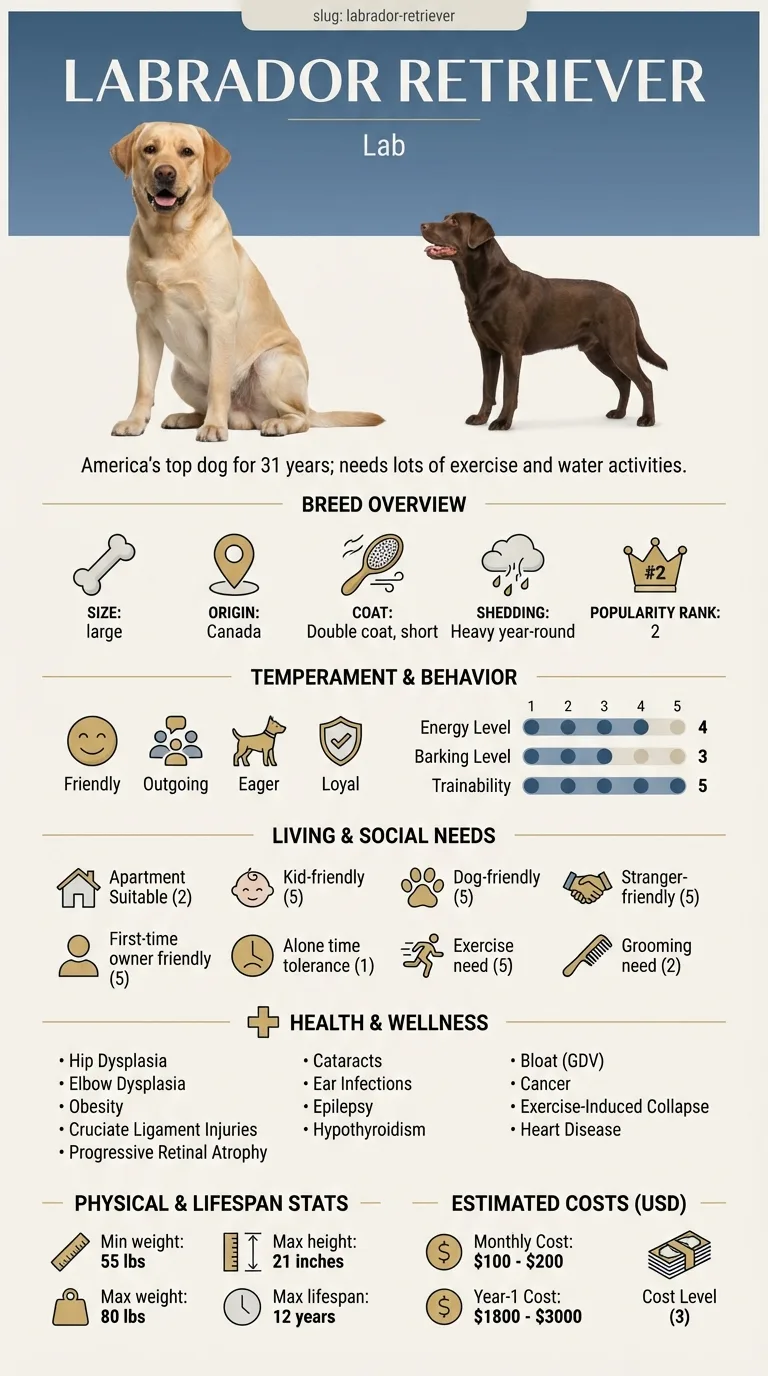
As a large, long-lived breed at 55 to 80 pounds with a 10 to 12 year lifespan, Labradors have enough years for both congenital neurologic predispositions and age-related degenerative processes to potentially emerge, which contributes to the broad category showing up across a real span of a dog's life rather than concentrated in one age group. Certain conditions within this category, like idiopathic epilepsy, also have documented genetic components in specific lines.
For epilepsy specifically, there's no clear environmental trigger in most idiopathic cases, though stress and sleep disruption are sometimes reported by owners as seizure triggers in already-diagnosed dogs. For spinal and peripheral nerve issues, obesity and high-impact activity can accelerate the underlying mechanical or degenerative processes involved.
Seek immediate emergency care for a seizure lasting more than five minutes, repeated seizures without recovery in between, sudden paralysis or significant weakness, or sudden severe disorientation. Schedule a prompt but non-emergency visit for a single short seizure, gradual weakness developing over weeks, or any other new neurologic symptom that doesn't fit the emergency criteria above.
See all Labrador Retriever health problems, which breeds are prone to neurologic disease, or the full Labrador Retriever breed guide for temperament, exercise needs and ownership costs.
Timelines vary enormously by specific condition — epilepsy management is typically an ongoing medication and monitoring process with no defined endpoint, while an acute spinal event has its own urgent, time-sensitive treatment window measured in hours to days.
Success looks different for each condition within this category — for epilepsy, it means well-controlled seizure frequency on medication; for a spinal or nerve condition, it means restored or stabilized function. There's no single definition of success across a category this broad, which is exactly why getting a specific diagnosis matters more than reacting to the umbrella term alone.
Insurance claims data groups a wide range of conditions under a neurologic heading, and for Labradors, several distinct issues contribute to that overall picture: epilepsy (recurrent seizures, often with no identifiable structural cause), intervertebral disc disease and related spinal cord compression, degenerative myelopathy in some individual lines, peripheral nerve issues like laryngeal paralysis in seniors, and less commonly, structural brain abnormalities.
Each of these has a wildly different profile. Idiopathic epilepsy, one of the more frequently diagnosed causes, often first appears between one and five years old and, while it requires lifelong management with anti-seizure medication in many cases, doesn't shorten a dog's life the way a progressive spinal cord disease might. A single seizure lasting under five minutes that resolves on its own is treated very differently by veterinary protocol than a seizure that doesn't stop (status epilepticus), which is a true emergency.
The honest takeaway from claims data showing elevated neurologic risk isn't that any specific outcome is likely for your individual dog — it's that this is a category worth taking seriously enough to know the emergency thresholds for, since several of the conditions within it do carry real urgency when they present acutely.

After reading that Labradors show elevated neurologic disease claims in an online article, Priya spent a worried evening researching every possible condition on the list before her dog, Fern, had shown a single symptom. A few months later, Fern did have one seizure lasting about ninety seconds, followed by full recovery within minutes. Priya's vet explained that a single short seizure, especially a first one, warranted diagnostic bloodwork and monitoring rather than panic, and that many dogs go on to live completely normal lives with well-managed idiopathic epilepsy if it's confirmed. Fern hasn't had another seizure in the year since, and no medication has been needed so far.
Key takeaway: An elevated risk statistic for a broad category describes the population, not any individual dog's actual outcome — a specific symptom deserves a specific diagnosis rather than reacting to the umbrella statistic alone.
The category spans several distinct conditions — epilepsy, spinal disc disease, and peripheral nerve issues among them — that together show up meaningfully in this breed's claims data, though no single condition within the category is necessarily dominant or inevitable for any given dog.
Idiopathic epilepsy is one of the more frequently diagnosed neurologic conditions in dogs broadly, including in Labradors, typically first appearing between one and five years old and managed with lifelong anti-seizure medication in many cases.
Not always — a single seizure under five minutes that resolves on its own generally warrants a same-week vet visit rather than an emergency trip, unless it's a first-time event, occurs in clusters, or lasts more than five minutes, all of which are more urgent.
It's a seizure lasting more than five minutes, or repeated seizures without full recovery in between — this is a true veterinary emergency requiring immediate treatment, since prolonged seizure activity can cause additional harm the longer it continues.
Diagnosis often involves ruling out other causes through bloodwork and sometimes imaging, since idiopathic epilepsy is partly a diagnosis of exclusion. Treatment is typically daily anti-seizure medication, adjusted based on seizure frequency and severity over time.
Anti-seizure medication typically runs $30–$80 a month depending on the drug and dosage, plus periodic bloodwork to monitor levels and organ function, adding $75–$150 per recheck a few times a year.
A seizure lasting more than five minutes, sudden paralysis or significant weakness, or sudden severe disorientation should all prompt an immediate emergency visit rather than waiting for the next available regular appointment.
Not necessarily — a single short seizure under five minutes usually warrants a same-week vet visit rather than an emergency trip, unless it's the first one or lasts longer.
A seizure lasting more than five minutes, or multiple seizures without full recovery in between, called status epilepticus.
Typically $30–$80 a month depending on the specific drug and dosage.
Generally no, with appropriate management — it's a manageable chronic condition for most affected dogs rather than a life-shortening disease.
Yes — this should be evaluated immediately, since it can indicate acute spinal cord compression with a time-sensitive treatment window.
A one-page prep sheet for this condition: the signs, the questions to ask, what to get priced. Unlocks here.
You get: Vet visit prep sheet
No spam. One-click unsubscribe. See our privacy policy.
Preview page 1 before you decide.