Bloodhound vs Labrador Retriever: Which Suits Your Home?
Quick answer
Bloodhound or Labrador Retriever?
For most households the Labrador is the easier, more versatile dog - better trained, friendlier across the board - while the Bloodhound is the choice if scent work and a calmer pace matter more to you than convenience.
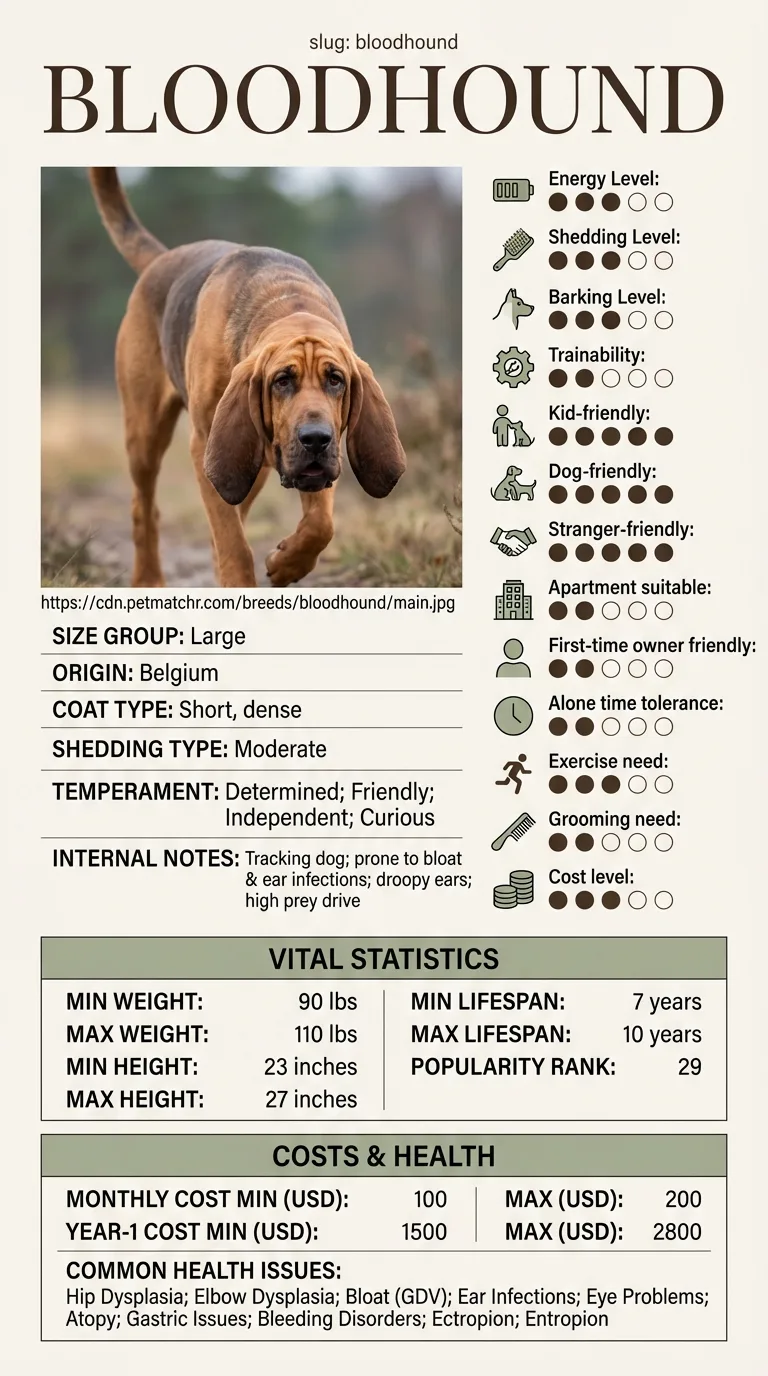
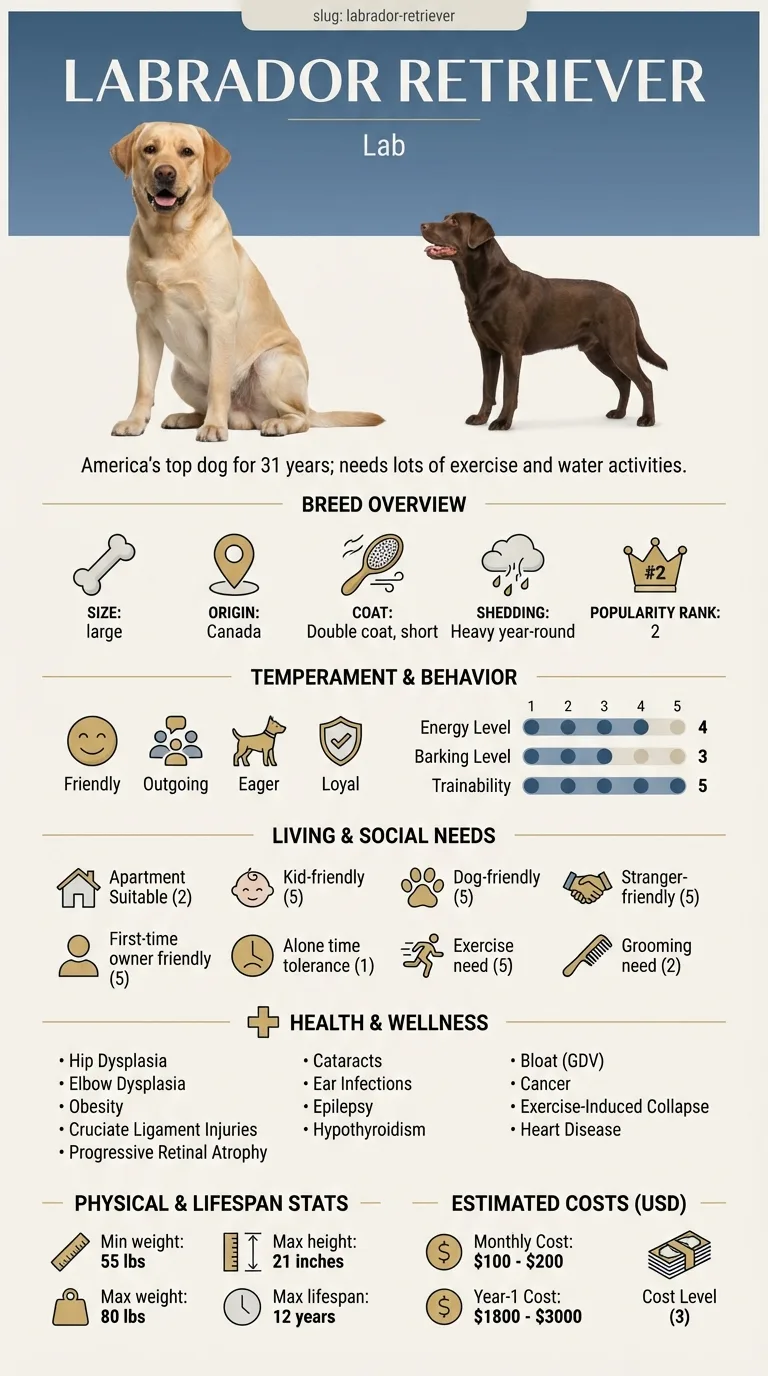
Bloodhound or Labrador Retriever? On paper they differ most on good for first-time owners, and on the scales Bloodhound is the heavier at 90–110 lbs. Here is how the two compare on everything that shapes an ordinary week.
This is for someone already down to Bloodhound and Labrador Retriever and deciding between them. For this pair the decision usually turns on good for first-time owners and trainability, so those are covered first and in most detail. Both rate 2/5 for flats, so housing does not settle this one. There is no origin story here — only what changes about your week.
Quick verdict
Between Bloodhound and Labrador Retriever, good for first-time owners is what separates them; neither is the lower-effort dog overall.
Choose bloodhound if...
Choose Bloodhound if shedding is a problem in your house, your walking routine is modest and you want a dog that is more watchful with visitors.
Choose labrador retriever if...
Choose Labrador Retriever if this is your first dog, there are young children at home and you already have another dog.
Head-to-head comparison
Feature
bloodhound
labrador retriever
Winner
Size class
large
large
Equal
Weight
90–110 lbs
55–80 lbs
Equal
Height
23–27 in
21–24 in
Equal
Lifespan
7–10 years
10–12 years
labrador retriever
Exercise need
Moderate (3/5)
Very high (5/5)
bloodhound
Grooming need
Low (2/5)
Low (2/5)
Equal
Shedding
Moderate (3/5)
High (4/5)
bloodhound
Energy level
Moderate (3/5)
High (4/5)
Equal
Barking
Moderate (3/5)
Moderate (3/5)
Equal
Apartment suitability
Low (2/5)
Low (2/5)
Equal
Good for first-time owners
Low (2/5)
Very high (5/5)
labrador retriever
Tolerates being alone
Low (2/5)
Very low (1/5)
bloodhound
Trainability
Low (2/5)
Very high (5/5)
labrador retriever
Good with kids
High (4/5)
Very high (5/5)
labrador retriever
Good with other dogs
High (4/5)
Very high (5/5)
labrador retriever
Friendly to strangers
High (4/5)
Very high (5/5)
labrador retriever
Cost level
Moderate (3/5)
Moderate (3/5)
Equal
Coat
Short, dense
Double coat, short
Equal
Origin
Belgium
Canada
Equal
Typical monthly cost
$100–$200
$100–$200
Equal
Typical first-year cost
$1,500–$2,800
$1,800–$3,000
Equal
Deep dive
Size and build
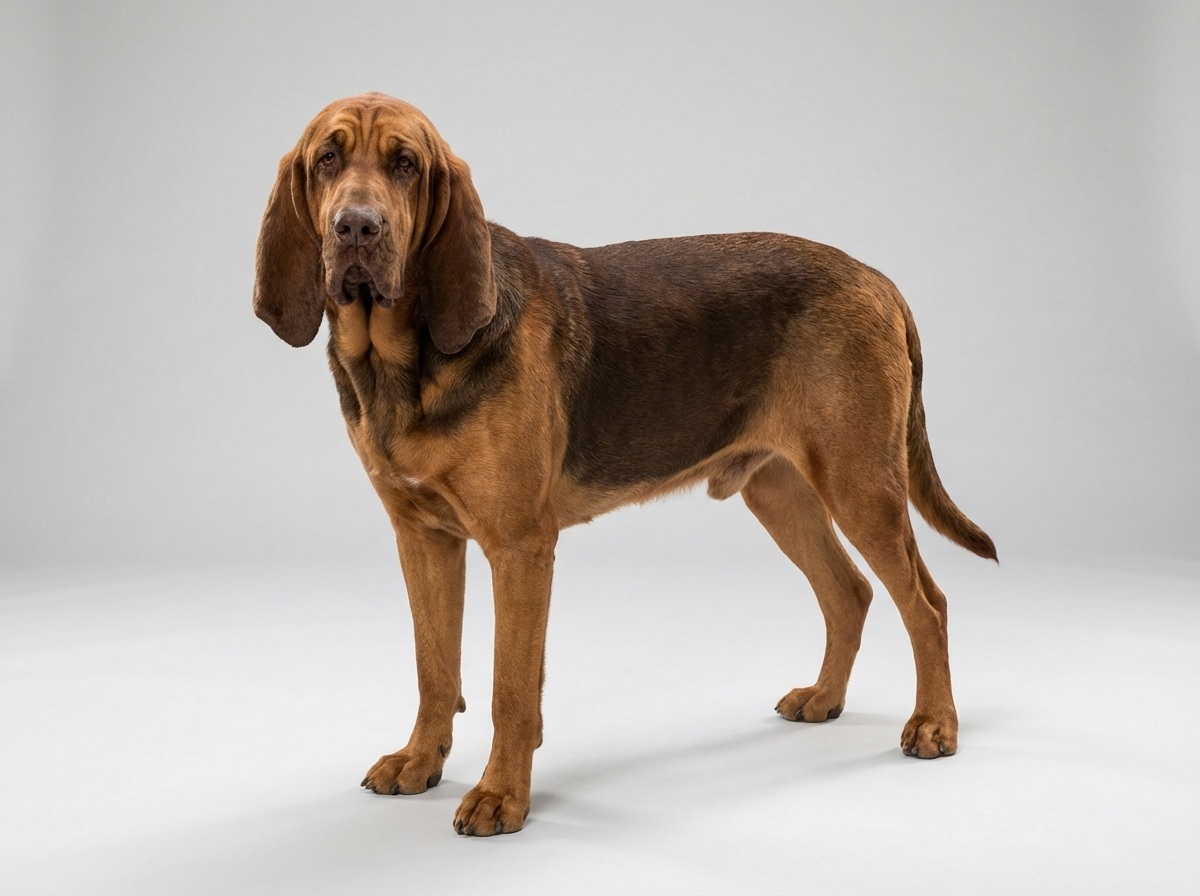
The Bloodhound outweighs the Labrador by up to 55 lbs at the high end - 90-110 lbs versus 55-80 lbs - while standing just a few inches taller (23-27 in against 21-24 in). Both are unmistakably large dogs, but the Bloodhound carries noticeably more mass on a similar frame length, which shows up in strength on the leash and floor space needed.
Energy and exercise
The Labrador needs more daily exercise, rating 5/5 versus the Bloodhound's 3/5, and it runs a bit hotter on general energy too, 4/5 against 3/5. Labs were bred to retrieve for hours in cold water and expect a real physical outlet; the Bloodhound's moderate needs are steadier, built around scent work rather than sustained athletic activity. A tired Lab is a good Lab - an under-exercised one gets into trouble fast.
Grooming and shedding
Grooming need ties at a low 2/5 for both breeds - easy to manage either way. Shedding is where they split: the Labrador rates a high 4/5 against the Bloodhound's moderate 3/5, thanks to that dense double coat blowing out seasonally. Low-maintenance brushing routines apply to both, but expect noticeably more loose hair with the Lab.
Apartment living, noise and time alone
Apartment suitability ties at a low 2/5 for both, and barking sits at a matching moderate 3/5. The real gap shows up in how each handles solitude: the Labrador's tolerance for being alone is rated a very low 1/5, actually worse than the Bloodhound's 2/5 - surprising, given the Lab's reputation as an easygoing family dog. Don't assume the more popular, more sociable breed handles an empty house better; on this measure, it doesn't.
Training and owner experience
The Labrador is far more trainable, 5/5 versus the Bloodhound's 2/5, and that carries straight into the first-time-owner score too - 5/5 for the Lab against a low 2/5 for the Bloodhound. This is one of the widest gaps in the whole comparison and a big reason Labs remain a default recommendation for new owners. If ease of training is your top priority, the numbers don't leave much room for debate.
Kids, other dogs and visitors
The Labrador rates at or near the top across the board here: 5/5 with kids, 5/5 with other dogs, 5/5 friendliness to strangers - all a step above the Bloodhound's already-solid 4/5 across the same three categories. Neither breed is a poor household fit, but the Lab's scores are about as strong as this comparison gets. If you're weighing this pairing purely on social temperament, the Labrador wins clearly.
Health and lifespan
Lifespan favors the Labrador modestly - 10 to 12 years versus the Bloodhound's 7 to 10. Shared risks include hip dysplasia, elbow dysplasia, bloat and ear infections. The Bloodhound's list adds eye problems, atopy, gastric issues, bleeding disorders, ectropion and entropion; the Labrador's longer list includes obesity, cruciate ligament injuries, progressive retinal atrophy, cataracts, epilepsy, hypothyroidism, cancer, exercise-induced collapse and heart disease.
Cost to keep
Cost is close to a wash: both rate a moderate 3/5, and monthly costs land in the identical $100-200 range. First-year costs run slightly higher for the Lab, $1,800-3,000 versus the Bloodhound's $1,500-2,800, likely reflecting higher food volume for a generally larger-bodied, more active dog. Beyond year one, expect the ongoing difference to stay fairly small.
Bloodhound vs Labrador Retriever at a glance
Bloodhound weighs 90–110 lbs and lives 7–10 years; Labrador Retriever weighs 55–80 lbs and lives 10–12 years. The two diverge most on good for first-time owners, trainability and exercise need. They are level on apartment suitability, barking and cost level, so those cannot decide it. Where the table declares a winner it means less work for the owner, nothing more; descriptive rows are left as ties on purpose. The value here is in the differences between the two columns; treat any single score as approximate.
Bloodhound vs Labrador Retriever: Which Suits Your Home? - Bloodhound vs Labrador Retriever at a glance
Frequently asked questions
How does a Bloodhound compare in size to a Labrador?
The Bloodhound is heavier - up to 110 lbs versus the Lab's 80 lbs - while standing only a couple inches taller. Both are solidly large-breed dogs.
Which sheds more?
The Labrador, rated 4/5 versus the Bloodhound's 3/5, thanks to its dense double coat. Grooming effort itself ties at a low 2/5 for both.
Which is better for a first-time owner?
The Labrador, decisively - a 5/5 first-time-owner score and 5/5 trainability against the Bloodhound's 2/5 on both.
How do they compare for apartment living?
Both tie at a low 2/5 for apartment suitability. Notably, the Labrador tolerates being alone worse than the Bloodhound does - 1/5 versus 2/5.
What's the cost difference?
Nearly none monthly - both run $100-200. First-year costs are close too, $1,800-3,000 for the Lab versus $1,500-2,800 for the Bloodhound.
Do their health risks overlap?
Yes, on the fundamentals - hip dysplasia, elbow dysplasia, bloat and ear infections appear on both lists. The Labrador's list is longer and includes cancer and obesity.
Which one lives longer?
The Labrador, by roughly two to five years - 10-12 years versus the Bloodhound's 7-10.
For most households the Labrador is the easier, more versatile dog - better trained, friendlier across the board - while the Bloodhound is the choice if scent work and a calmer pace matter more to you than convenience.
Costs
Monthly cost?
Both run $100-200 monthly - essentially tied.
Living
Exercise need?
The Labrador needs more - 5/5 versus the Bloodhound's 3/5.
Health
Lifespan?
10-12 years for the Labrador versus 7-10 for the Bloodhound.
Related DogBreedCompass guides
Bloodhound breed guide – Readers comparing the two usually want the full profile of Bloodhound before deciding.
Bloodhound vs Old English Sheepdog – Old English Sheepdog is the closest breed to Bloodhound on the measured axes, so it is the natural next comparison.
Health information here is general and is not veterinary advice. If your dog shows pain, sudden behaviour change, or worsening symptoms, consult a licensed veterinarian.
Some links on this site are affiliate links. We may earn a commission at no extra cost to you, and we only suggest products we believe are helpful for dog owners.
We research and check what we publish, but we do not warrant that any figure, date, price, or statement is accurate, complete, or current, and we accept no liability for any loss, cost, injury, or other harm arising from the use of this site. Use it as one reference among several. You remain responsible for your own decisions and for your dog's care - confirm anything that matters with a licensed veterinarian or another qualified professional before you act on it. Full disclaimer.