Living
Which one should I get?
If shedding is your main concern, the Labradoodle's 2/5 rating beats the Lab's 4/5. If you want the simplest coat to maintain and don't mind more hair around the house, the Lab is the lower-effort pick.

Quick answer
Which one should I get?
If shedding is your main concern, the Labradoodle's 2/5 rating beats the Lab's 4/5. If you want the simplest coat to maintain and don't mind more hair around the house, the Lab is the lower-effort pick.
Labradoodle or Labrador Retriever? On paper they differ most on grooming need, and on the scales Labrador Retriever is the heavier at 55–80 lbs. Here is how the two compare on everything that shapes an ordinary week.
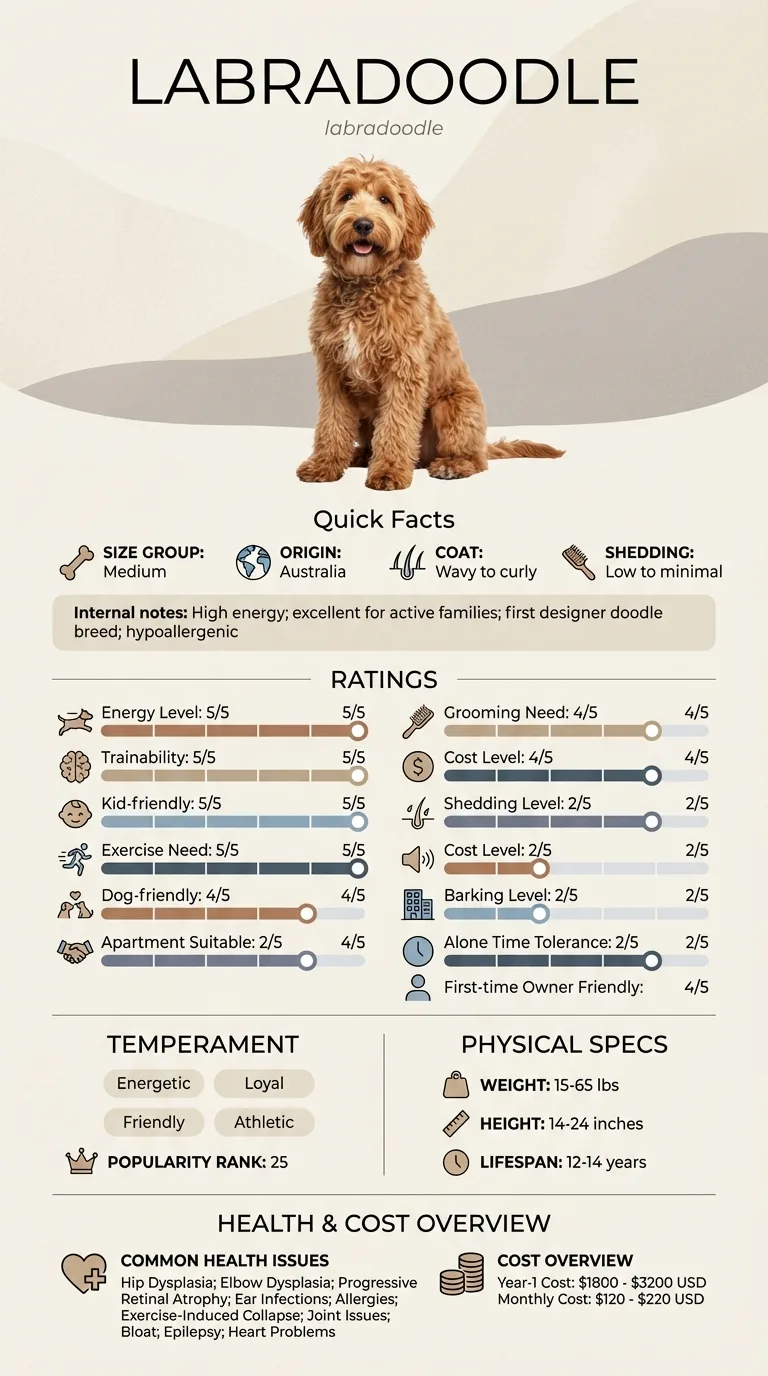
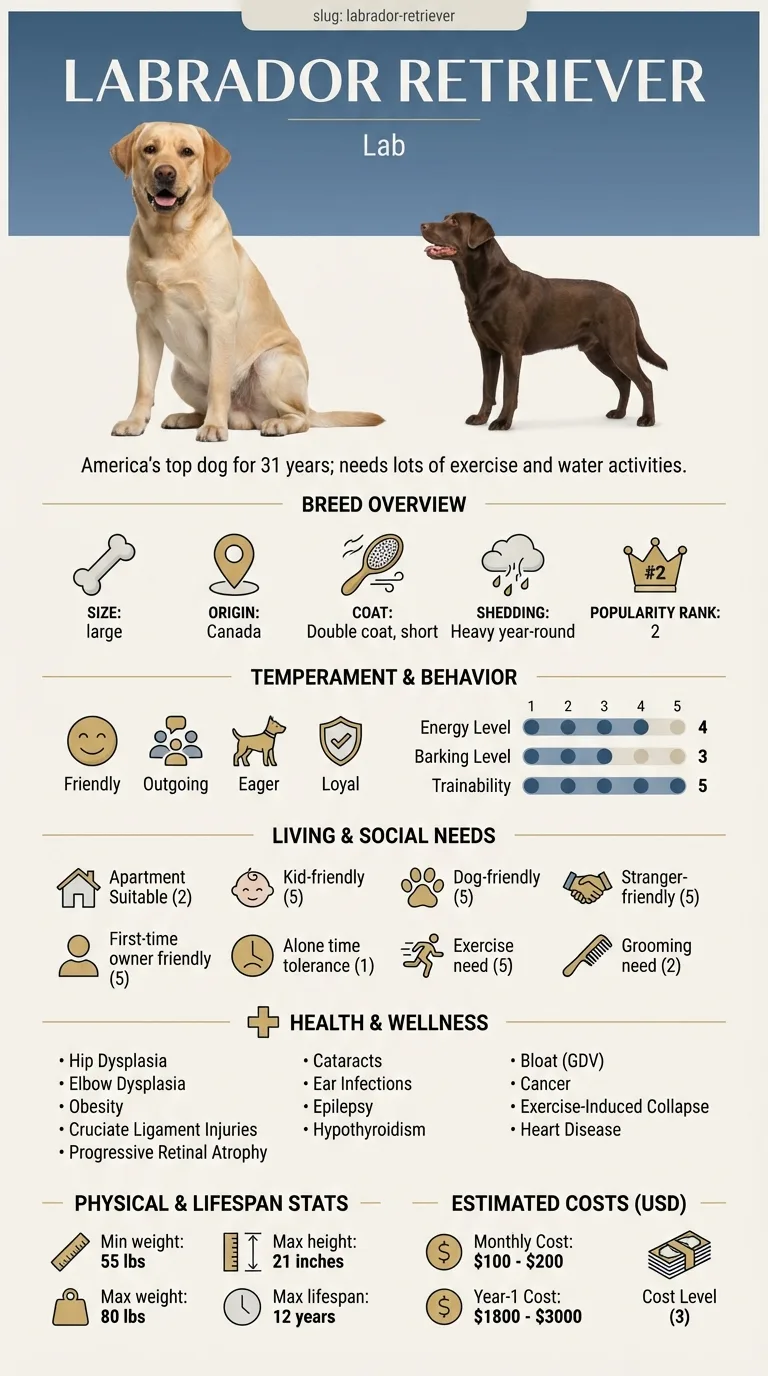
This is for someone already down to Labradoodle and Labrador Retriever and deciding between them. For this pair the decision usually turns on grooming need and shedding, so those are covered first and in most detail. Both rate 2/5 for flats, so housing does not settle this one. It is written for the decision rather than the breed history.
Between Labradoodle and Labrador Retriever, grooming need is what separates them, and Labrador Retriever is the lower-effort dog of the two to keep.
Choose Labradoodle if shedding is a problem in your house, a smaller dog suits your car, your home or your back and you want a dog that is more watchful with visitors.
Choose Labrador Retriever if this is your first dog, you do not want a standing grooming appointment and you already have another dog.
| Feature | labradoodle | labrador retriever | Winner |
|---|---|---|---|
| Size class | medium | large | Equal |
| Weight | 15–65 lbs | 55–80 lbs | Equal |
| Height | 14–24 in | 21–24 in | Equal |
| Lifespan | 12–14 years | 10–12 years | labradoodle |
| Exercise need | Very high (5/5) | Very high (5/5) | Equal |
| Grooming need | High (4/5) | Low (2/5) | labrador retriever |
| Shedding | Low (2/5) | High (4/5) | labradoodle |
| Energy level | Very high (5/5) | High (4/5) | Equal |
| Barking | Low (2/5) | Moderate (3/5) | labradoodle |
| Apartment suitability | Low (2/5) | Low (2/5) | Equal |
| Good for first-time owners | High (4/5) | Very high (5/5) | labrador retriever |
| Tolerates being alone | Low (2/5) | Very low (1/5) | labradoodle |
| Trainability | Very high (5/5) | Very high (5/5) | Equal |
| Good with kids | Very high (5/5) | Very high (5/5) | Equal |
| Good with other dogs | High (4/5) | Very high (5/5) | labrador retriever |
| Friendly to strangers | High (4/5) | Very high (5/5) | labrador retriever |
| Cost level | High (4/5) | Moderate (3/5) | labrador retriever |
| Coat | Wavy to curly | Double coat, short | Equal |
| Origin | Australia | Canada | Equal |
| Typical monthly cost | $120–$220 | $100–$200 | Equal |
| Typical first-year cost | $1,800–$3,200 | $1,800–$3,000 | Equal |
The Labradoodle's weight range is wide, 15-65 lbs, because it spans mini through standard breeding lines. The purebred Labrador is tighter and heavier on average, 55-80 lbs. Height is closer, 14-24 inches against 21-24 inches. A large standard Labradoodle can rival a Lab in size, but the breed's range means you could just as easily end up with something half that weight, so confirm the size line with the breeder before you commit.
Both breeds want a job. Exercise need rates 5/5, very high, for both the Labradoodle and the Lab, and energy level is high across the board too. Neither is a dog you can leave in a crate all day and expect calm behavior. If you're choosing between them for a lower-energy household, this table gives you no reason to think one is easier than the other on that front.
This is where the two genuinely diverge. The Labradoodle's coat needs more work, 4/5 grooming against the Lab's 2/5, but sheds far less, 2/5 versus the Lab's 4/5. If you're picking a Labradoodle specifically to avoid Lab-style shedding, that's a real, data-backed reason. If you'd rather skip the brushing and trimming and just vacuum more, the Lab is the lower-effort coat.
Apartment suitability ties at 2/5 for both, so neither is a natural fit for small spaces given their exercise needs. The Labradoodle barks less, 2/5 against the Lab's 3/5. Alone time is rough for both breeds, but the Lab does worse, 1/5 versus the Labradoodle's 2/5, reflecting the Lab's famously strong attachment to its people. A dog walker or midday break matters more for the Lab than for most other breeds on this site.
Both breeds train easily, tying at 5/5 trainability. The Lab edges ahead specifically for first-time owners, 5/5 versus the Labradoodle's 4/5, likely reflecting decades as America's go-to family and service breed. Either dog will pick up commands fast; the gap here is small enough that other factors, like coat care or budget, should probably decide this one instead of trainability.
Kids scores tie at 5/5 for both breeds, so this isn't a differentiator. The Lab wins narrowly on sociability elsewhere, rating higher with other dogs (5/5 vs. 4/5) and with strangers (5/5 vs. 4/5). Both are outgoing, people-oriented dogs; the Lab's scores just push slightly further in that direction, which can matter if you have a busy household with frequent guests.
The Labradoodle lives longer on average, 12-14 years against the Lab's 10-12. The health overlap is substantial, though: both lists include hip and elbow dysplasia, progressive retinal atrophy, ear infections, epilepsy, bloat, and exercise-induced collapse. The Lab's list runs longer and adds cancer, obesity, and cruciate ligament injuries, conditions tied partly to its heavier build and its enthusiasm for food.
Cost level favors the Lab, 3/5 moderate against the Labradoodle's 4/5 high, but the monthly ranges are close: $120-220 for the Labradoodle versus $100-200 for the Lab. First-year costs land almost identically, $1,800-3,200 versus $1,800-3,000. The gap is mostly grooming, not a fundamentally more expensive dog, so don't let the cost-level score alone drive the decision. Factor in whether you'll do the brushing yourself or pay a groomer, since that choice moves the real number more than the breed does.
Labradoodle weighs 15–65 lbs and lives 12–14 years; Labrador Retriever weighs 55–80 lbs and lives 10–12 years. The two diverge most on grooming need and shedding. They are level on apartment suitability, exercise need and good with kids, so those cannot decide it. In the table, a "winner" means easier for an ordinary household — not better. Size, coat and origin are recorded without a verdict. Because both breeds are scored the same way, the gaps are reliable even where the absolute numbers are rough.

Not quite. The Labradoodle is a Poodle-Labrador cross, so it inherits the Poodle's lower-shedding coat and generally weighs less on average, though its size range is much wider. Health-wise the two share a lot of the same risks, since half the Labradoodle's genetics come straight from the Lab.
The Labradoodle, rating 2/5 against the Lab's 4/5. If avoiding a house covered in dog hair is your main reason for considering a Labradoodle over a Lab, the data supports that choice.
The Lab, slightly, at 5/5 versus the Labradoodle's 4/5. Both are highly trainable and beginner-friendly; the Lab's decades as a mainstream family dog give it a small edge in this specific score.
Yes, both rate 5/5, very high. Neither breed suits a household that can't commit to real daily activity, regardless of which one you pick.
The Labradoodle, typically 12-14 years against the Lab's 10-12. That two-year edge is one of the more consistent advantages hybrid vigor claims point to, though the health lists still overlap heavily.
Expect $120-220 a month for a Labradoodle and $100-200 for a Lab, with first-year costs landing close to each other, $1,800-3,200 versus $1,800-3,000. The difference is mostly grooming, not a dramatically pricier dog overall.
Substantially, yes. Hip and elbow dysplasia, progressive retinal atrophy, ear infections, epilepsy, bloat, and exercise-induced collapse appear on both lists. The Lab's list is longer and adds cancer and obesity risk on top of that shared foundation.
If shedding is your main concern, the Labradoodle's 2/5 rating beats the Lab's 4/5. If you want the simplest coat to maintain and don't mind more hair around the house, the Lab is the lower-effort pick.
$120-220 for a Labradoodle and $100-200 for a Lab, with the Labradoodle's grooming needs accounting for most of the difference.
Both rate 5/5, very high. Plan on real daily exercise for either breed, not a quick walk around the block.
The Labradoodle, at 12-14 years versus the Lab's 10-12, though the two-year edge doesn't erase the health risks they share.
Secure checkout on Stripe. We never see your card.
7-day money-back guarantee. Instant access.
Health information here is general and is not veterinary advice. If your dog shows pain, sudden behaviour change, or worsening symptoms, consult a licensed veterinarian.
Some links on this site are affiliate links. We may earn a commission at no extra cost to you, and we only suggest products we believe are helpful for dog owners.
We research and check what we publish, but we do not warrant that any figure, date, price, or statement is accurate, complete, or current, and we accept no liability for any loss, cost, injury, or other harm arising from the use of this site. Use it as one reference among several. You remain responsible for your own decisions and for your dog's care - confirm anything that matters with a licensed veterinarian or another qualified professional before you act on it. Full disclaimer.
Match your lifestyle to the right dog.
Take quizNot sure which breed is right for you? Take our 2-minute quiz to find out.
Take the quiz