Living
Better family dog?
The Labrador Retriever -- very high (5/5) with kids, other dogs, and strangers.

Quick answer
Better family dog?
The Labrador Retriever -- very high (5/5) with kids, other dogs, and strangers.
Chihuahua or Labrador Retriever? On paper they differ most on exercise need, and on the scales Labrador Retriever is the heavier at 55–80 lbs. Here is how the two compare on everything that shapes an ordinary week.
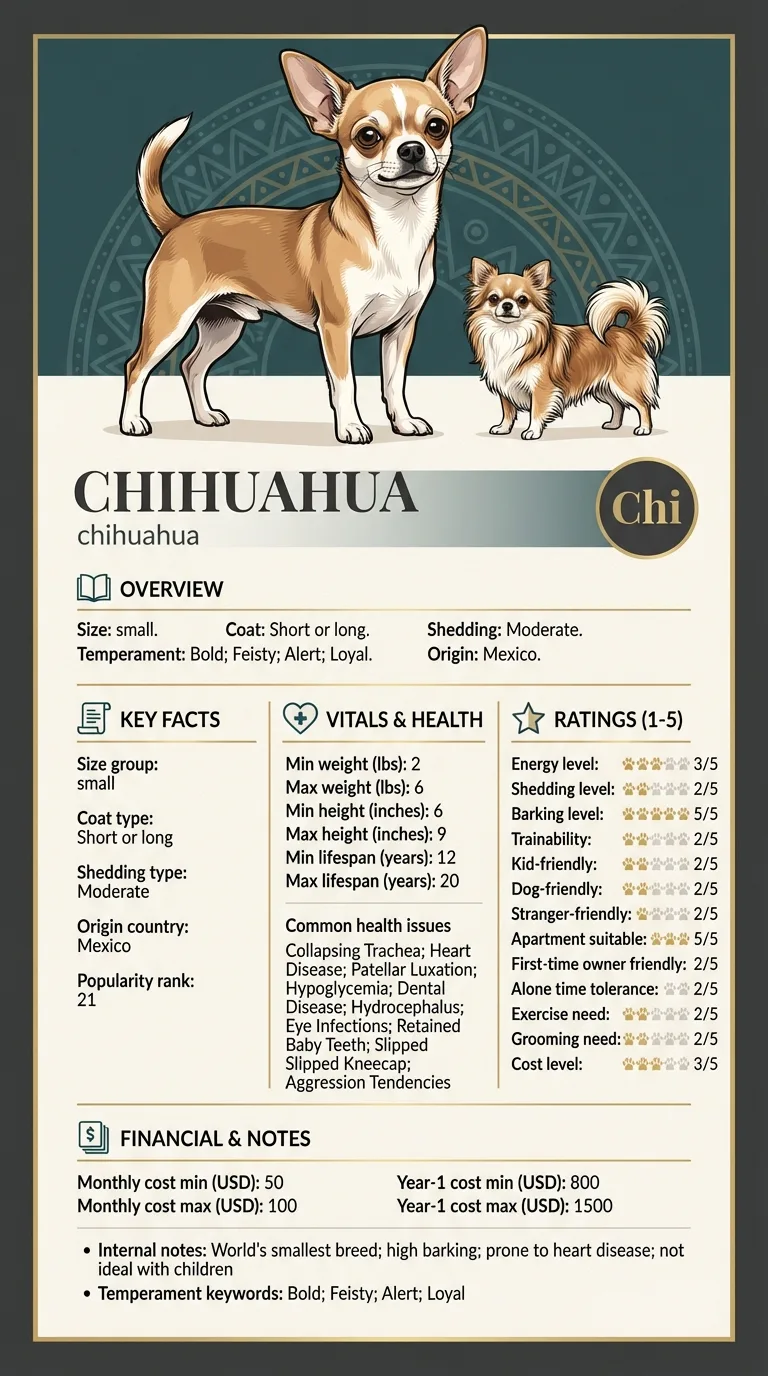
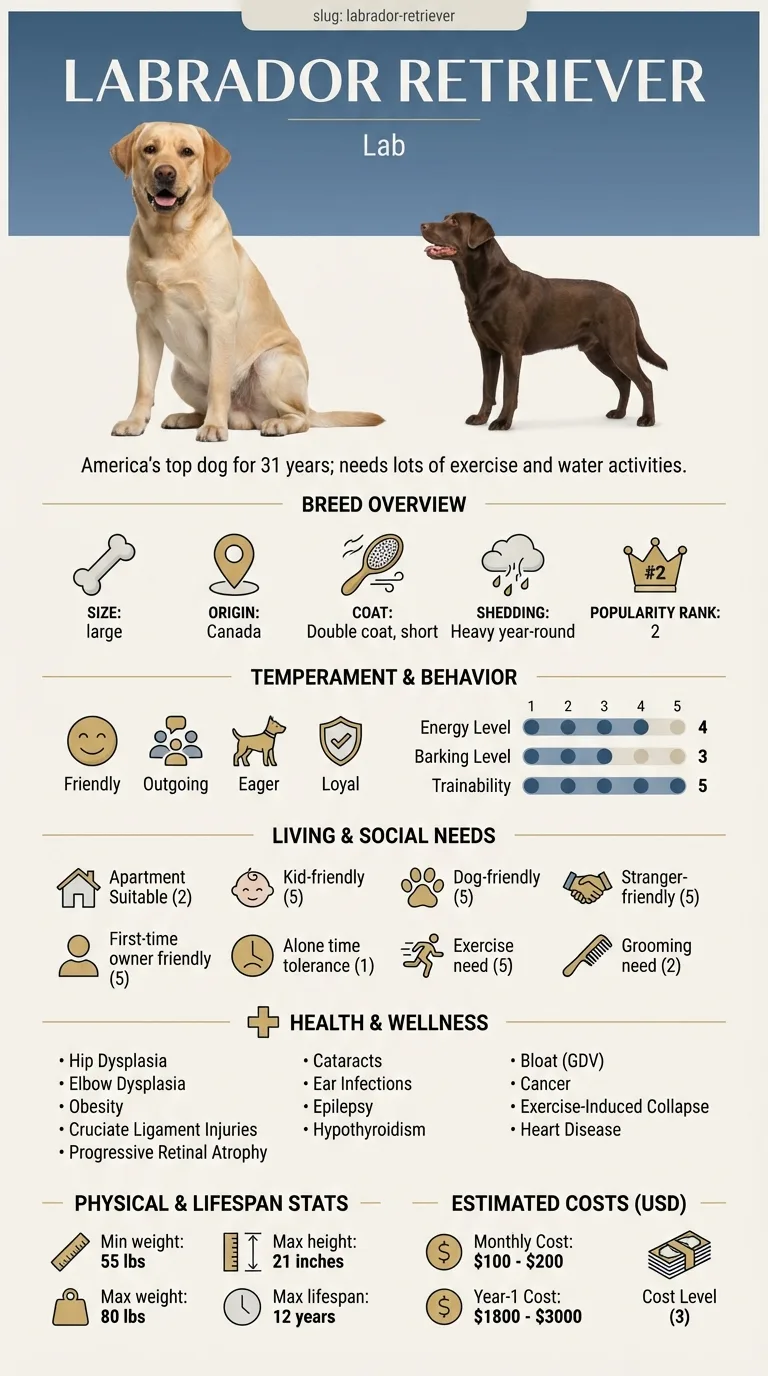
This is for someone already down to Chihuahua and Labrador Retriever and deciding between them. For this pair the decision usually turns on exercise need and apartment suitability, so those are covered first and in most detail. Anyone choosing from a flat has a clear answer here: Chihuahua rates 5/5 against 2/5. The focus throughout is on daily consequences rather than breed background.
Between Chihuahua and Labrador Retriever, exercise need is what separates them, and Chihuahua is the lower-effort dog of the two to keep.
Choose Chihuahua if you are in a flat or a smaller home, shedding is a problem in your house and your walking routine is modest.
Choose Labrador Retriever if this is your first dog, there are young children at home and you already have another dog.
| Feature | chihuahua | labrador retriever | Winner |
|---|---|---|---|
| Size class | small | large | Equal |
| Weight | 2–6 lbs | 55–80 lbs | Equal |
| Height | 6–9 in | 21–24 in | Equal |
| Lifespan | 12–20 years | 10–12 years | chihuahua |
| Exercise need | Low (2/5) | Very high (5/5) | chihuahua |
| Grooming need | Low (2/5) | Low (2/5) | Equal |
| Shedding | Low (2/5) | High (4/5) | chihuahua |
| Energy level | Moderate (3/5) | High (4/5) | Equal |
| Barking | Very high (5/5) | Moderate (3/5) | labrador retriever |
| Apartment suitability | Very high (5/5) | Low (2/5) | chihuahua |
| Good for first-time owners | Low (2/5) | Very high (5/5) | labrador retriever |
| Tolerates being alone | Low (2/5) | Very low (1/5) | chihuahua |
| Trainability | Low (2/5) | Very high (5/5) | labrador retriever |
| Good with kids | Low (2/5) | Very high (5/5) | labrador retriever |
| Good with other dogs | Low (2/5) | Very high (5/5) | labrador retriever |
| Friendly to strangers | Low (2/5) | Very high (5/5) | labrador retriever |
| Cost level | Moderate (3/5) | Moderate (3/5) | Equal |
| Coat | Short or long | Double coat, short | Equal |
| Origin | Mexico | Canada | Equal |
| Typical monthly cost | $50–$100 | $100–$200 | Equal |
| Typical first-year cost | $800–$1,500 | $1,800–$3,000 | Equal |
A Labrador Retriever's 55-80 lb frame and 21-24 inch height place it firmly in the large-breed category, a stark contrast to the Chihuahua's 2-6 lbs and 6-9 inches. The Lab's short, double coat is built for cold-water retrieving, while the Chihuahua's short-or-long coat offers no comparable insulation. Despite the dramatic size gap, both breeds actually tie on grooming need at low (2/5), a rare point of overlap in this comparison -- the Lab's short coat, despite covering far more surface area, requires no more brushing effort than the Chihuahua's does. Size aside, day-to-day coat care turns out to be one of the more evenly matched categories here.
Exercise need runs low (2/5) for the Chihuahua against very high (5/5) for the Labrador Retriever, one of the most popular and demanding family breeds in this comparison set. Energy level follows at moderate (3/5) versus high (4/5). Labs were bred as working retrievers and genuinely need daily vigorous exercise -- a long walk, a swim, or a serious fetch session -- to avoid the restless, sometimes destructive behavior that an under-exercised, Eager, Outgoing Lab is known for. The Chihuahua's modest requirements make it the far lower-effort choice for anyone without the time or space for an active dog's daily needs.
Grooming need actually ties at low (2/5) for both breeds, but shedding tips clearly toward the Chihuahua, low (2/5) against the Labrador's high (4/5). Labs shed steadily year-round and more heavily during seasonal coat blows, a well-known trait among owners who describe finding Lab hair in food, clothing, and car upholstery no matter how often they vacuum. The Chihuahua produces a fraction of that volume regardless of coat length. Anyone drawn to the Lab's easy, low-brushing coat should know that 'easy to groom' and 'doesn't shed much' are two different things with this breed.
Apartment suitability favors the Chihuahua sharply, very high (5/5) against the Labrador's low (2/5), driven mainly by the Lab's exercise needs rather than any behavioral issue. Barking actually favors the Lab, moderate (3/5) versus the Chihuahua's very high (5/5), so the larger dog is the quieter one despite common assumptions about big dogs being noisier. Tolerating time alone tips toward the Chihuahua here -- low (2/5) versus the Labrador's very low (1/5) -- meaning Labs, despite their friendly reputation, are actually more prone to separation-related distress than the notably independent-seeming Chihuahua.
Labrador Retrievers rate very high (5/5) for trainability and very high (5/5) for first-time-owner suitability, a combination that explains their long-running status as one of the most popular family breeds; their Friendly, Eager temperament makes them highly responsive to obedience training. Chihuahuas rate low (2/5) on both counts, consistent with their independent, Bold streak that tends to resist structured training, especially housebreaking. For a household with no prior dog experience, the data here points clearly toward the Lab as the more forgiving choice for learning the basics of dog ownership.
Labrador Retrievers score very high (5/5) with kids, very high (5/5) with other dogs, and very high (5/5) with strangers -- a perfect social score across the board and the strongest household-fit profile in this entire comparison set. Chihuahuas score low (2/5) across the same three categories, tending toward defensiveness with unfamiliar people, animals, and rough handling. For a busy household with kids, pets, and frequent visitors, the Labrador's ratings here are about as ideal as this dataset gets, while the Chihuahua remains better suited to a calmer, more predictable one-person or one-family environment.
The Chihuahua's 12-20 year lifespan clearly outpaces the Labrador's 10-12, and the Lab carries the longest health list in this comparison alongside the Golden Retriever, at 13 conditions including Cancer, Exercise-Induced Collapse, and Bloat (GDV) alongside common orthopedic issues like Hip and Elbow Dysplasia and Cruciate Ligament Injuries. Obesity also appears on the Lab's list -- a well-documented risk given the breed's food-motivated temperament and tendency to overeat if allowed. The Chihuahua's shorter list stays centered on Collapsing Trachea, Hypoglycemia, and Hydrocephalus. A Lab owner should plan for closer weight management and orthopedic monitoring than a Chihuahua owner typically needs.
Cost level actually ties at moderate (3/5) for both breeds, with monthly costs of $50-$100 for the Chihuahua versus $100-$200 for the Lab, and first-year costs of $800-$1,500 against $1,800-$3,000. Despite the Lab's much larger size, the cost gap here is narrower than in comparisons involving giant or heavily coated breeds, since Labs have relatively low grooming needs and no specialized coat-care expenses. Food volume remains the main driver of the difference, making the Labrador one of the more cost-efficient large breeds in this entire comparison set relative to its size.
Chihuahua weighs 2–6 lbs and lives 12–20 years; Labrador Retriever weighs 55–80 lbs and lives 10–12 years. The two diverge most on exercise need, apartment suitability and good for first-time owners and 6 other rated axes. They are level on cost level and grooming need, so those cannot decide it. The table below marks a winner only where one breed is genuinely easier for a typical owner; size and origin are facts rather than merits and stay level. Ratings come from one source applied to both breeds, so they are meaningful against each other rather than as absolute scores.

This data shows why -- very high (5/5) scores with kids, other dogs, strangers, and trainability, a near-perfect social and training profile rarely matched elsewhere in this comparison set.
Surprisingly, the Labrador Retriever, rated very low (1/5) for tolerating time alone, slightly worse than the Chihuahua's low (2/5), despite the Lab's friendly reputation.
The Labrador Retriever, rated high (4/5), versus the Chihuahua's low (2/5).
Yes, according to this data -- Obesity appears on the Lab's health list, tied to its food-motivated temperament, making portion control and exercise especially important.
The Chihuahua, rated very high (5/5), against the Labrador's moderate (3/5).
Not dramatically -- cost level ties at moderate (3/5) for both, though the Lab's first-year cost ($1,800-$3,000) is still roughly double the Chihuahua's ($800-$1,500).
The Labrador Retriever, rated very high (5/5) versus the Chihuahua's low (2/5).
The Labrador Retriever -- very high (5/5) with kids, other dogs, and strangers.
The Labrador Retriever, very high (5/5), versus the Chihuahua's low (2/5).
The Chihuahua, low (2/5), versus the Lab's high (4/5).
The Chihuahua, low (2/5), versus the Lab's very low (1/5).
Secure checkout on Stripe. We never see your card.
7-day money-back guarantee. Instant access.
Health information here is general and is not veterinary advice. If your dog shows pain, sudden behaviour change, or worsening symptoms, consult a licensed veterinarian.
Some links on this site are affiliate links. We may earn a commission at no extra cost to you, and we only suggest products we believe are helpful for dog owners.
We research and check what we publish, but we do not warrant that any figure, date, price, or statement is accurate, complete, or current, and we accept no liability for any loss, cost, injury, or other harm arising from the use of this site. Use it as one reference among several. You remain responsible for your own decisions and for your dog's care - confirm anything that matters with a licensed veterinarian or another qualified professional before you act on it. Full disclaimer.
Match your lifestyle to the right dog.
Take quizNot sure which breed is right for you? Take our 2-minute quiz to find out.
Take the quiz