Health
Is my dog vomiting or regurgitating?
Vomiting involves active retching and abdominal effort; regurgitation is passive, with undigested food coming up easily, often soon after eating.

Quick answer
Is my dog vomiting or regurgitating?
Vomiting involves active retching and abdominal effort; regurgitation is passive, with undigested food coming up easily, often soon after eating.
If your Lab is bringing up undigested food in a passive, effortless way rather than the active heaving of normal vomiting, that distinction alone should reshape what you and your vet look into next.
Owners who've noticed their Labrador regurgitating food, particularly soon after eating and without the typical retching of vomiting, are the ones for whom understanding this distinction matters most.
This guide is not medical advice. If your dog shows pain, sudden behavior change, or worsening symptoms, consult a licensed veterinarian.
Some links may be affiliate links. We may earn a commission at no extra cost to you. We only suggest products we believe are helpful for dog owners.
We research and check what we publish, but we do not warrant that any figure, date, price, or statement is accurate, complete, or current, and we accept no liability for any loss, cost, injury, or other harm arising from the use of this site. Use it as one reference among several. You remain responsible for your own decisions and for your dog's care - confirm anything that matters with a licensed veterinarian or another qualified professional before you act on it. Full disclaimer.
Esophageal disease in Labrador Retrievers isn't a defining breed-specific condition, but it's a genuine concern worth understanding, especially since its main symptom, regurgitation, is frequently mistaken for ordinary vomiting. Conditions like megaesophagus, reflux esophagitis, sometimes linked to this breed's documented obesity tendency, and less commonly a hiatal hernia are the realistic underlying causes, each requiring different diagnostic and management approaches.
Not documented as a hallmark Labrador condition, but esophageal problems, particularly reflux-related irritation connected to obesity, are a realistic concern in this breed given how commonly it carries excess weight.
Labrador Retrievers aren't documented with a specific breed-wide predisposition to esophageal disease, but as a large breed, they're represented among dogs affected by megaesophagus, and their well-documented tendency toward obesity is a real, breed-relevant contributor to reflux-related esophageal irritation specifically.
Fast eating, large meals, and excess abdominal fat from carrying extra weight all increase the pressure and conditions that push stomach acid backward into the esophagus, directly connecting this breed's documented weight tendency to its realistic esophageal disease risk.
See your vet if you notice regurgitation, especially if it happens repeatedly or your dog is losing weight. Treat any coughing, difficulty breathing, or fever following a regurgitation episode as urgent, since these can indicate aspiration pneumonia and need prompt veterinary care.
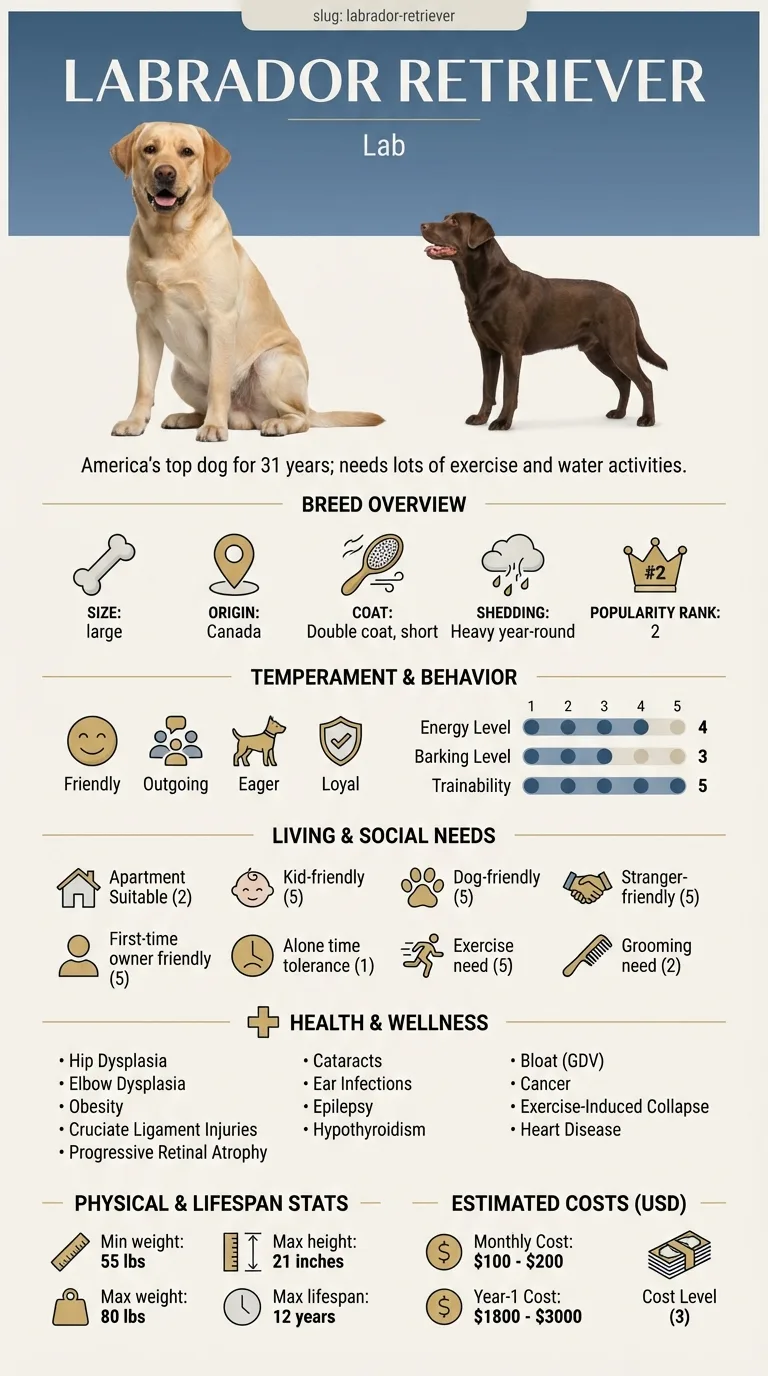
See all Labrador Retriever health problems, which breeds are prone to esophageal disease, or the full Labrador Retriever breed guide for temperament, exercise needs and ownership costs.
Diagnosis typically takes one to two vet visits including imaging. Management for a condition like reflux esophagitis often shows improvement within a few weeks of dietary and positional changes, while megaesophagus requires ongoing, lifelong management rather than a fixed treatment timeline.
Success looks like reduced regurgitation frequency and no aspiration pneumonia episodes, achieved through appropriate feeding management and any needed medication, rather than a full cure in cases involving a structural or motility-based esophageal problem.
Vomiting is an active process involving abdominal contractions, retching, and typically nausea beforehand, bringing up partially digested food or bile from the stomach. Regurgitation is passive: undigested food, sometimes still tube-shaped from the esophagus, comes back up with little to no effort or warning, often shortly after eating. This distinction matters enormously because regurgitation points toward an esophageal problem rather than a stomach or intestinal one, and describing it accurately to your vet, rather than calling it "vomiting" by default, meaningfully speeds up getting the right diagnostic workup.
Megaesophagus, an abnormally widened, poorly functioning esophagus that can't move food normally down to the stomach, is the most significant esophageal condition in dogs, and while it isn't singled out as a defining Labrador trait, large breeds are represented in the documented case population. Reflux esophagitis, inflammation from stomach acid moving backward into the esophagus, can also occur, sometimes linked to obesity, which is a well-documented issue in this breed and can increase abdominal pressure that pushes acid upward. A hiatal hernia, where part of the stomach pushes through the diaphragm, is a rarer but real cause of similar symptoms.

Pepper's owner had been describing her seven-year-old Labrador's recurring "vomiting" to friends for weeks before a vet visit revealed it wasn't vomiting at all: Pepper was regurgitating undigested food shortly after meals, with no retching or effort involved. An X-ray confirmed mild reflux esophagitis, likely worsened by the ten extra pounds Pepper had been carrying. Her vet recommended smaller, more frequent meals, keeping Pepper upright after eating, and a structured weight-loss plan. Within six weeks, the regurgitation episodes had become rare, and Pepper's owner now knows to describe the actual symptom accurately rather than defaulting to "vomiting" for any stomach-related issue.
Key takeaway: Correctly distinguishing regurgitation from vomiting in a Labrador points a vet toward the right diagnosis much faster, and in this breed, excess weight is often a real, addressable part of the underlying cause.
It isn't documented as a defining Labrador-specific condition, but large breeds are represented in cases of megaesophagus and related esophageal problems, and this breed's documented tendency toward obesity can contribute to reflux-related esophageal irritation.
Regurgitation is passive, undigested food comes back up with little effort, often shortly after eating. Vomiting is active, involving retching and abdominal contractions, and typically brings up partially digested food or bile. This distinction points toward different underlying causes.
A condition where the esophagus becomes abnormally widened and loses its normal ability to push food down to the stomach, leading to regurgitation, weight loss, and a serious risk of aspiration pneumonia if food or liquid enters the lungs.
Yes, primarily because of the aspiration pneumonia risk when regurgitated material enters the airway, which can be life-threatening. Managing feeding position and consistency is central to reducing this risk.
Yes, excess abdominal fat and pressure can worsen acid reflux into the esophagus, contributing to inflammation and discomfort, which is one of the more directly breed-relevant connections given this breed's documented obesity tendency.
X-rays, sometimes with a contrast dye, or an endoscopy are typically used to visualize the esophagus and confirm conditions like megaesophagus, reflux esophagitis, or a hiatal hernia.
Yes, depending on the specific cause, management may include upright feeding positions, specialized food consistency, medication for reflux, and close monitoring for aspiration pneumonia risk in more serious cases.
Vomiting involves active retching and abdominal effort; regurgitation is passive, with undigested food coming up easily, often soon after eating.
Regurgitation points toward an esophageal problem rather than a stomach issue, which changes what diagnostic testing and treatment your vet pursues.
Not documented as breed-defining, but large breeds are represented among affected dogs, making it a real possibility worth ruling out with persistent regurgitation.
Yes, reducing excess abdominal fat can lessen the pressure that contributes to acid reflux into the esophagus in some dogs.
X-rays with contrast dye are a moderate cost, while an endoscopy for more detailed evaluation is a larger, more specialized expense.
A one-page prep sheet for this condition: the signs, the questions to ask, what to get priced. Unlocks here.
You get: Vet visit prep sheet
No spam. One-click unsubscribe. See our privacy policy.
Preview page 1 before you decide.