Health
Is autoimmune disease a top health concern for Labradors?
No, it isn't documented as a hallmark risk for this breed the way it is for some others. The one real, well-supported link is hypothyroidism, which is often autoimmune in origin.

Quick answer
Is autoimmune disease a top health concern for Labradors?
No, it isn't documented as a hallmark risk for this breed the way it is for some others. The one real, well-supported link is hypothyroidism, which is often autoimmune in origin.
If you're worried your Lab's fatigue or coat changes point to some sweeping autoimmune disorder, the more useful question is usually simpler, and it starts with the thyroid.
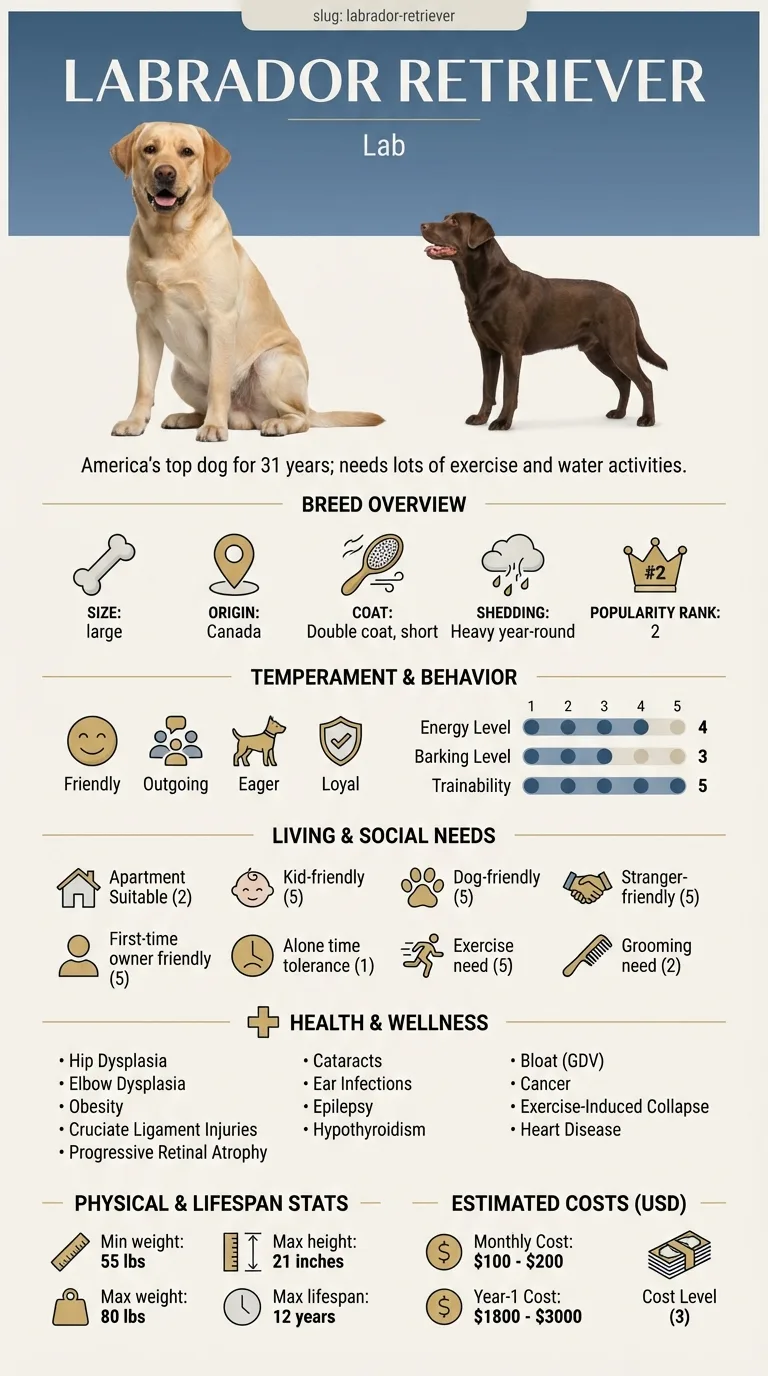
Owners of middle-aged Labradors noticing unexplained weight gain, lethargy, or a duller coat are the ones most likely to end up researching autoimmune disease, and the honest redirection toward hypothyroidism is genuinely useful information for this specific breed.
This guide is not medical advice. If your dog shows pain, sudden behavior change, or worsening symptoms, consult a licensed veterinarian.
Some links may be affiliate links. We may earn a commission at no extra cost to you. We only suggest products we believe are helpful for dog owners.
We research and check what we publish, but we do not warrant that any figure, date, price, or statement is accurate, complete, or current, and we accept no liability for any loss, cost, injury, or other harm arising from the use of this site. Use it as one reference among several. You remain responsible for your own decisions and for your dog's care - confirm anything that matters with a licensed veterinarian or another qualified professional before you act on it. Full disclaimer.
Autoimmune disease describes the immune system mistakenly attacking the body's own tissue. Labrador Retrievers aren't documented as a hallmark breed for broad autoimmune conditions the way some breeds with heavy autoimmune skin disease history are. The one genuinely well-supported link is hypothyroidism, a separately documented Labrador health concern, which in most affected dogs is itself driven by an autoimmune process attacking the thyroid gland.
Broad autoimmune disease is uncommon in this breed relative to hallmark-affected breeds. Hypothyroidism specifically, however, is a genuinely documented and reasonably common Labrador health concern, particularly in middle-aged and older dogs.
Labrador Retrievers don't carry the documented genetic predisposition to broad autoimmune skin and blood disorders that some other breeds do. What they do carry is a documented tendency toward hypothyroidism, and in the majority of cases this is caused by lymphocytic thyroiditis, the immune system gradually destroying thyroid tissue, making it the breed's one real, if narrowly defined, autoimmune-adjacent condition.
There's no strong environmental trigger identified for thyroid autoimmunity in dogs; it's considered primarily genetic in origin. Obesity, already a documented issue in this breed, can make hypothyroidism symptoms harder to distinguish from simple weight gain, sometimes delaying diagnosis.
Talk to your vet if you notice unexplained weight gain, persistent low energy, coat thinning, or cold intolerance, especially in a dog between four and ten years old. These are worth a thyroid panel rather than being dismissed as normal aging.
See all Labrador Retriever health problems, which breeds are prone to autoimmune diseases, or the full Labrador Retriever breed guide for temperament, exercise needs and ownership costs.
Diagnosis typically takes one blood panel and a follow-up visit to confirm. Once medication starts, most dogs show noticeable improvement in energy within two to four weeks, with coat and weight changes taking a bit longer, often two to three months.
Success is a dog whose energy, coat, and weight return to normal on stable daily medication, with periodic bloodwork confirming the dose stays correct as the dog ages, not a cure, since the condition itself is lifelong.
Breeds like the Akita, Chow Chow, and German Shepherd carry well-documented, heavy representation in classic autoimmune skin and blood disorders. Labrador Retrievers don't appear in that same tier of breed-specific autoimmune literature. Their documented health profile doesn't list a standalone autoimmune disease category the way it lists joint problems or eye conditions. That's a genuinely reassuring, accurate starting point, not a dodge.
Hypothyroidism is separately and specifically documented as a health concern in this breed, and in most affected dogs, it isn't simply a gland that stopped working, it's the immune system attacking and gradually destroying thyroid tissue, a process called lymphocytic thyroiditis. That makes hypothyroidism, functionally, this breed's one meaningfully documented autoimmune-mediated condition, even though it's filed under endocrine disease rather than labeled "autoimmune" outright. It shows up as weight gain despite normal food intake, low energy, a duller or thinning coat, and sometimes skin infections, all manageable with a simple daily thyroid hormone replacement once diagnosed.

If you think your Lab has autoimmune diseases, the plan is three steps: write down what you have seen and when it started, book a veterinary appointment rather than waiting for the next flare, and take video of the behaviour or symptom before you go — the thing you are worried about rarely happens in the consulting room. Screening in the parents covers hip dysplasia, elbow dysplasia, obesity.
What the vet visit should produce is a diagnosis and a written plan, not just reassurance: what is being ruled out, what the monitoring interval is, and which signs mean you come back sooner. Ask what the treatment costs across a year rather than per visit, because that is the number that decides whether you are managing this condition or reacting to it.
Between appointments, keep a short log — dates, what you saw, what changed. It is the single most useful thing an owner brings to a follow-up, and for autoimmune diseases it is often what separates a clear pattern from a guess.
Fern, a seven-year-old Labrador who had always maintained a lean, athletic build, started gaining weight over a few months despite her owner keeping her food portions unchanged. Her coat also looked noticeably duller, and she seemed to tire on walks she used to handle easily. Concerned about something serious, her owner researched autoimmune disease online and grew worried. A vet visit and bloodwork instead confirmed hypothyroidism, caused by lymphocytic thyroiditis, an autoimmune process attacking her thyroid gland. Once Fern started daily thyroid medication, her energy returned within three weeks, and her coat and weight normalized over the following two months. Her owner now schedules a thyroid recheck alongside her annual senior bloodwork.
Key takeaway: What looks like a mysterious autoimmune problem in a Labrador is very often, specifically, hypothyroidism, and it responds reliably well to simple, inexpensive daily treatment once correctly diagnosed.
Not broadly. This breed isn't documented in the same tier as breeds with heavy autoimmune skin disease history. The one genuine, well-established autoimmune-adjacent link in Labradors is hypothyroidism, which is often immune-mediated.
In most affected dogs, yes, functionally. The most common form is lymphocytic thyroiditis, where the immune system gradually attacks thyroid tissue. It's classified as an endocrine disease, but the underlying mechanism is autoimmune.
Unexplained weight gain despite normal or reduced food intake, low energy or reluctance to exercise, a duller or thinning coat, cold intolerance, and sometimes recurring skin infections.
A blood panel measuring thyroid hormone levels confirms the diagnosis. Treatment is a daily oral thyroid hormone replacement, typically inexpensive and highly effective once the right dose is established.
Yes, rare doesn't mean impossible. Any individual dog can develop conditions outside its breed's typical pattern, so persistent, unexplained skin lesions still deserve a full vet workup rather than being dismissed because the breed isn't a hallmark risk group.
Most commonly in middle age, roughly four to ten years old, though it can occur outside that range in individual dogs.
Generally not. Daily thyroid medication is inexpensive, and once dosing is stable, monitoring typically only requires periodic bloodwork every six to twelve months.
No, it isn't documented as a hallmark risk for this breed the way it is for some others. The one real, well-supported link is hypothyroidism, which is often autoimmune in origin.
No, but it's very manageable with lifelong daily medication that restores normal hormone levels and typically resolves symptoms completely.
Yes, it commonly causes weight gain and reduced energy even without a change in diet, which is why unexplained weight gain in a middle-aged Lab is worth a thyroid check.
Daily medication is typically low-cost, with periodic bloodwork adding a modest recurring expense a couple of times a year.
A duller or thinning coat alongside weight gain and low energy is worth mentioning to your vet as a possible sign of hypothyroidism, rather than assuming it's just seasonal shedding.
A one-page prep sheet for this condition: the signs, the questions to ask, what to get priced. Unlocks here.
You get: Vet visit prep sheet
No spam. One-click unsubscribe. See our privacy policy.
Preview page 1 before you decide.