Health
Is copper-associated liver disease specific to Labradors?
It has been specifically studied and documented in Labrador Retrievers through veterinary research, making it a genuinely breed-relevant condition to be aware of.

Quick answer
Is copper-associated liver disease specific to Labradors?
It has been specifically studied and documented in Labrador Retrievers through veterinary research, making it a genuinely breed-relevant condition to be aware of.
If your Lab's routine bloodwork ever shows elevated liver enzymes, copper-associated hepatopathy, a condition with real, specific documentation in this breed, deserves to be part of that conversation.
Owners of middle-aged Labradors with unexplained abnormal liver values on routine bloodwork are the ones for whom this specific, breed-relevant condition matters most, since it's often caught this way before symptoms appear.
This guide is not medical advice. If your dog shows pain, sudden behavior change, or worsening symptoms, consult a licensed veterinarian.
Some links may be affiliate links. We may earn a commission at no extra cost to you. We only suggest products we believe are helpful for dog owners.
We research and check what we publish, but we do not warrant that any figure, date, price, or statement is accurate, complete, or current, and we accept no liability for any loss, cost, injury, or other harm arising from the use of this site. Use it as one reference among several. You remain responsible for your own decisions and for your dog's care - confirm anything that matters with a licensed veterinarian or another qualified professional before you act on it. Full disclaimer.
Copper-associated hepatopathy, a form of chronic active hepatitis, is a hereditary liver condition specifically documented in Labrador Retrievers through veterinary research, where an inherited reduced ability to process copper causes it to accumulate in liver tissue and trigger progressive inflammation. It often causes no symptoms in early stages and is most reliably caught through routine wellness bloodwork showing elevated liver enzymes.
Genuinely documented as a breed-relevant condition through specific veterinary research on Labrador Retrievers, making it a real, if not universal, concern that routine senior bloodwork is well positioned to catch early.
Labrador Retrievers are the specific subject of veterinary research identifying a hereditary pattern of impaired copper processing in the liver, distinct from the more generic, cause-unknown chronic active hepatitis sometimes described in dogs broadly. This makes copper-associated hepatopathy a genuinely breed-relevant condition rather than a coincidental finding.
Diets unusually high in copper content can accelerate accumulation in a genetically predisposed dog, which is part of why a specifically formulated low-copper diet is a core part of management once the condition is identified.
Talk to your vet promptly about any elevated liver enzymes found on routine bloodwork, even without obvious symptoms. See your vet urgently if you notice yellowing of the gums or eyes, significant vomiting, or a sudden drop in appetite and energy.
See all Labrador Retriever health problems, which breeds are prone to chronic active hepatitis, or the full Labrador Retriever breed guide for temperament, exercise needs and ownership costs.
Diagnosis typically follows an abnormal bloodwork finding, with further testing over a few weeks to confirm. Diet-based management, once started, is a lifelong commitment, with periodic bloodwork every three to six months to monitor liver values and adjust treatment as needed.
Success is stable, controlled liver enzyme levels on an appropriate low-copper diet, preventing further liver damage, rather than a cure, since the underlying inherited processing issue doesn't go away, only its downstream effects are managed.
Copper-associated hepatopathy in Labrador Retrievers has been studied specifically in this breed, most notably through veterinary research in the Netherlands identifying a hereditary pattern of excess copper accumulation in the liver. Affected dogs' livers struggle to process and excrete copper normally, and it builds up in liver tissue over time, triggering inflammation that can progress to chronic active hepatitis and, in advanced untreated cases, liver failure. This is a genuinely documented, breed-relevant condition, distinct from the generic "chronic active hepatitis" label applied loosely across dog breeds without a specific known cause.
This condition often has no obvious symptoms in its early stages, which is exactly why routine senior wellness bloodwork, checking liver enzyme levels even in a dog that seems perfectly healthy, is the most realistic way to catch it before significant liver damage has occurred. Once elevated liver enzymes are found, further testing, sometimes including a liver biopsy to directly measure copper levels, confirms the diagnosis. Caught early, copper-associated hepatopathy is genuinely manageable through a low-copper diet and, if needed, copper-binding medication; caught late, after significant liver scarring has developed, management becomes considerably harder and the long-term outlook is more guarded.

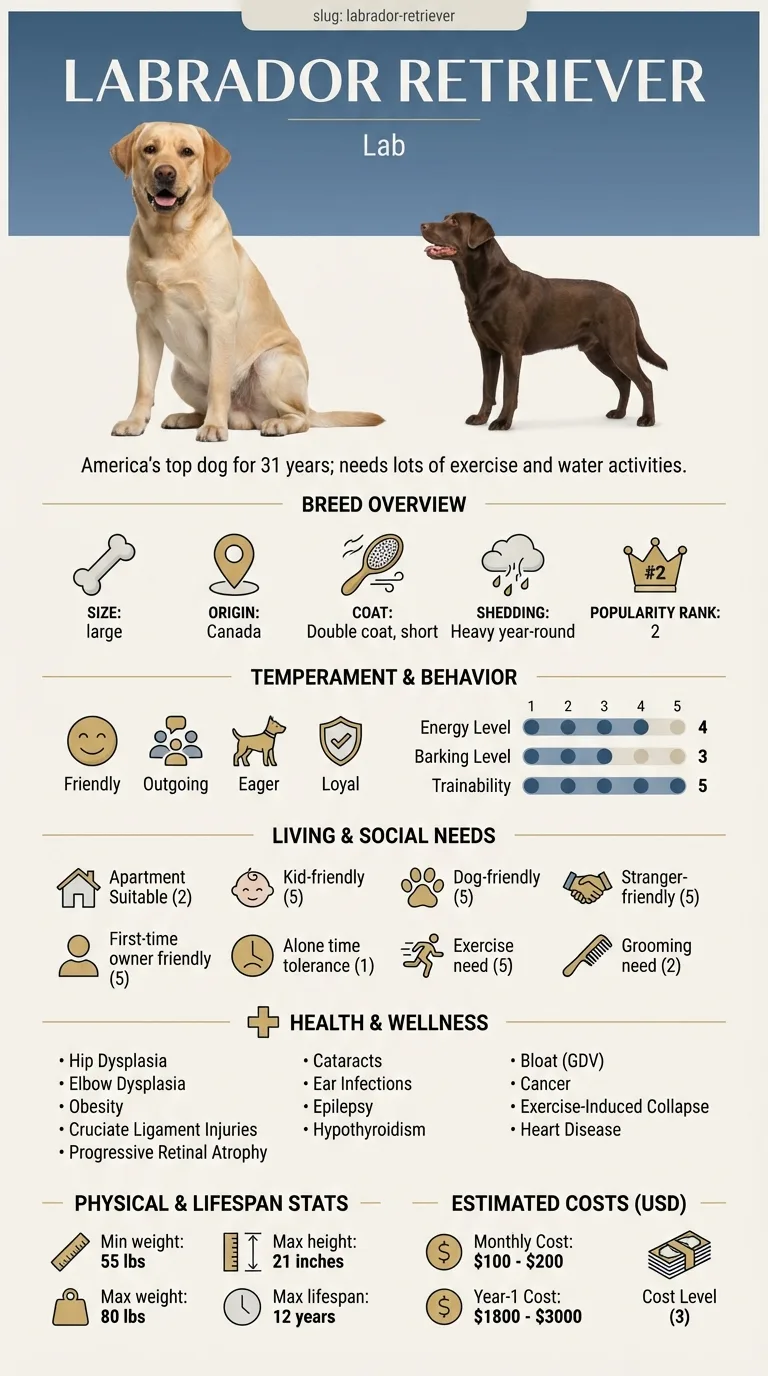
If you think your Lab has chronic active hepatitis, the plan is three steps: write down what you have seen and when it started, book a veterinary appointment rather than waiting for the next flare, and take video of the behaviour or symptom before you go — the thing you are worried about rarely happens in the consulting room. Screening in the parents covers hip dysplasia, elbow dysplasia, obesity.
What the vet visit should produce is a diagnosis and a written plan, not just reassurance: what is being ruled out, what the monitoring interval is, and which signs mean you come back sooner. Ask what the treatment costs across a year rather than per visit, because that is the number that decides whether you are managing this condition or reacting to it.
Between appointments, keep a short log — dates, what you saw, what changed. It is the single most useful thing an owner brings to a follow-up, and for chronic active hepatitis it is often what separates a clear pattern from a guess.
Ember, a healthy-seeming six-year-old Labrador, had no symptoms at all when her annual wellness bloodwork came back with mildly elevated liver enzymes. Her vet, aware of the documented copper-associated hepatopathy pattern in this breed, recommended further testing rather than dismissing it as a minor fluctuation. A follow-up biopsy confirmed early copper accumulation in her liver, caught well before it had caused any noticeable illness. Ember started a low-copper prescription diet immediately, and repeat bloodwork six months later showed her liver values had stabilized. Her owner now considers the annual senior panel one of the most important things she does for Ember, precisely because this condition gave no other warning.
Key takeaway: Copper-associated liver disease in a Labrador is often silent until caught on routine bloodwork, which is exactly why regular wellness screening matters even in a dog that seems completely healthy.
A specific form, copper-associated hepatopathy, has real documentation in this breed through veterinary research, making it a genuinely relevant, if not universally common, condition to be aware of, particularly in middle-aged dogs.
Affected dogs have an inherited reduced ability to process and excrete dietary copper normally, causing it to accumulate in liver tissue over time and trigger progressive inflammation.
Early stages often have no obvious symptoms at all. As it progresses, signs can include reduced appetite, lethargy, vomiting, increased thirst and urination, and in advanced cases, yellowing of the gums or eyes.
Routine bloodwork showing elevated liver enzymes is usually the first clue, followed by further testing, sometimes including a liver biopsy to directly measure copper levels and confirm the diagnosis.
Yes, particularly if caught early. A low-copper prescription diet and, in more advanced cases, copper-binding medication can meaningfully slow or halt progression and protect remaining liver function.
Annual wellness bloodwork, which typically includes liver enzyme screening, is the standard approach, with more frequent monitoring recommended if any abnormal values are found.
If caught late, after significant liver scarring has occurred, it can progress to liver failure, but caught early through routine bloodwork, it's genuinely manageable, which is exactly why early detection matters so much here.
It has been specifically studied and documented in Labrador Retrievers through veterinary research, making it a genuinely breed-relevant condition to be aware of.
Yes, and this is the most realistic way it's found, through elevated liver enzymes on routine wellness bloodwork in a dog that otherwise seems healthy.
Yes, a low-copper prescription diet is a core part of management and can meaningfully slow disease progression, especially when started early.
Prescription diet and periodic liver bloodwork add a moderate recurring cost; a liver biopsy if needed for diagnosis is a larger one-time expense.
Standard annual wellness bloodwork typically includes liver enzymes already, so simply keeping up with routine senior checks is usually sufficient without needing to request anything extra.
A one-page prep sheet for this condition: the signs, the questions to ask, what to get priced. Unlocks here.
You get: Vet visit prep sheet
No spam. One-click unsubscribe. See our privacy policy.
Preview page 1 before you decide.