Health
What is the earliest spinal sign in a GSP?
Scuffed or squared-off hind nails, or a paw left knuckled over for a moment. Both mean the dog has lost some sense of where its feet are.

Quick answer
What is the earliest spinal sign in a GSP?
Scuffed or squared-off hind nails, or a paw left knuckled over for a moment. Both mean the dog has lost some sense of where its feet are.
The first sign in a pointer is usually not a yelp. It is a hind paw that scuffs the ground, or a dog that stands with one toe folded under and does not seem to notice.
Owners of mature dogs, typically from six onwards, who have noticed a wobble or a scuff and are trying to work out whether it is a joint, a nerve or just age. Also owners facing a sudden crisis in a previously sound dog.
This guide is not medical advice. If your dog shows pain, sudden behavior change, or worsening symptoms, consult a licensed veterinarian.
Some links may be affiliate links. We may earn a commission at no extra cost to you. We only suggest products we believe are helpful for dog owners.
We research and check what we publish, but we do not warrant that any figure, date, price, or statement is accurate, complete, or current, and we accept no liability for any loss, cost, injury, or other harm arising from the use of this site. Use it as one reference among several. You remain responsible for your own decisions and for your dog's care - confirm anything that matters with a licensed veterinarian or another qualified professional before you act on it. Full disclaimer.
Disc-related spinal disease in a German Shorthaired Pointer is usually the slow, bulging kind seen in older large-breed dogs rather than the explosive rupture associated with dachshunds. It compresses the spinal cord gradually, so the presenting signs are clumsiness, scuffed nails and crossing hind legs rather than obvious pain.
Disc disease is not on the German Shorthaired Pointer's documented health list, and the breed is not one of those in which it is expected. When it does happen it tends to appear from about six years onwards. The slow-onset form is easily under-recognised, because owners attribute the early clumsiness to stiffness or old age.
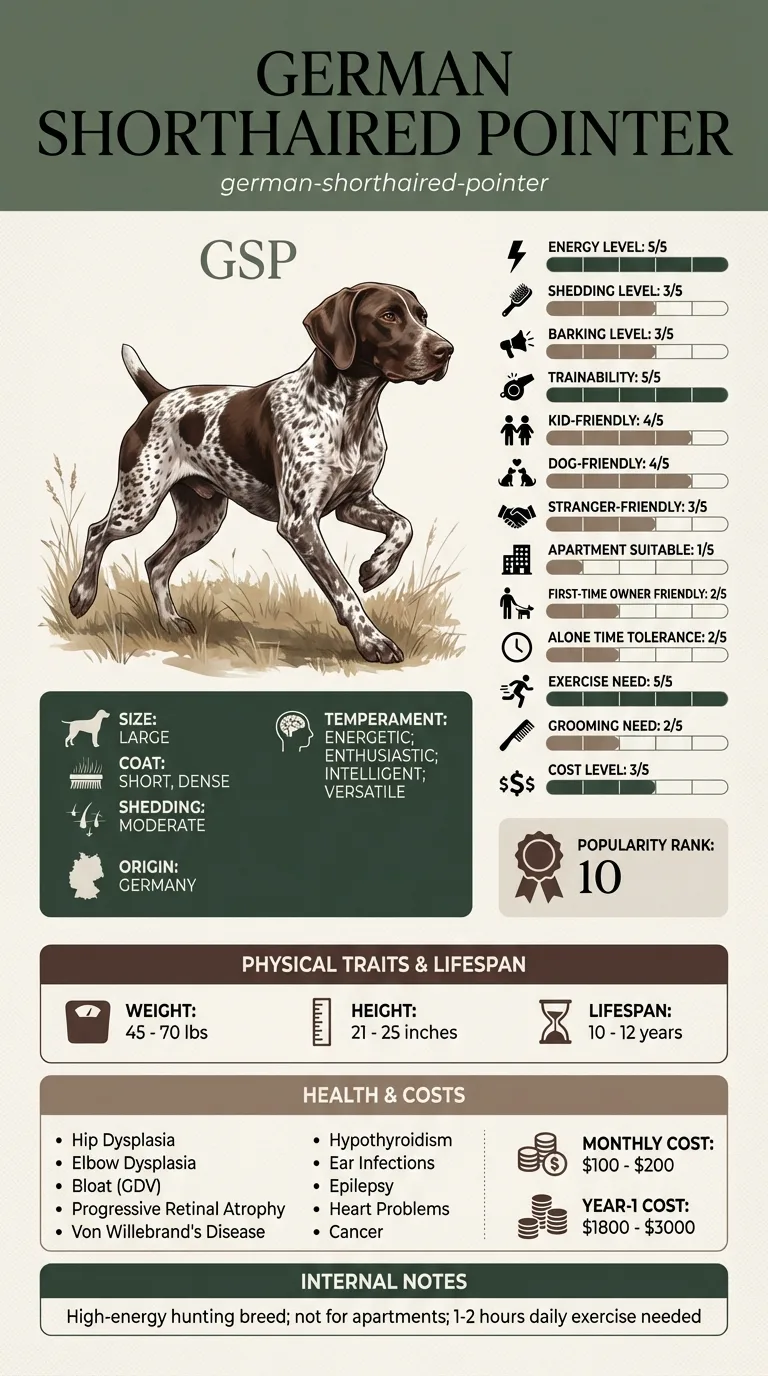
The absence of a breed driver is the important fact here. The German Shorthaired Pointer has normal limb proportions and none of the dwarfing that causes early disc calcification, so it is spared the disease's dangerous form. What it does have is a body that works extremely hard: a 45 to 70 pound dog rated at the maximum for exercise need, galloping and turning for hours across a ten to twelve year life, accumulates spinal wear that eventually contributes to the slow bulging type. Hip and elbow dysplasia, both documented in the breed, can add to the picture by altering gait.
Environment mostly determines how quickly a marginal disc is pushed over the edge. Repeated landings from vehicles, hard turns on frozen ground, slippery flooring at home, and steep stairs taken at speed all deliver the twisting loads a degenerating disc handles worst. Weight gain is the most modifiable factor of all, and it acts on every spinal segment simultaneously.
Book an appointment for scuffed nails, knuckling, crossing hind legs, or any hind-end wobble, and describe it as a possible neurological problem so it is triaged properly. Go to an emergency clinic immediately, at any hour, if your dog cannot stand or use its back legs, has gone from walking to dragging within hours, cannot urinate or has lost bladder control, is crying out with any movement of its back, or has lost feeling in the hind feet. Spinal cord compression is time-critical, and the difference between treatment starting within hours and starting the following morning can be the difference between walking and not.
See all German Shorthaired Pointer health problems, which breeds are prone to backspine issues, or the full German Shorthaired Pointer breed guide for temperament, exercise needs and ownership costs.
Dogs managed conservatively usually complete four to six weeks of strict confinement before any gradual return to exercise, and the return is measured in weeks rather than days. Surgical cases often show improvement within the first week but need two to three months of rehabilitation. The slow, bulging type is progressive, so the honest expectation is stabilisation and slowing rather than cure.
A dog that keeps its feet under it, empties its bladder normally, and walks comfortably on modified exercise for years. For many owners success also means recognising a real ceiling: the dog may keep a life it enjoys without ever going back to full days in heavy cover.
Veterinary medicine divides disc failure into two broad types, and knowing which one applies changes everything about what to expect.
The first type is the one that made intervertebral disc disease famous. The centre of the disc calcifies early in life and eventually bursts upward into the spinal canal in a single event. This is a disease of chondrodystrophic breeds, the dachshunds, corgis and beagles built on shortened limbs, and it typically strikes young or middle-aged dogs with dramatic speed. The German Shorthaired Pointer is not a chondrodystrophic breed and does not carry the skeletal architecture that drives it.
The second type is what a GSP is more likely to face. Here the tough outer ring of the disc thickens and bulges gradually, over months to years, squeezing the cord slowly rather than striking it. It is a disease of older, larger, normally proportioned dogs. Because the cord adapts as the pressure creeps up, the dog rarely appears to be in severe pain. What it shows instead is clumsiness: crossing its back legs, scuffing its nails, and losing the fine sense of where its feet are.
None of these replace an examination, but each gives you something concrete to describe on the phone, and together they help your vet decide how quickly you need to be seen.

If you think your GSP has back/spine issues, the plan is three steps: write down what you have seen and when it started, book a veterinary appointment rather than waiting for the next flare, and take video of the behaviour or symptom before you go — the thing you are worried about rarely happens in the consulting room. Screening in the parents covers hip dysplasia, elbow dysplasia, bloat (gdv).
What the vet visit should produce is a diagnosis and a written plan, not just reassurance: what is being ruled out, what the monitoring interval is, and which signs mean you come back sooner. Ask what the treatment costs across a year rather than per visit, because that is the number that decides whether you are managing this condition or reacting to it.
Between appointments, keep a short log — dates, what you saw, what changed. It is the single most useful thing an owner brings to a follow-up, and for back/spine issues it is often what separates a clear pattern from a guess.
Otto was eight when his owner clipped his nails and found the outer nails of both hind feet worn flat on one side. She had not seen him stumble once. He was still keen, still eating, still climbing into the truck. The neurological examination told a different story. His hind paw placement was delayed on both sides, he crossed his back legs turning tightly, and his reflexes localised the problem to the mid-back. Imaging showed a broad-based disc bulge compressing the cord. Because he was still walking well, the neurologist recommended conservative management first: six weeks of strict confinement, prescribed pain relief, then a graded rehabilitation programme. Otto came out of it walking better than he went in. He now works short days on flat ground, uses a ramp, and is checked every six months. His nails are the thing his owner still watches.
Key takeaway: A nail clipping caught what a month of walks had missed. In slow spinal compression the dog stops knowing where its feet are before anything hurts, and the evidence ends up written on the nails.
They can, but not the explosive dachshund version, because they are not built on dwarfed limbs. What GSPs are more likely to develop is the slow bulging type seen in older large dogs, and it is not among the conditions the breed is specifically flagged for.
Because slow compression damages the nerve pathways that report limb position before it damages the ones that report pain. The dog genuinely does not know its foot is folded. That is a neurological sign and it warrants investigation even though nothing hurts.
A neurological examination first, which localises the problem to a region of the spine, then advanced imaging under anaesthetic to see the disc itself. Plain radiographs are useful for excluding other causes but rarely show the compression.
No. Dogs that are still walking are often managed with strict confinement, pain control and rehabilitation. Surgery becomes the discussion when a dog is deteriorating, is severely affected, or has lost function, and the decision belongs with a neurologist.
Crate or small-room confinement, lead-only toileting, and no jumping, stairs or running for the full period your vet specifies, usually four to six weeks. For a breed needing one to two hours of exercise a day this is genuinely hard, and half-doing it is the main reason cases relapse.
Yes, and the alternatives matter. Degenerative myelopathy causes similar hind-end clumsiness without pain, lumbosacral disease causes reluctance to jump with tail-base pain, and a spinal tumour can mimic both. Distinguishing them is the point of the neurological workup.
Scuffed or squared-off hind nails, or a paw left knuckled over for a moment. Both mean the dog has lost some sense of where its feet are.
Yes, absolutely. Loss of use of the back legs, especially with loss of bladder control, needs an emergency clinic immediately, because outcomes depend heavily on how fast treatment starts.
Replace physical exercise with mental work the dog can do lying down: scent games in a snuffle mat, chews, and short training sessions. Plan it before you need it.
Advanced imaging plus specialist surgery is one of the largest bills in small animal medicine. Conservative management costs far less. Both are worth understanding before you are deciding at midnight.
A one-page prep sheet for this condition: the signs, the questions to ask, what to get priced. Unlocks here.
You get: Vet visit prep sheet
No spam. One-click unsubscribe. See our privacy policy.
Preview page 1 before you decide.