Health
What is the first sign of degenerative myelopathy?
A hind foot scuffing or knuckling, usually on one side, in an older dog that shows no pain at all. Worn nails on one hind foot are often the physical evidence.

Quick answer
What is the first sign of degenerative myelopathy?
A hind foot scuffing or knuckling, usually on one side, in an older dog that shows no pain at all. Worn nails on one hind foot are often the physical evidence.
This is the hardest entry on any breed health list, because everything an owner would normally rely on is absent. There is no pain to treat, no operation to consider, and no medication that changes the course.
Owners of older dogs whose hind end has become unsteady and who have been told the joints look better than the movement does. Also breeders and buyers weighing what a DNA test result actually means.
This guide is not medical advice. If your dog shows pain, sudden behavior change, or worsening symptoms, consult a licensed veterinarian.
Some links may be affiliate links. We may earn a commission at no extra cost to you. We only suggest products we believe are helpful for dog owners.
We research and check what we publish, but we do not warrant that any figure, date, price, or statement is accurate, complete, or current, and we accept no liability for any loss, cost, injury, or other harm arising from the use of this site. Use it as one reference among several. You remain responsible for your own decisions and for your dog's care - confirm anything that matters with a licensed veterinarian or another qualified professional before you act on it. Full disclaimer.
Degenerative myelopathy is a progressive breakdown of the insulating sheaths around spinal cord nerve fibres, beginning in the mid-back and moving forwards. It produces painless, steadily worsening hind-limb weakness in older dogs. There is no treatment that halts it, and diagnosis in life is made by excluding everything else.
Degenerative myelopathy is not listed among the German Shorthaired Pointer's documented health issues. The associated mutation has been identified in a very wide range of breeds, and the disease is most strongly associated with a handful of others. In a GSP it should be considered when an older dog develops painless progressive weakness, but it is not what most wobbly older pointers turn out to have.
No breed driver is documented for the German Shorthaired Pointer, and it would be misleading to invent one. The breed's contribution to this topic is in the differential rather than the cause. Hip and elbow dysplasia are both on the GSP's documented list, and years of hard work at a top-of-scale exercise level leave many older pointers with genuine joint disease. That means an ageing GSP with a wobbly hind end almost always has something else that plausibly explains it, and degenerative myelopathy hides behind that explanation.
There are no environmental causes. What environment determines is how well an affected dog copes and for how long. Slippery flooring turns a dog with poor foot placement into a dog that falls. Steps and thresholds become obstacles. Long grass and rough ground catch dragging feet. A household that adapts early, with runners, ramps, boots and a support harness, keeps a dog mobile and safe considerably longer than one that adapts reluctantly.
Book an appointment for any hind foot that scuffs or knuckles, for a hind end that has become unsteady, or for hind-limb weakness in an older dog that does not seem to hurt. Ask specifically for a neurological assessment rather than a joint-focused one. Go to an emergency clinic immediately, however, for a dog that goes from walking to dragging within hours, that cries out on movement of its back, that has lost bladder control suddenly, or that cannot stand at all. A sudden change is not this disease, which is always gradual, and a rapid deterioration means something compressive and time-critical that may be treatable.
See all German Shorthaired Pointer health problems, which breeds are prone to degenerative myelopathy dm, or the full German Shorthaired Pointer breed guide for temperament, exercise needs and ownership costs.
From the first scuff to loss of hind-limb function usually takes six months to three years. Most owners describe a gradual decline through unsteadiness, then frequent falls, then an inability to rise unaided. Physiotherapy and a cart commonly extend the mobile phase by months. The honest framing is that this is a condition to plan for, not one to fight.
Success here is not recovery, and pretending otherwise helps nobody. It is a dog kept mobile, clean, uninjured and mentally occupied for as long as possible, in a home adapted before it was urgent, with an owner who has thought about where their line is in advance rather than deciding it in a crisis at four in the morning.
Almost every case is initially mistaken for arthritis or a back problem, and the distinguishing features are mostly about what is missing rather than what is present.
A genetic test exists for the mutation most strongly associated with degenerative myelopathy, and it is widely available. Understanding what it can and cannot do prevents a lot of unnecessary distress.
The test reports three results: clear, carrier, or at risk. A dog that is clear is very unlikely to develop the disease, which is genuinely useful information. A carrier has one copy and is not expected to develop it, though it can pass the mutation to offspring. The complication is the third category. At risk means the dog has two copies of the mutation, but a large proportion of dogs with that result never develop clinical signs at all. The mutation appears to be necessary rather than sufficient.
So an at-risk result is not a diagnosis and should not be treated as one. It does not mean your dog will become paralysed, it does not justify changing anything about how the dog lives now, and it certainly does not warrant any treatment. What it does is make degenerative myelopathy a genuine consideration if that dog develops a painless, progressive hind-limb weakness in old age, which is exactly the situation where the information helps.
For breeders the test is more directly useful, since it allows carriers and at-risk dogs to be bred to clear mates without losing them from the gene pool.

Ivy had been treated for hip arthritis for eight months. It was a reasonable diagnosis in a ten-year-old GSP with documented hip changes, but her owner kept saying the same thing at every recheck: the pain relief did not seem to make any difference to how she walked. The vet took that seriously and examined her neurologically rather than orthopaedically. Ivy showed no pain response anywhere along her spine or hips, but her left hind foot stayed knuckled when placed and her reflexes were abnormal. Advanced imaging showed arthritic hips and a spinal cord with nothing compressing it. Her DNA test came back at risk. The working diagnosis was degenerative myelopathy. Nothing could be done to stop it, but a great deal changed anyway: runners across the house, a support harness, twice-weekly physiotherapy, boots to protect her dragging foot, and scentwork instead of walks. She stayed mobile for another fourteen months.
Key takeaway: The clue was that the painkillers were not working, which meant the problem was probably not pain. When treatment for the obvious diagnosis produces nothing, that is information, and it is worth saying out loud at the recheck.
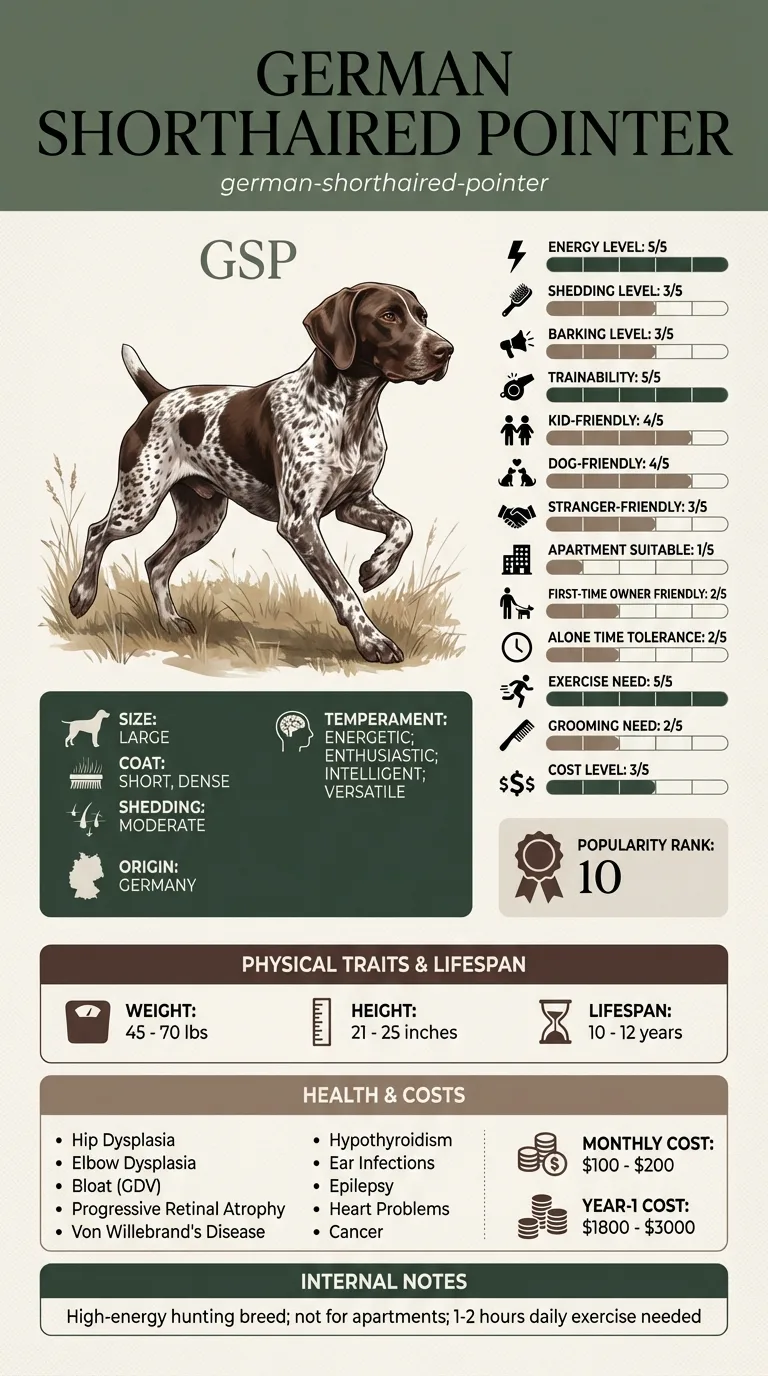
It is not among the breed's documented health issues, which list joint dysplasia, bloat, progressive retinal atrophy, von Willebrand's disease, hypothyroidism, ear infections, epilepsy, heart problems and cancer. The mutation has been found across many breeds, so an individual GSP can be affected, but it is not a breed hallmark.
Only by examining spinal cord tissue after death. In life it is a diagnosis of exclusion: a characteristic painless, progressive pattern, plus advanced imaging showing no compression of the cord, plus a supportive genetic result. That uncertainty is uncomfortable but honest.
No medication has been shown to stop or reverse it. Consistent physiotherapy and controlled exercise are the only interventions with reasonable evidence for prolonging mobility, and they work by maintaining muscle and coordination rather than by treating the disease.
The disease itself is not painful, and that is genuinely important. What causes distress is the secondary consequences: sore skin from dragging, falls, and eventually the loss of dignity and continence. Those are what quality-of-life decisions are usually based on rather than pain.
Typically six months to three years from the first noticeable scuff to loss of hind-limb function, with wide individual variation. Progression usually continues to involve the front limbs and breathing in the late stages, though most dogs are helped to go before that point.
For many dogs, yes, and often for longer than owners expect. A well-fitted cart lets a dog keep exercising, keep its front-end muscle and keep its routine. It works best when introduced early, while the dog can still learn to use it confidently.
A hind foot scuffing or knuckling, usually on one side, in an older dog that shows no pain at all. Worn nails on one hind foot are often the physical evidence.
No. Many dogs with two copies of the mutation never develop signs. It raises the possibility rather than predicting the outcome.
No medication changes the course. Physiotherapy, controlled exercise and mobility aids are what genuinely help, by maintaining function for longer.
Diagnosis requires advanced imaging, which is a substantial one-off cost. After that the costs are physiotherapy, harnesses, boots and possibly a cart, spread over months.
A one-page prep sheet for this condition: the signs, the questions to ask, what to get priced. Unlocks here.
You get: Vet visit prep sheet
No spam. One-click unsubscribe. See our privacy policy.
Preview page 1 before you decide.