Behavior
Which is calmer indoors?
The Shar-Pei, with Low (2/5) energy versus the GSP's Very high (5/5).

Quick answer
Which is calmer indoors?
The Shar-Pei, with Low (2/5) energy versus the GSP's Very high (5/5).
Chinese Shar-Pei or German Shorthaired Pointer? On paper they differ most on exercise need, and on the scales German Shorthaired Pointer is the heavier at 45–70 lbs. Here is how the two compare on everything that shapes an ordinary week.
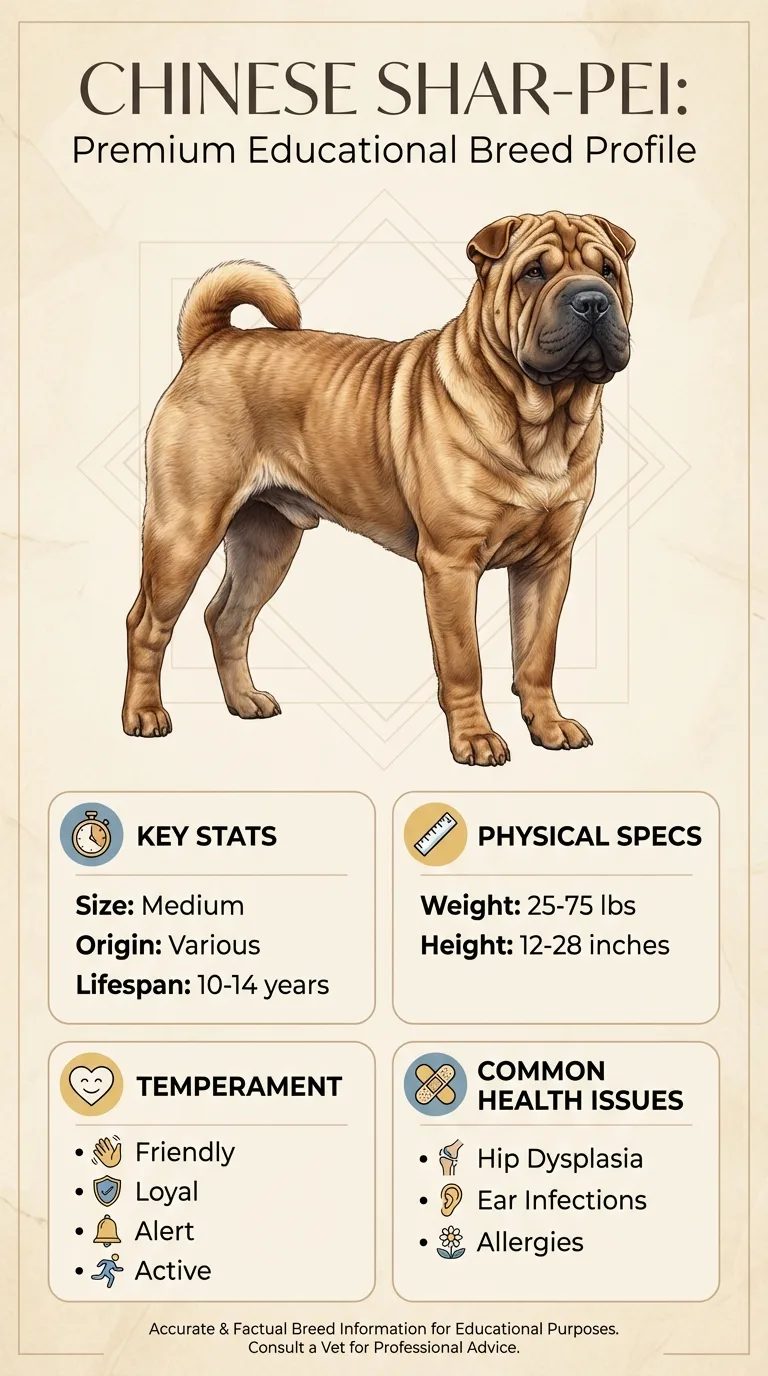
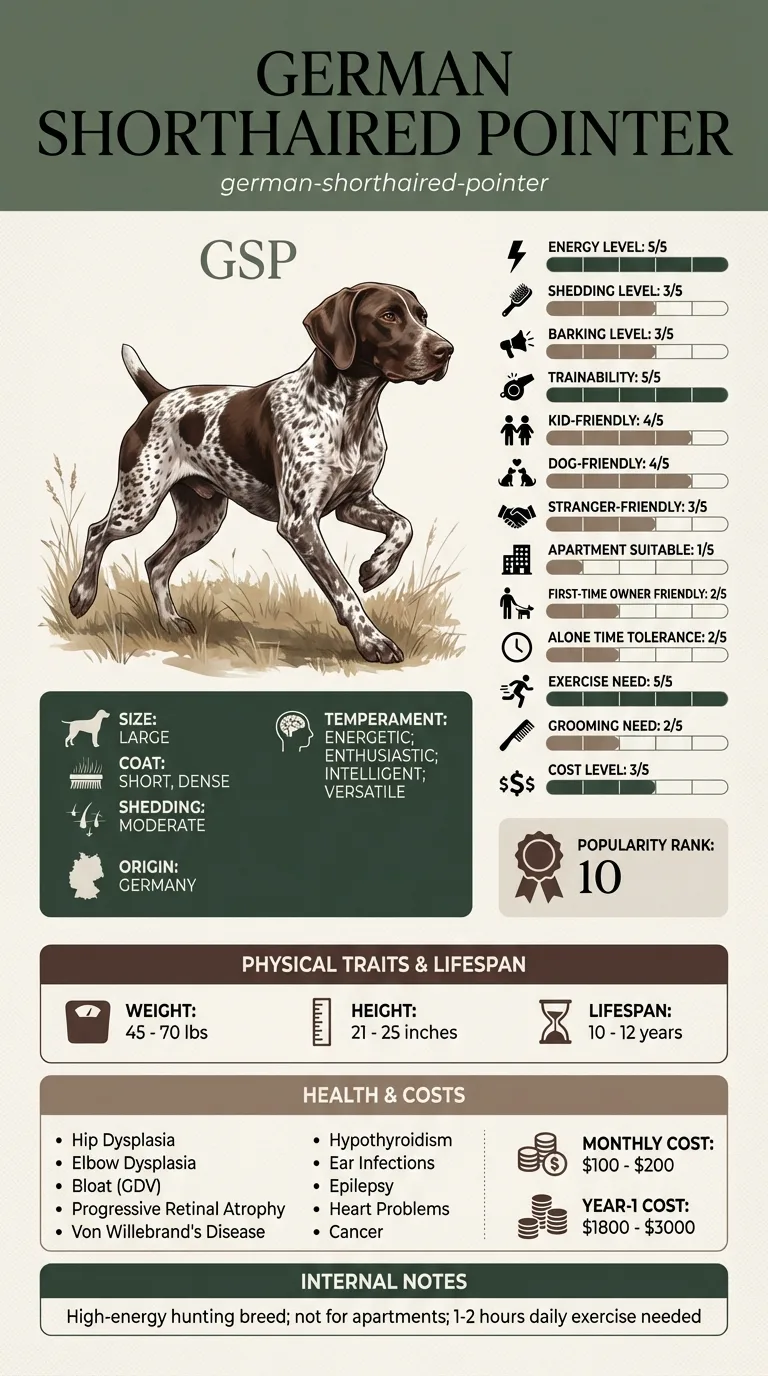
This is for someone already down to Chinese Shar-Pei and German Shorthaired Pointer and deciding between them. For this pair the decision usually turns on exercise need and energy level, so those are covered first and in most detail. Anyone choosing from a flat has a clear answer here: Chinese Shar-Pei rates 4/5 against 1/5. It is written for the decision rather than the breed history.
Between Chinese Shar-Pei and German Shorthaired Pointer, exercise need is what separates them, and Chinese Shar-Pei is the lower-effort dog of the two to keep.
Choose Chinese Shar-Pei if you are in a flat or a smaller home, shedding is a problem in your house and your walking routine is modest.
Choose German Shorthaired Pointer if there are young children at home, you already have another dog and you want a dog that picks up training quickly.
| Feature | chinese shar pei | german shorthaired pointer | Winner |
|---|---|---|---|
| Size class | medium | large | Equal |
| Weight | 45–60 lbs | 45–70 lbs | Equal |
| Height | 18–20 in | 21–25 in | Equal |
| Lifespan | 8–12 years | 10–12 years | german shorthaired pointer |
| Exercise need | Low (2/5) | Very high (5/5) | chinese shar pei |
| Grooming need | Low (2/5) | Low (2/5) | Equal |
| Shedding | Low (2/5) | Moderate (3/5) | chinese shar pei |
| Energy level | Low (2/5) | Very high (5/5) | Equal |
| Barking | Low (2/5) | Moderate (3/5) | chinese shar pei |
| Apartment suitability | High (4/5) | Very low (1/5) | chinese shar pei |
| Good for first-time owners | Low (2/5) | Low (2/5) | Equal |
| Tolerates being alone | Moderate (3/5) | Low (2/5) | chinese shar pei |
| Trainability | Low (2/5) | Very high (5/5) | german shorthaired pointer |
| Good with kids | Moderate (3/5) | High (4/5) | german shorthaired pointer |
| Good with other dogs | Low (2/5) | High (4/5) | german shorthaired pointer |
| Friendly to strangers | Low (2/5) | Moderate (3/5) | german shorthaired pointer |
| Cost level | High (4/5) | Moderate (3/5) | german shorthaired pointer |
| Coat | Short and harsh | Short, dense | Equal |
| Origin | Various | Germany | Equal |
| Typical monthly cost | $100–$200 | $100–$200 | Equal |
| Typical first-year cost | $1,400–$2,900 | $1,800–$3,000 | Equal |
Weight ranges actually overlap more here than the size classes suggest: the Shar-Pei's 45-60 lbs sits well inside the German Shorthaired Pointer's broader 45-70 lb range, though the Pointer stands taller at 21-25 inches versus 18-20. What separates them physically isn't bulk but build -- the GSP is a lean, athletic sporting dog engineered for endurance in the field, while the Shar-Pei carries its weight in a dense, wrinkled, low-slung frame. A buyer comparing the two side by side would notice the Pointer's rangy, muscular silhouette reads as a much bigger dog than its modest weight advantage over the Shar-Pei implies.
Few pairings on this site highlight a bigger exercise mismatch than this one: the German Shorthaired Pointer rates Very high (5/5) on exercise need, true to its Energetic, Versatile hunting-dog roots, while the Shar-Pei sits at the opposite end with Low (2/5). A GSP bred to run field trials all day will not thrive on the short walks that satisfy a Shar-Pei's needs -- without daily vigorous exercise, GSPs are known to become anxious and destructive. The Shar-Pei's Calm, Independent temperament, by contrast, makes it genuinely content with modest activity, a rare trait among medium-to-large breeds on this comparison.
Grooming needs actually tie here -- both breeds rate Low (2/5) -- but shedding tells a different story, with the GSP's short, dense coat rated Moderate (3/5) against the Shar-Pei's Low (2/5). The Pointer's coat sheds year-round in fine, hard-to-remove hairs despite its short length, while the Shar-Pei's harsh, short coat releases less hair but requires the added step of cleaning its characteristic skin folds. Neither breed demands the brushing regimen of a longer-coated dog, but households with light-colored furniture will still notice more GSP hair than Shar-Pei hair over a typical month.
The apartment picture strongly favors the Shar-Pei: High (4/5) apartment suitability and Low (2/5) barking against the GSP's Very low (1/5) apartment score, among the lowest ratings in this dataset, and Moderate (3/5) barking. A German Shorthaired Pointer's Very high exercise requirement doesn't pause for building rules or thin walls, and its Enthusiastic, Energetic nature tends to translate into vocal frustration when under-exercised in confined spaces. The Shar-Pei's Moderate (3/5) tolerance for being alone also beats the GSP's Low (2/5), making the Shar-Pei the more realistic choice for anyone in a small unit or without a yard.
The German Shorthaired Pointer rates Very high (5/5) on trainability, driven by its Intelligent, Versatile working heritage, while the Shar-Pei rates Low (2/5), consistent with its Independent streak. Both, however, score Low (2/5) for first-time owners -- the GSP because its trainability comes bundled with relentless exercise demands that overwhelm a novice's schedule, the Shar-Pei because its Reserved nature requires patient, experienced socialization work. An owner who wants a dog that visibly masters commands will get more from GSP training sessions; one who wants a dog that simply keeps its own counsel around the house may find the Shar-Pei's aloofness easier to live with day to day.
The GSP outperforms the Shar-Pei across every social category in this comparison: High (4/5) with kids versus Moderate (3/5), High (4/5) with other dogs versus Low (2/5), and Moderate (3/5) with strangers versus Low (2/5). Its Enthusiastic, Versatile temperament makes it a dog that generally welcomes new people and other animals once its energy is properly spent, while the Shar-Pei's Reserved disposition means it tends to bond tightly with its immediate family and stay wary of everyone else. Households that host frequently, own other pets, or have active kids will likely find the GSP the smoother social fit of the two.
The GSP has a modest lifespan edge, 10-12 years against the Shar-Pei's 8-12, but carries the longer health list: hip and elbow dysplasia, bloat, progressive retinal atrophy, Von Willebrand's disease, hypothyroidism, ear infections, epilepsy, heart problems, and cancer. Notably, the GSP and Shar-Pei share two conditions -- hypothyroidism and ear infections -- despite their very different builds, meaning owners of either breed should keep an eye on thyroid function and ear health regardless of which dog they choose. The Shar-Pei's remaining concerns, skin fold dermatitis, entropion, and Familial Shar-Pei Fever, are specific to its wrinkled structure and have no GSP equivalent.
Here the Shar-Pei is actually the pricier breed on the cost-level score, High (4/5) against the GSP's Moderate (3/5), even though the two breeds' typical monthly costs tie at $100-$200 and their first-year costs land close, $1,400-$2,900 for the Shar-Pei versus $1,800-$3,000 for the GSP. The difference likely comes down to specialized care: Shar-Pei owners often budget for skin-fold cleaning products and more frequent ear checks, while GSP owners spend more on food volume and exercise-related gear like long leads or field equipment. Either way, buyers should expect comparable overall spending despite the differing cost-level labels.
Chinese Shar-Pei weighs 45–60 lbs and lives 8–12 years; German Shorthaired Pointer weighs 45–70 lbs and lives 10–12 years. The two diverge most on exercise need, energy level and apartment suitability and 2 other rated axes. They are level on good for first-time owners and grooming need, so those cannot decide it. In the table, a "winner" means easier for an ordinary household — not better. Size, coat and origin are recorded without a verdict. Because both breeds are scored the same way, the gaps are reliable even where the absolute numbers are rough.

The German Shorthaired Pointer needs dramatically more, rated Very high (5/5) versus the Shar-Pei's Low (2/5) -- a GSP typically needs an hour or more of vigorous activity daily.
The Shar-Pei is far better suited, scoring High (4/5) on apartment suitability against the GSP's Very low (1/5).
The GSP, rated Moderate (3/5) versus the Shar-Pei's Low (2/5), reflecting its more outgoing, Versatile temperament.
Yes -- both breeds are prone to hypothyroidism and ear infections, despite otherwise different health profiles.
The GSP rates Very high (5/5) on trainability compared to the Shar-Pei's Low (2/5), though neither is recommended for first-time owners.
They're close overall -- the Shar-Pei runs $1,400-$2,900 in year one and the GSP $1,800-$3,000, with the Shar-Pei rated the pricier breed on the general cost-level scale.
The GSP, rated High (4/5) with other dogs against the Shar-Pei's Low (2/5).
The Shar-Pei, with Low (2/5) energy versus the GSP's Very high (5/5).
The GSP, rated Moderate (3/5) against the Shar-Pei's Low (2/5).
The GSP, typically 10-12 years versus the Shar-Pei's 8-12 years.
The GSP, rated Moderate (3/5) on barking versus the Shar-Pei's Low (2/5).
Secure checkout on Stripe. We never see your card.
7-day money-back guarantee. Instant access.
Health information here is general and is not veterinary advice. If your dog shows pain, sudden behaviour change, or worsening symptoms, consult a licensed veterinarian.
Some links on this site are affiliate links. We may earn a commission at no extra cost to you, and we only suggest products we believe are helpful for dog owners.
We research and check what we publish, but we do not warrant that any figure, date, price, or statement is accurate, complete, or current, and we accept no liability for any loss, cost, injury, or other harm arising from the use of this site. Use it as one reference among several. You remain responsible for your own decisions and for your dog's care - confirm anything that matters with a licensed veterinarian or another qualified professional before you act on it. Full disclaimer.
Match your lifestyle to the right dog.
Take quizNot sure which breed is right for you? Take our 2-minute quiz to find out.
Take the quiz