Behavior
Which breed sheds less?
The Weimaraner, at low (2/5) versus the GSP's moderate (3/5).

Quick answer
Which breed sheds less?
The Weimaraner, at low (2/5) versus the GSP's moderate (3/5).
German Shorthaired Pointer or Weimaraner? On paper they differ most on grooming need, and on the scales Weimaraner is the heavier at 55–90 lbs. Here is how the two compare on everything that shapes an ordinary week.
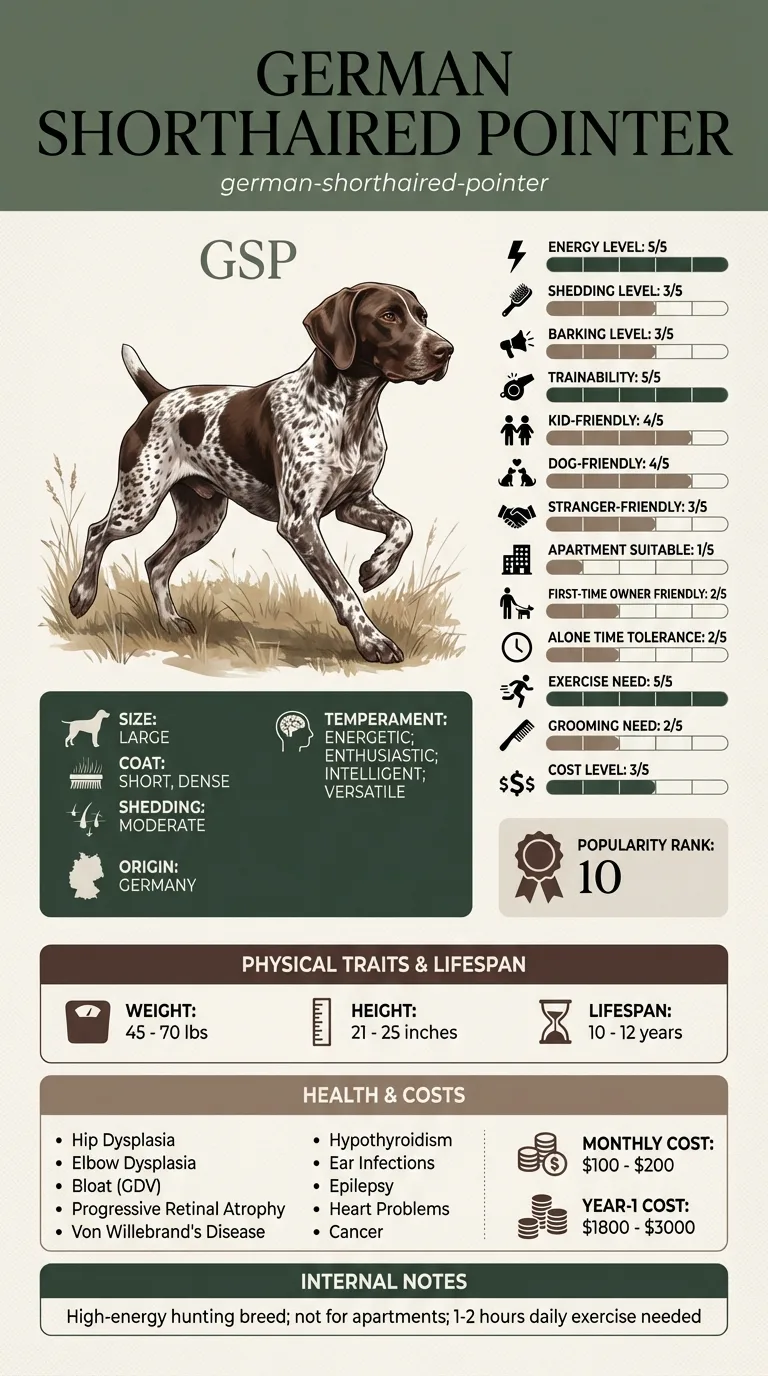
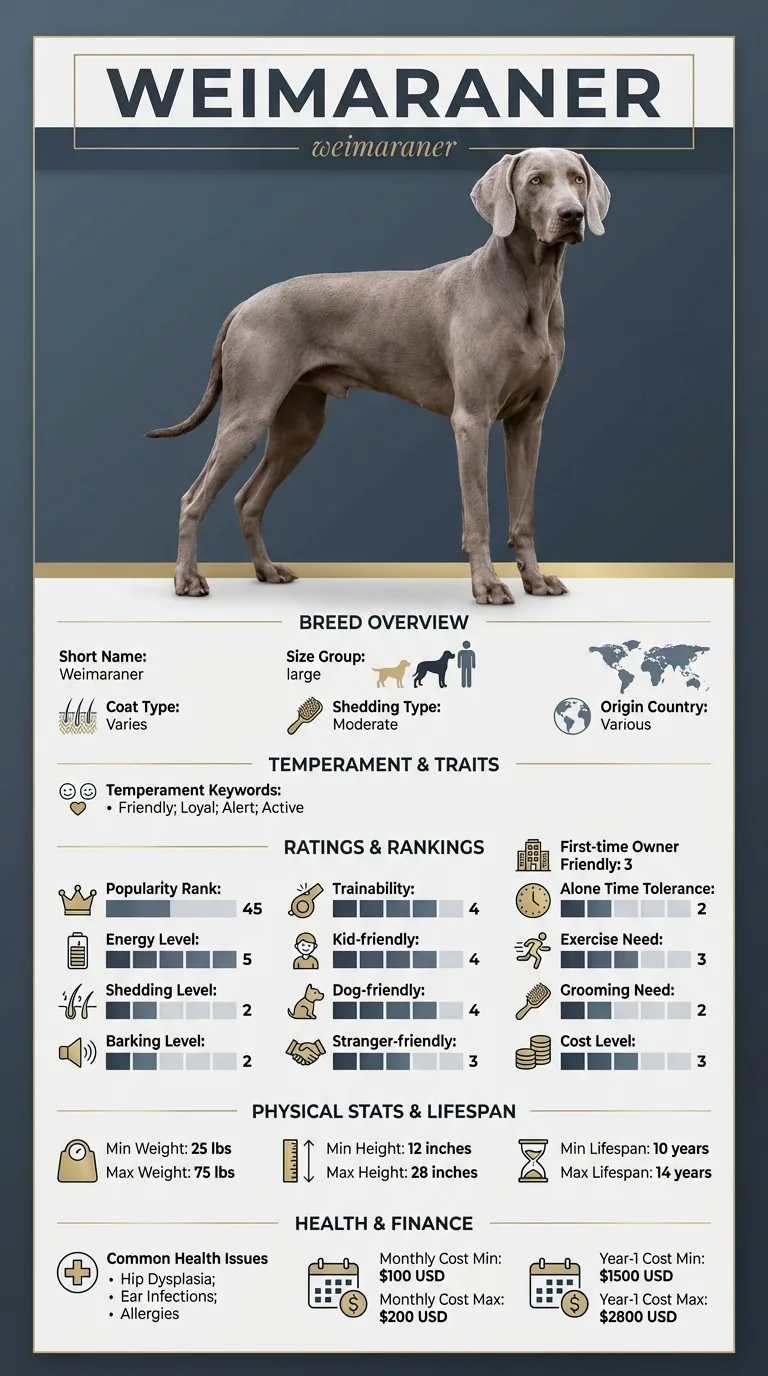
This is for someone already down to German Shorthaired Pointer and Weimaraner and deciding between them. Because the two are so evenly matched, the page works through every axis rather than leading with one. Both rate 1/5 for flats, so housing does not settle this one. It is written for the decision rather than the breed history.
Between German Shorthaired Pointer and Weimaraner, they are closer than most pairings, and the choice comes down to temperament; neither is the lower-effort dog overall.
Choose German Shorthaired Pointer if you already have another dog, you want a dog that picks up training quickly and a smaller dog suits your car, your home or your back.
Choose Weimaraner if you do not want a standing grooming appointment and shedding is a problem in your house.
| Feature | german shorthaired pointer | weimaraner | Winner |
|---|---|---|---|
| Size class | large | large | Equal |
| Weight | 45–70 lbs | 55–90 lbs | Equal |
| Height | 21–25 in | 23–27 in | Equal |
| Lifespan | 10–12 years | 10–13 years | weimaraner |
| Exercise need | Very high (5/5) | Very high (5/5) | Equal |
| Grooming need | Low (2/5) | Very low (1/5) | weimaraner |
| Shedding | Moderate (3/5) | Low (2/5) | weimaraner |
| Energy level | Very high (5/5) | Very high (5/5) | Equal |
| Barking | Moderate (3/5) | Moderate (3/5) | Equal |
| Apartment suitability | Very low (1/5) | Very low (1/5) | Equal |
| Good for first-time owners | Low (2/5) | Low (2/5) | Equal |
| Tolerates being alone | Low (2/5) | Very low (1/5) | german shorthaired pointer |
| Trainability | Very high (5/5) | High (4/5) | german shorthaired pointer |
| Good with kids | High (4/5) | High (4/5) | Equal |
| Good with other dogs | High (4/5) | Moderate (3/5) | german shorthaired pointer |
| Friendly to strangers | Moderate (3/5) | Moderate (3/5) | Equal |
| Cost level | Moderate (3/5) | Moderate (3/5) | Equal |
| Coat | Short, dense | Short and sleek | Equal |
| Origin | Germany | Various | Equal |
| Typical monthly cost | $100–$200 | $110–$240 | Equal |
| Typical first-year cost | $1,800–$3,000 | $1,700–$3,200 | Equal |
Ten to twenty pounds separates these two large hunting breeds: the GSP at 45-70 lbs and 21-25 inches, the Weimaraner running larger at 55-90 lbs and 23-27 inches. Both share a lean, athletic silhouette built for the field — the Weimaraner's distinctive silver-grey short coat is really the most visible difference between them at a glance, since their overall size classes, builds and proportions land in the same neighborhood.
Exercise need ties at the top of the scale for both breeds — very high (5/5) — and so does energy level, also very high (5/5) for both. This is not a pair where one dog out-hustles the other; both were bred as versatile hunting companions expected to work full days in the field. The practical difference shows up elsewhere: the Weimaraner rates very low (1/5) for tolerating time alone, a full point below the GSP's already-low (2/5), meaning separation-related risk runs even higher for the Weimaraner specifically — a risk borne out by its own health list, which flags separation anxiety by name.
The Weimaraner comes out ahead on both grooming measures: very low (1/5) grooming need against the GSP's low (2/5), and low (2/5) shedding against the GSP's moderate (3/5). That short, sleek coat is about as maintenance-free as coats get in a large hunting breed, needing little beyond an occasional wipe-down. The GSP's coat isn't demanding by any standard, but the Weimaraner edges it out on every measure in this category.
Both breeds rate a bottom-of-scale very low (1/5) for apartment suitability — tied for the worst score either dog earns anywhere in this comparison — which should settle the question for anyone in a small urban space. Barking ties too, at moderate (3/5). The real gap is in alone-time tolerance: the Weimaraner's very low (1/5) against the GSP's low (2/5) means whichever breed you choose, plan on minimal solo hours, but plan for even less with the Weimaraner.
Trainability favors the GSP, very high (5/5) against the Weimaraner's still-strong high (4/5). Both rate low (2/5) for first-time owners, tied at the bottom of that measure. The Weimaraner's headstrong temperament trait is the likely explanation for its one-point trainability gap versus the GSP's more purely enthusiastic drive — headstrong dogs require more consistency and patience to move past their own preferences. Neither breed forgives inconsistent handling, so anyone new to structured obedience work should plan on professional classes for either one rather than winging it alone.
The GSP edges the Weimaraner with other dogs, rated high (4/5) against moderate (3/5), while kids and strangers both tie — high (4/5) with kids for both, moderate (3/5) with strangers for both. The gap on other-dog compatibility is modest but real, and tracks loosely with the Weimaraner's more one-owner-focused devoted temperament versus the GSP's more broadly versatile sociability. Multi-dog households and busy dog parks are where that one-point difference is most likely to actually surface day to day.
The Weimaraner's health list runs notably shorter — just five named conditions (bloat, hip dysplasia, hypertrophic osteodystrophy, von Willebrand disease and separation anxiety) against the GSP's ten. Both breeds share bloat (GDV), hip dysplasia and von Willebrand's disease as common concerns, which makes sense given their similar size and build. Lifespan comes out close: 10-13 years for the Weimaraner against 10-12 for the GSP, a marginal edge for the Weimaraner but not one that should drive the decision on its own.
Both breeds land at moderate (3/5) for cost, with monthly spending close: $100-$200 for the GSP, slightly higher at $110-$240 for the Weimaraner. First-year totals nearly overlap too — $1,800-$3,000 for the GSP against $1,700-$3,200 for the Weimaraner — reflecting how similar these two large, short-coated, high-energy breeds are in almost every practical expense category. Anyone budgeting for either dog should expect food and routine vet care, rather than grooming, to be the bulk of the recurring bill, since neither coat adds meaningful upkeep costs.
German Shorthaired Pointer weighs 45–70 lbs and lives 10–12 years; Weimaraner weighs 55–90 lbs and lives 10–13 years. No rated axis separates them by more than a single point, which makes this one of the closer pairings on the site. They are level on apartment suitability, barking and cost level, so those cannot decide it. In the table, a "winner" means easier for an ordinary household — not better. Size, coat and origin are recorded without a verdict. Because both breeds are scored the same way, the gaps are reliable even where the absolute numbers are rough.

Neither is a good fit — both rate low on tolerating time alone (2/5 for the GSP, an even lower 1/5 for the Weimaraner), and the Weimaraner's own health list specifically flags separation anxiety as a common issue.
The Weimaraner, at 55-90 lbs and 23-27 inches, compared to the GSP's 45-70 lbs and 21-25 inches.
The Weimaraner, rated very low (1/5) versus the GSP's already-low (2/5) — its sleek coat needs almost no upkeep.
No — both score the lowest possible very low (1/5) for apartment suitability, reflecting their shared very-high exercise needs and hunting-dog backgrounds.
The GSP, rated very high (5/5) against the Weimaraner's high (4/5), likely due to the Weimaraner's more headstrong temperament.
They're close — Weimaraners typically live 10-13 years, GSPs 10-12 years — a marginal edge to the Weimaraner.
They're nearly identical, both moderate (3/5) in cost, though the Weimaraner runs slightly higher monthly ($110-$240 versus $100-$200 for the GSP).
The Weimaraner, at low (2/5) versus the GSP's moderate (3/5).
The Weimaraner, rated very low (1/5) versus the GSP's low (2/5).
The Weimaraner, with five commonly flagged conditions versus the GSP's ten.
The German Shorthaired Pointer, rated very high (5/5) versus the Weimaraner's high (4/5).
Secure checkout on Stripe. We never see your card.
7-day money-back guarantee. Instant access.
Health information here is general and is not veterinary advice. If your dog shows pain, sudden behaviour change, or worsening symptoms, consult a licensed veterinarian.
Some links on this site are affiliate links. We may earn a commission at no extra cost to you, and we only suggest products we believe are helpful for dog owners.
We research and check what we publish, but we do not warrant that any figure, date, price, or statement is accurate, complete, or current, and we accept no liability for any loss, cost, injury, or other harm arising from the use of this site. Use it as one reference among several. You remain responsible for your own decisions and for your dog's care - confirm anything that matters with a licensed veterinarian or another qualified professional before you act on it. Full disclaimer.
Match your lifestyle to the right dog.
Take quizNot sure which breed is right for you? Take our 2-minute quiz to find out.
Take the quiz