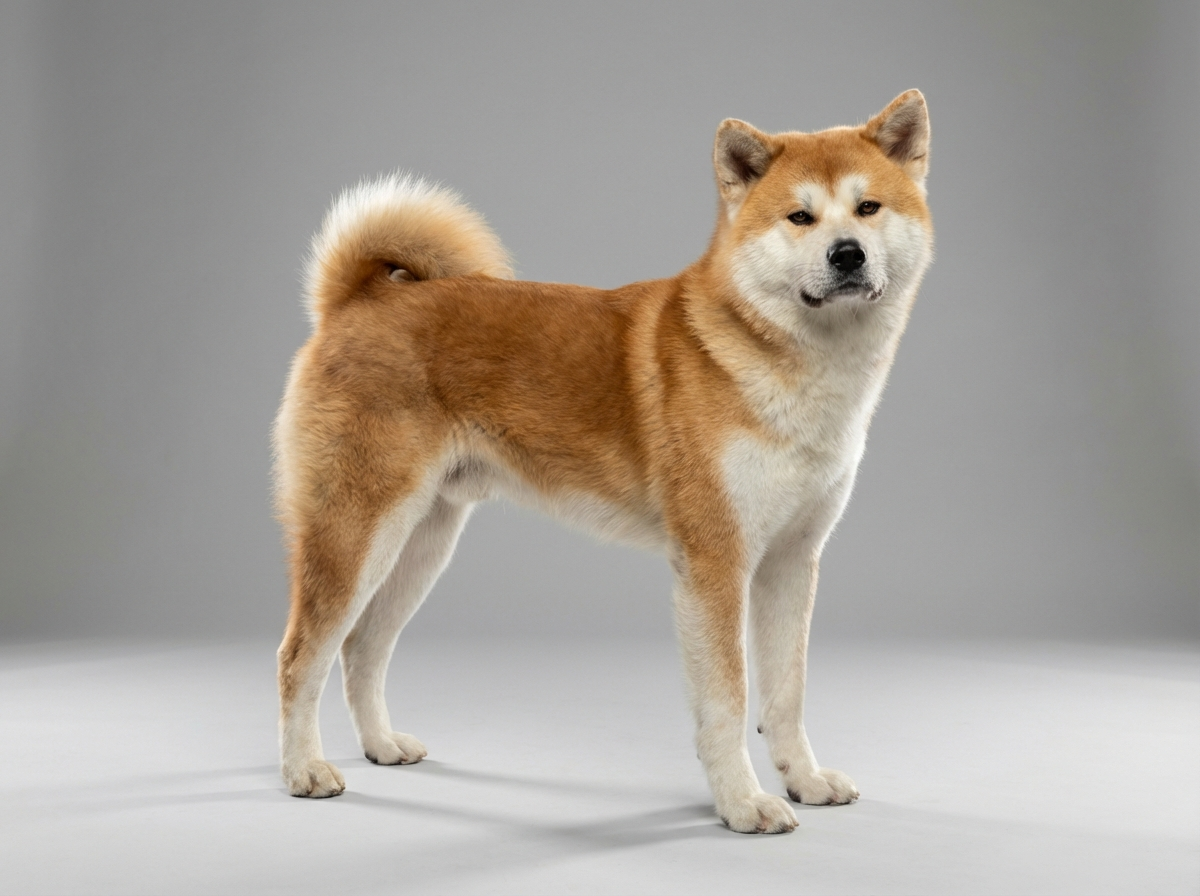
Health
What's the first sign of back trouble in an Akita?
Often it's hesitation before jumping onto furniture or into a car, or a slightly hunched posture after resting.

Quick answer
What's the first sign of back trouble in an Akita?
Often it's hesitation before jumping onto furniture or into a car, or a slightly hunched posture after resting.
A once-fluid Akita that now hesitates before jumping onto the couch, or that arches its back oddly, is telling you something about its spine.
Owners of Akitas past the age of six or seven notice it first, usually as reluctance to jump into the truck or a change in how the dog gets up from lying down.
This guide is not medical advice. If your dog shows pain, sudden behavior change, or worsening symptoms, consult a licensed veterinarian.
Some links may be affiliate links. We may earn a commission at no extra cost to you. We only suggest products we believe are helpful for dog owners.
We research and check what we publish, but we do not warrant that any figure, date, price, or statement is accurate, complete, or current, and we accept no liability for any loss, cost, injury, or other harm arising from the use of this site. Use it as one reference among several. You remain responsible for your own decisions and for your dog's care - confirm anything that matters with a licensed veterinarian or another qualified professional before you act on it. Full disclaimer.
Check this first
Some back and spine signs in an Akita mean you call the vet now, not tomorrow. If your dog suddenly can't stand, drags a rear paw, loses bladder or bowel control, or cries out when touched anywhere near the spine, treat it as urgent. These can point to significant disc compression or nerve involvement, and the window to prevent permanent damage can be measured in hours, not days.
More common in Akitas is a slower pattern: a gradual reluctance to jump, a lowered head carriage, a stiff or shortened stride after rest, or occasional yelping on getting up. These signs still deserve a vet visit, but they're not necessarily a same-day emergency — they're a sign to schedule an orthopedic and neurologic exam soon.
The distinction that matters is whether the hind legs are still working normally. Weakness, knuckling over on the paw, or dragging toenails on one or both back feet is the line between 'monitor and schedule' and 'go now.'
If any of these apply, call your vet or an emergency clinic now. The rest of this page is for the cases that are not an emergency.
Back and spine trouble in Akitas typically develops gradually rather than striking as an acute emergency. Owners usually notice a stiffer gait after rest, reluctance to jump, or a change in how the dog carries its head and tail before anything looks dramatically wrong.
Spinal stiffness and disc-related discomfort become more common as Akitas move into their senior years, in line with what's typical for large, long-lived dogs. It is far less common in an Akita under three, which points toward an acute injury rather than degeneration when it does happen young.
The Akita's size works against its spine over time: a torso built to carry up to 130 pounds means every disc and facet joint along the back bears more continuous load than in a small dog. Unlike short-legged, chondrodystrophic breeds, Akitas aren't wired for early disc calcification, so problems in this breed tend to be a slower degenerative story tied to age, weight, and cumulative wear rather than a sudden Type I herniation in a young dog.
A home environment full of stairs, slick floors, and high furniture asks a lot of a large spine. Dogs that are allowed to leap off beds or out of tall vehicles repeatedly, or that carry extra weight because of overfeeding, put more day-to-day strain on the discs and joints of the back than dogs whose environment is set up to reduce impact.
Call promptly if your Akita shows dragging of a rear paw, sudden weakness in the back legs, crying out when the back is touched, or any loss of bladder or bowel control — these suggest nerve involvement and need same-day attention. For gradual stiffness or hesitation to jump, a scheduled exam is appropriate rather than an emergency visit.
A few habits quietly accelerate spinal wear in a big-bodied dog like the Akita. Avoid these.
See all Akita health problems, which breeds are prone to backspine issues, or the full Akita breed guide for temperament, exercise needs and ownership costs.
Mild cases managed with rest, weight control, and anti-inflammatory care often show improvement within two to four weeks. More significant disc disease can take months of restricted activity, and some degree of ongoing management is usually permanent rather than something that resolves completely.
Success looks like a dog that moves comfortably through its normal daily routine — walks, getting up from rest, and getting into the car — even if some conditioning or activity limits remain in place long term.
Renata noticed her nine-year-old Akita, Kuma, had stopped jumping into the back of her SUV sometime that winter in Denver. She assumed it was just age until Kuma yelped one morning getting up from his bed. A vet exam and X-rays showed early disc degeneration in his lower back, not a herniation, but enough to explain the stiffness. Renata built a ramp for the car, put non-slip runners down over the hardwood floors, and worked with her vet on a weight-loss plan since Kuma had crept up several pounds. Within a month his morning stiffness had noticeably eased, and by spring he was taking his usual long walks again, just without the jumping he used to do without thinking.
Key takeaway: A gradual change in how an older Akita moves is worth investigating early — small environmental fixes and weight control can prevent a manageable problem from becoming a serious one.
Not in the same way. Akitas aren't a chondrodystrophic breed, so the early-onset disc calcification seen in Dachshunds and Corgis isn't the typical pattern. Akita spinal problems more often show up later in life, tied to gradual disc degeneration and body weight.
Gradual disc degeneration, spinal arthritis, or lumbosacral disease (irritation where the spine meets the pelvis) are the more common culprits in a large breed at this age, more so than a sudden herniation.
Usually yes, but shorter and more frequent walks on flat ground tend to work better than one long outing. A vet can help you calibrate activity to what the spine can currently tolerate.
Yes. A large-breed spine supports significant load already; every extra pound adds continuous strain to the discs and the joints around them. Keeping your Akita lean is one of the few things fully within an owner's control.
Most cases are managed medically with rest, weight control, and anti-inflammatory treatment under a vet's guidance. Surgery is reserved for cases with significant nerve compression or loss of limb function, and a vet or veterinary neurologist would make that call.
A vet starts with a neurologic exam checking reflexes and paw-placement responses, then may recommend X-rays, and if something concerning turns up, advanced imaging like a CT or MRI at a referral center.
Not entirely — some degeneration is part of aging in a large breed — but keeping weight down, avoiding repeated high-impact jumping, and treating stiffness early instead of waiting all meaningfully lower the risk of a severe episode.
Often it's hesitation before jumping onto furniture or into a car, or a slightly hunched posture after resting.
If your dog shows any back stiffness, yes — limiting repeated stair climbing and jumping reduces ongoing spinal strain.
Routine cases (weight control, activity modification, anti-inflammatories) are modest; imaging and surgery for severe cases can run into the thousands.
Yes — teaching a calmer approach to jumping on and off furniture, and using ramps, reduces repeated stress on the spine.
No — hip or knee issues can look similar. A vet exam is the only reliable way to tell where the pain is actually coming from.
A one-page prep sheet for this condition: the signs, the questions to ask, what to get priced. Unlocks here.
You get: Vet visit prep sheet
No spam. One-click unsubscribe. See our privacy policy.
Preview page 1 before you decide.