Health
What is the key sign that points away from hip dysplasia?
Weakness spreading to the front legs, or neck pain and resistance to lowering the head, both suggest a cervical spinal problem instead.

Quick answer
What is the key sign that points away from hip dysplasia?
Weakness spreading to the front legs, or neck pain and resistance to lowering the head, both suggest a cervical spinal problem instead.
A wobbly back end in a Chow Chow gets attributed to hip dysplasia almost automatically, since the breed already carries that diagnosis on its documented list. Occasionally the actual problem is a compressed spinal cord in the neck, and the resemblance can delay a correct diagnosis for months.
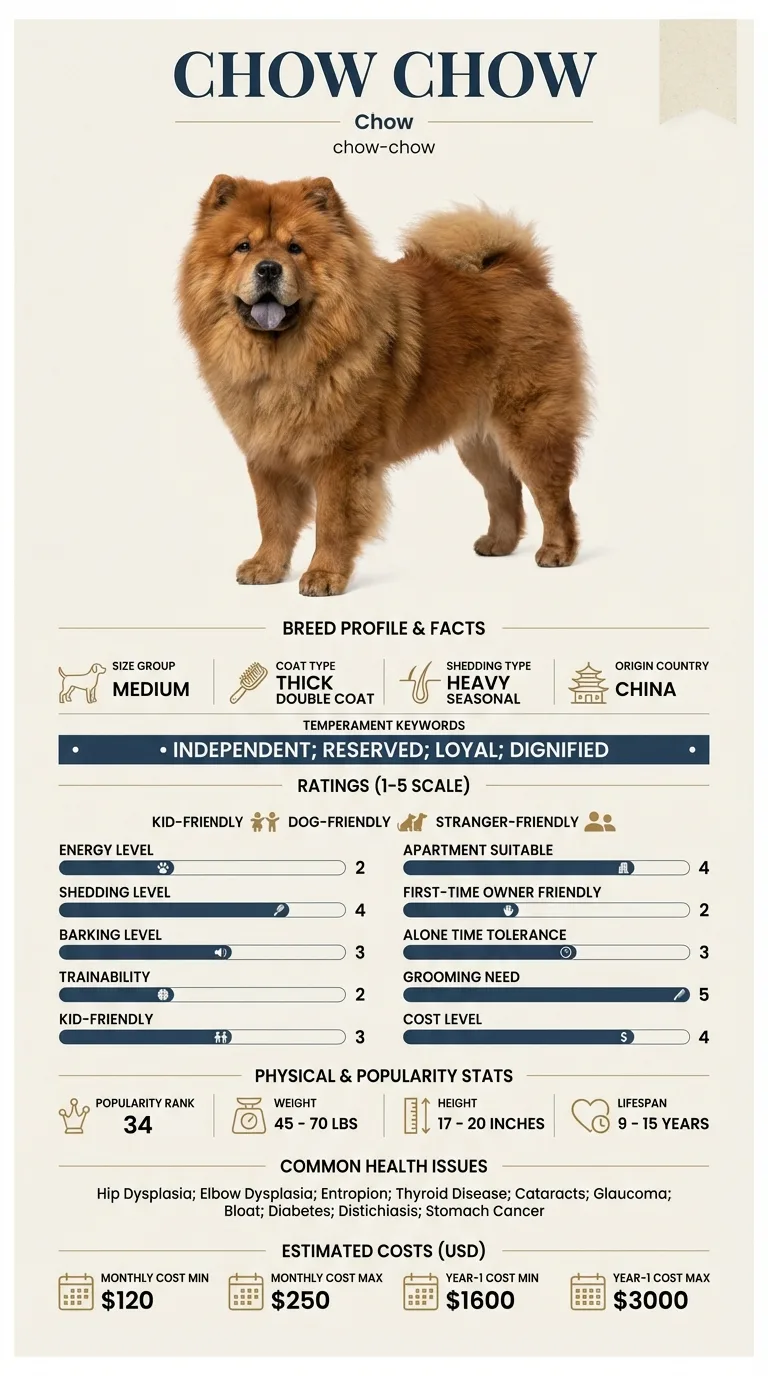
Owners of a Chow Chow whose hind-end weakness has not responded to standard hip dysplasia management, and anyone whose dog has weakness in all four legs rather than just the back end, which points away from hips entirely.
This guide is not medical advice. If your dog shows pain, sudden behavior change, or worsening symptoms, consult a licensed veterinarian.
Some links may be affiliate links. We may earn a commission at no extra cost to you. We only suggest products we believe are helpful for dog owners.
We research and check what we publish, but we do not warrant that any figure, date, price, or statement is accurate, complete, or current, and we accept no liability for any loss, cost, injury, or other harm arising from the use of this site. Use it as one reference among several. You remain responsible for your own decisions and for your dog's care - confirm anything that matters with a licensed veterinarian or another qualified professional before you act on it. Full disclaimer.
Wobbler syndrome is compression of the spinal cord in the neck producing a wobbly, weak gait, most classically seen in giant and large breeds and uncommon in a medium breed like the Chow Chow. It matters here specifically because its gait can resemble the breed's well-documented hip dysplasia closely enough to delay correct diagnosis for months.
Rare in medium breeds generally and not among the Chow Chow's most strongly documented conditions. It is included here because it is reported to occur in the breed and because misattribution to the far more common hip dysplasia is a genuine, practical diagnostic risk.
Wobbler syndrome is not strongly tied to any specific Chow Chow trait the way hip dysplasia is. What connects it to this breed is diagnostic overlap: because hip dysplasia is common and documented here, a wobbly hind-end gait is reasonably assumed to be hip-related first, delaying recognition of a rarer neck-based cause when treatment does not work as expected.
Nothing environmental specifically causes wobbler syndrome, but a slow, cautious diagnostic approach, treating a lack of improvement as reason to reassess rather than simply continue the same plan, is the environmental and clinical factor that determines how quickly it gets identified when it is present.
Talk to your vet if hind-end weakness is not improving as expected on hip dysplasia treatment, if weakness spreads to the front legs, or if you notice neck pain or resistance to head movement, and seek prompt care for any sudden, significant loss of coordination or an inability to walk.
See all Chow Chow health problems, which breeds are prone to wobbler syndrome, or the full Chow Chow breed guide for temperament, exercise needs and ownership costs.
Reaching a correct diagnosis after an initial hip dysplasia assumption commonly takes several more weeks once a lack of improvement prompts further investigation.
Success is a correct diagnosis reached without excessive delay, with a management plan, whether medical or surgical, that matches the actual underlying problem rather than continuing to treat the wrong one.
These are useful home observations, but they are not a substitute for imaging. Because the two conditions can genuinely overlap in early presentation, a dog not responding as expected to hip dysplasia treatment deserves a second look rather than an increased dose of the same plan.
Hip dysplasia is documented in the Chow Chow, which means both owners and vets reasonably reach for it first when a Chow's back end looks weak or wobbly. That is the correct first instinct in most cases, since hip dysplasia is genuinely far more common in this breed than a cervical spinal problem.
The issue arises when a dog does not improve on an appropriate hip dysplasia plan, whether that is weight management, joint supplements, pain control or surgery, and the lack of progress gets attributed to a slow responder rather than triggering a look further up the spine. Wobbler syndrome is confirmed through MRI or myelography, imaging that specifically shows the neck rather than the hips, which only gets ordered once someone questions the original assumption.
This is not a case for panic over every stiff-legged Chow Chow, since hip dysplasia remains overwhelmingly the more likely explanation. It is a case for revisiting the diagnosis if treatment that should be working clearly is not.

If you think your Chow has wobbler syndrome, the plan is three steps: write down what you have seen and when it started, book a veterinary appointment rather than waiting for the next flare, and take video of the behaviour or symptom before you go — the thing you are worried about rarely happens in the consulting room. Screening in the parents covers hip dysplasia, elbow dysplasia, entropion.
What the vet visit should produce is a diagnosis and a written plan, not just reassurance: what is being ruled out, what the monitoring interval is, and which signs mean you come back sooner. Ask what the treatment costs across a year rather than per visit, because that is the number that decides whether you are managing this condition or reacting to it.
Between appointments, keep a short log — dates, what you saw, what changed. It is the single most useful thing an owner brings to a follow-up, and for wobbler syndrome it is often what separates a clear pattern from a guess.
Tao had been diagnosed with hip dysplasia at four years old after his hind end started looking weak on stairs, and his owner Priya began the standard plan of weight management, joint supplements and activity restriction. Three months in, Priya expected some improvement but instead noticed Tao's front paws had started occasionally knuckling over, which she assumed was simply the hip disease progressing. At a routine recheck, Priya mentioned the front-paw issue almost as an aside, and her vet, noting that front-leg involvement was unusual for hip dysplasia alone, referred Tao for spinal imaging. An MRI found significant compression in his neck consistent with wobbler syndrome, present alongside, but distinct from, his confirmed hip dysplasia.
Key takeaway: A dog can genuinely have hip dysplasia and still have something else going on. When a symptom does not fit the expected pattern, that mismatch is worth raising rather than filing under slow progress.
No, it is classically associated with giant and large breeds and is uncommon in a medium, stocky breed like the Chow Chow. It occurs but should be considered an atypical explanation rather than a first assumption.
Watch whether weakness stays limited to the hind end, as is typical for hip dysplasia, or spreads to affect the front legs too, along with any neck pain or resistance to lowering the head, both of which point toward wobbler syndrome instead.
Bring this up directly with your vet rather than assuming the treatment simply needs more time. A lack of expected improvement is a reasonable trigger to reconsider the original diagnosis and consider imaging further up the spine.
Through advanced imaging, typically MRI or myelography, that specifically visualizes the cervical spinal cord and surrounding vertebrae, which is different imaging from what is used to diagnose hip dysplasia.
Mild cases can sometimes be managed with restricted activity, weight control and anti-inflammatory medication, while more significant compression may require surgical decompression, with outcomes varying by severity and how long compression has been present.
It is a strong neurological sign worth investigating, though it can have other causes too. It is not typical of straightforward hip dysplasia and warrants a specific conversation with your vet.
Not routinely. This is worth pursuing when a dog is not responding as expected to hip dysplasia management, not as a standard add-on test for every diagnosed dog.
Weakness spreading to the front legs, or neck pain and resistance to lowering the head, both suggest a cervical spinal problem instead.
MRI or myelography for the neck commonly costs well over a thousand dollars, often requiring referral to a specialty or teaching hospital.
Mild cases sometimes respond to restricted activity, weight control and medication, though more significant cases may eventually need surgical decompression.
Yes, a lack of expected progress on an appropriate treatment plan is a reasonable and common reason to seek a second opinion or further imaging.
Not directly, though the breed's broader documented vulnerability to skeletal and joint conditions is part of why any orthopedic-looking symptom deserves careful, specific diagnosis rather than assumption.
A one-page prep sheet for this condition: the signs, the questions to ask, what to get priced. Unlocks here.
You get: Vet visit prep sheet
No spam. One-click unsubscribe. See our privacy policy.
Preview page 1 before you decide.