Living
Which is bigger?
The Chow Chow, at 45-70 lbs versus the Cavalier's 13-18 lbs.

Quick answer
Which is bigger?
The Chow Chow, at 45-70 lbs versus the Cavalier's 13-18 lbs.
Cavalier King Charles Spaniel or Chow Chow? On paper they differ most on good for first-time owners, and on the scales Chow Chow is the heavier at 45–70 lbs. Here is how the two compare on everything that shapes an ordinary week.
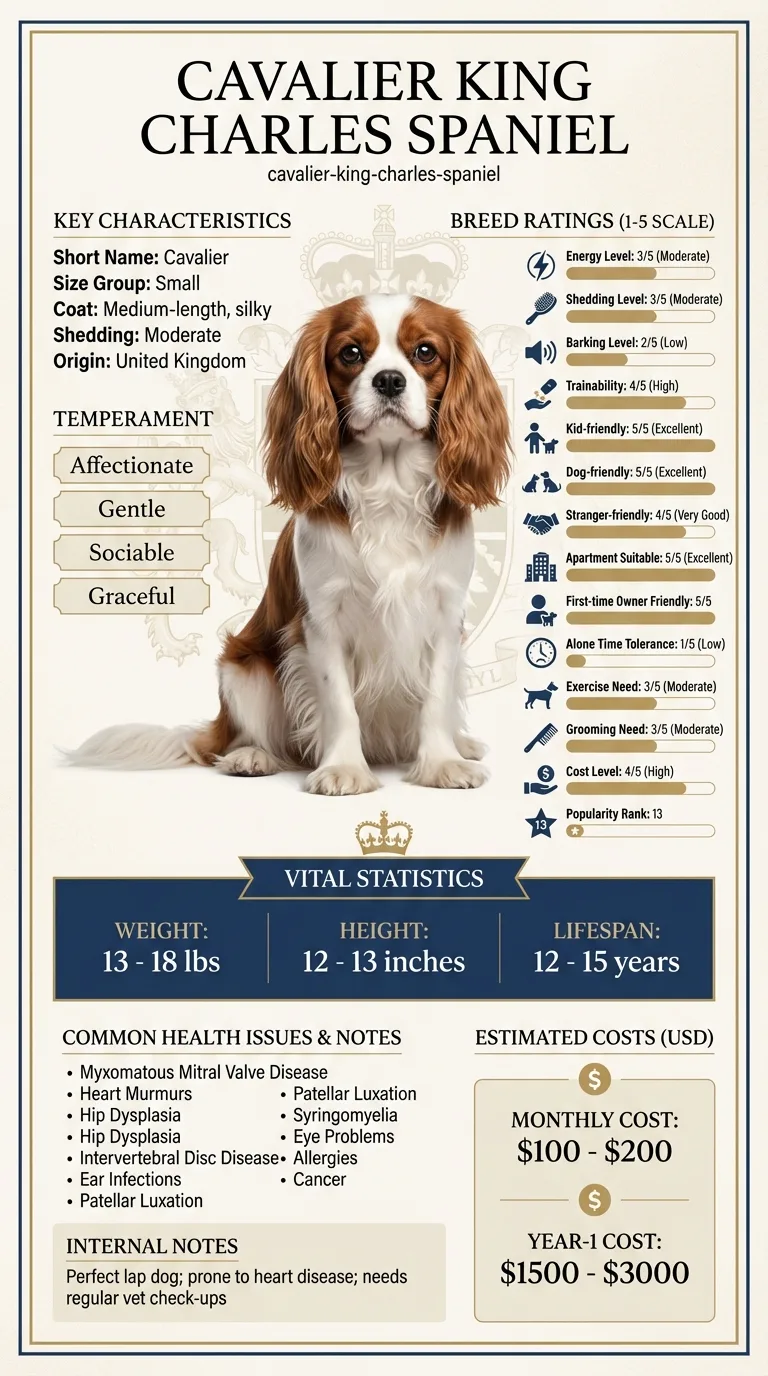
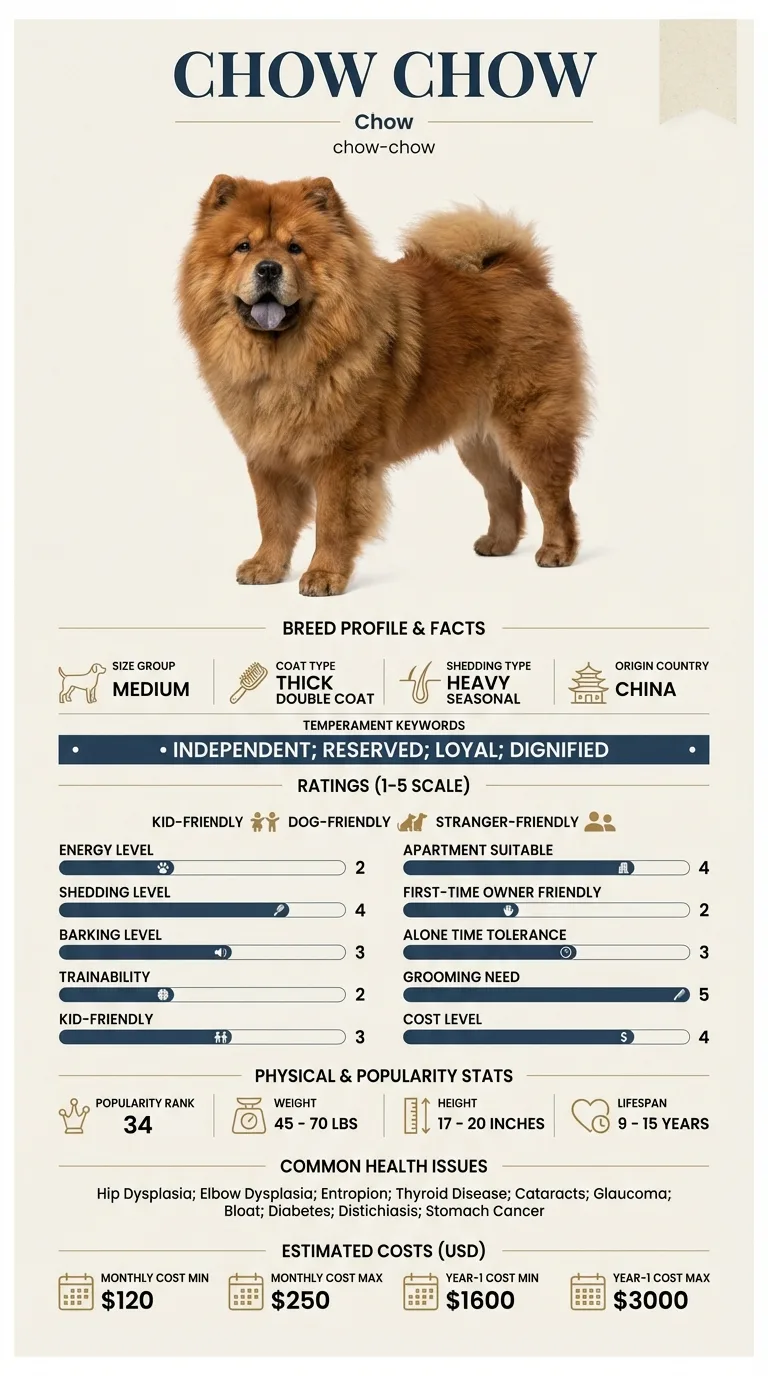
This is for someone already down to Cavalier King Charles Spaniel and Chow Chow and deciding between them. For this pair the decision usually turns on good for first-time owners and good with other dogs, so those are covered first and in most detail. Anyone choosing from a flat has a clear answer here: Cavalier King Charles Spaniel rates 5/5 against 4/5. The focus throughout is on daily consequences rather than breed background.
Between Cavalier King Charles Spaniel and Chow Chow, good for first-time owners is what separates them, and Cavalier King Charles Spaniel is the lower-effort dog of the two to keep.
Choose Cavalier King Charles Spaniel if you are in a flat or a smaller home, this is your first dog and you do not want a standing grooming appointment.
Choose Chow Chow if your walking routine is modest, the dog will be alone during the working day and you want a dog that is more watchful with visitors.
| Feature | cavalier king charles spaniel | chow chow | Winner |
|---|---|---|---|
| Size class | small | medium | Equal |
| Weight | 13–18 lbs | 45–70 lbs | Equal |
| Height | 12–13 in | 17–20 in | Equal |
| Lifespan | 12–15 years | 9–15 years | cavalier king charles spaniel |
| Exercise need | Moderate (3/5) | Low (2/5) | chow chow |
| Grooming need | Moderate (3/5) | Very high (5/5) | cavalier king charles spaniel |
| Shedding | Moderate (3/5) | High (4/5) | cavalier king charles spaniel |
| Energy level | Moderate (3/5) | Low (2/5) | Equal |
| Barking | Low (2/5) | Moderate (3/5) | cavalier king charles spaniel |
| Apartment suitability | Very high (5/5) | High (4/5) | cavalier king charles spaniel |
| Good for first-time owners | Very high (5/5) | Low (2/5) | cavalier king charles spaniel |
| Tolerates being alone | Very low (1/5) | Moderate (3/5) | chow chow |
| Trainability | High (4/5) | Low (2/5) | cavalier king charles spaniel |
| Good with kids | Very high (5/5) | Moderate (3/5) | cavalier king charles spaniel |
| Good with other dogs | Very high (5/5) | Low (2/5) | cavalier king charles spaniel |
| Friendly to strangers | High (4/5) | Low (2/5) | cavalier king charles spaniel |
| Cost level | High (4/5) | High (4/5) | Equal |
| Coat | Medium-length, silky | Thick double coat | Equal |
| Origin | United Kingdom | China | Equal |
| Typical monthly cost | $100–$200 | $120–$250 | Equal |
| Typical first-year cost | $1,500–$3,000 | $1,600–$3,000 | Equal |
A Chow Chow can outweigh a Cavalier King Charles Spaniel by more than three and a half times -- 45 to 70 pounds against 13 to 18 -- and stands a good five to seven inches taller at 17-20 inches versus 12-13. The Chow's thick double coat and famously blue-black tongue give it a bear-like density the Cavalier's medium-length silky coat doesn't approach; even before the scale difference, the two breeds read as entirely different animals in a room. The Cavalier's small frame suits lap-sitting and easy carrying, while the Chow's stocky, muscular medium build was shaped for guarding Chinese households, not being tucked under an arm.
Exercise need sits at Moderate (3/5) for the Cavalier against Low (2/5) for the Chow Chow, and energy level matches -- Moderate (3/5) versus Low (2/5) -- making the Chow the calmer of the two despite its larger size. A Chow Chow's independent, dignified temperament means it's rarely interested in fetch marathons; a daily walk and some yard time generally satisfies it. The Cavalier, despite being the smaller dog, wants more interactive engagement day to day, consistent with its sociable nature. Neither breed demands serious mileage, which makes this pairing unusual: it's the bigger dog, not the smaller one, that needs less physical activity.
Grooming need climbs to Very high (5/5) for the Chow Chow against Moderate (3/5) for the Cavalier, and shedding follows the same pattern -- High (4/5) for the Chow's thick double coat versus Moderate (3/5) for the Cavalier's silky coat. A Chow Chow typically needs brushing several times a week to prevent the dense undercoat from matting, especially around the ruff and britches, plus heavier seasonal blowouts twice a year. The Cavalier's coat is comparatively low-maintenance, needing regular but not daily brushing and occasional trims around the ears and feet. Anyone choosing the Chow should budget real time -- or a groomer's fee -- for coat upkeep that the Cavalier simply doesn't require.
The Cavalier rates Very high (5/5) for apartment living against the Chow Chow's still-solid High (4/5), and barking runs Low (2/5) for the Cavalier versus Moderate (3/5) for the Chow. Where the two diverge sharply is alone tolerance: the Cavalier scores just Very low (1/5), reflecting a breed that was built to be a constant companion and struggles genuinely with solitude, while the Chow's independent nature earns it Moderate (3/5) -- it's more content entertaining itself for a workday. A renter who works long hours may find the reserved, self-sufficient Chow easier to leave alone than the affectionate but clingy Cavalier, size difference aside.
Trainability favors the Cavalier, High (4/5), by a wide margin over the Chow Chow's Low (2/5), and the first-time-owner ratings show the same gap even more starkly -- Very high (5/5) for the Cavalier against just Low (2/5) for the Chow. A Chow Chow's independent, reserved temperament isn't defiance so much as a genuine lack of interest in pleasing for its own sake, which means training requires patience, consistency, and often professional guidance, especially given its guarding instincts. The eager-to-please Cavalier, by contrast, is one of the more forgiving toy breeds for a first dog. Anyone new to dog ownership should weigh that Low (2/5) first-timer score on the Chow very seriously.
The contrast here is dramatic: the Cavalier rates Very high (5/5) with kids, other dogs, and High (4/5) with strangers, while the Chow Chow rates Moderate (3/5) with kids and Low (2/5) with both other dogs and strangers. A Chow's loyal, dignified, reserved nature tends to translate into deep attachment to its own family and real wariness of anyone or anything outside it -- a trait bred into the breed as a guardian, not a flaw, but one that demands careful, early socialization and cautious introductions. The Cavalier's sociable, gentle temperament makes it the far easier choice for a busy household with frequent visitors, playdates, or a multi-dog home.
Lifespan ranges overlap -- 12-15 years for the Cavalier, a wider 9-15 for the Chow Chow -- but the health lists point to very different risks. The Cavalier's list is dominated by cardiac and neurological concerns: Myxomatous Mitral Valve Disease and Heart Murmurs sit alongside Syringomyelia and Intervertebral Disc Disease, conditions that make cardiac screening and careful skull/spine evaluation from a breeder essential. The Chow's ten conditions lean ocular and endocrine instead -- Entropion, Cataracts, Glaucoma, and Distichiasis affect the eyes, while Thyroid Disease and Diabetes affect metabolism, plus a Stomach Cancer listing. Both share Hip Dysplasia and Bloat risk, so joint screening and slow feeding matter for either dog.
Both breeds land at High (4/5) for overall cost level, with the Chow Chow's monthly range ($120-250) running slightly above the Cavalier's ($100-200), and first-year costs of $1,600-3,000 versus $1,500-3,000 nearly matching. The gap widens in practice once grooming enters the picture -- the Chow's Very high (5/5) grooming need often means recurring professional coat care the Cavalier's Moderate (3/5) coat doesn't require. On the veterinary side, the Cavalier's heart-focused condition list can mean earlier and more frequent cardiology visits, while the Chow's eye and thyroid conditions bring their own recurring specialist costs. Neither breed is a budget dog; both reward pet insurance.
Cavalier King Charles Spaniel weighs 13–18 lbs and lives 12–15 years; Chow Chow weighs 45–70 lbs and lives 9–15 years. The two diverge most on good for first-time owners, good with other dogs and grooming need and 4 other rated axes. Almost every rated axis separates them at least slightly. The table below marks a winner only where one breed is genuinely easier for a typical owner; size and origin are facts rather than merits and stay level. Ratings come from one source applied to both breeds, so they are meaningful against each other rather than as absolute scores.

Not really -- it rates just Low (2/5) for first-time owners against the Cavalier's Very high (5/5), reflecting its independent, reserved temperament and need for confident, consistent handling.
The Cavalier, rated High (4/5) against the Chow Chow's Low (2/5); the Chow's loyal, dignified nature tends toward reserve with unfamiliar people.
The Chow Chow, rated Very high (5/5) grooming need for its thick double coat, against the Cavalier's Moderate (3/5).
Not typically -- it rates Low (2/5) with other dogs, well below the Cavalier's Very high (5/5), so careful, early socialization matters more with a Chow.
The Cavalier, whose health list is topped by Myxomatous Mitral Valve Disease and Heart Murmurs, conditions not listed for the Chow Chow.
Better than a Cavalier can -- it rates Moderate (3/5) for tolerating being alone against the Cavalier's Very low (1/5), though neither breed is ideal for very long stretches.
Lifespans overlap -- 12-15 years for the Cavalier against a wider 9-15 range for the Chow Chow.
The Chow Chow, at 45-70 lbs versus the Cavalier's 13-18 lbs.
The Cavalier, rated High (4/5) against the Chow Chow's Low (2/5).
The Chow Chow, rated Low (2/5) against the Cavalier's Moderate (3/5).
The Cavalier, rated Very high (5/5) against the Chow Chow's Moderate (3/5).
Secure checkout on Stripe. We never see your card.
7-day money-back guarantee. Instant access.
Health information here is general and is not veterinary advice. If your dog shows pain, sudden behaviour change, or worsening symptoms, consult a licensed veterinarian.
Some links on this site are affiliate links. We may earn a commission at no extra cost to you, and we only suggest products we believe are helpful for dog owners.
We research and check what we publish, but we do not warrant that any figure, date, price, or statement is accurate, complete, or current, and we accept no liability for any loss, cost, injury, or other harm arising from the use of this site. Use it as one reference among several. You remain responsible for your own decisions and for your dog's care - confirm anything that matters with a licensed veterinarian or another qualified professional before you act on it. Full disclaimer.
Match your lifestyle to the right dog.
Take quizNot sure which breed is right for you? Take our 2-minute quiz to find out.
Take the quiz