Health
What is the giveaway sign in this breed?
Loss of dark pigment from the nose, lips or tongue, particularly alongside crusting. In a breed defined by black pigment, this is visible early.

Quick answer
What is the giveaway sign in this breed?
Loss of dark pigment from the nose, lips or tongue, particularly alongside crusting. In a breed defined by black pigment, this is visible early.
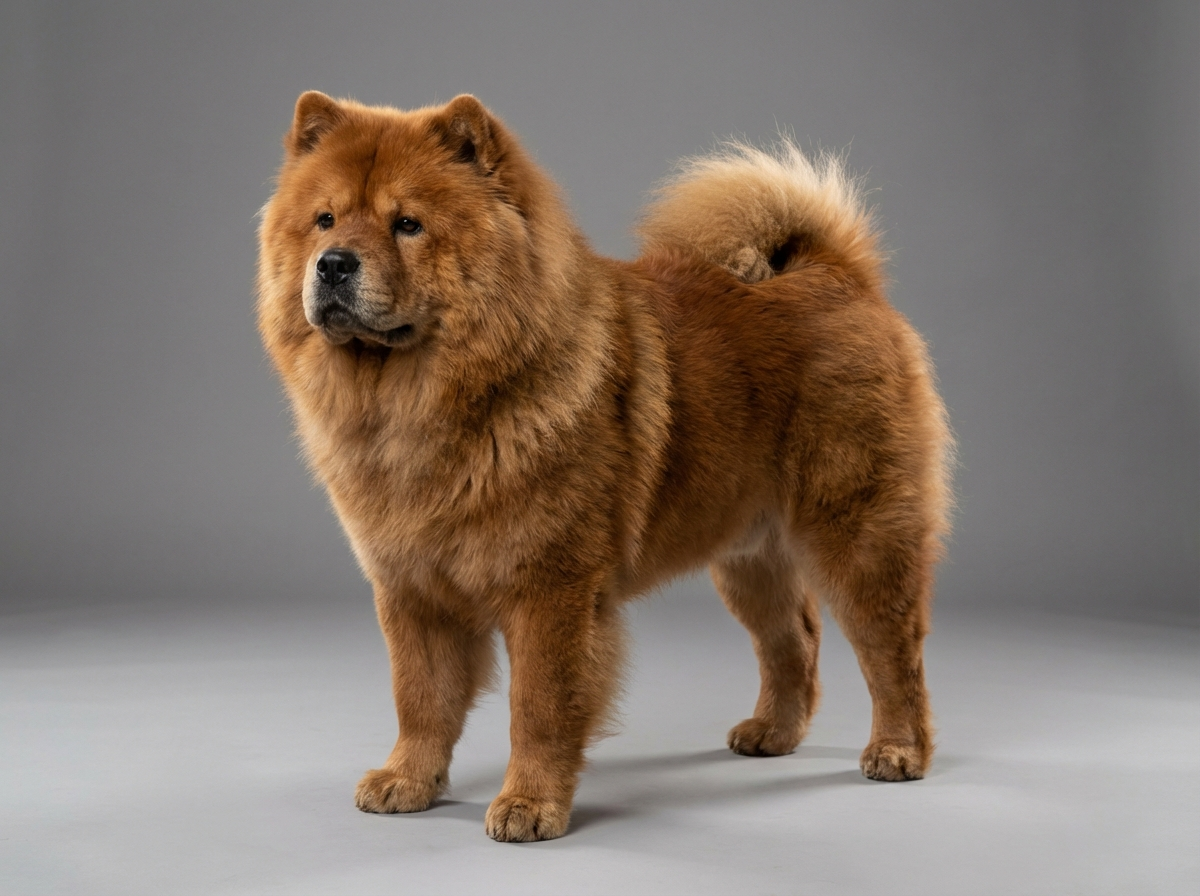
The Chow Chow is defined by dark pigment - the blue-black tongue, the black lips and nose. That makes it one of the few breeds where an owner can actually see pigment being lost. A nose that has gone from black to slate grey, or lips turning pale at the edges, is a visible finding that would be invisible on a pink-skinned dog.
Owners who have been managing what they believed was a stubborn allergy, and who keep treating flares that never fully resolve. It also concerns anyone whose Chow has developed thyroid disease, since the immune system attacking the thyroid gland is one of the more common autoimmune processes documented in this breed.
This guide is not medical advice. If your dog shows pain, sudden behavior change, or worsening symptoms, consult a licensed veterinarian.
Some links may be affiliate links. We may earn a commission at no extra cost to you. We only suggest products we believe are helpful for dog owners.
We research and check what we publish, but we do not warrant that any figure, date, price, or statement is accurate, complete, or current, and we accept no liability for any loss, cost, injury, or other harm arising from the use of this site. Use it as one reference among several. You remain responsible for your own decisions and for your dog's care - confirm anything that matters with a licensed veterinarian or another qualified professional before you act on it. Full disclaimer.
Autoimmune disease covers a group of conditions in which the immune system damages the dog's own tissue. In the skin this produces crusting, erosions, sores and permanent hair loss, often symmetrically and often at the borders between skin and mucous membrane. In the Chow Chow the most reliably documented immune-mediated process is thyroid destruction, while skin forms are less common but visually distinctive because of the breed's heavy pigmentation.
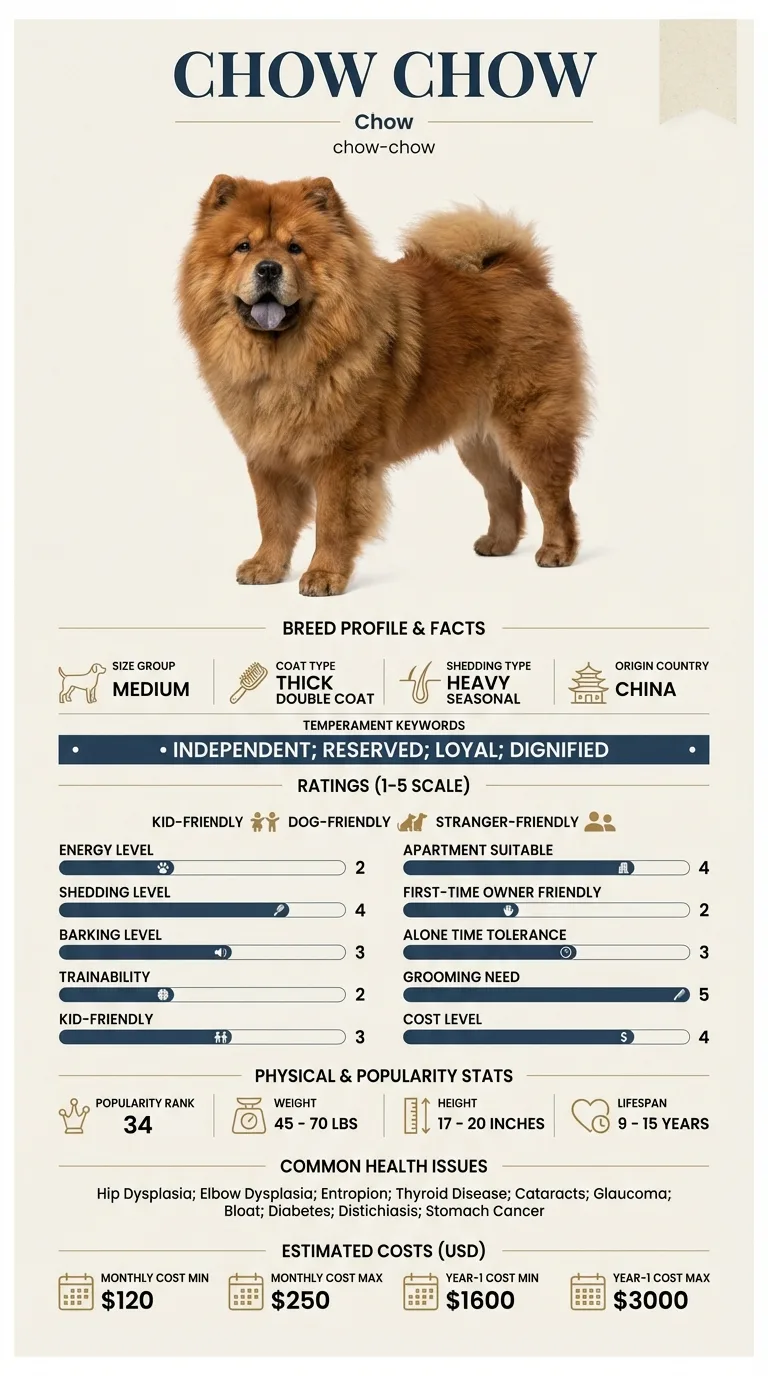
Immune-mediated skin disease is uncommon in dogs generally and is not a headline risk for the Chow Chow, whose documented profile is dominated by hip and elbow dysplasia, eyelid and eye disease, thyroid disease, bloat, diabetes and stomach cancer. Thyroiditis is the exception and is worth being alert to. Most Chows with sore skin have allergy or infection, not autoimmunity - but the ones that do not are frequently the dogs that never responded to allergy treatment.
The clearest breed link is the thyroid. Thyroid disease is documented in the Chow Chow, and the usual mechanism in dogs is immune-mediated inflammation that gradually destroys the gland, so a Chow that becomes hypothyroid has often had an autoimmune process running quietly for a long time. The breed's heavy pigmentation is not itself a risk factor, but it changes presentation: depigmentation is conspicuous on a black nose and a blue-black tongue in a way it simply is not on a pale-muzzled dog, which can mean earlier detection for the conditions that cause it.
Environment plays a smaller role here than in allergy, and owners should be wary of anyone claiming a specific household cause. Sun exposure genuinely aggravates certain facial forms of the disease. Secondary infection driven by a warm, damp undercoat can inflame lesions and confuse the picture. Otherwise the disease is largely internal, which is frustrating for owners used to being able to change something and see a result.
Book an appointment for any non-healing sore, symmetrical hair loss, crusting at the lips, nose or eyelids, or new pigment loss with texture change. Ask specifically whether a biopsy is indicated, and whether to withhold topical treatment first. Seek urgent care if lesions are widespread and painful, if the dog stops eating because its mouth hurts, if there is fever and lethargy alongside skin disease, or if you see pale gums, weakness or dark urine, since some immune-mediated conditions attack blood cells and become emergencies quickly. Never start or stop immune-suppressing medication on your own judgement.
See all Chow Chow health problems, which breeds are prone to autoimmune diseases, or the full Chow Chow breed guide for temperament, exercise needs and ownership costs.
Diagnosis usually takes two to four weeks from first appointment, allowing for biopsy and laboratory turnaround. Initial control of an active flare typically takes four to eight weeks on immune-suppressing treatment. Finding a stable long-term dose is a matter of months, with rechecks along the way, and relapse when doses are reduced is a normal part of the process rather than a failure.
Success is remission held on the lowest effective medication, with skin that is intact and comfortable and a dog behaving normally. Hair may not return to previously scarred areas, and lost pigment often does not come back. Owners who define success as a return to how the dog looked before are usually disappointed; owners who define it as a comfortable dog on stable treatment usually are not.
Allergy and autoimmune disease can look similar from a distance and behave completely differently up close, and the distinction matters because the treatments diverge sharply. Three features tend to separate them.
The first is distribution. Allergic skin disease concentrates where the dog licks and where the coat traps damp - feet, armpits, groin, ears. Immune-mediated disease more often shows up at the junctions between skin and mucous membrane: the edges of the lips, the rim of the nose, the eyelids, the footpads. If the trouble is at the borders rather than in the folds, that is worth flagging.
The second is symmetry. Autoimmune processes are frequently mirror-imaged left to right in a way that infection and localised irritation are not. Both ears, both eyelids, both footpads.
The third is pigment. Loss of colour from the nose leather or the lip margins, or a tongue that develops pale patches in a breed whose tongue should be uniformly dark, is a genuine finding rather than a cosmetic one. Photograph it. In a Chow this is often the earliest thing an owner can point to.

Immune-mediated disease waxes and wanes, so the version your vet sees may not be the version that worried you. Photographic evidence with dates does real diagnostic work.
If you think your Chow has autoimmune diseases, the plan is three steps: write down what you have seen and when it started, book a veterinary appointment rather than waiting for the next flare, and take video of the behaviour or symptom before you go — the thing you are worried about rarely happens in the consulting room. Screening in the parents covers hip dysplasia, elbow dysplasia, entropion.
What the vet visit should produce is a diagnosis and a written plan, not just reassurance: what is being ruled out, what the monitoring interval is, and which signs mean you come back sooner. Ask what the treatment costs across a year rather than per visit, because that is the number that decides whether you are managing this condition or reacting to it.
Between appointments, keep a short log — dates, what you saw, what changed. It is the single most useful thing an owner brings to a follow-up, and for autoimmune diseases it is often what separates a clear pattern from a guess.
Suki was seven and had been treated for allergies on and off for two years. Her owner, Owen, had run a diet trial, changed shampoos twice and never felt the itching had properly gone away. What finally moved things along was a photograph. Owen was scrolling back through his phone and found a picture from a beach trip three summers earlier. Suki's nose in that photo was solid black. The nose in front of him was mottled grey, and the edges of her lips had gone pale and crusty. He had watched it happen too slowly to notice. His vet biopsied two lesions before starting any new treatment. The result changed the plan entirely, and Suki went onto immune-suppressing therapy with monitoring bloods every three months. The crusting settled over about six weeks. Her nose never went black again, and Owen has stopped expecting it to.
Key takeaway: In a breed built around dark pigment, a fading nose or lip margin is data. Photograph your Chow in good light once a year, because the changes that matter most here happen too gradually to see from day to day.
Thyroid disease is documented in this breed, and in dogs generally the common form is immune-mediated destruction of the thyroid gland. Beyond that, the breed's documented profile centres on joints, eyes and eyelids rather than skin autoimmunity. Treat it as a possibility to investigate rather than an expectation.
Usually by skin biopsy, taken under sedation or anaesthetic from an active untreated lesion. This matters practically: if you start medicating the area before the biopsy, you can make the sample uninformative. Ask your vet whether to hold off on treatment until the sample is taken.
No. Some dogs develop seasonal nose fading that comes and goes with daylight, and it is harmless. What warrants attention is pigment loss combined with texture change - crusting, cracking, a loss of the normal cobbled surface - or pigment loss accompanied by lesions elsewhere.
Often yes. Immune-mediated disease is generally suppressed rather than cured, and treatment is usually tapered to the lowest dose that holds the disease quiet. That means regular monitoring bloodwork alongside the medication, which is a long-term commitment of both time and money.
For some immune-mediated conditions affecting the nose and face, ultraviolet exposure worsens lesions. If your vet identifies one of those, limiting midday sun becomes part of management - which fits reasonably well with a breed that should be avoiding midday heat anyway.
On the body, considerably. This is why the face, feet and pigment changes carry so much diagnostic weight in a Chow: they are the places you can actually see. Regular hands-on grooming is how body lesions get found before they become extensive.
Loss of dark pigment from the nose, lips or tongue, particularly alongside crusting. In a breed defined by black pigment, this is visible early.
Ask first. Topical treatment applied before a biopsy can obscure the diagnosis and cost you weeks.
No. Autoimmune disease is the dog's own immune system misfiring and cannot be passed on.
Medication plus quarterly monitoring bloods is an ongoing annual expense that sits alongside this breed's already high baseline cost of care.
A one-page prep sheet for this condition: the signs, the questions to ask, what to get priced. Unlocks here.
You get: Vet visit prep sheet
No spam. One-click unsubscribe. See our privacy policy.
Preview page 1 before you decide.