Health
What's the difference between regurgitation and vomiting?
Regurgitation is passive and effortless, often within minutes of eating. Vomiting involves retching and abdominal effort and happens later. Film it if you can.

Quick answer
What's the difference between regurgitation and vomiting?
Regurgitation is passive and effortless, often within minutes of eating. Vomiting involves retching and abdominal effort and happens later. Film it if you can.
A puppy who brings up an undigested tube of food minutes after eating, unbothered and ready to eat it again, is not doing the same thing as a dog who vomits. The difference is the entire diagnosis.
New puppy owners who assume a weaning-age dog that keeps bringing food back up is simply eating too fast, and owners of older dogs whose occasional regurgitation gets dismissed as a food sensitivity for months before anyone asks the right question.
This guide is not medical advice. If your dog shows pain, sudden behavior change, or worsening symptoms, consult a licensed veterinarian.
Some links may be affiliate links. We may earn a commission at no extra cost to you. We only suggest products we believe are helpful for dog owners.
Esophageal disease covers problems with the muscular tube that carries food from mouth to stomach, and Chihuahuas are documented as carrying a substantially elevated risk of it compared with the average dog. In puppies the usual cause is a congenital vascular ring trapping the esophagus near the heart; in adults it is more often generalized loss of normal muscle tone. Both produce regurgitation rather than vomiting, and both carry a real risk of aspiration if food or fluid enters the airway instead of the stomach.
Esophageal disease as a category is uncommon in the general dog population, but breed-level genetic risk data place Chihuahuas well above average, and vascular ring anomalies are one of the more frequently recognized congenital causes of puppy regurgitation in small breeds specifically.
In puppies, a fibrous vessel remnant that should dissolve before birth instead persists and encircles the esophagus near the heart, and it does not expand as the puppy grows, creating a fixed narrowing exactly where solid food needs to pass. In adults, generalized esophageal muscle weakness can develop on its own or alongside another documented condition affecting nerve or hormone function. Because this breed's neck and chest are already compact, structures that would have more room in a larger dog sit close together here.
Rapid eating, competitive multi-dog feeding, and large meal volumes all increase the physical strain on an esophagus that is already narrowed or weak. Feeding position matters directly: a dog fed on the floor with a compromised esophagus has gravity working against it, while an upright feeding posture works with it. Stress and excitement around mealtimes can also worsen the frequency of episodes in dogs with a generalized motility problem.
Book an appointment for any puppy who regularly regurgitates solid food shortly after weaning, or any adult dog with new or recurring regurgitation, so contrast imaging can identify whether the cause is a fixed obstruction or generalized weakness. Seek same-day or emergency care for coughing, fever, lethargy or labored breathing following a regurgitation episode, since these can indicate aspiration pneumonia, which is the dangerous complication of this condition.
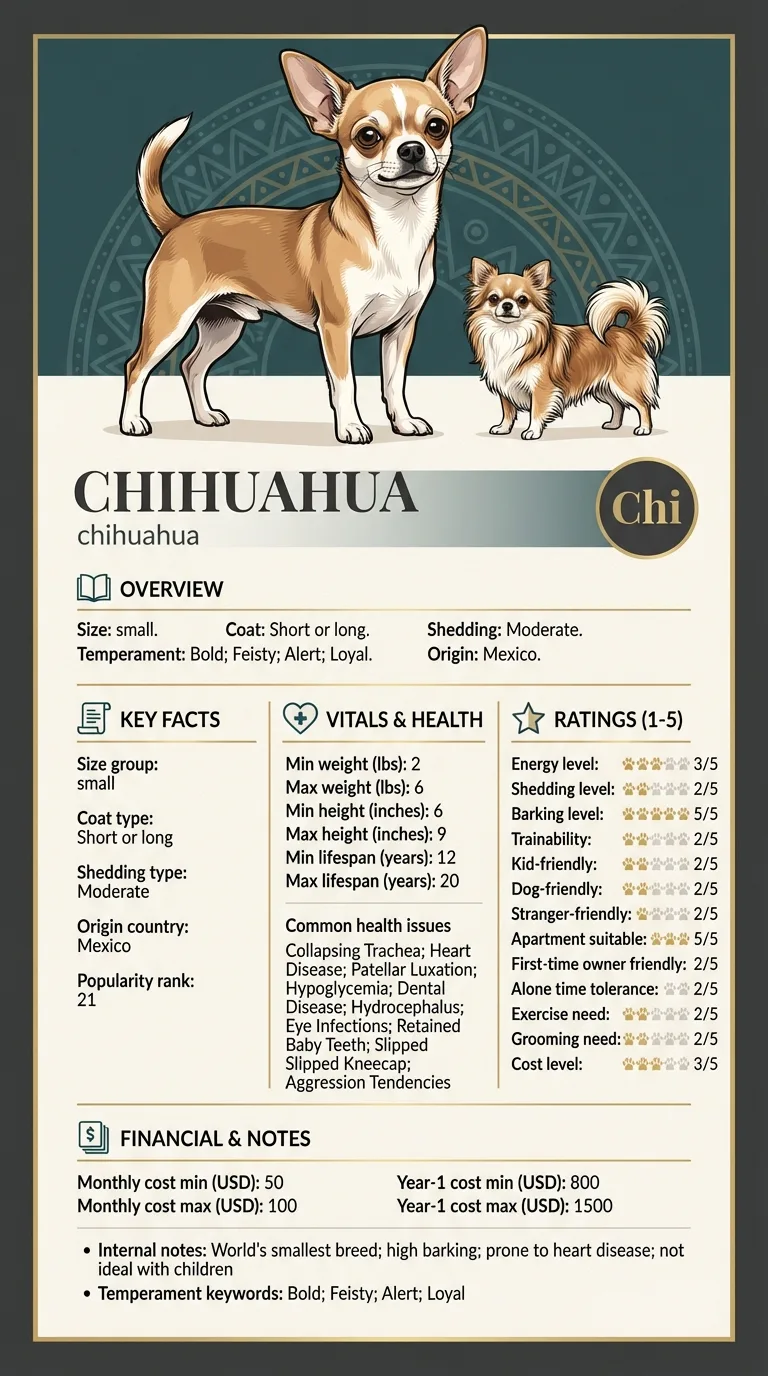
See all Chihuahua health problems, which breeds are prone to esophageal disease, or the full Chihuahua breed guide for temperament, exercise needs and ownership costs.
A vascular ring anomaly diagnosed and corrected surgically while the esophagus is still relatively healthy often shows improvement within weeks, though some residual widening can persist and require ongoing feeding adjustments. Generalized esophageal weakness is typically a long-term management situation from diagnosis onward, with feeding routine doing most of the practical work indefinitely.
Success looks like a dog who reliably keeps meals down, gains weight appropriately, and has not had an aspiration event. For a surgically corrected vascular ring, it can mean an eventual return to normal feeding. For generalized weakness, it usually means a permanent but manageable routine rather than a return to feeding without accommodation.
In a small number of puppies, a blood vessel near the heart that should have disappeared before birth persists and forms a loop around the esophagus. As the puppy grows and starts eating solid food, that fibrous ring does not grow with it, and the esophagus becomes trapped and narrowed at the point where the ring crosses it. Food backs up behind the constriction and comes back up, often as a tube-shaped mass of undigested food, usually within minutes of eating rather than hours.
This usually shows up right at weaning, because milk and soft gruel pass the narrowing easily while solid kibble does not. It is a mechanical problem, not a behavioral one, and no amount of slowing the puppy's eating fixes it. Diagnosis is by contrast radiography, which shows the barium-coated esophagus narrowing sharply at a fixed point, and correction is surgical division of the offending vessel. Puppies diagnosed and corrected before the esophagus has stretched permanently around the obstruction generally do very well.
A second, separate pattern is generalized esophageal weakness, sometimes present from birth and sometimes developing later, in which the whole tube loses its normal wave-like motion rather than being narrowed at one spot. This produces a widened, poorly emptying esophagus and carries a real risk of food or fluid being inhaled into the lungs, which is the complication that makes any esophageal disease worth investigating rather than managing by guesswork.

Owners describe both as 'throwing up,' but a vet needs to know which one actually happened, because the causes and the urgency are different.
If you think your Chi has esophageal disease, the plan is three steps: write down what you have seen and when it started, book a veterinary appointment rather than waiting for the next flare, and take video of the behaviour or symptom before you go — the thing you are worried about rarely happens in the consulting room. Screening in the parents covers collapsing trachea, heart disease, patellar luxation.
What the vet visit should produce is a diagnosis and a written plan, not just reassurance: what is being ruled out, what the monitoring interval is, and which signs mean you come back sooner. Ask what the treatment costs across a year rather than per visit, because that is the number that decides whether you are managing this condition or reacting to it.
Between appointments, keep a short log — dates, what you saw, what changed. It is the single most useful thing an owner brings to a follow-up, and for esophageal disease it is often what separates a clear pattern from a guess.
Pancho started solid food at eight weeks, and within days his owner Marisela noticed him bringing back what looked like an intact tube of kibble a few minutes after every meal, then eating it again without hesitation. Her first assumption was that he simply ate too fast, so she switched to a slow-feeder bowl. Nothing changed. At his next puppy visit she happened to have a video on her phone, and her vet watched it twice before ordering contrast radiographs. The films showed his esophagus narrowing sharply at one fixed point near his heart, consistent with a persistent vascular ring. He was referred for surgery within the week, before the esophagus above the narrowing had a chance to stretch permanently. Recovery took about a month of upright, softened-food feedings. By his six-month checkup he was eating a normal kibble diet from a normal bowl with no further episodes, and his vet's main caution was that had they waited another few months for the regurgitation to 'grow out of it,' as a slow-feeder bowl seemed to half-support, the surgical outcome would likely have been less clean.
Key takeaway: A puppy who regurgitates a recognizable tube of undigested food right after eating is not a fast eater; that shape is a physical description of the esophagus, and it is worth a phone video and an early appointment rather than a slower bowl.
Watch for effort. Vomiting involves visible retching and abdominal heaving; regurgitation is passive, often silent, and tends to happen within minutes of eating rather than hours later. Filming an episode is the single most useful thing you can bring to an appointment.
It is uncommon in absolute terms but is one of the recognized congenital causes of regurgitation in small-breed puppies, and this breed carries an elevated overall risk of esophageal disease. It is worth ruling out in any puppy that consistently regurgitates solid food shortly after weaning.
A vascular ring anomaly is corrected surgically and many puppies recover normal or near-normal function, especially if treated early. Generalized esophageal weakness is usually managed rather than cured, with feeding position and food consistency doing most of the practical work.
Because a poorly clearing esophagus can allow food or liquid to spill into the airway instead of the stomach. This is the complication that turns a manageable feeding problem into a respiratory emergency, and it is the reason lethargy, fever or coughing after an episode needs same-day attention.
For dogs with reduced esophageal motility, gravity-assisted upright feeding, sometimes for several minutes after eating, helps move food down into the stomach and is one of the few at-home measures with real physiological logic behind it. It does not correct a mechanical vascular ring narrowing.
If a vascular ring is corrected surgically while the esophagus is still healthy, many dogs return to normal food and feeding position. If there is lasting stretching of the esophagus or a generalized motility problem, upright feeding, food consistency and small frequent meals typically become permanent management rather than a temporary fix.
Regurgitation is passive and effortless, often within minutes of eating. Vomiting involves retching and abdominal effort and happens later. Film it if you can.
Not always, but coughing, fever or lethargy after an episode can mean aspiration pneumonia and needs same-day veterinary care.
No. It is a physical narrowing that requires surgical correction; feeding changes only help generalized motility problems.
Upright feeding, holding position for several minutes after eating, helps some dogs with reduced esophageal motility move food into the stomach.
A one-page prep sheet for this condition: the signs, the questions to ask, what to get priced. Unlocks here.
You get: Vet visit prep sheet
No spam. One-click unsubscribe. See our privacy policy.
Preview page 1 before you decide.