Behavior
More active breed?
The Labradoodle, very high (5/5) exercise need versus the Chihuahua's low (2/5).

Quick answer
More active breed?
The Labradoodle, very high (5/5) exercise need versus the Chihuahua's low (2/5).
Chihuahua or Labradoodle? On paper they differ most on exercise need, and on the scales Labradoodle is the heavier at 15–65 lbs. Here is how the two compare on everything that shapes an ordinary week.
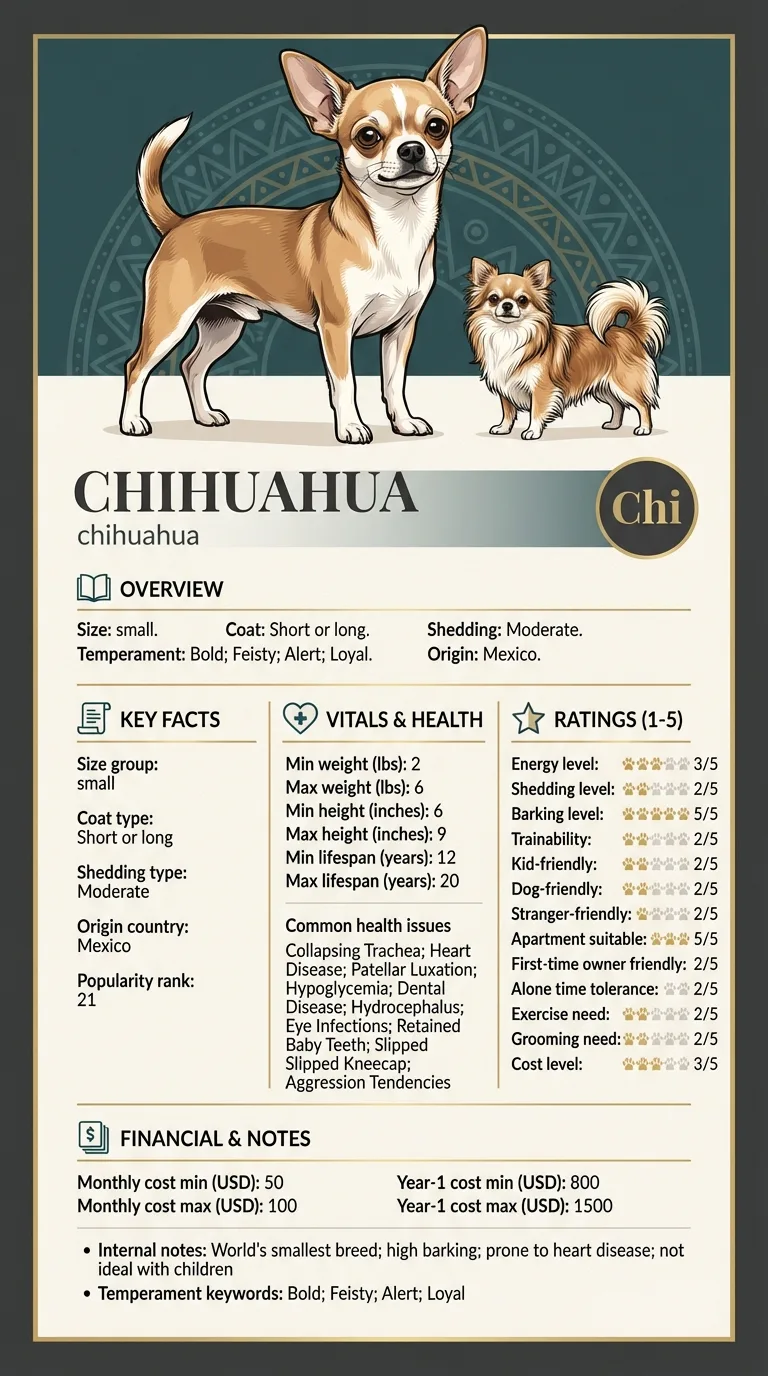
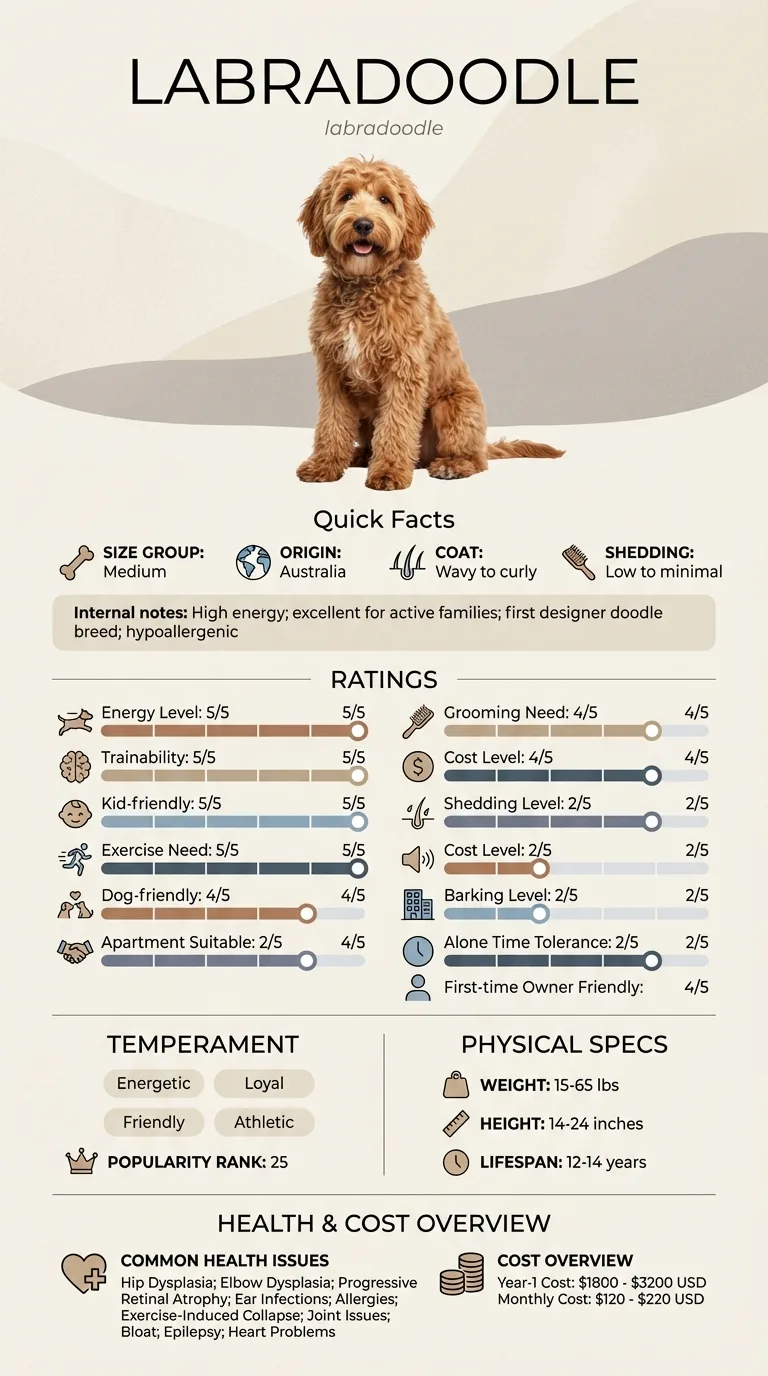
This is for someone already down to Chihuahua and Labradoodle and deciding between them. For this pair the decision usually turns on exercise need and apartment suitability, so those are covered first and in most detail. Anyone choosing from a flat has a clear answer here: Chihuahua rates 5/5 against 2/5. Breed history is left out; what follows is what you will actually live with.
Between Chihuahua and Labradoodle, exercise need is what separates them, and Chihuahua is the lower-effort dog of the two to keep.
Choose Chihuahua if you are in a flat or a smaller home, you do not want a standing grooming appointment and your walking routine is modest.
Choose Labradoodle if this is your first dog, there are young children at home and you already have another dog.
| Feature | chihuahua | labradoodle | Winner |
|---|---|---|---|
| Size class | small | medium | Equal |
| Weight | 2–6 lbs | 15–65 lbs | Equal |
| Height | 6–9 in | 14–24 in | Equal |
| Lifespan | 12–20 years | 12–14 years | chihuahua |
| Exercise need | Low (2/5) | Very high (5/5) | chihuahua |
| Grooming need | Low (2/5) | High (4/5) | chihuahua |
| Shedding | Low (2/5) | Low (2/5) | Equal |
| Energy level | Moderate (3/5) | Very high (5/5) | Equal |
| Barking | Very high (5/5) | Low (2/5) | labradoodle |
| Apartment suitability | Very high (5/5) | Low (2/5) | chihuahua |
| Good for first-time owners | Low (2/5) | High (4/5) | labradoodle |
| Tolerates being alone | Low (2/5) | Low (2/5) | Equal |
| Trainability | Low (2/5) | Very high (5/5) | labradoodle |
| Good with kids | Low (2/5) | Very high (5/5) | labradoodle |
| Good with other dogs | Low (2/5) | High (4/5) | labradoodle |
| Friendly to strangers | Low (2/5) | High (4/5) | labradoodle |
| Cost level | Moderate (3/5) | High (4/5) | chihuahua |
| Coat | Short or long | Wavy to curly | Equal |
| Origin | Mexico | Australia | Equal |
| Typical monthly cost | $50–$100 | $120–$220 | Equal |
| Typical first-year cost | $800–$1,500 | $1,800–$3,200 | Equal |
Like its Goldendoodle cousin, the Labradoodle spans a wide size range -- 15 to 65 lbs and 14 to 24 inches tall -- depending on whether it's bred from a miniature, medium, or standard Poodle line crossed with a Labrador Retriever. Even the smallest Labradoodle still dwarfs the Chihuahua's 2-6 lb frame several times over. The Labradoodle's wavy-to-curly coat draws on its Poodle parentage, a sharp contrast to the Chihuahua's short-or-long coat with minimal styling involved. Because the breed spans such a wide size window, prospective buyers should confirm which generation and size category a specific Labradoodle falls into before assuming it will land anywhere near the smaller end.
Exercise need runs low (2/5) for the Chihuahua and very high (5/5) for the Labradoodle, one of the more demanding exercise ratings in this comparison set, reflecting the Labrador Retriever's working retriever heritage passed down through the cross. Energy level follows the same pattern, moderate (3/5) versus very high (5/5). An Energetic, Athletic Labradoodle genuinely needs daily vigorous activity -- running, swimming, or fetch -- to stay settled indoors; without it, that drive tends to surface as jumping, chewing, or restlessness. The Chihuahua's needs are satisfied by far less, making it the clearly lower-effort option for anyone without an active daily routine.
Grooming need favors the Chihuahua, low (2/5) against the Labradoodle's high (4/5), though shedding actually ties at low (2/5) for both thanks to the Labradoodle's Poodle-influenced coat. The trade-off is real: less loose fur around the house with a Labradoodle, but its wavy-to-curly coat needs regular brushing and periodic professional grooming to avoid matting, a recurring time and cost commitment the Chihuahua's coat never demands. Buyers drawn to the Labradoodle specifically for a low-shed home should budget for that grooming schedule as a genuine ongoing expense rather than a one-time consideration.
Apartment suitability favors the Chihuahua clearly, very high (5/5) versus the Labradoodle's low (2/5), tracking directly with the Labradoodle's very high exercise needs. Barking flips that pattern, though -- the Labradoodle rates low (2/5) while the Chihuahua rates very high (5/5), making the smaller dog the noisier housemate in a building with thin walls. Both breeds rate low (2/5) on tolerating time alone, meaning a Labradoodle left in an apartment without its exercise needs met and without company for long stretches is likely to develop anxiety-driven behaviors despite its otherwise adaptable, Friendly temperament.
Labradoodles rate very high (5/5) for trainability and high (4/5) for first-time-owner suitability, drawing on the Labrador Retriever's famously biddable nature and an Energetic, Loyal temperament that responds well to consistent training. Chihuahuas rate low (2/5) on both measures, consistent with their independent streak and resistance to structured obedience, especially housebreaking. For a first-time owner willing to commit to daily exercise, the Labradoodle offers a much smoother training experience on paper than the Chihuahua, whose small size doesn't translate into an easier learning curve for a new dog owner.
Labradoodles score very high (5/5) with kids, high (4/5) with other dogs, and high (4/5) with strangers -- a highly social profile that reflects the Friendly half of its Labrador heritage. Chihuahuas score low (2/5) across all three categories, tending toward wariness with unfamiliar people, animals, and boisterous handling. For a household with children or other pets, the Labradoodle is by far the more predictable and forgiving choice according to this data, while the Chihuahua remains better suited to a quieter, more controlled environment centered on one or two people.
The Chihuahua's 12-20 year lifespan comfortably exceeds the Labradoodle's 12-14, though both fall on the longer end for their respective size classes. The Labradoodle's health list includes Exercise-Induced Collapse, an inherited condition tied to its Labrador lineage that can cause weakness or collapse during intense activity, alongside more familiar concerns like Hip Dysplasia, Elbow Dysplasia, and Bloat. The Chihuahua's list centers on Collapsing Trachea, Hypoglycemia, and Hydrocephalus. Owners of an active Labradoodle should be aware of Exercise-Induced Collapse specifically, since it directly intersects with the breed's very high exercise needs and could be mistaken for simple fatigue.
Cost level rates moderate (3/5) for the Chihuahua and high (4/5) for the Labradoodle, with monthly costs of $50-$100 versus $120-$220 and first-year costs of $800-$1,500 versus $1,800-$3,200. As with the Goldendoodle, a meaningful share of the Labradoodle's ongoing cost comes from professional grooming to manage its curly coat, on top of the larger food volume a 65-lb dog requires compared to a 6-lb one. For budget-conscious buyers, the Chihuahua remains the clearly cheaper commitment, while the Labradoodle's cost reflects both its size and its coat-care needs combined.
Chihuahua weighs 2–6 lbs and lives 12–20 years; Labradoodle weighs 15–65 lbs and lives 12–14 years. The two diverge most on exercise need, apartment suitability and barking and 7 other rated axes. They are level on tolerates being alone and shedding, so those cannot decide it. The comparison marks an easier option only where one exists. Facts like weight and country of origin are not scored. Both dogs are rated from the same dataset, which is what makes the numbers comparable with each other even though any individual dog sits somewhere inside its breed's range.

It varies widely -- this comparison lists a 15-65 lb range and 14-24 inch height, since Labradoodles come in miniature, medium, and standard sizes depending on the Poodle parent used.
The Labradoodle, rated very high (5/5) versus the Chihuahua's low (2/5).
It's an inherited condition on the Labradoodle's health list, tied to its Labrador ancestry, that can cause weakness or collapse during intense exercise -- worth discussing with a vet for an active dog.
They tie at low (2/5), though the Labradoodle's coat needs far more brushing and professional grooming to stay that way.
The Labradoodle, rated high (4/5) for first-time-owner suitability versus the Chihuahua's low (2/5).
The Labradoodle, low (2/5), versus the Chihuahua's very high (5/5).
The Chihuahua, at $800-$1,500 in the first year versus the Labradoodle's $1,800-$3,200.
The Labradoodle, very high (5/5) exercise need versus the Chihuahua's low (2/5).
The Labradoodle, very high (5/5), versus the Chihuahua's low (2/5).
The Labradoodle, high (4/5), versus the Chihuahua's low (2/5).
The Chihuahua, roughly half the Labradoodle's first-year cost.
Secure checkout on Stripe. We never see your card.
7-day money-back guarantee. Instant access.
Health information here is general and is not veterinary advice. If your dog shows pain, sudden behaviour change, or worsening symptoms, consult a licensed veterinarian.
Some links on this site are affiliate links. We may earn a commission at no extra cost to you, and we only suggest products we believe are helpful for dog owners.
We research and check what we publish, but we do not warrant that any figure, date, price, or statement is accurate, complete, or current, and we accept no liability for any loss, cost, injury, or other harm arising from the use of this site. Use it as one reference among several. You remain responsible for your own decisions and for your dog's care - confirm anything that matters with a licensed veterinarian or another qualified professional before you act on it. Full disclaimer.
Match your lifestyle to the right dog.
Take quizNot sure which breed is right for you? Take our 2-minute quiz to find out.
Take the quiz