Health
What are the first signs of IVDD in a Chihuahua?
A hunched or stiff posture, yelping when lifted, reluctance to jump or use stairs, trembling, and any wobbliness or dragging in the back legs.

Quick answer
What are the first signs of IVDD in a Chihuahua?
A hunched or stiff posture, yelping when lifted, reluctance to jump or use stairs, trembling, and any wobbliness or dragging in the back legs.
IVDD is graded on what the dog can still do, not on how much she seems to hurt. A dog who is screaming may be less seriously affected than a quiet one who has stopped feeling her back feet.
Owners of Chihuahuas who have been diagnosed and sent home with a crate-rest instruction and very little detail, and owners of dogs with mild recurring back pain who want to know how worried to be.
This guide is not medical advice. If your dog shows pain, sudden behavior change, or worsening symptoms, consult a licensed veterinarian.
Some links may be affiliate links. We may earn a commission at no extra cost to you. We only suggest products we believe are helpful for dog owners.
Intervertebral disc disease occurs when disc material displaces into the spinal canal and compresses the cord. It is graded from one to five according to what the dog can still do, and the grade drives both urgency and treatment. Lower grades are usually managed with strict confinement and veterinary pain control; higher grades raise the question of surgery, sometimes within hours.
Disc disease is a well-recognised problem across small breeds, though Chihuahuas are less strongly affected than the classic long-backed breeds and it does not appear in this breed's documented health issues. When it does occur, the clinical picture and the urgency are the same as in any small dog, and outcomes depend heavily on how quickly the grade is recognised.
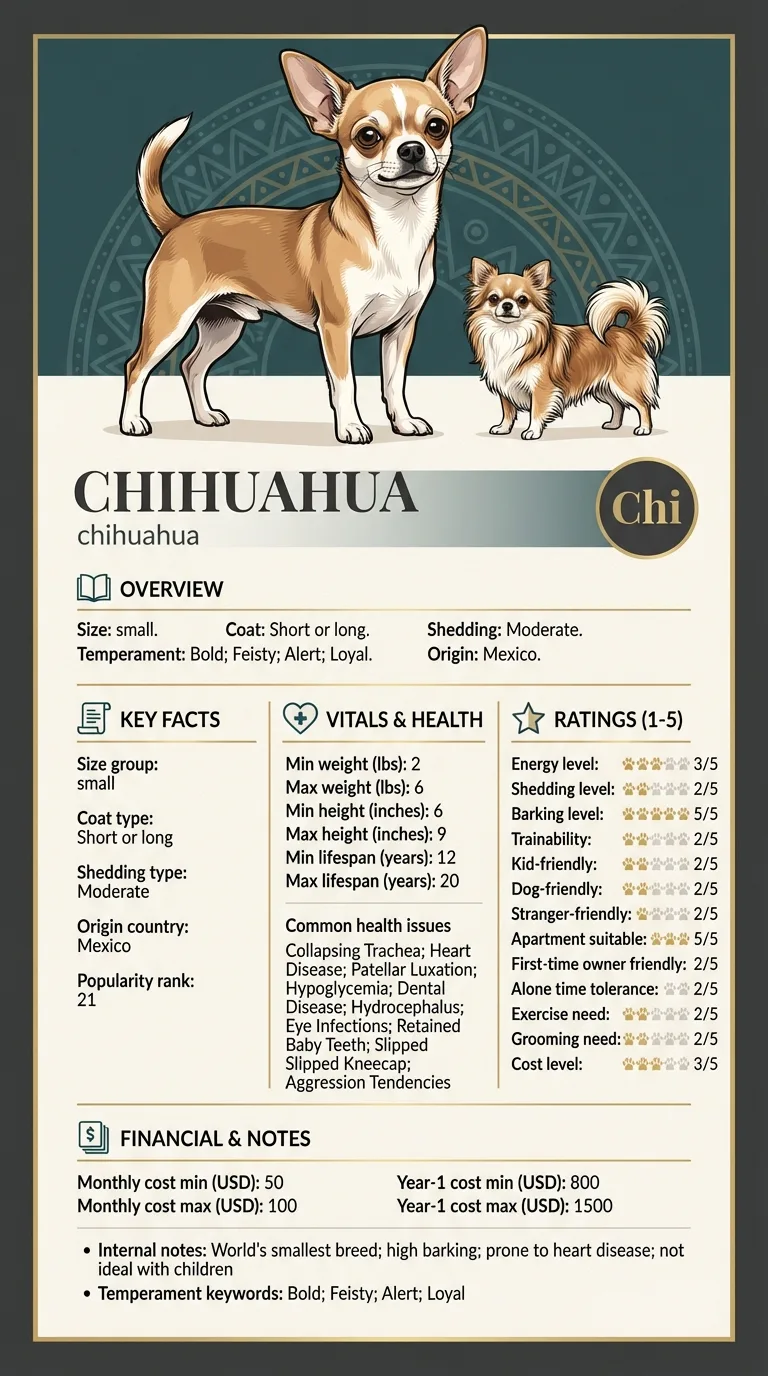
In small breeds prone to disc disease, the soft centre of the disc begins converting to a harder, more brittle material early in life, sometimes within the first year or two. A brittle centre under load can push through the outer ring suddenly rather than degenerating slowly. The relevant Chihuahua anatomy is scale: a spinal canal in a dog 6 to 9 inches tall is very narrow, so a small volume of displaced material occupies a large proportion of the available space and compresses the cord more severely than the same volume would in a larger dog.
Household architecture does most of the environmental work. Sofas and beds sized for people are a substantial drop for a dog this height, and repeated landings load the spine hard. Slippery floors cause the sudden twisting slips that precipitate acute episodes. Being scooped up under the armpits, which is how most people instinctively pick up a small dog, leaves the spine unsupported. Excess weight, on a frame built for two to six pounds, increases the load on every disc continuously.
Go to a veterinary clinic immediately, tonight and not tomorrow, for any of the following: back legs that are dragging, knuckling over or crossing; an inability to stand or walk; loss of bladder or bowel control; a dog who has stopped reacting to her back feet being touched; or sudden severe pain with a rigid, hunched posture. These are grade three and above, they can progress within hours, and the surgical window narrows fast. Book a same-day or next-day appointment for pain alone, including yelping when lifted, reluctance to jump, trembling, or a stiff neck held low. Do not give any human pain medication, which is dangerous for dogs, and do not attempt to manipulate or stretch her back.
See all Chihuahua health problems, which breeds are prone to intervertebral disc disease ivdd, or the full Chihuahua breed guide for temperament, exercise needs and ownership costs.
Conservative management runs four to six weeks of strict confinement followed by two to four weeks of gradual reintroduction to normal activity. Improvement in low-grade cases is often visible within the first week, which is precisely when owners are most tempted to relax the restriction. For surgical cases, hospitalisation is usually several days and rehabilitation runs weeks to months. Recovery of walking, where it happens, is generally seen within the first few weeks after surgery; recovery beyond that point is slower and less certain.
For lower grades, success is a dog who walks normally, uses her ramps, and has no further episodes. For higher grades, success may be more qualified: a dog who walks with a slightly abnormal gait, or who manages well with assistance, and who is comfortable. Honesty matters here. Some dogs with severe cord injury do not regain the ability to walk, and a good outcome for them is defined by comfort, continence management and quality of life rather than by full recovery.
Grade one is pain alone. The dog is reluctant to jump, may hold her neck or back stiffly, yelps when picked up wrongly, and walks normally. Grade two adds weakness: she can still walk but is wobbly, drags a nail, or crosses her back feet. Grade three means she cannot walk but can still move the legs voluntarily. Grade four adds loss of bladder control, and grade five, the most serious, means the deep pain sensation carried by the innermost fibres of the cord has gone.
The reason vets ask about function rather than pain is that pain is a poor guide to severity. Once the cord is badly compressed, painful sensation may be lost along with everything else, so a deteriorating dog can appear to become more comfortable. Owners very reasonably interpret that as improvement. It is not.
Grade determines everything downstream. The lower grades are usually managed conservatively with strict rest and veterinary pain control, and most respond. From grade three upwards, surgical decompression enters the conversation, and the urgency increases sharply with each grade. At grade five in particular, the window in which surgery gives the best chance of recovery is measured in a day or two, not a week.
Progression can be fast. A dog can move from grade one to grade four inside a few hours, which is why any Chihuahua who is newly wobbly behind needs assessing the same day rather than being watched overnight.

Conservative management fails more often from being done loosely than from being the wrong choice. This is what it genuinely requires.
If you think your Chi has intervertebral disc disease (ivdd), the plan is three steps: write down what you have seen and when it started, book a veterinary appointment rather than waiting for the next flare, and take video of the behaviour or symptom before you go — the thing you are worried about rarely happens in the consulting room. Screening in the parents covers collapsing trachea, heart disease, patellar luxation.
What the vet visit should produce is a diagnosis and a written plan, not just reassurance: what is being ruled out, what the monitoring interval is, and which signs mean you come back sooner. Ask what the treatment costs across a year rather than per visit, because that is the number that decides whether you are managing this condition or reacting to it.
Between appointments, keep a short log — dates, what you saw, what changed. It is the single most useful thing an owner brings to a follow-up, and for intervertebral disc disease (ivdd) it is often what separates a clear pattern from a guess.
Pancho was grade two: wobbly behind but still walking. His vet prescribed six weeks of strict confinement and medication, and for the first ten days his owner Farid was exact about it. In week two Pancho seemed completely normal, and Farid began letting him potter around the living room while he worked. On day nineteen, Pancho heard the letterbox, ran, and jumped at the door. By evening he could not stand. He went to grade four and had surgery two days later. He walked again, with a slightly wide hind gait he never lost. Farid's reflection was that the medication had made Pancho feel fine, that feeling fine was exactly what made him dangerous to himself, and that the crate was never meant to be a response to how the dog seemed.
Key takeaway: Pain relief removes the signal that would otherwise stop your dog from re-injuring herself. Crate rest is timed by the calendar and the vet, never by how well she appears to be doing.
Chihuahuas are among the small breeds in which disc disease is seen, though it is not listed among the ten health issues documented for the breed and is far more strongly associated with long-backed breeds such as the Dachshund. What is true is that any small dog with back pain or hind-limb weakness needs the possibility taken seriously, because the consequences of missing it are severe.
You largely cannot at home, which is the point. Suggestive signs are a hunched or rigid posture, yelping when picked up, reluctance to use stairs, trembling, and any unsteadiness behind. A soft-tissue strain does not cause knuckling, dragging or crossed hind feet. If there is any neurological sign at all, treat it as a disc until a vet says otherwise.
It is restrictive and dogs dislike it, but the alternative is far worse. Four to six weeks of confinement against a lifetime of impaired mobility is not a close comparison. Make it tolerable with food puzzles, chews and company rather than by relaxing the restriction, because it only works if it is genuinely strict.
Recurrence is possible and, in dogs with underlying disc degeneration, reasonably likely over the following years. Permanent household changes reduce the risk: ramps instead of jumps, a harness rather than a collar, and maintaining a lean body weight, which is the most powerful factor you control at 2 to 6 pounds.
A collar does not cause disc degeneration, but pressure and jerking on the neck is a genuinely bad idea in a dog with cervical disc disease, and this breed already has documented tracheal issues. A well-fitted harness is the sensible default for every Chihuahua regardless of spinal history.
Conservative management is comparatively inexpensive: consultation, imaging and a course of medication. Surgical management involves advanced imaging and specialist neurosurgery and is one of the larger bills in small-animal practice, frequently running into several thousand. Cost is a real factor in the decision, and it is a legitimate one to raise with your vet openly.
A hunched or stiff posture, yelping when lifted, reluctance to jump or use stairs, trembling, and any wobbliness or dragging in the back legs.
Any loss of hind-limb function, bladder control or the ability to walk is a same-day emergency. Pain alone still needs assessment within a day.
Typically four to six weeks of genuine confinement, followed by a structured, gradual return to activity rather than an immediate resumption.
Ramps to furniture, a harness instead of a collar, runners on slippery floors, and keeping her lean within the two to six pound range.
A one-page prep sheet for this condition: the signs, the questions to ask, what to get priced. Unlocks here.
You get: Vet visit prep sheet
No spam. One-click unsubscribe. See our privacy policy.
Preview page 1 before you decide.