Health
What is the biggest anesthesia risk for a Chihuahua?
Hypothermia. A tiny body loses heat fast, cold slows drug clearance, and that deepens anesthesia and drops blood pressure. Active warming throughout is the single most important safeguard.

Quick answer
What is the biggest anesthesia risk for a Chihuahua?
Hypothermia. A tiny body loses heat fast, cold slows drug clearance, and that deepens anesthesia and drops blood pressure. Active warming throughout is the single most important safeguard.
The real hazards for an anaesthetised Chihuahua are not exotic. They are body temperature, blood sugar, blood pressure and the sheer difficulty of doing precise things to a patient that fits in one hand.
Owners who have been told their Chihuahua needs a dental, a spay or a luxating patella repair and want to understand what separates a well-run small-dog anesthetic from a risky one, plus owners of senior Chihuahuas weighing the procedure against the years the breed usually has left.
This guide is not medical advice. If your dog shows pain, sudden behavior change, or worsening symptoms, consult a licensed veterinarian.
Some links may be affiliate links. We may earn a commission at no extra cost to you. We only suggest products we believe are helpful for dog owners.
We research and check what we publish, but we do not warrant that any figure, date, price, or statement is accurate, complete, or current, and we accept no liability for any loss, cost, injury, or other harm arising from the use of this site. Use it as one reference among several. You remain responsible for your own decisions and for your dog's care - confirm anything that matters with a licensed veterinarian or another qualified professional before you act on it. Full disclaimer.
Anesthesia in a Chihuahua is a small-patient problem rather than a drug-allergy problem. The same procedure that is routine in a 60-pound dog demands warming, glucose awareness, precise micro-dosing, careful intravenous access and continuous monitoring when the patient weighs 2 to 6 pounds. Handled properly the risk is low. Handled as though the dog were simply a scaled-down Labrador, it is not.
Nearly every Chihuahua will be anaesthetised at least once and most will face it repeatedly, because dental disease and retained deciduous teeth both appear on the breed's documented health list and both are addressed under general anesthesia. Serious complications are uncommon in healthy patients with proper monitoring; the risk climbs with undiagnosed heart disease, low body weight and long procedures.
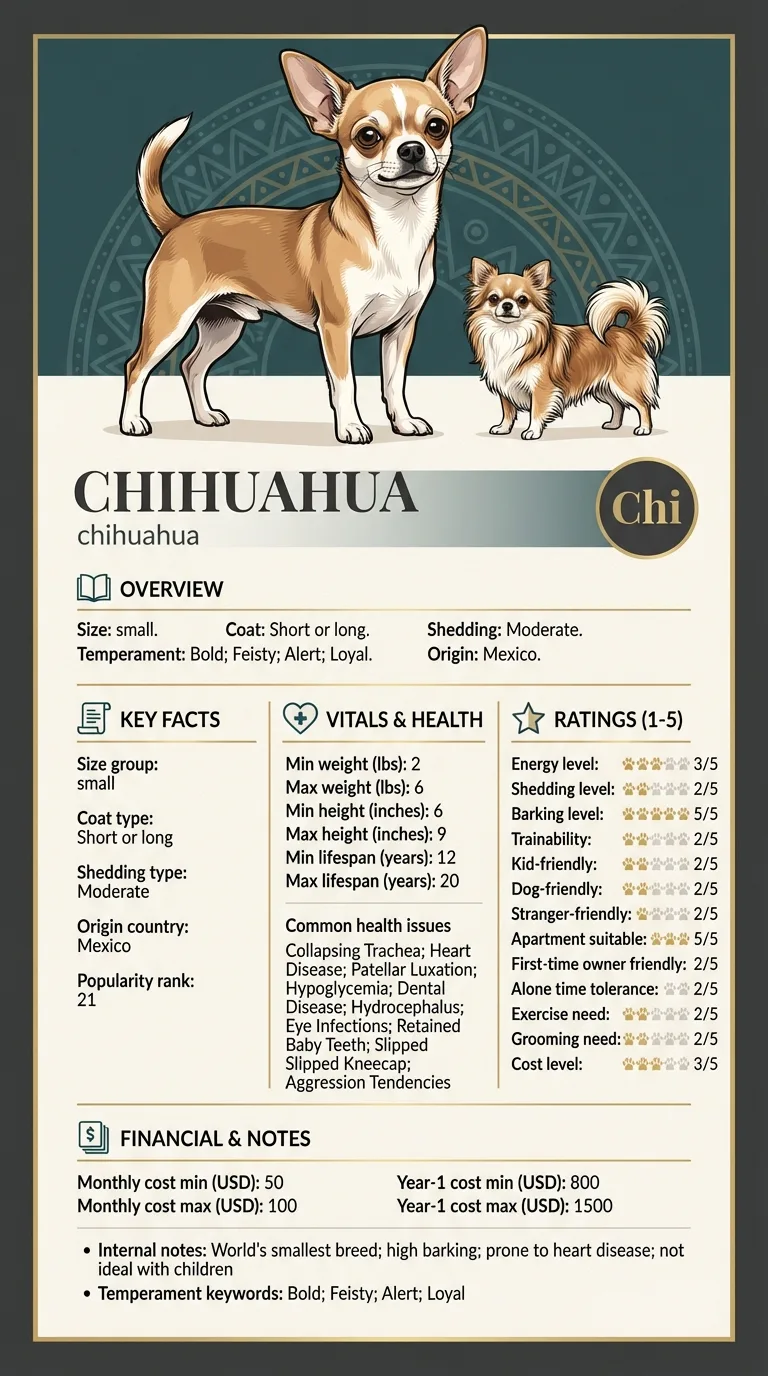
The Chihuahua is the smallest recognised breed at 2 to 6 pounds and 6 to 9 inches, and every anesthetic concern follows from that. Surface area relative to body mass drives rapid heat loss. A small liver means a small glycogen store and a real hypoglycemia risk around fasting, which is why hypoglycemia sits on the breed's health list at all. Veins are small enough that catheter placement is a genuine skill. The trachea is narrow, and collapsing trachea is common in this breed, so airway handling needs care. Heart disease is likewise common, so an undetected murmur can change how a patient tolerates drugs and fluids.
The controllable factors are almost entirely about the setting. A practice that warms actively, monitors blood pressure and temperature continuously, uses a dedicated monitoring person and staffs recovery properly changes the risk profile. So does an owner who follows the exact fasting instruction rather than an overnight guess, who reports every supplement and medication beforehand, and who does not delay a dental until the mouth is infected and the dog is older, thinner and harder to anaesthetise safely.
Before the procedure, raise anything cardiac or respiratory: a cough, a honking noise, fainting, exercise intolerance or a previously mentioned murmur, since any of these should change the plan. Afterwards, call the same day if your Chihuahua feels cold, is unresponsive rather than merely sleepy, has pale gums, has not urinated, or has a swollen or bleeding surgical site. Go straight to an emergency clinic for laboured breathing, collapse, seizures or repeated vomiting during recovery.
See all Chihuahua health problems, which breeds are prone to anesthesia sensitivity, or the full Chihuahua breed guide for temperament, exercise needs and ownership costs.
A healthy Chihuahua is usually home the same afternoon, unsteady that evening and close to normal within twenty-four to forty-eight hours. Dental extractions add roughly ten to fourteen days of soft food and a sore mouth. Orthopaedic surgery runs on a scale of weeks to months. Older dogs and those with heart disease may take a few days longer to feel themselves, which is expected rather than alarming as long as the direction of travel is upward.
Success is a boring day. The dog goes in, stays warm, keeps its blood pressure and blood sugar steady, wakes up promptly, eats a small meal that evening and is bouncing the next morning. The measure of a good small-dog anesthetic is that there is nothing to report, and the way to get one is choosing a team that treats a 4-pound patient as a distinct problem rather than a small version of an ordinary one.
Heat comes first. An anaesthetised animal stops shivering and loses the ability to regulate temperature, and heat is lost across the body surface. A Chihuahua has an enormous surface area relative to its mass, so it cools far faster than a Labrador on the same table. Hypothermia then slows drug metabolism, which deepens the plane of anesthesia, which lowers blood pressure further. This is the loop that turns a routine procedure into a difficult one, and it is why active warming from before induction until full recovery is not a luxury in this breed.
Blood sugar is second. Hypoglycemia is on the Chihuahua's documented health list, and a small dog has a small liver holding a small glycogen reserve. A long pre-operative fast that a big dog shrugs off can leave a 3-pound Chihuahua genuinely low, so modern practice uses shorter, tailored fasting rather than the old midnight rule.
Third is access and precision. Placing an intravenous catheter in a vein the width of a pencil lead is a skill, and it matters because the catheter is the route by which anything can be corrected quickly. Drugs are drawn in fractions of a millilitre, sometimes diluted first, and fluid rates that are trivially safe in a big dog can overload a patient this size.
Fourth is the airway. The Chihuahua's trachea is small and this breed is prone to collapsing trachea, so the endotracheal tube is narrow and must be placed gently.

You are not auditing the practice. You are checking that the size-specific parts of the plan exist, and a good team will be glad to answer.
Rigo is an eleven-year-old, 3.8-pound long-coated Chihuahua in Tucson with a mouth his owner Deborah had been avoiding for two years, on the advice of a friend who said small dogs die under anesthesia. By the time she gave in, three teeth were loose and Rigo had stopped chewing on the left side. The practice she chose ran bloodwork, found a soft murmur, and sent Rigo for a cardiac assessment before booking anything. That assessment changed his fluid rate and his drug plan. On the day, he was on a warming mat before induction, had a catheter in his left foreleg, and had one nurse doing nothing but watching his numbers. He had six extractions and went home that afternoon at a normal temperature. Deborah's clearest memory is that he ate a soft meal that same evening, something he had not done with any enthusiasm in months.
Key takeaway: The two years of waiting were the risky part, not the anesthetic. Delay made the mouth worse and the patient older, while the things that actually protect a tiny dog - warming, a catheter, a dedicated monitor and a cardiac check first - were available the whole time.
There is no documented Chihuahua-specific drug sensitivity of the kind seen in some herding breeds. The breed's risk comes from physiology and physics: rapid heat loss, a limited glucose reserve, tiny veins, small drug volumes where a measurement error is proportionally large, and a narrow airway. Those are manageable problems, but they have to be actively managed rather than assumed away.
Because the part that matters happens below the gumline. Full-mouth dental radiographs, probing every tooth and cleaning under the gum cannot be done on a conscious dog, and a Chihuahua's crowded jaw hides most of its disease exactly where you cannot see. Anesthesia-free scaling polishes the visible crown and leaves the actual disease untouched.
Age is not a disease, and this breed commonly lives twelve to twenty years, so a twelve-year-old Chihuahua may have years ahead. What matters is organ function and cardiac status, which is why pre-anesthetic bloodwork and a careful listen to the heart come first. A painful mouth left untreated for three years is its own serious harm.
A physical examination with careful cardiac auscultation, and bloodwork covering red cells, kidney and liver values and blood glucose. If a murmur is heard, this breed's high rate of heart disease makes further cardiac assessment a sensible next step rather than an upsell, because it changes drug choice and fluid rates.
Follow the clinic's specific instruction and ask for it in writing, because it should be shorter than the traditional overnight fast. Small dogs deplete glycogen quickly, and an unnecessarily long fast in a 3-pound Chihuahua trades a small anesthetic risk for a real hypoglycemia risk.
A wobbly, sleepy dog that wants to be warm and quiet is normal for the rest of the day. Offer the small meal your clinic advises rather than waiting until morning. Call if your Chihuahua is still unsteady the next day, will not eat, feels cold to the touch, or seems dull rather than merely tired.
Hypothermia. A tiny body loses heat fast, cold slows drug clearance, and that deepens anesthesia and drops blood pressure. Active warming throughout is the single most important safeguard.
Not a real one. Radiographs and cleaning below the gumline require a still, intubated patient, and that is where a crowded Chihuahua jaw hides its disease.
Yes, and expect the answer to be that one is standard. It is the route for correcting blood pressure or blood sugar in seconds rather than minutes.
Considerably more than a scale and polish sounds like, because the price covers bloodwork, monitoring, radiographs and often extractions. Ask for a written estimate with extractions included.
Sleepy and unsteady the same day, largely themselves the next. Persistent wobbliness, refusal to eat, or a cold-feeling dog on day two warrants a call.
A one-page prep sheet for this condition: the signs, the questions to ask, what to get priced. Unlocks here.
You get: Vet visit prep sheet
No spam. One-click unsubscribe. See our privacy policy.
Preview page 1 before you decide.