Health
What is the earliest sign of kidney disease in a dog?
Drinking and urinating more than usual, which appears before blood values change. It is easy to miss in a dog who only drinks a small amount to begin with.

Quick answer
What is the earliest sign of kidney disease in a dog?
Drinking and urinating more than usual, which appears before blood values change. It is easy to miss in a dog who only drinks a small amount to begin with.
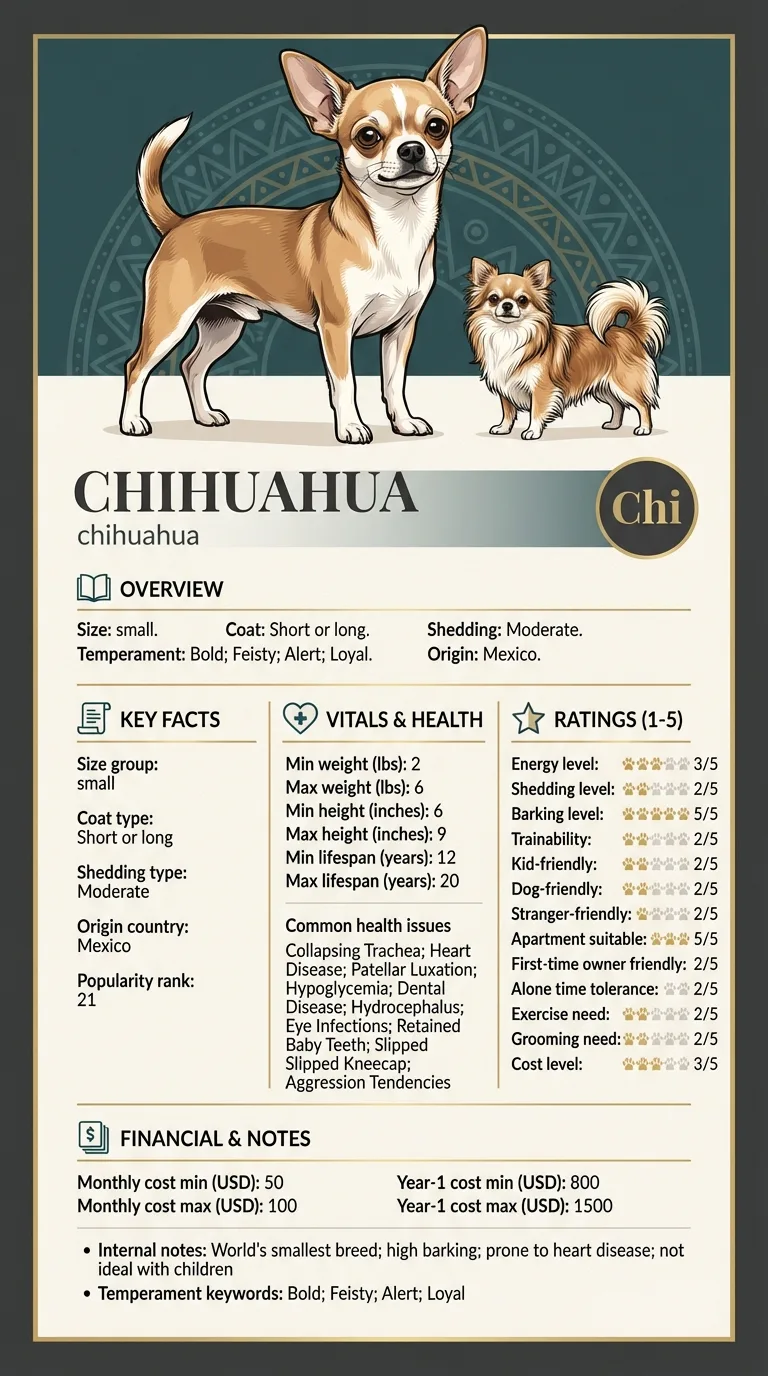
A breed with a lifespan of 12 to 20 years has a lot of dogs who live long enough for their kidneys to wear out. That is not a tragedy, it is a consequence of longevity, and it is manageable.
Owners of senior Chihuahuas whose bloodwork has come back abnormal, and owners who have noticed the water bowl emptying faster and are trying to work out whether it means anything.
This guide is not medical advice. If your dog shows pain, sudden behavior change, or worsening symptoms, consult a licensed veterinarian.
Some links may be affiliate links. We may earn a commission at no extra cost to you. We only suggest products we believe are helpful for dog owners.
Chronic kidney disease is the progressive, irreversible loss of kidney function that accompanies old age in many dogs. It is staged on blood and urine testing alongside blood pressure, and each stage has its own management. In Chihuahuas it is largely a disease of the last third of a life that may run to twenty years, and it is managed rather than cured.
Chronic kidney disease is among the most frequently diagnosed conditions in senior dogs of any breed, and longevity is the main risk factor. It is not listed among the ten health issues specific to Chihuahuas, but a breed whose lifespan runs 12 to 20 years produces a great many senior dogs, and a substantial proportion of them will develop some degree of kidney impairment.
There is no distinctive Chihuahua kidney pathology. What the breed contributes is time. A dog who lives to eighteen has been filtering blood for six years longer than a large breed that reaches twelve, and cumulative wear on nephrons is exactly the mechanism at work. The breed's documented dental disease also matters, because a mouth that has carried chronic infection for a decade delivers a continuous inflammatory burden to a filtering organ.
Dehydration is the environmental factor with the sharpest edge. Hot weather, an inaccessible water bowl, or a dog too stiff to walk to the kitchen at night all reduce intake in an animal whose kidneys can no longer conserve water. Some human medications and household substances are directly toxic to kidneys, which is a strong argument against giving anything not prescribed for the dog. Diets very high in phosphorus place additional load on an already struggling filter.
Seek same-day care if she stops eating entirely for more than a day, is vomiting repeatedly, has become weak, wobbly or unresponsive, is producing almost no urine or is straining without producing any, or has bad breath together with mouth ulceration and drooling. A dog who is not passing urine is an emergency in its own right and should never be observed overnight. Book a routine appointment within a week or two for increased thirst and urination, gradual weight loss, a duller coat, reduced appetite, or accidents in a previously reliable house-trained dog. Do not withhold water, and do not give any medication or supplement that has not been prescribed for her specifically.
See all Chihuahua health problems, which breeds are prone to kidney disease, or the full Chihuahua breed guide for temperament, exercise needs and ownership costs.
Progression is measured in months to years and varies widely by stage at diagnosis. Early-stage dogs on a renal diet with blood pressure managed often remain stable for a long period, with rechecks every three to six months. Later stages move faster and rechecks tighten to every one to three months. Improvements after starting treatment, where they occur, are usually visible within four to eight weeks, mainly as better appetite and energy rather than as better numbers.
Success is a comfortable old dog whose decline is slow and whose bad days are rare. Practically: she eats reliably, holds her weight, drinks and urinates a lot but without accidents that distress her, and her bloodwork moves gradually rather than in steps. This is not a disease with a cure to aim at, and the honest goal is a good long final chapter rather than a return to normal kidneys.
Kidneys have enormous spare capacity. A dog can lose a substantial majority of functioning nephrons before standard blood values move at all. That is why chronic kidney disease is so often described as being caught late; by the time creatinine rises on a routine panel, the disease has been developing quietly for a long time.
The first thing to fail is not filtration but concentration. Healthy kidneys reclaim water and produce concentrated urine. As that ability declines, the dog produces more dilute urine, loses more water, and drinks more to compensate. So increased thirst and increased urination arrive before any of the dramatic signs, and they arrive before most blood tests flag anything.
This is genuinely useful for owners, because thirst is observable at home and creatinine is not. It is also easy to miss in a small dog. A four-pound Chihuahua drinks so little in absolute terms that a doubling of her intake still looks like a modest amount of water in a bowl. Owners of large dogs notice this change far more readily.
Later, as waste accumulates, appetite falls, nausea appears, weight is lost from muscle, breath develops a distinctive smell and the dog becomes lethargic. Anaemia often follows, since damaged kidneys stop signalling red cell production, and it adds a layer of weakness that owners frequently attribute to age alone.

Chronic kidney disease is managed largely at home, with the clinic setting direction every few months.
If you think your Chi has kidney disease, the plan is three steps: write down what you have seen and when it started, book a veterinary appointment rather than waiting for the next flare, and take video of the behaviour or symptom before you go — the thing you are worried about rarely happens in the consulting room. Screening in the parents covers collapsing trachea, heart disease, patellar luxation.
What the vet visit should produce is a diagnosis and a written plan, not just reassurance: what is being ruled out, what the monitoring interval is, and which signs mean you come back sooner. Ask what the treatment costs across a year rather than per visit, because that is the number that decides whether you are managing this condition or reacting to it.
Between appointments, keep a short log — dates, what you saw, what changed. It is the single most useful thing an owner brings to a follow-up, and for kidney disease it is often what separates a clear pattern from a guess.
Pilar was fifteen and had always been a light drinker. Her owner Renata noticed she was refilling the bowl every evening instead of every second or third day, which in a four-pound dog amounted to a very small absolute change that she nearly dismissed. She mentioned it at a routine visit anyway. Bloodwork and a urine test put Pilar in an early stage of chronic kidney disease, before she had lost any weight or shown any other sign. She went onto a renal diet, which took three attempts and a great deal of warming before she accepted it, and her blood pressure was checked and treated. Pilar lived another two years and eight months, eating well for almost all of it. Her vet was clear that the diet and the blood pressure control had bought most of that time, and that none of it would have started when it did without a person noticing a water bowl.
Key takeaway: In a dog this small the earliest sign of kidney disease is a change of a few tablespoons a day. Knowing her normal water intake is what makes that change visible at all.
Chronic kidney disease cannot. The lost tissue does not come back, and treatment aims to slow progression and manage the consequences. Acute kidney injury, which comes on suddenly from a toxin, infection or obstruction, is a different situation and can sometimes be partly or fully reversed with prompt intensive treatment. Distinguishing the two is one of the first things a vet does.
It varies enormously with the stage at diagnosis. A dog caught in an early stage, on a renal diet with blood pressure controlled, may live for years. A dog diagnosed in advanced disease with weight loss and vomiting has a much shorter and less predictable course. Ask which stage she is in; it is the version of this question that has an answer.
It is the intervention with the strongest evidence behind it, working by reducing the workload the kidneys face. The practical problem is palatability, especially in a breed known for being fussy. A renal diet the dog refuses is worth nothing, so work with your vet on transition strategies and alternatives rather than simply insisting.
Nausea. Accumulated waste products cause a queasiness that makes food unappealing even when the body needs it, and dogs will often approach a bowl, sniff it and turn away. This is treatable, and it is worth raising specifically rather than describing her as simply fussy, because anti-nausea support often restores appetite substantially.
Ordinary drinking water is fine. Filtered water is not a treatment and there is no evidence it slows kidney disease. What matters is quantity and constant availability, not source. Spend the effort on making sure she always has water within a few steps rather than on the water itself.
Chronic oral infection puts a continuous inflammatory and bacterial load into the bloodstream, and both dental disease and retained baby teeth appear among this breed's documented health issues. Keeping the mouth healthy is worth doing on its own merits, and it is one of the few genuinely preventive things available in a breed that ages into kidney trouble.
Drinking and urinating more than usual, which appears before blood values change. It is easy to miss in a dog who only drinks a small amount to begin with.
Chronic kidney disease is common in senior dogs generally, and a breed that regularly reaches its late teens gives it plenty of opportunity to develop.
No. She cannot concentrate her urine, so restricting water risks dehydration. Manage accidents with pads and more frequent trips outside instead.
Recurring blood tests every few months, a prescription diet, and often medication or home fluids. Costs are steady rather than dramatic, but they run for years.
A one-page prep sheet for this condition: the signs, the questions to ask, what to get priced. Unlocks here.
You get: Vet visit prep sheet
No spam. One-click unsubscribe. See our privacy policy.
Preview page 1 before you decide.