Costs
Chihuahua cost in Washington, DC
About $66–$125/month, $1,020–$1,830 for year one — above average, with a real international pet-relocation resource unusually concentrated here.

See Chihuahua price across all cities →
Quick answer
Chihuahua cost in Washington, DC
About $66–$125/month, $1,020–$1,830 for year one — above average, with a real international pet-relocation resource unusually concentrated here.
A Chihuahua in Washington, DC costs about $66–$125 a month, with the first year around $1,020–$1,830 — above the national average, in a city with an unusually international pet-relocation industry.
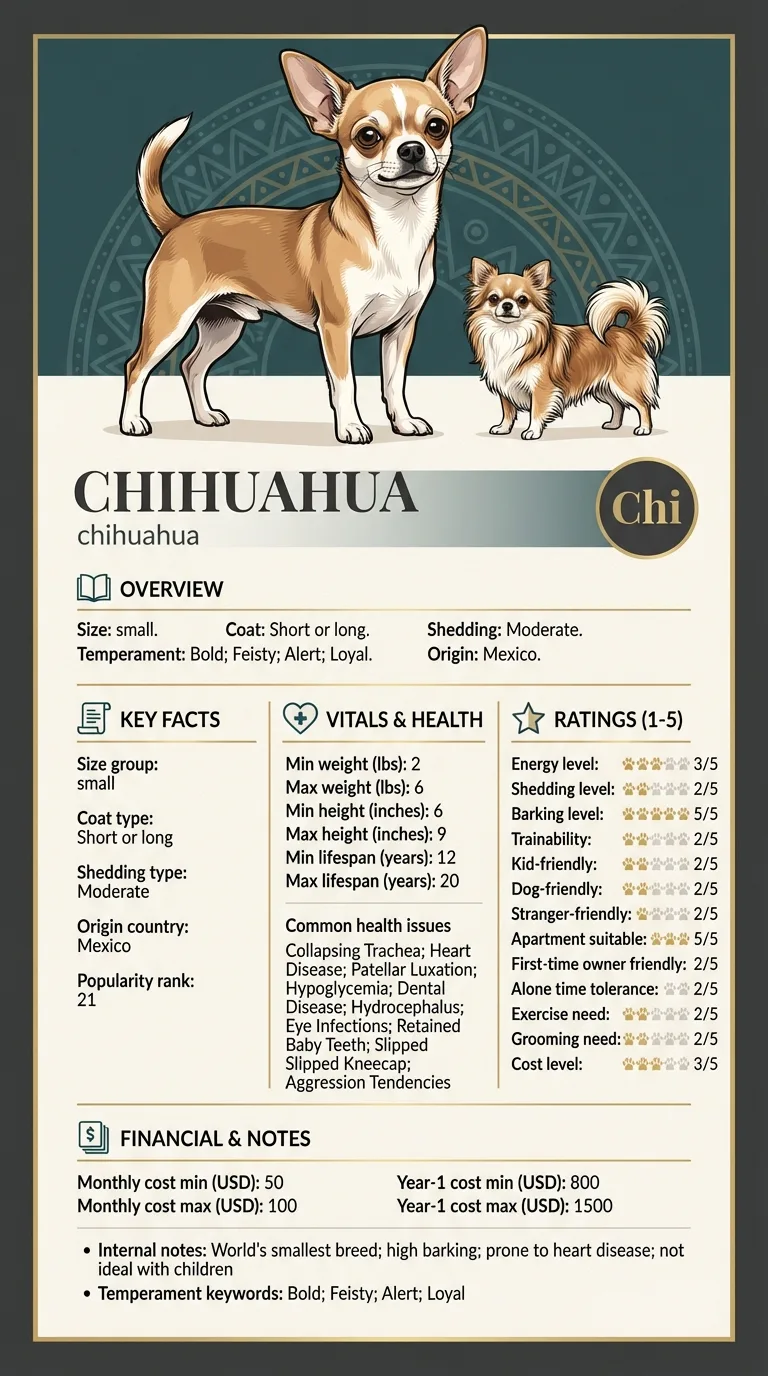
Heart disease and collapsing trachea are the two chronic conditions most worth a vet's early attention in this breed. Hypoglycemia is the acute risk specific to small puppies — a missed meal can turn dangerous fast in a dog this size.
These figures reflect DC's above-national-average pricing, with a note on the real international pet-relocation resource concentrated here for diplomatic or international-assignment families.
Estimate · source: estimation · confidence: medium · updated 2026-09-05 · not a quote
| Item | Cost range |
|---|---|
International relocation documentation (if applicable) A real, if niche, cost for diplomatic or international-assignment families, genuinely more accessible locally than in most cities this site covers. | $200 - $500 |
One-time setup (initial vet visit, spay/neuter, gear) Covers the first exam, vaccinations, spay/neuter if needed, and basic gear — priced at DC's above-average rates. | $270 - $455 |
| Item | Cost range |
|---|---|
Food Genuinely low given this breed's tiny size, adjusted up for DC's above-average cost of living. | $17 - $30 |
Flea & tick prevention The region's temperate climate keeps this seasonal rather than year-round. | $9 - $18 |
Each range starts from a national baseline for this breed's size class and is then adjusted for local cost of living and veterinary pricing. The baselines, and the source each one came from, are listed on our sources page (dataset 2026.09). Two inputs, the purchase price and the emergency reserve, have no published national figure we could verify, so we leave them to you rather than invent them.
These are planning estimates, not quotes. Your own numbers will move with the individual dog, your vet and your insurer. Build a budget with your own figures.
For a Chihuahua in Washington, DC, insurance is one of the higher-value purchases covered anywhere on this site — the breed's documented health risks meet a market where specialist care is priced at a genuine premium.
This breed's documented seizure and cardiac risk make insurance a genuinely proactive purchase — buy before a diagnosis, not after, since pre-existing conditions won't be covered.
A family that's built a genuine cash reserve and would rather self-fund a major vet bill than pay monthly premiums can reasonably skip coverage, as long as that reserve is sized for a specialist procedure.
DC's baseline costs are largely fixed and high; the real value-add specific to this breed is the international relocation resource, if it applies to your household.
Washington's dense concentration of embassies, international organizations and diplomatic households has supported a genuine local cluster of pet-relocation specialists, familiar with the differing import and quarantine rules of dozens of countries. For a diplomatic or international-assignment family relocating with a dog this size, that's a real, practical resource concentrated here in a way it simply isn't in most other cities this site covers.
DC's own housing stock, dominated by apartments and rowhouses without much private yard access, makes a dog walker or daycare membership a genuinely common recurring cost for many local dogs, though this breed's low exercise needs make that less of a factor here than for a larger, more active breed.
Washington's overall cost of living runs well above the national average, consistent with the broader Mid-Atlantic's most expensive metro, and the region's temperate climate keeps flea-and-tick prevention seasonal rather than year-round.

A DC-based diplomatic family received notice of an overseas posting with a tight timeline, and initial research into pet import rules for the destination country felt overwhelming. A local pet-relocation specialist, familiar with that exact country's requirements from prior clients, handled the documentation and health-certificate timing directly, turning what could have been a frantic scramble into a manageable, well-organized process.
Key takeaway: For a diplomatic or internationally mobile family, DC's concentrated pet-relocation expertise is a real, practical resource worth using rather than researching a country's import rules alone from scratch.
About $66–$125, above the national average, consistent with DC's status as one of the Mid-Atlantic's most expensive metros.
Roughly $1,020–$1,830, including the initial vet exam, spay/neuter if needed, and gear on top of ongoing monthly costs.
Genuinely, yes — the city's dense concentration of embassies and diplomatic households has supported a local cluster of pet-relocation specialists familiar with dozens of countries' import rules, a resource most cities this site covers don't have at this scale.
Less often than a larger breed would — this breed's low exercise needs make DC's apartment- and rowhouse-heavy housing stock less of a limitation than it is for most active dogs this site covers.
Especially worth pricing out here given both the breed's documented health risks and DC's premium specialist pricing, purchased while the dog is young.
Around $530 covers a typical significant vet visit in this market, reflecting DC's above-average Mid-Atlantic pricing.
About $66–$125/month, $1,020–$1,830 for year one — above average, with a real international pet-relocation resource unusually concentrated here.
This guide is not medical advice. If your dog shows pain, sudden behavior change, or worsening symptoms, consult a licensed veterinarian.
Some links may be affiliate links. We may earn a commission at no extra cost to you. We only suggest products we believe are helpful for dog owners.
We research and check what we publish, but we do not warrant that any figure, date, price, or statement is accurate, complete, or current, and we accept no liability for any loss, cost, injury, or other harm arising from the use of this site. Use it as one reference among several. You remain responsible for your own decisions and for your dog's care - confirm anything that matters with a licensed veterinarian or another qualified professional before you act on it. Full disclaimer.
One sheet with every line item, the emergency fund and when insurance pays off - unlocks on this page.
You get: 12-month budget sheet
No spam. One-click unsubscribe. See our privacy policy.
Preview page 1 before you decide.