Health
What does a heart condition diagnosis mean for a Chihuahua?
A structural or electrical abnormality was found. Whether it changes anything depends on the stage, which usually requires an echocardiogram to establish.

Quick answer
What does a heart condition diagnosis mean for a Chihuahua?
A structural or electrical abnormality was found. Whether it changes anything depends on the stage, which usually requires an echocardiogram to establish.
A cardiac note in your Chihuahua's file is not one thing. It might be a faint sound that changes nothing this year, or a structural problem that reshapes the next decade.
Owners who left an appointment holding a referral slip and a word they had never heard before, and owners of older Chihuahuas told to keep an eye on it for years without ever being told what they are watching for.
This guide is not medical advice. If your dog shows pain, sudden behavior change, or worsening symptoms, consult a licensed veterinarian.
Some links may be affiliate links. We may earn a commission at no extra cost to you. We only suggest products we believe are helpful for dog owners.
Heart condition is an umbrella phrase a Chihuahua owner may hear at any point across a 12 to 20 year life. Underneath it sit leaking valves, enlarged chambers, abnormal rhythms and, less often, defects present from birth. They share a vocabulary and a set of tests but not a prognosis, which is why two owners can hear the same phrase and face completely different situations.
Heart disease appears explicitly in the breed's documented health issues, and cardiac findings become more likely with every year of a long life. Many Chihuahuas reach their teens with a documented murmur that never becomes clinically significant; a smaller share progress to a stage requiring daily management.
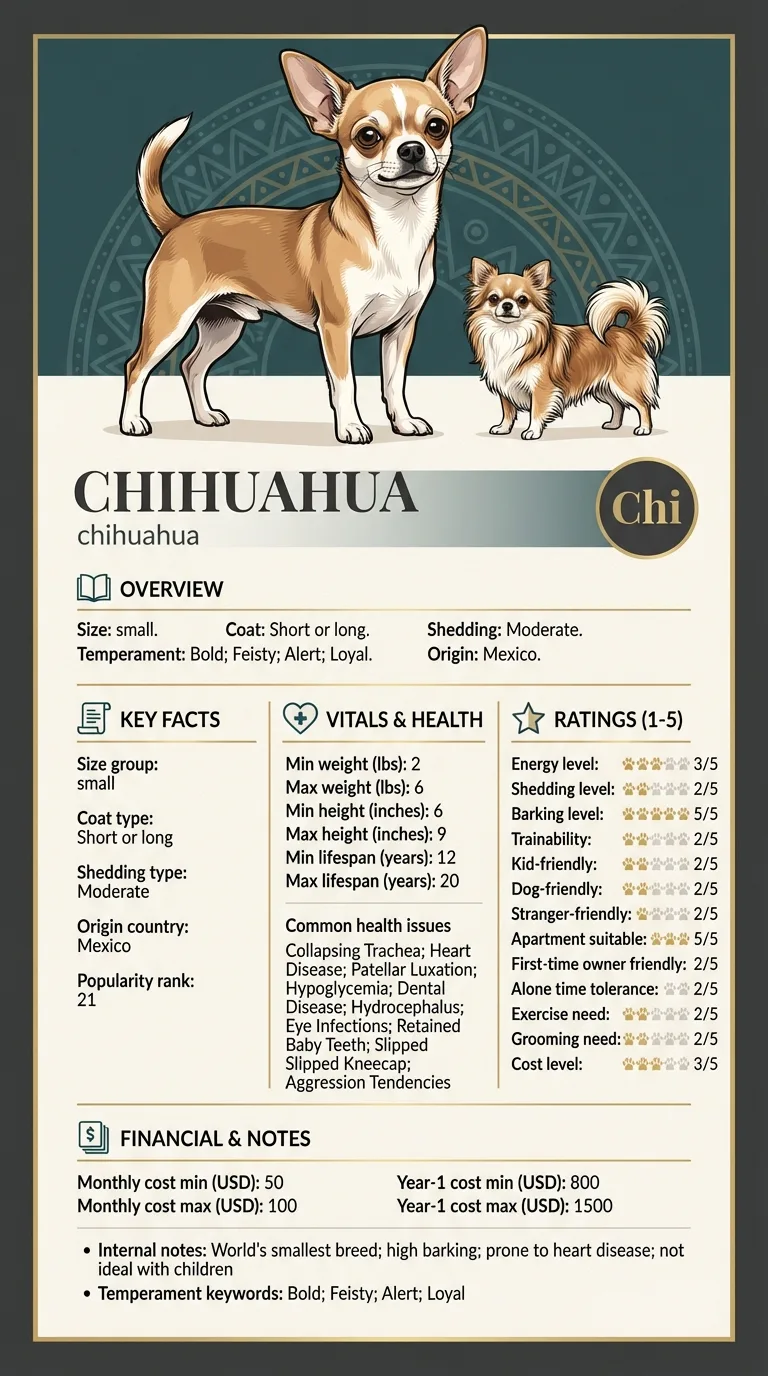
The Chihuahua is the smallest recognized breed at 2 to 6 pounds and 6 to 9 inches tall, and toy breeds as a group carry a tendency toward degenerative valve change rather than the muscle-wall diseases seen in giant breeds. Heart disease is listed among this breed's documented problems, meaning the tendency is inherited at a population level. Long lifespan compounds it: a condition that progresses slowly has more years in which to become visible.
Body condition has the most leverage. On a four-pound frame, even half a pound of excess weight is a meaningful percentage of body mass and adds work the heart must do every minute. Untreated dental disease, which this breed is prone to, keeps a chronic inflammatory load in circulation. Households that skip annual exams simply find cardiac problems later, at a stage with fewer options.
Same-day care is warranted for laboured or open-mouth breathing at rest, a sleeping breathing rate well above the dog's own baseline, gums that look grey, blue or unusually pale, a distended abdomen, or any collapse. Breathing distress in a dog this small can deteriorate quickly and should be treated as an emergency, not observed overnight. For non-urgent changes, a new cough, a walk she will no longer finish, or a drop in appetite lasting more than two days all justify moving the next appointment forward rather than waiting for the scheduled recheck.
See all Chihuahua health problems, which breeds are prone to heart conditions, or the full Chihuahua breed guide for temperament, exercise needs and ownership costs.
Expect the diagnostic phase to take two to six weeks, from the first finding through radiographs and, if needed, an echocardiogram. After that the timeline is measured in years. A finding caught in a middle-aged Chihuahua may sit unchanged through several annual rechecks before anything is required.
Success is a dog whose condition is staged, tracked and stable, not a dog whose heart has been fixed. Concretely: a sleeping breathing rate you can quote from memory, rechecks that happen on schedule instead of in a crisis, and a dog still doing the walks she enjoys. Many Chihuahuas with a documented cardiac condition reach the upper end of the 12 to 20 year range and die of something else.
The stethoscope is a screening tool, nothing more. A vet listening to a four-pound chest can hear turbulence, count the rate, and notice whether the rhythm is regular. What she cannot do by ear is measure a chamber, see a valve, or predict a year. That is why a murmur usually leads to more tests rather than to a prescription.
Chest radiographs answer a different question: is the heart pushing on anything? Films show its silhouette against the ribs, the vessels leaving it, and whether fluid has begun collecting in the lungs. In a dog this small, positioning matters enormously; a slightly rotated film can make a normal heart look enlarged, which is one reason a single set of images is often repeated later rather than acted on immediately.
An echocardiogram is the only test that watches the heart work, measuring how much blood leaks backward and putting numbers on chamber size. It separates a sound from a disease with a stage. An ECG records electricity rather than structure, making it right for an irregular rhythm and wrong for valve function.

Cardiac appointments move fast and the vocabulary is unfamiliar. These questions turn a vague impression into a plan you can follow at home.
If you think your Chi has heart conditions, the plan is three steps: write down what you have seen and when it started, book a veterinary appointment rather than waiting for the next flare, and take video of the behaviour or symptom before you go — the thing you are worried about rarely happens in the consulting room. Screening in the parents covers collapsing trachea, heart disease, patellar luxation.
What the vet visit should produce is a diagnosis and a written plan, not just reassurance: what is being ruled out, what the monitoring interval is, and which signs mean you come back sooner. Ask what the treatment costs across a year rather than per visit, because that is the number that decides whether you are managing this condition or reacting to it.
Between appointments, keep a short log — dates, what you saw, what changed. It is the single most useful thing an owner brings to a follow-up, and for heart conditions it is often what separates a clear pattern from a guess.
Bruno was six and weighed four and a half pounds when a locum vet paused during a routine visit and said she could hear something. His owner, Priya, had brought him in for a nail trim and left with a radiograph referral. The films were unremarkable. The vet set a six-month recheck and told Priya to count his breathing while he slept. Priya did it every Sunday. For years the number sat between eighteen and twenty-two. Bruno hiked, barked at the postal carrier, and had two dental cleanings, each preceded by an anaesthetic conversation that would not have happened without the original note in his file. At fifteen, the Sunday number crept to thirty-two. Priya called on a Monday rather than waiting for the April recheck. That call led to an echocardiogram, a stage, and daily medication. Bruno lived to seventeen and a half.
Key takeaway: The finding is not the event. The change in the finding is the event, and you can only detect change if you have been quietly measuring something at home all along.
No. Canine heart disease has a long silent phase during which the dog runs, eats and plays normally while the heart quietly compensates. Catching it in that phase is the entire point of the checkup.
Most vets move from annual to every six months once a finding is documented, and to every three or four months if it is progressing. Ask your vet to set the interval explicitly rather than leaving it open-ended.
It depends on which condition and which stage. Some findings never progress far enough to affect a dog who is already fourteen. A breed that can reach twenty years gives a slowly progressing heart problem a lot of runway compared with a large breed diagnosed at eight.
The value is in the echocardiogram and the staging it produces, because that determines whether medication should start now. If your general practice can arrange an echo, a specialist visit may not be necessary.
Not on your own. Sodium restriction is sometimes part of later-stage management, but restricting it too early in a picky four-pound dog risks the bigger problem of her not eating at all.
Faster or more effortful breathing while asleep, a cough that starts at night, unwillingness to do an easy walk, a swollen belly, blue or grey gums, or any collapse. The breathing change is usually earliest and most reliable.
A structural or electrical abnormality was found. Whether it changes anything depends on the stage, which usually requires an echocardiogram to establish.
Radiographs and an exam sit in the lower tier; an echocardiogram with a specialist is several times that. Ask the price of each step separately so you can stage the spending.
Often yes, but the anesthetic plan changes and pre-anesthetic cardiac assessment matters. Discuss it before scheduling, not on the morning of the procedure.
Not by itself. Restrict activity only when she shows breathlessness or fatigue, and let her set the pace rather than imposing rest early.
Sleeping breathing rate once a week, appetite, any coughing and when it happens, and any episode where she stopped and would not continue a walk.
A one-page prep sheet for this condition: the signs, the questions to ask, what to get priced. Unlocks here.
You get: Vet visit prep sheet
No spam. One-click unsubscribe. See our privacy policy.
Preview page 1 before you decide.