Health
What is stomach torsion in a dog?
A gas-filled stomach rotating on its own axis, sealing its entrance and exit and twisting its blood supply, followed rapidly by shock.

Quick answer
What is stomach torsion in a dog?
A gas-filled stomach rotating on its own axis, sealing its entrance and exit and twisting its blood supply, followed rapidly by shock.
The stomach does not tie itself in a knot. It rotates, usually clockwise viewed from behind, and in doing so it clamps its own entrance, its own exit and its own blood supply in a single movement.
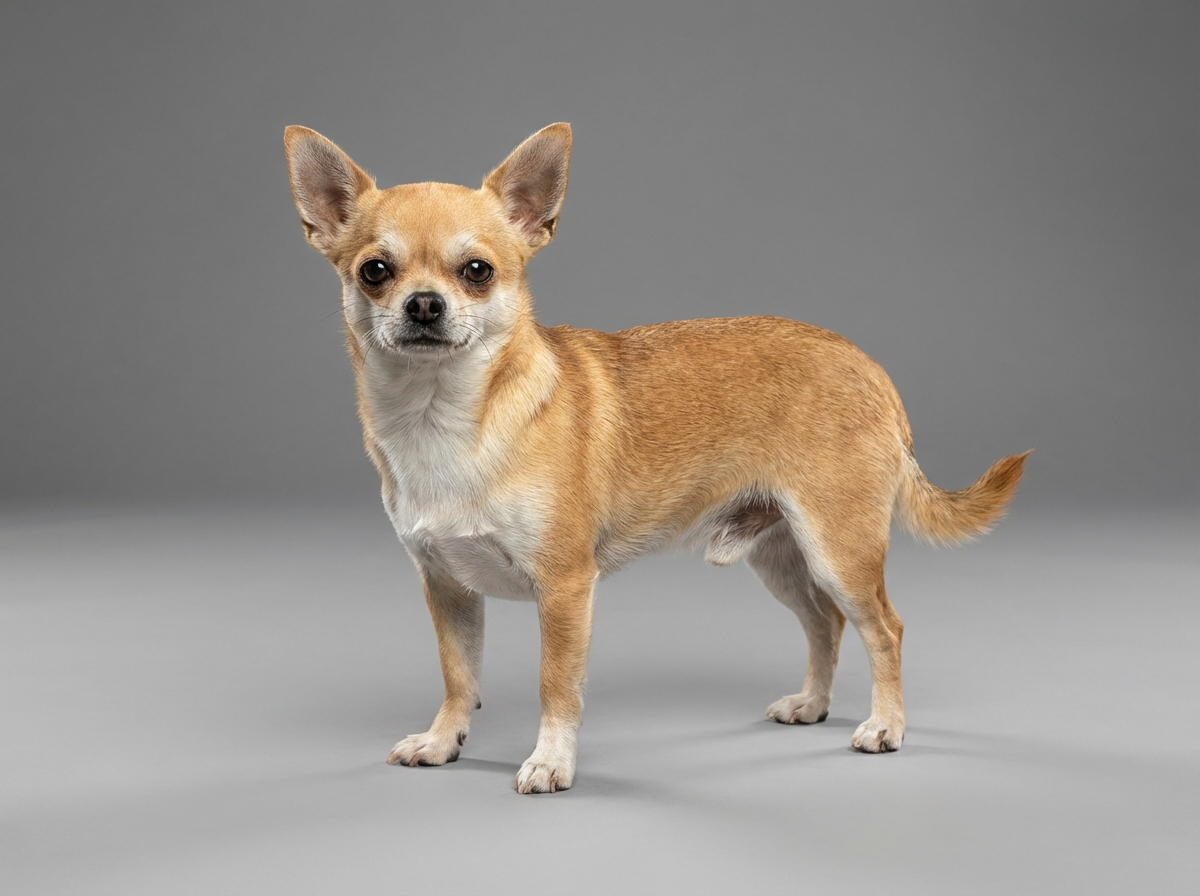
Owners who want to understand what is actually happening inside a dog with GDV rather than being handed a list of symptoms, and Chihuahua owners trying to judge whether their compact toy dog shares the anatomy that makes this possible.
This guide is not medical advice. If your dog shows pain, sudden behavior change, or worsening symptoms, consult a licensed veterinarian.
Some links may be affiliate links. We may earn a commission at no extra cost to you. We only suggest products we believe are helpful for dog owners.
We research and check what we publish, but we do not warrant that any figure, date, price, or statement is accurate, complete, or current, and we accept no liability for any loss, cost, injury, or other harm arising from the use of this site. Use it as one reference among several. You remain responsible for your own decisions and for your dog's care - confirm anything that matters with a licensed veterinarian or another qualified professional before you act on it. Full disclaimer.
Gastric dilatation-volvulus is a mechanical failure. A stomach distends with gas until it becomes buoyant enough to rotate on the axis between its fixed entrance and exit, sealing both, twisting its own blood supply, dragging the spleen with it and compressing the major vein returning blood to the heart. Death follows from shock and tissue necrosis within hours. The conditions the mechanism requires are supplied by deep, narrow-chested anatomy, which is the opposite of the Chihuahua's compact build.
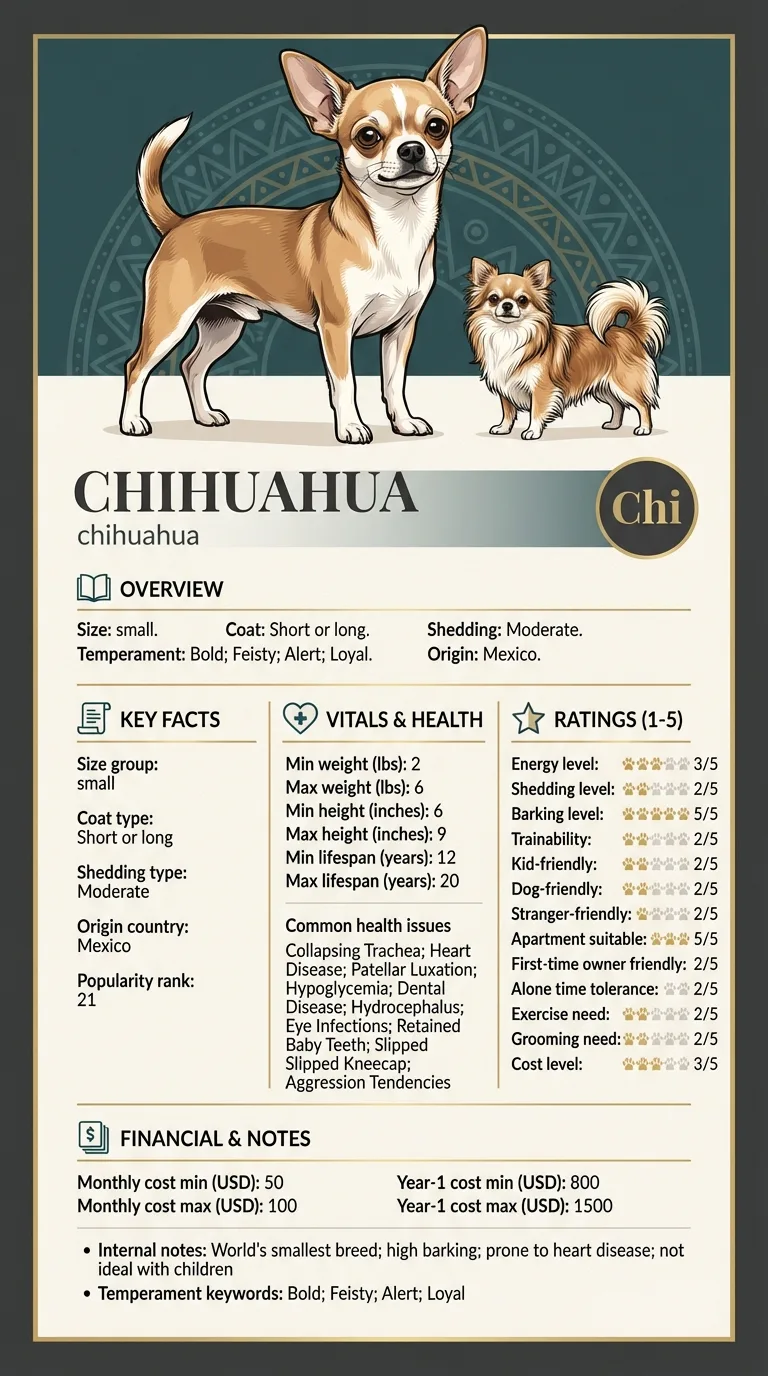
Common enough in Great Danes and other giant deep-chested breeds that preventive surgery is routinely discussed, and rare enough in Chihuahuas that it is absent from the breed's documented problems. The Chihuahua's recognised health list covers dental disease, collapsing trachea, heart disease, patellar luxation, hypoglycemia, hydrocephalus and eye conditions, none of which involve the stomach.
The mechanism above is anatomy-dependent, and the Chihuahua's anatomy does not supply what it needs. This is a compact breed of two to six pounds standing six to nine inches at the shoulder, with a shallow, short thorax and correspondingly short ligamentous attachments. Its stomach is small enough that reaching the volume required for buoyant rotation is difficult. Where the breed does have genuine mechanical vulnerabilities, they sit above the stomach rather than in it: a narrow, collapse-prone trachea and a small oesophagus in which regurgitation and choking are far more plausible events than torsion.
In susceptible breeds, feeding a single enormous meal, gulping air while eating, competitive feeding in a multi-dog household and hard exercise immediately after eating all raise the odds by increasing gastric volume and gas. Those habits are worth avoiding in any dog and cost nothing to change. For a Chihuahua they are sensible practice rather than protective necessity, and the more relevant environmental risks are food theft from bins and counters, and swallowing objects or unchewed kibble that a very small oesophagus cannot handle.
This condition has no home management and no waiting period. Drive to an emergency clinic immediately for repeated retching that brings nothing up, a hard swollen drum-like abdomen, an anxious dog that paces and cannot settle or lie down, heavy drooling, pale gums or collapse. Do not attempt to relieve gas, induce vomiting or wait for a morning appointment. In a Chihuahua the diagnosis will probably turn out to be something else, and that is a good outcome reached the right way, because the distinction between dilatation, torsion and a dozen other abdominal problems is made on radiographs.
See all Chihuahua health problems, which breeds are prone to bloat gdv, or the full Chihuahua breed guide for temperament, exercise needs and ownership costs.
In a dog that does develop volvulus, the whole event unfolds over one to a few hours from first retching to circulatory collapse, and survival depends on reaching surgery within that window. Dogs that survive surgery need several days of hospitalisation and monitoring for heart rhythm disturbances, followed by weeks of restricted activity. For Chihuahua owners, the realistic expectation is different: this is a mechanism to understand and an emergency to recognise, not a condition to spend years preventing.
Success is understanding the machinery well enough that you would never try to manage a distended abdomen at home, that you recognise unproductive retching as a drive-now sign, and that you can hold both truths at once - that GDV is a genuine catastrophe, and that your compact toy breed is poorly built to suffer it. That combination produces fast action without years of misplaced anxiety.
The stomach is not rigidly fixed. It is slung between a fixed entrance at the oesophagus and a fixed exit at the duodenum, with a broad mobile body hanging in between and the spleen attached along one side.
The sequence begins with dilatation. Gas accumulates faster than it can be belched or passed onward, and the stomach balloons. A gas-filled stomach is lighter, more buoyant and far more mobile than a full one, and once it is large enough it can pivot on the axis running between its two fixed points.
That pivot is the volvulus, and it is catastrophic because of what the rotation closes. The oesophagus is kinked shut, so the dog cannot belch or vomit, which is exactly why the hallmark sign is retching that produces nothing. The exit into the intestine is kinked shut, so the gas cannot leave that way either. The blood vessels running to the stomach wall are twisted, so the tissue begins to die. And the spleen, attached along the way, is dragged around and can have its own blood supply cut off.
Meanwhile the hugely distended stomach presses on the vena cava, the large vein returning blood to the heart from the back half of the body. Return falls, cardiac output falls and the dog goes into shock. That combination of dying stomach wall and circulatory collapse is why untreated GDV kills within hours and why the only treatment is decompression and surgery.

The mechanism above needs specific anatomical conditions to occur. Reading them alongside the Chihuahua's build explains the risk difference better than any statistic.
If you think your Chi has bloat, the plan is three steps: write down what you have seen and when it started, book a veterinary appointment rather than waiting for the next flare, and take video of the behaviour or symptom before you go — the thing you are worried about rarely happens in the consulting room. Screening in the parents covers collapsing trachea, heart disease, patellar luxation.
What the vet visit should produce is a diagnosis and a written plan, not just reassurance: what is being ruled out, what the monitoring interval is, and which signs mean you come back sooner. Ask what the treatment costs across a year rather than per visit, because that is the number that decides whether you are managing this condition or reacting to it.
Between appointments, keep a short log — dates, what you saw, what changed. It is the single most useful thing an owner brings to a follow-up, and for bloat it is often what separates a clear pattern from a guess.
Kiko, a 4-pound Chihuahua in Winnipeg, was brought in retching with a firm abdomen after an evening at a family barbecue. His owner Simon had watched a video about bloat and arrived asking for surgery. The clinic's first move was not the operating theatre. It was intravenous access, then two radiographs, because the pattern that identifies volvulus is visible on film and looks quite different from a stomach that is simply overloaded. Kiko's stomach was full and gassy but unrotated, sitting in its normal position. He was decompressed, given fluids and anti-nausea medication and kept overnight. The vet explained the anatomy to Simon on the radiograph itself, tracing the fixed points and showing how little room a dog Kiko's shape gives a stomach to swing in. Simon left understanding why the answer had been imaging rather than a scalpel.
Key takeaway: The urgency was justified and the drive was right. The surgery was not, and only a radiograph could establish that, which is exactly why the distinction gets made at a clinic rather than at home.
Because the rotation kinks the oesophagus closed at the stomach entrance. The dog's body is trying hard to vomit and physically cannot, which is why the most recognisable sign of GDV is repeated retching that produces nothing but foam or saliva. That specific combination, strong effort with no result, is what distinguishes it from ordinary vomiting.
Not quite. Simple dilatation is the stomach distending with gas without rotating, and it can sometimes be managed without surgery. Volvulus is the rotation on top of it, and that is the surgical emergency. From the outside the two can look similar in the early minutes, which is why the distinction is made on radiographs at a clinic rather than by an owner at home.
Frequently, yes, because it is attached along the greater curvature of the stomach and travels with it as it rotates. That is why GDV surgery sometimes includes removal of the spleen, and it is part of why the procedure is expensive and why recovery is more involved than the phrase untwisting the stomach suggests.
It is possible and case reports exist, but the anatomy is working against it and the condition does not appear on the breed's documented health list. A Chihuahua's stomach is small, its chest is shallow and compact, and the conditions the mechanism requires are largely absent. Recognise the emergency signs, but do not manage this dog as though it were a Great Dane.
The distended stomach presses on the vena cava, the major vein bringing blood back to the heart from the abdomen and hind end. Less blood returning means less blood pumped out, and blood pressure falls. That circulatory failure, not the gas itself, is usually what kills first, and it is why treatment starts with intravenous fluids before any surgery begins.
It surgically tacks the stomach wall to the inside of the body wall, so the stomach can still fill but cannot rotate. It is performed in high-risk breeds, often at the time of neutering, and it does not prevent dilatation, only the rotation. It is not standard for Chihuahuas, because the risk it removes is small in a compact breed and the surgery itself is not free of risk.
A gas-filled stomach rotating on its own axis, sealing its entrance and exit and twisting its blood supply, followed rapidly by shock.
Because the rotation has kinked the oesophagus shut. The dog is trying to vomit and physically cannot, which is the classic sign.
No. Torsion needs a deep narrow chest and a large mobile stomach. A compact six-to-nine-inch toy breed provides neither.
Never. It requires decompression, intravenous fluid support and surgery. Any delay to attempt home measures costs the dog time it does not have.
Generally not. It is a high-risk-breed procedure, and adding abdominal surgery to a tiny dog to prevent a rare event is a poor trade.
A one-page prep sheet for this condition: the signs, the questions to ask, what to get priced. Unlocks here.
You get: Vet visit prep sheet
No spam. One-click unsubscribe. See our privacy policy.
Preview page 1 before you decide.